
1. Introduction
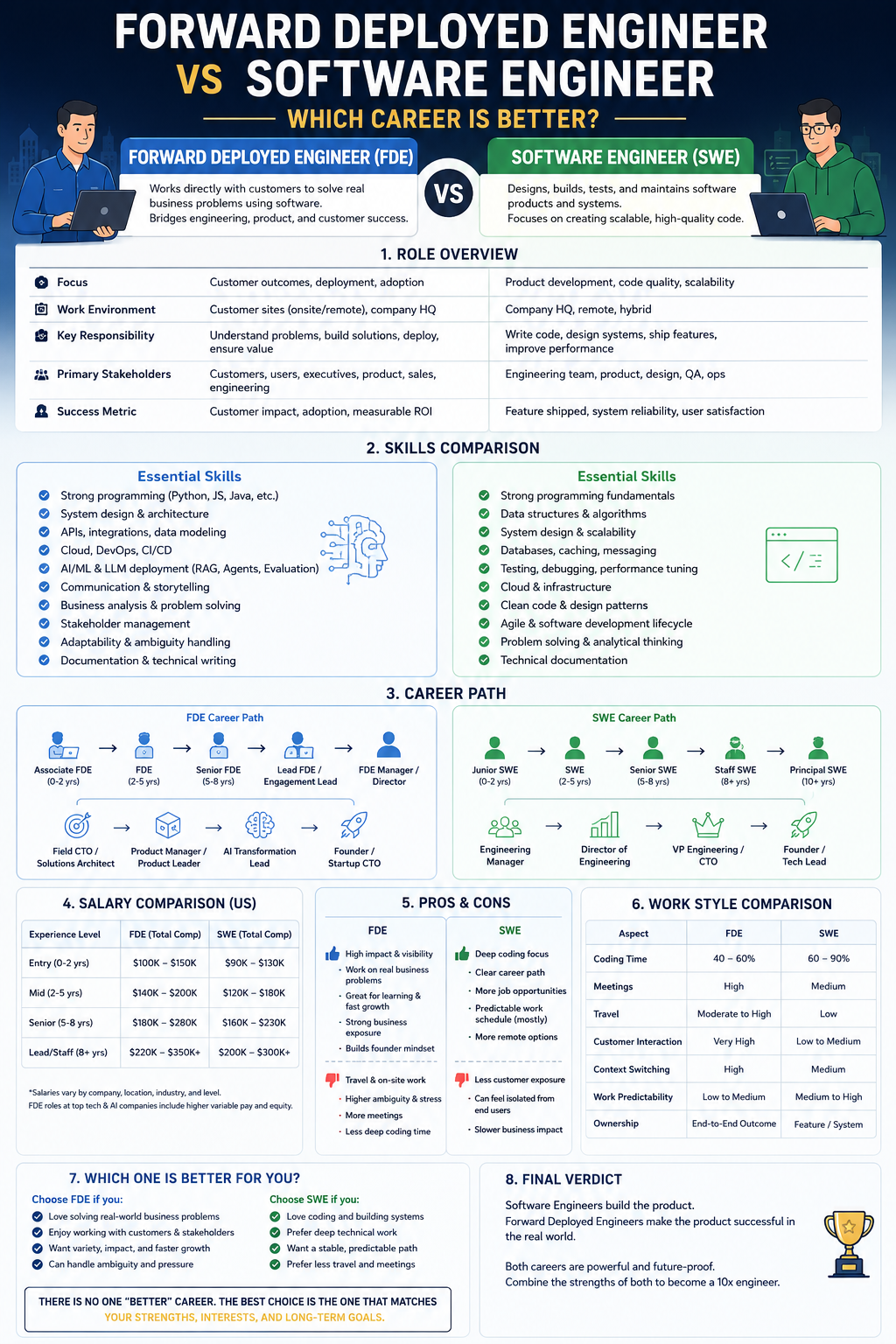
Two of the most important engineering careers in 2026 are Software Engineer and Forward Deployed Engineer.
A Software Engineer builds software products, systems, platforms, applications, APIs, infrastructure, and services.
A Forward Deployed Engineer, often called an FDE, is also an engineer, but works much closer to customers, users, business problems, and real-world deployment. An FDE does not only build software. An FDE helps make sure the software actually works inside a real customer environment.
In simple words:
A Software Engineer builds the product.
A Forward Deployed Engineer takes the product into the real world and makes it solve a serious customer problem.
Both careers are powerful. Both can pay well. Both can lead to leadership, product, architecture, startup, and AI careers. But they are not the same.
The better career depends on your personality, strengths, lifestyle, and long-term goal.
This guide will explain the difference from basic to advanced level.
2. Quick Answer: Which Career Is Better?
There is no universal winner.
| Your Goal | Better Career |
|---|---|
| You love deep coding and building scalable systems | Software Engineer |
| You love customers, business problems, and hands-on delivery | Forward Deployed Engineer |
| You want a more predictable engineering path | Software Engineer |
| You want faster business exposure | Forward Deployed Engineer |
| You want to become CTO or engineering leader | Both can work |
| You want to become product leader or founder | FDE may give stronger customer insight |
| You want less travel and fewer customer meetings | Software Engineer |
| You want high-impact AI deployment work | FDE is becoming very attractive |
| You want broader job availability | Software Engineer |
| You want a rare, high-leverage hybrid role | Forward Deployed Engineer |
One-line answer:
Software Engineering is better if you want to become a deep product/system builder. Forward Deployed Engineering is better if you want to become a real-world problem solver who combines engineering, customer strategy, product thinking, and business impact.
3. Why This Comparison Matters in 2026
For many years, “Software Engineer” was the default dream tech job.
But the AI era has changed the market.
Companies are no longer only asking:
“Can we build software?”
They are now asking:
“Can we deploy AI and software into real business workflows and prove measurable value?”
That is why the FDE role is rising. OpenAI describes its Forward Deployed Engineers as people who lead complex production deployments of frontier models with strategic customers, owning discovery, technical scoping, system design, build, and production rollout.
AWS announced a dedicated Forward Deployed Engineering organization backed by a $1 billion investment to embed engineers directly with customers and co-develop agentic AI systems under real customer constraints. Microsoft also announced a $2.5 billion Microsoft Frontier Company initiative, embedding 6,000 industry and engineering experts with customers to co-design, deploy, and improve AI systems at scale.
This means the market is shifting from “build software in isolation” to “build, deploy, integrate, measure, and improve software in the real world.”
That is exactly where the FDE career becomes important.
4. What Is a Software Engineer?
A Software Engineer is a technical professional who designs, builds, tests, maintains, and improves software systems.
Software Engineers work on:
| Area | Examples |
|---|---|
| Web applications | E-commerce sites, dashboards, SaaS platforms |
| Mobile apps | iOS and Android apps |
| Backend systems | APIs, databases, business logic |
| Infrastructure | Cloud systems, CI/CD, containers, Kubernetes |
| Data systems | Pipelines, warehouses, analytics platforms |
| AI systems | Model integration, ML platforms, AI products |
| Security software | Authentication, encryption, monitoring |
| Internal tools | Admin panels, automation, workflows |
The U.S. Bureau of Labor Statistics describes software developers as people who create applications and systems, analyze user needs, design software, plan how system pieces work together, maintain programs, and document systems for future upgrades. The BLS listed the U.S. median annual wage for software developers as $133,080 in May 2024 and projected strong growth for software developers, QA analysts, and testers from 2024 to 2034.
In simple words:
A Software Engineer builds software that users, companies, systems, or other developers depend on.
5. What Is a Forward Deployed Engineer?
A Forward Deployed Engineer is a customer-facing engineer who works directly with customers or field teams to design, build, customize, integrate, deploy, and improve software in real environments.
The word “forward” means close to the front line. In business software, the front line means the customer, user, factory, hospital, bank, government agency, logistics team, sales team, operations center, or engineering team actually using the system.
An FDE usually works on:
| Area | Examples |
|---|---|
| Customer discovery | Understanding what problem the customer really has |
| Technical scoping | Deciding what must be built or integrated |
| Architecture | Designing how the system should work |
| Coding | Building full-stack features, APIs, scripts, or integrations |
| Deployment | Taking prototype to production |
| Adoption | Helping real users use the system |
| Product feedback | Sending field learning back to product teams |
| AI deployment | Deploying LLMs, agents, RAG, workflows, and evaluation systems |
Palantir calls its Forward Deployed Software Engineer role “the blueprint” for embedding engineers directly with customers to solve pressing problems, build custom applications, work with business-critical data, use AI, and engage stakeholders from technical teams to executives.
In simple words:
A Forward Deployed Engineer is a software engineer who goes close to the customer, understands the real problem, writes code, deploys the solution, and makes sure it creates value.
6. FDE vs Software Engineer in One Diagram
flowchart LR
    A[Business or User Problem] --> B[Product Team]
    B --> C[Software Engineer]
    C --> D[Core Product / Platform]
    D --> E[Customer Environment]
    E --> F[Forward Deployed Engineer]
    F --> G[Custom Integration / Deployment / Adoption]
    G --> H[Real Business Outcome]
    F --> I[Feedback to Product Team]
    I --> B
Code language: CSS (css)
The Software Engineer usually strengthens the core product or platform.
The FDE usually makes the product successful inside a specific real-world environment.
7. The Core Difference
The main difference is not coding ability. Both roles require coding.
The main difference is where the engineer sits in the value chain.
| Question | Software Engineer | Forward Deployed Engineer |
|---|---|---|
| Where do they usually work? | Inside product or engineering team | Close to customer or field environment |
| What do they optimize for? | Product quality, scalability, reliability, features | Customer outcome, adoption, deployment success |
| Who do they talk to most? | Engineers, product managers, designers, QA, SREs | Customers, users, executives, product, engineers, security, operations |
| What do they build? | Reusable product capabilities | Customer-specific or customer-driven solutions |
| What is success? | Feature shipped, system stable, product improved | Customer problem solved, system adopted, measurable value created |
| What is the risk? | Building technically good software users may not adopt | Becoming too custom, too reactive, or too customer-specific |
| Best personality fit | Deep builder | Builder + consultant + product thinker |
8. Day-in-the-Life Comparison
8.1 A Day in the Life of a Software Engineer
A Software Engineer may spend the day doing:
| Time | Work |
|---|---|
| Morning | Standup meeting with engineering team |
| Mid-morning | Review pull requests |
| Afternoon | Build a backend API or frontend feature |
| Later | Write tests, fix bugs, update documentation |
| End of day | Deploy code or prepare for next sprint |
Typical tasks:
| Task | Example |
|---|---|
| Feature development | Build a payment settings page |
| Bug fixing | Fix database timeout issue |
| Code review | Review another engineer’s pull request |
| Testing | Add integration tests |
| System design | Design a notification service |
| Performance improvement | Optimize API response time |
| Maintenance | Refactor old code |
8.2 A Day in the Life of a Forward Deployed Engineer
An FDE may spend the day doing:
| Time | Work |
|---|---|
| Morning | Customer workshop to understand workflow |
| Mid-morning | Debug customer data/API integration |
| Afternoon | Build prototype or full-stack workflow |
| Later | Meet internal product/security team |
| End of day | Deploy fix, write customer update, capture product feedback |
Typical tasks:
| Task | Example |
|---|---|
| Customer discovery | Understand why a bank’s fraud workflow is slow |
| Architecture | Design secure data flow between systems |
| Coding | Build API integration with customer system |
| Deployment | Ship prototype into customer environment |
| Adoption | Train users and gather feedback |
| Product feedback | Tell internal product team what should become reusable |
| AI evaluation | Measure whether LLM output is accurate and safe |
OpenAI’s FDE role includes owning technical delivery from prototype to stable production, building full-stack systems, embedding with customer teams, contributing code when needed, codifying patterns into tools/playbooks, and sharing field feedback with Research and Product.
9. Skill Comparison
9.1 Technical Skills
| Skill | Software Engineer | Forward Deployed Engineer |
|---|---|---|
| Programming | Very important | Very important |
| Data structures and algorithms | Important | Important |
| System design | Very important | Very important |
| Frontend/backend development | Depends on role | Often useful |
| APIs and integrations | Important | Extremely important |
| Databases | Important | Extremely important |
| Cloud | Important | Important |
| DevOps/CI/CD | Useful | Very useful |
| Security | Important | Very important |
| Observability | Important | Very important |
| AI/LLM systems | Increasingly important | Becoming extremely important |
9.2 Non-Technical Skills
| Skill | Software Engineer | Forward Deployed Engineer |
|---|---|---|
| Communication | Important | Critical |
| Customer empathy | Useful | Critical |
| Business understanding | Useful | Critical |
| Ambiguity handling | Important | Critical |
| Presentation | Sometimes needed | Often needed |
| Stakeholder management | Sometimes needed | Very important |
| Product thinking | Important | Very important |
| Documentation | Important | Very important |
| Negotiation/trade-off handling | Useful | Very important |
Stripe’s Forward Deployed Engineer role expects hands-on full-stack development, rapid prototyping, product and business understanding, communication with technical and non-technical stakeholders, ambiguity handling, ownership mindset, and direct customer work.
10. Software Engineer Career Path
A common Software Engineer career path looks like this:
flowchart TD
    A[Junior Software Engineer] --> B[Software Engineer]
    B --> C[Senior Software Engineer]
    C --> D[Staff Engineer]
    D --> E[Principal Engineer]
    C --> F[Engineering Manager]
    F --> G[Director of Engineering]
    G --> H[VP Engineering / CTO]
Code language: CSS (css)
Common Software Engineer Levels
| Level | Main Responsibility |
|---|---|
| Junior Software Engineer | Learn codebase, fix bugs, build small features |
| Software Engineer | Own features and services |
| Senior Software Engineer | Design systems, mentor others, own larger work |
| Staff Engineer | Lead technical direction across teams |
| Principal Engineer | Solve company-level architecture problems |
| Engineering Manager | Manage people and delivery |
| Director/VP/CTO | Own engineering strategy |
Software Engineering gives you a more established career ladder. It is easier to find examples, interview guides, salary bands, promotion paths, and technical expectations.
11. Forward Deployed Engineer Career Path
An FDE career path is usually less standardized, but very powerful.
flowchart TD
    A[Software Engineer / Consultant / Data Engineer / SRE] --> B[Associate FDE]
    B --> C[Forward Deployed Engineer]
    C --> D[Senior FDE]
    D --> E[Lead FDE / Engagement Lead]
    E --> F[FDE Manager]
    E --> G[Field CTO / Solutions Architect]
    E --> H[Product Manager / Product Lead]
    E --> I[Founder / Startup CTO]
    E --> J[AI Transformation Lead]
Code language: CSS (css)
Common FDE Levels
| Level | Main Responsibility |
|---|---|
| Associate FDE | Help with customer deployments and integrations |
| FDE | Own customer-facing technical delivery |
| Senior FDE | Own complex deployments and major accounts |
| Lead FDE | Lead mission-critical customer engagements |
| FDE Manager | Manage multiple FDEs and delivery strategy |
| Field CTO | Advise customers and internal leadership |
| Product Leader | Convert field patterns into product strategy |
| Founder | Build a company based on customer problems seen in the field |
FDE is especially strong for people who want to become founders, product leaders, solution architects, AI transformation leaders, or field CTOs.
12. Salary Comparison
Salary depends on country, company, level, equity, bonus, industry, and negotiation. But current public data shows both careers can pay very well.
12.1 Software Engineer Salary
The U.S. Bureau of Labor Statistics listed the median annual wage for software developers as $133,080 in May 2024. It also reported that the highest 10% of software developers earned more than $211,450.
12.2 Forward Deployed Engineer Salary
FDE salary can be high, especially at AI companies, infrastructure companies, and enterprise software companies.
| Company / Source | Public Salary Signal |
|---|---|
| Palantir Forward Deployed Software Engineer | $135,000–$200,000/year estimated salary range |
| Stripe Forward Deployed Engineer, Privy | $156,800–$235,200 annual U.S. base salary range |
| OpenAI Forward Deployed Software Engineer – SF | $185,000–$325,000 + equity |
| U.S. Software Developer median, BLS | $133,080 median annual wage in May 2024 |
12.3 Salary Verdict
FDE roles at top AI/product companies can pay more than average software engineering roles, but they are fewer, more selective, and often demand customer-facing experience, ambiguity tolerance, and sometimes travel.
Software Engineering has a broader job market and more predictable compensation ladders.
Simple conclusion:
FDE may have higher upside in certain companies. Software Engineering has broader availability and more stable career structure.
13. Job Market Comparison
Software Engineer Market
Software Engineering is a large, mature career. There are roles in almost every industry:
| Industry | Software Engineer Demand |
|---|---|
| SaaS | Very high |
| Banking | High |
| Healthcare | High |
| Retail | High |
| Government | High |
| Telecom | High |
| Manufacturing | High |
| AI companies | Very high |
| Startups | Very high |
The BLS projects strong employment growth for software developers, QA analysts, and testers from 2024 to 2034, driven partly by AI, IoT, robotics, automation, cybersecurity, and software in more products.
FDE Market
FDE is smaller but growing fast in AI, enterprise software, cloud, data, cybersecurity, fintech, and government technology.
Business Insider reported that FDE postings grew sharply from April 2025 to April 2026, connecting the growth to enterprise AI deployment and companies such as OpenAI, Anthropic, Palantir, Stripe, and Google Cloud hiring for this kind of role.
Job Market Verdict
| Factor | Winner |
|---|---|
| More total jobs | Software Engineer |
| Faster emerging AI-era demand | Forward Deployed Engineer |
| Easier entry-level access | Software Engineer |
| Higher rarity value | Forward Deployed Engineer |
| More global availability | Software Engineer |
| More customer-impact roles | Forward Deployed Engineer |
14. Work Style Comparison
| Work Style Area | Software Engineer | Forward Deployed Engineer |
|---|---|---|
| Daily routine | More structured | More variable |
| Meetings | Team/product meetings | Customer + internal meetings |
| Coding time | Usually higher | Can vary heavily |
| Travel | Usually low | Can be medium/high |
| Ambiguity | Medium | High |
| Pressure | Product deadlines | Customer outcomes and executive visibility |
| Collaboration | Engineering/product/design | Customer/product/engineering/security/sales |
| Documentation | Technical docs | Technical + customer + playbooks |
| Ownership | Feature/service ownership | Outcome/deployment ownership |
| Feedback loop | Product metrics and users | Direct customer feedback |
OpenAI’s FDE and FDSWE roles mention travel up to 50%, customer embedding, direct work with customer technical teams, and production deployment responsibilities. Palantir’s FDSE role mentions travel up to 25% depending on client needs and preferences.
15. Which Role Has Better Long-Term Future?
Both have a strong future, but the nature of the future is different.
Software Engineer Future
Software Engineering will remain foundational. AI may automate some coding tasks, but software engineers will still be needed for:
| Future Need | Why Engineers Matter |
|---|---|
| System design | AI does not fully own architecture context |
| Verification | AI-generated code must be tested and validated |
| Security | Systems need secure design |
| Reliability | Production systems need human judgment |
| Product engineering | Users need coherent products |
| AI integration | AI must be connected to real apps |
| Platform engineering | Companies need internal developer platforms |
Software Engineers who only write simple code may face more automation pressure. Software Engineers who understand systems, product, architecture, reliability, security, and AI will remain valuable.
FDE Future
FDEs may become more important because companies struggle to turn AI demos into real production systems.
FDEs are useful because they combine:
| FDE Advantage | Why It Matters |
|---|---|
| Engineering ability | They can build |
| Customer proximity | They know the real problem |
| Product feedback | They improve the platform |
| AI deployment skill | They turn models into workflows |
| Business understanding | They measure outcomes |
| Ambiguity handling | They work in messy real environments |
AWS’s FDE announcement directly says enterprise AI has moved beyond advisory roadmaps and proof-of-concepts into production systems running on real data under real governance.
Future Verdict
| Future Scenario | Better Role |
|---|---|
| AI automates basic coding | FDE advantage increases |
| Companies need scalable platforms | Software Engineer remains essential |
| Enterprises struggle with AI adoption | FDE becomes more valuable |
| Products need deep architecture | Software Engineer wins |
| AI systems need field deployment | FDE wins |
| You want maximum flexibility | Software Engineer wins |
| You want rare hybrid advantage | FDE wins |
16. The AI-Era Difference
In the old software world, the main challenge was building software.
In the AI era, the main challenge is often making AI useful, safe, measurable, and trusted inside real business workflows.
That requires:
| AI Deployment Need | Software Engineer Role | FDE Role |
|---|---|---|
| Build AI feature | Strong | Strong |
| Connect to customer data | Medium/strong | Very strong |
| Understand business workflow | Medium | Very strong |
| Evaluate model behavior | Strong if AI-focused | Very strong if AI-focused |
| Handle governance | Medium/strong | Very strong |
| Drive adoption | Medium | Very strong |
| Convert field feedback into product | Medium | Very strong |
OpenAI says FDEs measure success through production adoption, measurable workflow impact, and evaluation-driven feedback that changes product and model roadmaps.
That sentence captures the AI-era FDE perfectly.
17. FDE vs Software Engineer: Deep Comparison Table
| Dimension | Software Engineer | Forward Deployed Engineer |
|---|---|---|
| Main identity | Builder of software | Builder of customer outcomes |
| Primary environment | Product engineering team | Customer + product + engineering |
| Main question | “How do we build this well?” | “What should we build to solve this real problem?” |
| Coding depth | High | Medium to high |
| Customer exposure | Low to medium | High |
| Business exposure | Medium | High |
| Product influence | Medium to high | High through field feedback |
| Architecture | Strong | Strong, especially integration architecture |
| AI opportunity | High | Very high in enterprise AI deployment |
| Travel requirement | Usually low | Sometimes medium/high |
| Communication requirement | Medium/high | Very high |
| Job availability | Very high | Smaller but growing |
| Career structure | Mature and clear | Emerging and flexible |
| Best for introverts | Often better | Can be harder |
| Best for founders | Good | Excellent |
| Best for deep specialists | Excellent | Good, but broader |
| Best for generalists | Good | Excellent |
| Main risk | Becoming too narrow or replaceable by AI-assisted coding | Becoming too custom, reactive, or stretched |
| Main reward | Deep technical mastery | Real-world impact and strategic visibility |
18. Personality Fit
Choose Software Engineer If You Are Like This
| You Prefer | Why Software Engineering Fits |
|---|---|
| Deep focus time | More coding blocks |
| Clean technical problems | More structured engineering work |
| Building scalable systems | Core product/platform work |
| Less customer pressure | Usually fewer external meetings |
| Clear career ladders | Junior → Senior → Staff → Principal |
| Technical specialization | Backend, frontend, infra, AI, security, data |
| Remote-friendly roles | More options |
Choose FDE If You Are Like This
| You Prefer | Why FDE Fits |
|---|---|
| Real-world problem solving | You work close to actual users |
| Business impact | You see outcomes directly |
| Fast-changing work | Every customer is different |
| Communication | You talk to many stakeholders |
| Ownership | You own delivery, not only code |
| Ambiguity | You create clarity from messy situations |
| Product thinking | You influence what product should become |
| Founder-like work | You operate like a mini technical founder |
19. Technical Depth: Who Becomes the Better Engineer?
This is a common question.
Some people think FDEs are “less technical” because they talk to customers.
That is wrong.
A weak FDE may become a glorified consultant.
A strong FDE can be extremely technical.
The difference is the type of technical depth.
| Engineering Depth Type | Software Engineer | FDE |
|---|---|---|
| Algorithm depth | Higher in some roles | Needed but less central |
| Product code depth | High | Medium/high |
| Integration depth | Medium | Very high |
| Debugging messy systems | High | Very high |
| Customer environment complexity | Medium | Very high |
| Architecture trade-offs | High | Very high |
| AI workflow deployment | Role-dependent | Increasingly high |
| Security and compliance context | Role-dependent | Often high |
| User workflow understanding | Medium | Very high |
A Software Engineer may become deeper in one system.
An FDE may become broader across many systems, customers, and domains.
Neither is automatically superior. They train different muscles.
20. Career Risk Comparison
Software Engineer Risks
| Risk | Explanation |
|---|---|
| AI-assisted coding pressure | Basic implementation work is becoming easier to automate |
| Narrow specialization | Knowing only one framework may limit growth |
| Less business visibility | You may not always see customer impact |
| Product distance | You may build features without understanding adoption |
| Large-company stagnation | You may work on small parts of huge systems |
FDE Risks
| Risk | Explanation |
|---|---|
| Too much travel | Some roles require heavy customer presence |
| Too many meetings | Coding time may reduce |
| Custom work trap | You may build one-off solutions that do not scale |
| Stress | Customer deadlines can be intense |
| Ambiguous promotion path | FDE ladders are less standard than SWE ladders |
| Context switching | Many customers and problems can be mentally heavy |
21. Career Reward Comparison
Software Engineer Rewards
| Reward | Explanation |
|---|---|
| Strong technical mastery | You can go deep in systems |
| Broad job market | Many industries need software engineers |
| Clear promotion ladder | Senior, Staff, Principal, Manager |
| Remote options | Many SWE roles support remote or hybrid |
| Product creation | You build things used by many people |
| Architecture influence | Senior engineers shape platforms |
FDE Rewards
| Reward | Explanation |
|---|---|
| Direct customer impact | You see the problem and result |
| Strong business understanding | You learn how industries work |
| Faster leadership exposure | You may work with executives early |
| Product influence | Field patterns shape roadmap |
| Founder training | You learn customer pain deeply |
| AI-era leverage | Enterprise AI needs deployment engineers |
22. Real Example: Same Problem, Different Role
Imagine a company sells an AI-powered document processing platform.
A large bank wants to use it to process loan documents.
Software Engineer’s Work
The Software Engineer may build:
| Component | Example |
|---|---|
| Core document upload API | Upload PDFs securely |
| OCR service | Extract text from documents |
| Document classification engine | Identify payslip, bank statement, tax form |
| Admin dashboard | Manage document rules |
| Audit system | Store processing history |
| Performance optimization | Process documents faster |
FDE’s Work
The FDE may do:
| Component | Example |
|---|---|
| Customer workflow discovery | Understand how bank officers review loans |
| Integration | Connect platform to bank’s loan system |
| Access control | Ensure users only see allowed documents |
| Custom rules | Handle country-specific document formats |
| Human review workflow | Add approval step for low-confidence AI output |
| Deployment | Launch pilot with 20 bank users |
| Measurement | Track reduction in processing time |
| Feedback | Tell product team which document types should become core features |
Diagram
flowchart TD
    A[Core Product Built by Software Engineers] --> B[Document AI Platform]
    B --> C[Customer Bank Environment]
    C --> D[FDE Discovers Workflow]
    D --> E[FDE Builds Integration]
    E --> F[FDE Adds Governance and Human Review]
    F --> G[Bank Users Adopt System]
    G --> H[Measured Business Impact]
    H --> I[Feedback to Product Team]
    I --> A
Code language: CSS (css)
Both roles matter. Without Software Engineers, there is no platform. Without FDEs, the platform may fail to produce real customer value.
23. Which Career Is Better for Freshers?
For most freshers, Software Engineer is usually the better starting point.
Why?
| Reason | Explanation |
|---|---|
| More entry-level jobs | FDE roles often expect experience |
| Better learning structure | SWE ladders are clearer |
| More coding practice | Freshers need engineering depth |
| Easier interview preparation | SWE interviews are well documented |
| Strong foundation | You can move to FDE later |
However, a fresher can target FDE-like roles if they have:
| Required Strength | Example |
|---|---|
| Strong coding ability | Full-stack projects |
| Communication skill | Presenting, writing, workshops |
| Customer/project experience | Freelance, internships, open source |
| AI projects | RAG, agents, LLM apps |
| Business thinking | Case studies with measurable outcomes |
Best fresher strategy:
Start as a Software Engineer, build strong technical fundamentals, then move toward FDE after 2–5 years if you enjoy customer-facing impact.
24. Which Career Is Better for Experienced Engineers?
For experienced engineers, the answer depends on career direction.
Stay Software Engineer If You Want:
| Goal | Why |
|---|---|
| Staff/Principal Engineer path | Deep technical leadership |
| Backend/platform specialization | More technical depth |
| AI infrastructure | Strong SWE path |
| Distributed systems | Strong SWE path |
| Remote work flexibility | More SWE opportunities |
| Engineering management | Clearer ladder |
Move to FDE If You Want:
| Goal | Why |
|---|---|
| Customer impact | FDE gives direct exposure |
| Product leadership | You learn real user pain |
| Founder path | You discover problems worth solving |
| AI deployment | FDE is booming in enterprise AI |
| Field CTO path | Customer + architecture combo |
| Consulting + engineering hybrid | Perfect fit |
For an experienced DevOps, SRE, platform engineer, data engineer, or full-stack engineer, FDE can be a powerful next step.
25. Which Career Is Better for AI?
Both can be excellent AI careers, but in different ways.
| AI Career Type | Better Fit |
|---|---|
| Building AI infrastructure | Software Engineer |
| Building model-serving platforms | Software Engineer |
| Building AI product features | Software Engineer or FDE |
| Deploying AI in enterprise workflows | FDE |
| Building RAG/agent systems for customers | FDE |
| Evaluating AI in real workflows | FDE |
| Building reusable AI developer tools | Software Engineer |
| AI transformation consulting with code | FDE |
| AI startup founder | FDE experience can be very valuable |
OpenAI’s Forward Deployed Software Engineer role specifically involves building custom software using OpenAI APIs, working with customers and FDEs, designing scalable solutions, and creating abstractions to scale delivery across engagements.
So, in the AI era:
Software Engineers build AI platforms and products. FDEs make AI work inside real customer environments.
26. Decision Matrix: FDE or Software Engineer?
Score yourself from 1 to 5 for each statement.
| Statement | Your Score |
|---|---|
| I enjoy talking to customers and users | /5 |
| I enjoy writing code for long focused hours | /5 |
| I like solving ambiguous business problems | /5 |
| I prefer clear technical tasks | /5 |
| I want to travel or work close to customers | /5 |
| I want deep system design expertise | /5 |
| I want to influence product strategy | /5 |
| I want a clear promotion ladder | /5 |
| I enjoy demos, workshops, and presentations | /5 |
| I want to build scalable reusable platforms | /5 |
How to Interpret
| Your Pattern | Better Fit |
|---|---|
| High customer + high ambiguity + high communication | FDE |
| High coding + high system depth + lower customer interest | Software Engineer |
| High coding + high customer + high product thinking | FDE or Product Engineer |
| High architecture + high business + high communication | Senior FDE / Solutions Architect |
| High coding + high research/infra | Software Engineer / ML Engineer |
27. The Best Hybrid Path
The strongest career path may not be choosing one forever.
A very powerful path is:
flowchart LR
    A[Software Engineer Foundation] --> B[Senior Engineer Skills]
    B --> C[Customer-Facing Projects]
    C --> D[Forward Deployed Engineer]
    D --> E[Product / Field CTO / Founder / AI Leader]
Code language: CSS (css)
This path works because you first build engineering credibility, then add customer and business leverage.
Recommended sequence:
| Career Stage | Focus |
|---|---|
| Years 0–2 | Become strong in coding, APIs, databases, debugging |
| Years 2–5 | Own features, services, deployments, architecture |
| Years 5–7 | Work with customers, sales, support, solutions, field teams |
| Years 7+ | Move into FDE, Staff Engineer, Product, Architect, or Founder path |
This is why many FDE roles prefer experienced engineers. OpenAI’s NYC FDE role asks for 5+ years of engineering or technical deployment experience with customer-facing work, while its SF Forward Deployed Software Engineer role asks for 7+ years of full-stack engineering experience.
28. How to Move from Software Engineer to FDE
If you are already a Software Engineer, do this:
Step 1: Volunteer for Customer-Adjacent Work
Examples:
| Opportunity | Why It Helps |
|---|---|
| Join customer escalation calls | Learn real pain |
| Help solutions engineering | Understand pre-sales and deployment |
| Build internal tools for support teams | Learn operational workflows |
| Review customer logs/issues | Learn real usage patterns |
| Write implementation docs | Practice communication |
Step 2: Build Integration Skills
Learn:
| Skill | Why |
|---|---|
| REST APIs | Most customer systems integrate through APIs |
| Webhooks | Event-driven integration |
| OAuth/SSO | Enterprise identity |
| SQL | Customer data analysis |
| ETL/ELT | Data movement |
| Error handling | Real customer systems fail often |
| Observability | You must debug production issues |
Step 3: Learn Business Discovery
Practice asking:
| Question | Purpose |
|---|---|
| What workflow is broken? | Find real problem |
| Who uses this daily? | Identify user |
| What happens before and after this step? | Understand process |
| What data is trusted? | Avoid bad assumptions |
| What does success mean numerically? | Measure outcome |
| What security rules matter? | Avoid risk |
| What must be live in 30 days? | Scope correctly |
Step 4: Build an FDE-Style Portfolio
Your case study should include:
| Section | Example |
|---|---|
| Problem | “Support team spends 4 hours/day triaging tickets” |
| Users | Support agents and team leads |
| Architecture | Diagram |
| Build | API, dashboard, AI classifier |
| Deployment | Docker/AWS/Kubernetes |
| Security | RBAC, audit logs |
| Measurement | Time saved, accuracy, adoption |
| Productization | What can become reusable |
29. How to Move from FDE to Software Engineer
Sometimes FDEs want to return to deeper product engineering.
To do that:
| Action | Why |
|---|---|
| Maintain strong coding habits | Avoid becoming only customer-facing |
| Contribute to core product | Build reusable platform credibility |
| Write high-quality tests | Show engineering maturity |
| Reduce one-off scripts | Build maintainable code |
| Learn deeper system design | Prepare for senior SWE interviews |
| Document technical decisions | Show architecture thinking |
| Own internal tools/platforms | Bridge field and core engineering |
A strong FDE can become an excellent Software Engineer because they understand real users better than many pure product engineers.
30. Interview Difference
Software Engineer Interview
Usually tests:
| Area | Example |
|---|---|
| Coding | Algorithms, data structures |
| System design | Design scalable services |
| Technical depth | Language/framework/database |
| Debugging | Find and fix issues |
| Behavioral | Teamwork, ownership |
FDE Interview
Usually tests:
| Area | Example |
|---|---|
| Coding | Build/debug practical systems |
| System design | Design customer deployment |
| Customer simulation | Handle ambiguous customer problem |
| Product thinking | Decide what should be built |
| Communication | Explain trade-offs clearly |
| Business judgment | Prioritize outcome over shiny tech |
| AI deployment | RAG, agents, evaluation, governance |
Example FDE Case Question
A large hospital wants to use AI to summarize patient intake documents. What do you do?
A strong FDE answer:
- Identify users: doctors, nurses, intake staff.
- Map workflow: document upload, review, approval, record update.
- Clarify risks: privacy, wrong summary, access control.
- Design architecture: ingestion, OCR, retrieval, LLM, human review, audit.
- Build small pilot: one department, limited document types.
- Measure: time saved, accuracy, override rate.
- Add governance: logs, permissions, retention policy.
- Productize repeated patterns.
31. Which Role Is Better for Becoming a Founder?
Both can produce founders, but FDE has a special advantage.
Why?
| Founder Skill | Software Engineer | FDE |
|---|---|---|
| Building product | Strong | Strong |
| Understanding customer pain | Medium | Very strong |
| Selling ideas | Medium | Strong |
| Handling ambiguity | Strong | Very strong |
| Building MVPs | Strong | Strong |
| Knowing enterprise workflows | Medium | Very strong |
| Seeing market gaps | Medium | Very strong |
| Product intuition | Strong if product-focused | Very strong if customer-facing |
FDE work often feels like startup work inside a larger company. You discover real problems, build fast, talk to users, handle constraints, and measure value.
That is founder training.
32. Which Role Is Better for Work-Life Balance?
Usually, Software Engineer has better work-life predictability.
| Factor | Software Engineer | FDE |
|---|---|---|
| Schedule predictability | Better | More variable |
| Customer urgency | Lower | Higher |
| Travel | Lower | Higher |
| Deep work time | Higher | Lower/variable |
| Context switching | Medium | High |
| Production pressure | High in some teams | High in customer deployments |
| Meeting load | Medium | High |
But this depends heavily on company culture. Some Software Engineers have brutal on-call. Some FDE teams are well managed. Some FDE roles travel a lot; others are mostly remote/hybrid.
33. Which Role Is Better for Learning?
It depends on what you want to learn.
| Learning Goal | Better Role |
|---|---|
| Coding depth | Software Engineer |
| Distributed systems | Software Engineer |
| Product architecture | Software Engineer |
| Customer workflows | FDE |
| Enterprise integration | FDE |
| AI deployment | FDE |
| Product-market insight | FDE |
| Communication | FDE |
| Leadership exposure | FDE |
| Technical specialization | Software Engineer |
| Generalist power | FDE |
Software Engineering makes you a stronger builder.
Forward Deployed Engineering makes you a stronger real-world problem solver.
The best people eventually learn both.
34. Red Flags Before Choosing FDE
Do not choose FDE only because it sounds trendy.
Avoid FDE if:
| Red Flag | Why It Matters |
|---|---|
| You hate customer meetings | FDE is customer-heavy |
| You want only deep coding | FDE includes discovery and communication |
| You dislike ambiguity | FDE problems are often unclear |
| You do not want travel | Many FDE roles involve travel |
| You dislike documentation | FDE requires playbooks and handoffs |
| You struggle with pressure | Customer deadlines can be intense |
| You dislike business context | Business impact is central |
35. Red Flags Before Choosing Software Engineering
Do not choose Software Engineering only because it is the default tech career.
Avoid pure SWE if:
| Red Flag | Why It Matters |
|---|---|
| You get bored working far from users | SWE can feel disconnected |
| You want fast business exposure | SWE may be slower |
| You dislike long codebase work | SWE requires patience |
| You want customer ownership | FDE may fit better |
| You prefer broad problem solving | SWE may become narrow |
| You want founder-like learning | FDE may expose you to more market pain |
36. Gold Standard Decision Framework
Use this final framework.
flowchart TD
    A[Do you love deep coding more than customer interaction?] -->|Yes| B[Choose Software Engineer]
    A -->|No| C[Do you enjoy solving messy real-world business problems?]
    C -->|No| B
    C -->|Yes| D[Can you handle ambiguity, meetings, and stakeholder pressure?]
    D -->|No| E[Choose Product-Focused Software Engineer]
    D -->|Yes| F[Do you want direct customer impact and AI deployment work?]
    F -->|Yes| G[Choose Forward Deployed Engineer]
    F -->|No| H[Choose Software Engineer or Solutions Architect]
Code language: PHP (php)
Final Rule
Choose Software Engineer if you want technical depth first.
Choose Forward Deployed Engineer if you want impact, customers, product, and engineering together.
37. Best 12-Month Roadmap for Software Engineer
Months 1–3: Foundation
| Skill | What to Learn |
|---|---|
| Programming | Python, Java, Go, or TypeScript |
| Data structures | Arrays, maps, trees, graphs |
| Backend | APIs, auth, databases |
| Frontend | React basics |
| Git | Branching, pull requests |
Months 4–6: Production Skills
| Skill | What to Learn |
|---|---|
| Testing | Unit and integration tests |
| CI/CD | GitHub Actions or GitLab CI |
| Docker | Containerize apps |
| Cloud | AWS/Azure/GCP basics |
| Observability | Logs and metrics |
Months 7–9: System Design
| Skill | What to Learn |
|---|---|
| Scalability | Load balancing, caching |
| Databases | Indexes, transactions |
| Messaging | Kafka, queues |
| Reliability | Retries, idempotency |
| Security | OAuth, secrets, encryption |
Months 10–12: Portfolio
Build:
| Project | Why |
|---|---|
| SaaS app | Full-stack ability |
| API platform | Backend depth |
| Real-time system | Architecture skill |
| AI feature | Current relevance |
| Deployment docs | Professional quality |
38. Best 12-Month Roadmap for Forward Deployed Engineer
Months 1–3: Engineering Base
| Skill | What to Learn |
|---|---|
| Full-stack development | React + backend |
| APIs | REST, webhooks |
| SQL | Data analysis |
| Auth | OAuth, SSO, RBAC |
| Cloud | Deployment basics |
Months 4–6: Customer and Integration Skills
| Skill | What to Learn |
|---|---|
| Discovery | How to ask business questions |
| Requirements | Turn vague pain into scope |
| Integrations | Connect external systems |
| Documentation | Write runbooks and playbooks |
| Communication | Explain clearly to non-technical people |
Months 7–9: AI Deployment
| Skill | What to Learn |
|---|---|
| LLM APIs | OpenAI/Anthropic/Azure OpenAI |
| RAG | Retrieval over documents |
| Agents | Tool calling and workflow automation |
| Evaluation | Accuracy, safety, latency, cost |
| Governance | Audit logs, permissions, human review |
Months 10–12: FDE Portfolio
Build a complete case study:
| Section | Example |
|---|---|
| Customer problem | Manual invoice approval is slow |
| Workflow map | Current process diagram |
| Architecture | Mermaid diagram |
| Solution | Full-stack app + AI + integrations |
| Deployment | Docker/cloud |
| Security | RBAC + logs |
| Metrics | Time saved, accuracy, adoption |
| Productization | Reusable patterns |
39. Final Verdict: Which Career Is Better?
Software Engineer Is Better If:
| You Want | Reason |
|---|---|
| Deep coding | More engineering focus |
| Clear ladder | SWE path is mature |
| More jobs | Huge market |
| Less customer pressure | Usually internal-facing |
| Technical specialization | Backend, infra, AI, data, security |
| Remote flexibility | More options |
| Long-term technical leadership | Staff/Principal path |
Forward Deployed Engineer Is Better If:
| You Want | Reason |
|---|---|
| Customer impact | Direct problem-solving |
| AI deployment work | Strong 2026 demand |
| Business exposure | You work near outcomes |
| Founder training | You learn real pain |
| Product influence | Field feedback shapes roadmap |
| High ownership | You own delivery |
| Hybrid engineering career | Code + architecture + customer + product |
The Honest Final Answer
If you are early in your career, start with Software Engineering.
If you already have strong engineering skills and want more customer impact, business exposure, AI deployment work, and founder-like learning, move toward Forward Deployed Engineering.
If you want the safest and broadest career, choose Software Engineer.
If you want the rarer, more intense, more customer-facing, high-impact AI-era career, choose Forward Deployed Engineer.
The best long-term path may be:
Become a strong Software Engineer first. Then become a Forward Deployed Engineer if you want to turn technology into real-world outcomes.
40. Final Summary
A Software Engineer builds software systems.
A Forward Deployed Engineer makes software succeed in the real world.
Software Engineers are the backbone of technology companies. They build the products, platforms, infrastructure, and systems that power modern life.
Forward Deployed Engineers are the bridge between powerful technology and real customer value. They enter messy environments, understand the problem, build the solution, deploy it, drive adoption, and bring learning back to the product team.
In the AI era, this difference matters more than ever.
AI demos are easy.
AI production impact is hard.
Software Engineers will build the AI platforms.
Forward Deployed Engineers will make those platforms work inside banks, hospitals, factories, governments, telecom companies, retailers, and enterprises.
So which career is better?
The better career is the one that matches your operating system.
If your operating system is deep build, clean architecture, scalable systems, choose Software Engineering.
If your operating system is real-world problems, customers, ambiguity, business impact, and hands-on engineering, choose Forward Deployed Engineering.
Both are excellent.
But the rarest engineer of the next decade may be the one who can do both.

I’m Rajesh Kumar, a DevOps, SRE, DevSecOps, Cloud, and Platform Engineering expert passionate about sharing practical knowledge, real-world experiences, and industry best practices. I have worked at Cotocus and regularly write about technology, travel, investing, health, product reviews, and digital marketing through my various platforms.
I publish technical articles at DevOps School, travel stories at Holiday Landmark, stock market insights at Stocks Mantra, health and fitness guidance at My Medic Plus, product reviews at TrueReviewNow, and SEO and digital marketing strategies at Wizbrand.
Find Trusted Cardiac Hospitals
Compare heart hospitals by city and services — all in one place.
Explore Hospitals