
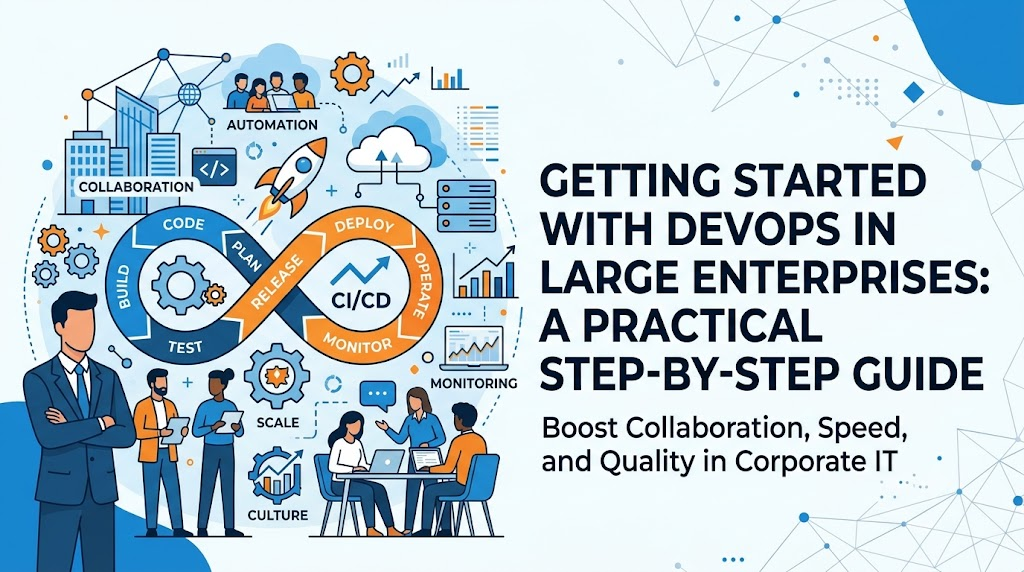
DevOps is relatively easy to explain in a small engineering team. A few developers, an operations engineer, a source-code repository, a CI pipeline, and some automation can take you a long way. Large enterprises are a different story. A typical enterprise may have hundreds or thousands of applications, multiple development teams, legacy systems, private data centers, public clouds, centralized security teams, database teams, network teams, formal change-management processes, and applications with very different levels of technical maturity. That is why starting DevOps in a large enterprise requires more than selecting a CI/CD tool. The real challenge is building a delivery system that allows teams to develop, test, secure, deploy, operate, and improve software with less friction while maintaining appropriate governance and reliability.
This guide explains how to approach that transformation step by step.
What Is DevOps in a Large Enterprise?
DevOps is best understood as a combination of:
- Engineering practices
- Automation
- Collaboration
- Shared ownership
- Continuous feedback
- Operational discipline
- Security integration
The basic lifecycle looks like this:
Plan
  ↓
Code
  ↓
Build
  ↓
Test
  ↓
Secure
  ↓
Release
  ↓
Deploy
  ↓
Operate
  ↓
Monitor
  ↓
Learn
  ↓
Improve
The important point is that DevOps is not a product.
Installing Jenkins does not create DevOps.
Moving an application to Kubernetes does not create DevOps.
Buying a cloud subscription does not create DevOps.
A DevOps transformation succeeds when the organization changes the way software moves from development into reliable production operation.
Why DevOps Is Different in Large Enterprises
In a small organization, a developer may be able to talk directly to the person responsible for production.
In a large enterprise, the same change might involve:
Developer
   ↓
Development Team
   ↓
QA
   ↓
Security
   ↓
Architecture
   ↓
Infrastructure
   ↓
Change Management
   ↓
Operations
   ↓
Production
Every team may have legitimate responsibilities. The problem appears when those responsibilities become long queues of manual handoffs.
For example, imagine a developer has completed a small application change.
The code is ready, tests are passing, and the change is low risk.
Yet the release takes two weeks because the team is waiting for:
- A manual test window
- An infrastructure request
- A security review
- A change approval meeting
- A deployment ticket
- An operations engineer
The technology may be perfectly capable of delivering the change in minutes. The organizational process is what takes two weeks.
This is one of the central problems DevOps attempts to solve.
Step 1: Define Why the Enterprise Needs DevOps
Do not start by choosing tools.
Start by identifying the problems.
Ask questions such as:
- Why do releases take so long?
- Where do deployment requests get stuck?
- How much testing is manual?
- How frequently do releases cause incidents?
- How long does it take to restore service?
- How long does infrastructure provisioning take?
- Where are security checks performed?
- How much work is repeated by different teams?
- Which activities require tickets between teams?
- How difficult is it to understand what changed in production?
Your answers become the starting point for the DevOps roadmap.
Example
Suppose an organization discovers:
Release frequency:      Once per month
Average lead time:      15 days
Testing:                Mostly manual
Infrastructure setup:   5 business days
Security review:        Manual
Rollback:               Difficult
Monitoring:             Inconsistent
The first DevOps objective should not be:
“Deploy Kubernetes.”
It should be something like:
“Create a repeatable software delivery process that reduces unnecessary manual work while improving release confidence.”
That objective gives the technical teams room to choose the right implementation.
Step 2: Assess the Current Environment
Before changing the organization, understand what already exists.
A useful assessment covers five areas.
1. Applications
Create an application inventory.
For each important application, record:
- Application owner
- Business owner
- Programming language
- Runtime
- Database
- Hosting environment
- Deployment method
- Criticality
- Dependencies
- Security classification
- Current monitoring
- Recovery requirements
You will quickly discover that not all applications can follow the same DevOps model.
2. Teams
Identify who is responsible for:
- Development
- Testing
- Infrastructure
- Security
- Networking
- Databases
- Deployment
- Production support
Then ask a simple question:
Who owns the application after it reaches production?
If the answer is unclear, fix the ownership model before investing heavily in automation.
3. Processes
Map the actual release process.
For example:
Developer commits code
        ↓
Pull request
        ↓
Code review
        ↓
Build
        ↓
Manual testing
        ↓
Security review
        ↓
Release ticket
        ↓
Change approval
        ↓
Deployment request
        ↓
Operations deployment
Then mark every manual handoff.
Those handoffs are potential improvement opportunities.
4. Technology
Inventory existing tools.
You may find several:
- Git platforms
- CI servers
- Artifact repositories
- Cloud platforms
- Container platforms
- Infrastructure tools
- Monitoring systems
- Security scanners
- Ticketing systems
- Configuration-management tools
Do not immediately replace them.
First determine whether the problem is the technology or the way it is being used.
5. Metrics
Measure the current state before trying to improve it.
Useful delivery and operational measures include:
- Deployment frequency
- Lead time for changes
- Change failure rate
- Time to restore service
- Reliability
- Deployment duration
- Pipeline success rate
- Infrastructure provisioning time
- Vulnerability remediation time
DORA research has used deployment frequency, lead time for changes, change failure rate, and time to restore service as important software delivery performance measures, with reliability also considered in more recent measurement approaches.
The purpose is not to create a scoreboard for teams.
The purpose is to identify where the delivery system is struggling.
Step 3: Choose the Right Pilot Application
Do not attempt to transform the entire enterprise on day one.
Choose one or a small number of pilot applications.
A good pilot should be:
- Important enough to attract attention
- Small enough to control
- Representative of real enterprise challenges
- Supported by a motivated team
- Measurable
- Safe enough to experiment with
Avoid two extremes.
Too simple
If you select a tiny internal application with no dependencies, you may learn very little about enterprise problems.
Too critical
If you choose the most business-critical legacy system first, the organization may spend all its energy managing risk instead of learning DevOps.
A representative middle ground is usually better.
Step 4: Establish Source Control as the Starting Point
Every application that participates in the DevOps journey should have controlled source management.
The repository should contain more than application code where appropriate.
It may include:
Application Code
Tests
Build Configuration
Deployment Configuration
Infrastructure Code
Documentation
Security Configuration
Use:
- Pull or merge requests
- Code review
- Protected branches
- Access controls
- Version history
- Automated validation
The repository should become a reliable source of truth for the application.
Step 5: Build Your First CI Pipeline
Continuous Integration is one of the first practical DevOps capabilities to establish.
A basic pipeline can be:
Developer Commit
       ↓
Checkout
       ↓
Build
       ↓
Unit Tests
       ↓
Static Analysis
       ↓
Dependency Checks
       ↓
Package
       ↓
Publish ArtifactCode language: PHP (php)
The pipeline should fail when important quality requirements are not met.
For example:
if build fails
    stop

if unit tests fail
    stop

if critical security check fails
    stop

if artifact cannot be created
    stop

otherwise
    publish artifact
The exact gates depend on the application and organizational risk.
Do not create dozens of pipeline stages simply because the organization can.
Every stage should answer a useful question.
Step 6: Create a Reliable Artifact Strategy
One subtle but important enterprise practice is to separate building software from deploying software.
For example:
Source Code
    ↓
Build
    ↓
Artifact A
    ↓
Test Artifact A
    ↓
Stage Artifact A
    ↓
Production Artifact A
The same versioned artifact should move through environments whenever practical.
Avoid rebuilding the application separately for development, testing, staging, and production if that can result in different binaries or packages.
This gives the organization much better traceability.
You can answer:
What exactly is running in production?
and:
Which source change produced it?
Step 7: Automate Testing
CI/CD without adequate testing simply moves failures faster.
A practical test strategy can contain several layers:
Unit Tests
     ↓
Component Tests
     ↓
Integration Tests
     ↓
API Tests
     ↓
Security Tests
     ↓
End-to-End Tests
Do not assume that every application needs the same test pyramid.
A transaction-processing application may require extensive integration testing.
A simple stateless service may rely more heavily on unit and API tests.
The important principle is to obtain sufficient confidence at a reasonable cost.
A common mistake
Some enterprises create huge end-to-end test suites that take hours to execute.
Developers then avoid running them frequently.
The result is technically “high test coverage” but poor feedback.
Fast tests should provide rapid feedback. Slower tests should be reserved for checks that genuinely need them.
Step 8: Introduce Infrastructure as Code
Manual infrastructure becomes increasingly difficult to manage as the enterprise grows.
Infrastructure as Code allows infrastructure definitions to be:
- Version controlled
- Reviewed
- Tested
- Reused
- Audited
- Reproduced
The workflow can look like:
Infrastructure Change
        ↓
Pull Request
        ↓
Validation
        ↓
Plan
        ↓
Policy Checks
        ↓
Approval if Required
        ↓
Apply
        ↓
Validation
Terraform is one example of an Infrastructure as Code technology, but the important concept is not the specific tool.
The important concept is that infrastructure changes should be treated as controlled engineering changes rather than undocumented manual activity.
Step 9: Add Security to the Delivery Process
Enterprise DevOps should naturally evolve toward DevSecOps.
Security should not be something that happens only immediately before production.
NIST’s current DevSecOps guidance emphasizes integrating security into development and operations, automating security checks, incorporating security into CI/CD, managing security as code where appropriate, and continuously monitoring and improving the environment.
A practical pipeline could therefore look like:
Code
 ↓
SAST
 ↓
Dependency / SCA Checks
 ↓
Build
 ↓
Artifact Scan
 ↓
Infrastructure Policy
 ↓
Deploy
 ↓
Runtime Monitoring
Depending on the application, security activities may include:
- Static application security testing
- Dependency analysis
- Secret detection
- Container scanning
- Infrastructure policy checks
- Dynamic testing
- Vulnerability management
- Artifact signing
- Access control
- Runtime monitoring
Step 10: Secure the Software Supply Chain
Modern applications are rarely built entirely from code written by one organization.
They may contain:
- Open-source libraries
- Container images
- Build plugins
- Third-party packages
- Cloud services
- Internal libraries
- External dependencies
That means the software supply chain needs attention.
NIST SP 800-204D specifically addresses integrating software supply-chain security into DevSecOps CI/CD pipelines and discusses concepts such as artifact provenance, repositories, attestations, SBOMs, and SLSA-related practices.
At an enterprise level, ask:
- Where did this artifact come from?
- Which source revision produced it?
- Which dependencies were included?
- Was the artifact modified?
- Can we verify its integrity?
- Can we identify vulnerable components?
- Can we trace a production artifact back to its build?
These questions become increasingly important as the organization scales.
Step 11: Treat Secrets Properly
One of the simplest security rules in DevOps is also one of the most frequently violated:
Do not put production secrets directly into source code.
Avoid:
DATABASE_PASSWORD=password123
API_KEY=abc123
inside application repositories.
Instead, use an appropriate secrets-management mechanism.
The exact technology depends on the organization’s environment, but the principles are consistent:
- Restrict access
- Avoid hard-coded credentials
- Rotate secrets
- Audit access
- Separate environments
- Avoid exposing secrets in logs
- Prevent accidental repository commits
Step 12: Automate Deployment
Once CI and testing are working reliably, automate deployment.
A simple progression is:
Build
 ↓
Test
 ↓
Package
 ↓
Deploy to Development
 ↓
Validate
 ↓
Deploy to Test
 ↓
Validate
 ↓
Deploy to Production
You do not have to begin with completely automatic production deployment.
A mature enterprise can progressively move from:
Manual Deployment
      ↓
Scripted Deployment
      ↓
Automated Non-Production Deployment
      ↓
Controlled Production Deployment
      ↓
Automated Production Deployment
The correct stopping point depends on application risk.
Step 13: Do Not Confuse Governance With Manual Approval
This is especially important in large enterprises.
Many organizations believe DevOps means removing every approval.
That is not realistic.
A better approach is to distinguish between governance and manual intervention.
Suppose a deployment is:
- Low risk
- Fully tested
- Using a standard deployment pattern
- Within approved infrastructure
- Passing security checks
- Easy to roll back
There may be little value in requiring a person to approve it manually every time.
On the other hand, a major database migration or high-risk infrastructure change may reasonably require additional review.
This leads to a better model:
Low Risk
   ↓
Automated Controls
   ↓
Automatic Deployment

High Risk
   ↓
Automated Controls
   ↓
Additional Human Review
   ↓
Deployment
The goal is risk-based governance, not governance-free deployment.
Step 14: Introduce a Platform Team Carefully
As more teams adopt DevOps, another problem appears.
Every development team starts building its own:
- Pipeline
- Infrastructure modules
- Monitoring
- Deployment scripts
- Security integrations
- Developer tooling
Initially this feels flexible.
At enterprise scale it creates duplication.
This is where platform engineering becomes valuable.
A platform team can provide reusable capabilities such as:
Developer Portal
       |
       +--- Service Template
       |
       +--- CI Template
       |
       +--- Deployment Template
       |
       +--- Security Integration
       |
       +--- Observability
       |
       +--- Infrastructure Modules
The platform team should ideally make the secure, supported approach easier to use.
It should not become another centralized ticket queue.
Step 15: Create Golden Paths
A golden path is a supported way of performing a common engineering task.
For example:
“Create a production-ready API service.”
Instead of giving developers a blank repository, the platform could provide:
New Service
    ↓
Repository
    ↓
Build Pipeline
    ↓
Unit Test Framework
    ↓
Security Checks
    ↓
Artifact Repository
    ↓
Deployment Configuration
    ↓
Logging
    ↓
Metrics
    ↓
Tracing
    ↓
DocumentationCode language: PHP (php)
This is one of the strongest ways to scale DevOps practices across a large organization.
The developer still owns the application.
The platform simply removes unnecessary engineering work.
Step 16: Add Observability Before Scaling Deployments
Automation without observability is dangerous.
If deployment becomes faster but the organization cannot determine whether the application is healthy, the enterprise has simply increased the speed at which it can create incidents.
At minimum, production services should have useful:
Metrics
Examples:
- Request rate
- Error rate
- Latency
- CPU
- Memory
- Queue depth
Logs
Useful application and infrastructure events.
Traces
Particularly useful for distributed systems.
The deployment process should be connected to operational visibility.
For example:
Deploy Version 2
      ↓
Monitor Error Rate
      ↓
Monitor Latency
      ↓
Monitor Availability
      ↓
Compare With Version 1
      ↓
Continue / Pause / Roll BackCode language: JavaScript (javascript)
Step 17: Use Safer Deployment Strategies
A large enterprise should not depend exclusively on “deploy everything at once.”
Several deployment strategies can reduce risk.
Rolling Deployment
Replace instances gradually.
Useful for many distributed applications.
Blue-Green Deployment
Maintain two environments:
Blue  → Current Version
Green → New VersionCode language: PHP (php)
After validation, traffic can be moved to the new version.
Canary Deployment
Send a small portion of traffic to the new version.
Users
  |
  +---- 95% → Existing Version
  |
  +---- 5%  → New VersionCode language: PHP (php)
If the new version performs well, traffic can gradually increase.
Feature Flags
Feature flags separate:
deploying code
from:
enabling functionality
This can be extremely useful when a feature needs to be deployed before the business is ready to expose it to everyone.
Step 18: Be Careful With Database Changes
Application deployment and database deployment are not the same problem.
An application binary can often be rolled back.
A database migration may have already changed production data.
Suppose version 2 requires a new database column.
A safer migration may be:
Add New Column
      ↓
Keep Old Application Compatible
      ↓
Deploy New Application
      ↓
Start Using New Column
      ↓
Migrate Data
      ↓
Remove Old Compatibility LaterCode language: PHP (php)
This approach is often safer than making a destructive database change and hoping the application rollback will solve everything.
Database migrations deserve their own testing, monitoring, backup, and recovery strategy.
Step 19: Handle Legacy Applications Realistically
This is where many enterprise DevOps programs lose credibility.
Not every application should become a microservice.
Not every application should run on Kubernetes.
Not every application needs continuous deployment.
Some applications are:
- Mainframe-based
- Vendor-managed
- Highly regulated
- Extremely stable
- Difficult to modify
- Scheduled for retirement
A sensible enterprise strategy classifies applications.
| Application | Sensible DevOps Approach |
|---|---|
| Modern cloud service | Full CI/CD and automated operations |
| Traditional application | Progressive automation |
| Legacy application | Automate what provides value |
| Highly regulated system | Strong controls and controlled deployment |
| Vendor application | Automate integration where supported |
| Retirement candidate | Minimize unnecessary investment |
DevOps should improve the delivery system without forcing every workload into the same architecture.
Step 20: Make Environments Reproducible
One of the oldest deployment problems is:
“It works in development.”
Usually that means environments are different.
For example:
Development
- Runtime 3.1
- Database A
- Configuration X

Production
- Runtime 3.0
- Database B
- Configuration YCode language: CSS (css)
The solution is not necessarily to make environments identical in every detail.
The goal is to make differences intentional, controlled, and reproducible.
Infrastructure as Code, configuration management, immutable artifacts, containers where appropriate, and automated environment provisioning can help.
Step 21: Introduce Policy as Code
Large enterprises have many policies.
Examples include:
- Required encryption
- Approved cloud regions
- Mandatory resource tags
- Prohibited public exposure
- Required logging
- Approved container settings
- Required security controls
Manually checking these rules across thousands of resources does not scale.
Where appropriate, convert them into automated policies.
Infrastructure Change
        ↓
Policy Evaluation
       / \
      /   \
Pass      Fail
 |          |
Continue   Stop/ReviewCode language: PHP (php)
This does not eliminate governance.
It makes governance more consistent and repeatable.
Step 22: Build a Feedback Loop
DevOps is not:
Code → Deploy → FinishedIt is closer to:
Code
 ↓
Build
 ↓
Test
 ↓
Deploy
 ↓
Operate
 ↓
Observe
 ↓
Learn
 ↓
Improve
 ↓
Code Again
Production information should influence development.
For example:
A service has increased latency.
The team investigates.
They discover a database query problem.
The fix is implemented.
The pipeline tests the fix.
The application is deployed.
Monitoring confirms the improvement.
That is the feedback loop DevOps is designed to create.
NIST’s current DevSecOps reference model similarly emphasizes continuous feedback, monitoring, security, and improvement throughout the lifecycle.
Step 23: Measure the Transformation Properly
Avoid metrics such as:
- Number of pipelines created
- Number of containers deployed
- Number of Kubernetes clusters
- Number of automation scripts
- Number of DevOps tools purchased
These measure activity.
Instead, ask whether delivery is actually improving.
Delivery Metrics
- Deployment frequency
- Lead time for changes
Stability Metrics
- Change failure rate
- Time to restore service
- Reliability
Quality Metrics
- Production defects
- Test effectiveness
- Defect escape rate
Security Metrics
- Critical vulnerability remediation time
- Failed security checks
- Secret exposure incidents
- Supply-chain findings
Developer Experience
- Time required to create a new service
- Time required to provision an environment
- Time spent waiting for other teams
- Time spent maintaining pipelines
The metrics should help teams improve the system rather than encourage unhealthy competition.
Step 24: Scale Through Reuse, Not Through Copy-Paste
After the pilot works, do not simply tell 100 teams:
“Copy this pipeline.”
That creates 100 slightly different pipelines.
Instead, turn the successful patterns into reusable capabilities.
For example:
Pilot Pipeline
      ↓
Standard Template
      ↓
Reusable Platform Capability
      ↓
Multiple Teams
      ↓
Continuous Improvement
When the security team changes a requirement, the platform can update the shared capability instead of asking every team to manually modify its pipeline.
A Practical Enterprise DevOps Roadmap
A sensible transformation can be organized into several stages.
Phase 1 — Understand
Application Inventory
        ↓
Team Mapping
        ↓
Process Mapping
        ↓
Technology Assessment
        ↓
Baseline Metrics
Phase 2 — Pilot
Choose representative applications and implement:
- Source control
- CI
- Automated tests
- Artifact management
- Basic security checks
- Deployment automation
- Infrastructure as Code where appropriate
- Monitoring
Phase 3 — Improve
Measure:
- Delivery speed
- Deployment reliability
- Testing effectiveness
- Security findings
- Operational incidents
Fix the weaknesses discovered during the pilot.
Phase 4 — Standardize
Create:
- Pipeline templates
- Infrastructure modules
- Security controls
- Deployment patterns
- Observability integrations
- Documentation
- Golden paths
Phase 5 — Platformize
Build self-service capabilities.
Developers should increasingly be able to perform routine tasks without opening tickets with several central teams.
Phase 6 — Scale
Expand gradually across:
- Business units
- Application groups
- Technology stacks
- Cloud environments
- Legacy platforms where practical
Continue measuring outcomes.
A Reference Enterprise DevOps Architecture
A simplified architecture might look like this:
                    Developers
                        |
                        v
                Source Control
                        |
                        v
                 CI/CD Platform
                        |
          +-------------+-------------+
          |             |             |
        Build         Test         Security
          |             |             |
          +-------------+-------------+
                        |
                        v
                 Artifact Store
                        |
                        v
              Deployment Platform
                        |
          +-------------+-------------+
          |             |             |
       Development    Staging      Production
                                      |
                         +------------+------------+
                         |            |            |
                      Metrics        Logs       Traces
                         |            |            |
                         +------------+------------+
                                      |
                                Observability
                                      |
                                      v
                                  Feedback
                                      |
                                      v
                                  Developers
This is a conceptual model, not a prescription to use a particular product.
The actual enterprise architecture should be based on existing technology, regulatory requirements, application architecture, team capabilities, and business priorities.
Common Mistakes to Avoid
1. Starting With Tools
Problem: The organization purchases a CI/CD platform before understanding its delivery problems.
Better: Define outcomes first.
2. Trying to Transform Everything at Once
Problem: Too many teams, applications, and platforms change simultaneously.
Better: Start with controlled pilots and scale proven patterns.
3. Treating DevOps as the Operations Team’s Responsibility
Problem: Developers continue throwing applications over the wall.
Better: Establish shared responsibility for production outcomes.
4. Creating a Centralized Deployment Bottleneck
Problem: Every team submits deployment tickets to the DevOps team.
Better: Build self-service capabilities with appropriate automated controls.
5. Automating a Bad Process
Problem: An inefficient six-step approval process becomes a six-step automated approval process.
Better: Simplify the process before automating it.
6. Forcing One Technology Everywhere
Problem: Every workload is forced onto one platform regardless of suitability.
Better: Standardize where standardization provides value and allow justified exceptions.
7. Ignoring Security Until the End
Problem: Security becomes a release blocker.
Better: Integrate security throughout the delivery lifecycle.
8. Ignoring Operations
Problem: Teams optimize deployment but cannot operate what they deploy.
Better: Make monitoring, ownership, incident response, and recovery part of the delivery model.
9. Measuring Automation Instead of Outcomes
Problem: The organization celebrates the number of pipelines rather than improved delivery.
Better: Measure delivery, reliability, security, and developer experience.
Enterprise DevOps Checklist
Before scaling a DevOps program, check whether you have:
Strategy
- Clear business objectives
- Executive sponsorship
- Defined success criteria
- Baseline measurements
People
- Clear application ownership
- Defined production responsibility
- Platform team responsibilities
- Security collaboration
- Operations participation
Engineering
- Source control
- Pull/merge request workflow
- Automated builds
- Automated testing
- Artifact management
- Deployment automation
Infrastructure
- Infrastructure as Code where appropriate
- Reproducible environments
- Controlled configuration
- Automated validation
Security
- Secure authentication
- Least-privilege access
- Secrets management
- Dependency scanning
- Artifact/container scanning where applicable
- Security policy checks
- Vulnerability management
- Supply-chain visibility
Operations
- Application monitoring
- Centralized logging
- Useful alerting
- Service ownership
- Runbooks
- Incident response
- Backup and recovery
- Rollback strategy
Platform
- Reusable pipeline templates
- Infrastructure modules
- Golden paths
- Self-service capabilities
- Documentation
- Platform ownership
Measurement
- Deployment frequency
- Lead time
- Change failure rate
- Time to restore service
- Reliability
- Security metrics
- Developer experience metrics
Final Thoughts
Getting started with DevOps in a large enterprise is less about introducing a new tool and more about changing the way the organization delivers software.
The most practical path is usually:
Assess
  ↓
Choose a Pilot
  ↓
Automate the Basics
  ↓
Add Security
  ↓
Automate Deployment
  ↓
Improve Observability
  ↓
Measure Results
  ↓
Create Reusable Patterns
  ↓
Build Self-Service Platforms
  ↓
ScaleCode language: PHP (php)
The biggest mistake is trying to make the enterprise “fully DevOps” in one large transformation program.
A better approach is to prove useful engineering practices on real applications, measure what changed, fix what did not work, turn successful practices into reusable capabilities, and then expand.
Most importantly, DevOps maturity should not be measured by how many tools an organization has adopted.
A mature enterprise is one where teams can make changes confidently, deliver them repeatedly, understand what is happening in production, recover quickly when something goes wrong, and meet security and governance requirements without turning every change into a manual process.

Find Trusted Cardiac Hospitals
Compare heart hospitals by city and services — all in one place.
Explore Hospitals
Enterprise DevOps transformations should also account for legacy systems that cannot immediately fit modern CI/CD workflows. The difficult part is often not building a new pipeline, but integrating older applications, manual approval processes, proprietary infrastructure, and long-running release cycles. A practical migration strategy should allow incremental automation rather than forcing every system into the same pipeline model from day one.