
Introduction
Managing infrastructure has undergone a massive transformation over the past decade. If you started your career in the era of physical data centers, you likely remember racking servers, manually plugging in network cables, and spending hours configuring operating systems by hand. Today, the world of cloud computing has replaced those physical tasks with APIs. However, the manual method of “clicking” in a web console—often called ClickOps—has created a new set of problems: inconsistency, lack of documentation, and significant human error.
This is where Infrastructure as Code (IaC) comes into play. It is the practice of managing and provisioning computing infrastructure through machine-readable definition files, rather than physical hardware configuration or interactive configuration tools. For those looking to master this skill, DevOpsSchool provides comprehensive resources and hands-on learning to help engineers navigate this shift. Whether you are a system administrator, a developer, or a budding cloud engineer, mastering IaC is no longer optional; it is the baseline requirement for building reliable, scalable systems. In this guide, we will break down exactly how IaC works, why it matters, and how you can start implementing it in your daily workflow.
What Is Infrastructure as Code (IaC)?
At its core, Infrastructure as Code is the process of treating your infrastructure like software code. Just as developers write code to build an application, infrastructure engineers write code to build their servers, networks, databases, and load balancers.
Think of it this way: Instead of a team of engineers manually logging into a cloud console to create a virtual machine, a database, and a firewall, they write a text file that describes what the end result should look like. An automation tool then reads that text file and executes the commands to create that environment. This text file acts as the “source of truth.” If you need to change the infrastructure, you update the code, not the server itself.
Why Infrastructure as Code Matters
In my 20 years of experience, the biggest benefit of IaC is consistency. When you build infrastructure manually, it is impossible to ensure that two environments are exactly the same. One engineer might name a server slightly differently, or forget to enable a specific security group rule. These minor differences lead to “snowflake servers”—unique, fragile systems that are difficult to update and prone to failing in production.
IaC brings order to this chaos through:
- Consistency: Every environment (development, staging, production) is created using the same code, ensuring they are identical.
- Automation: Tasks that used to take hours can now be completed in minutes with a single command.
- Speed: You can spin up or tear down entire environments on demand.
- Version Control: Since your infrastructure is code, you can store it in Git. This allows you to track changes, see who made them, and roll back to previous versions if something goes wrong.
Manual Infrastructure vs Infrastructure as Code
Understanding the contrast between traditional management and modern automation is essential for any engineer.
| Area | Manual Infrastructure | Infrastructure as Code |
| Speed | Slow, prone to bottlenecks | High, automated and repeatable |
| Consistency | Low; high risk of configuration drift | High; environments are identical |
| Error risk | High; human error during manual entry | Low; code is tested before deployment |
| Scaling | Difficult; requires manual effort | Easy; scale up with one command |
| Documentation | Rarely updated; tribal knowledge | Built-in; code serves as documentation |
| Repeatability | Near impossible to recreate exactly | Easy to reproduce environments |
How Infrastructure as Code Works
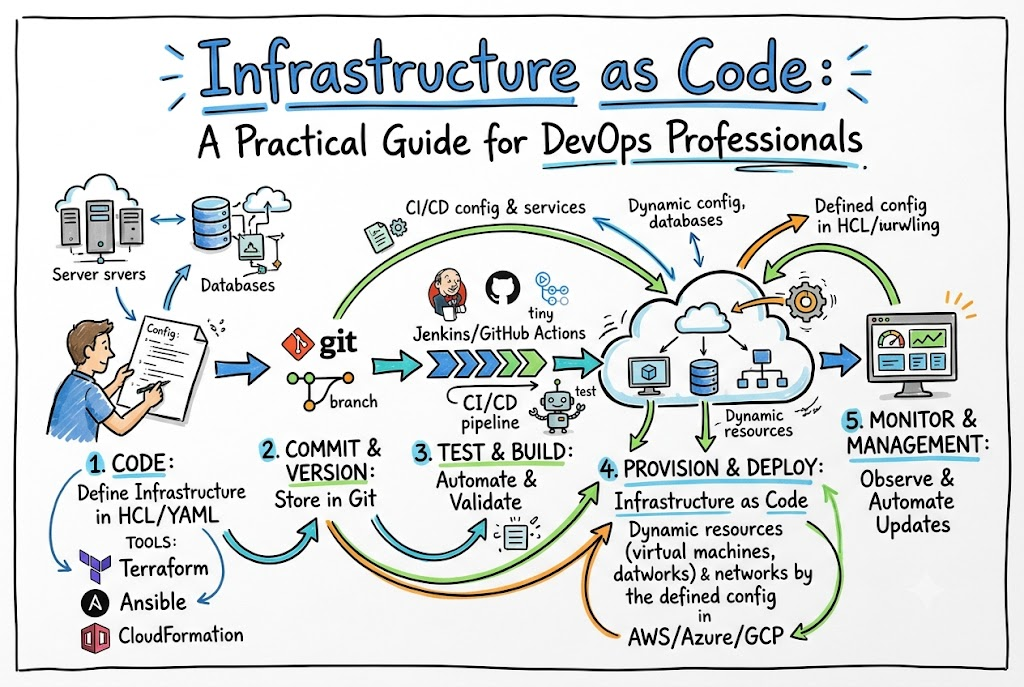
The workflow of IaC is designed to mirror the software development lifecycle. Here is the typical pipeline:
- Write Configuration Files: An engineer writes a declaration of the desired infrastructure state in a specific language (e.g., HCL for Terraform, YAML for Ansible).
- Store in Git: The configuration file is committed to a version control system like Git. This creates a history of all changes.
- Run Automation: The IaC tool is executed against the cloud provider or environment.
- Deploy Infrastructure: The tool compares the desired state (in the code) with the current state (in the cloud) and makes the necessary API calls to update the resources.
Practical Scenario: You need to launch a web server. With IaC, you write a file stating: “I need one EC2 instance with this specific image, connected to this network.” When you run the tool, it handles the API authentication, resource creation, and network attachment. If you decide you need two servers instead of one, you change the number in the code from one to two and run the update again. The system handles the rest.
Declarative vs Imperative Infrastructure
It is important to understand the two main approaches to defining infrastructure.
| Approach | Meaning | Example |
| Declarative | You define the final state you want. The tool figures out how to get there. | “I want a server with 8GB RAM.” |
| Imperative | You define the specific steps to achieve the result. | “Create server, install updates, run command, check status.” |
Most modern IaC tools are declarative. You tell the tool what you want, and it handles the heavy lifting of figuring out the changes required to match that state.
Popular Infrastructure as Code Tools
The ecosystem is vast, but these are the primary tools used in the industry today.
| Tool | Primary Use |
| Terraform | Infrastructure Provisioning |
| Ansible | Configuration Management |
| AWS CloudFormation | AWS-Specific Automation |
| Pulumi | Programming-based Infrastructure |
| Chef | Configuration Management |
| Puppet | Configuration Consistency |
Tool #1: Terraform
What it is: The industry standard for infrastructure provisioning. It uses HashiCorp Configuration Language (HCL).
Why it matters: It is provider-agnostic, meaning you can manage AWS, Azure, GCP, and other services with one tool.
Beginner advice: Start here. It has the largest community and the most extensive documentation. Learn how to write basic resource blocks first.
Tool #2: Ansible
What it is: A tool focused on configuration management and application deployment.
Why it matters: It is agentless, meaning you do not need to install software on the destination server. It communicates via SSH.
Beginner advice: Use Ansible to manage what happens inside the server (e.g., installing software, updating configuration files) after Terraform has provisioned it.
Tool #3: AWS CloudFormation
What it is: A native AWS service that models and sets up your Amazon resources.
Why it matters: It is deeply integrated into the AWS ecosystem and is free to use.
Beginner advice: If your company is 100% on AWS, this is a powerful alternative to third-party tools.
Tool #4: Pulumi
What it is: An IaC tool that allows you to define infrastructure using general-purpose programming languages like Python, JavaScript, or Go.
Why it matters: If you are already a strong developer, this feels more natural than learning a domain-specific language.
Beginner advice: Learn the basics of Terraform HCL before jumping into Pulumi to understand the underlying infrastructure concepts.
Tool #5: Chef
What it is: A powerful configuration management tool that uses Ruby-based DSLs.
Why it matters: It is highly scalable and great for complex, large-scale enterprise environments.
Beginner advice: It has a steeper learning curve than Ansible. Tackle this once you are comfortable with the basics of configuration management.
Tool #6: Puppet
What it is: An automation tool that focuses on enforcing state consistency across many servers.
Why it matters: It is excellent for maintaining compliance and ensuring servers do not drift from the desired configuration.
Beginner advice: Focus on understanding the concept of “desired state” as this is the core of how Puppet functions.
Real-World Example: Team Managing Infrastructure Manually
Imagine a team of engineers managing a fleet of 50 web servers manually.
- The Scenario: A security patch needs to be applied to all 50 servers.
- The Execution: Engineers log in to each server one by one to update the packages.
- The Failure: Engineer A misses one server. Engineer B misconfigures a setting on server 23.
- The Result: Configuration drift occurs. Server 23 crashes at 3:00 AM because of the misconfiguration. The team spends hours troubleshooting because they do not have a record of what was changed. This is the definition of high-risk, unscalable engineering.
Real-World Example: Team Using Infrastructure as Code
Now, imagine the same team using IaC.
- The Scenario: The same security patch is needed.
- The Execution: An engineer updates the code definition to specify the new package version and pushes the update to the repository. The CI/CD pipeline triggers the deployment.
- The Success: The automation tool updates all 50 servers simultaneously and reliably.
- The Result: The update is applied in minutes with zero manual intervention. There is no drift because the code enforces the state. If something goes wrong, they simply revert the Git commit, and the system restores the previous configuration.
Benefits of Infrastructure as Code
- Faster Provisioning: Reducing setup time from days to minutes.
- Repeatability: Creating a staging environment that is an exact replica of production is trivial.
- Version Control: Every change is tracked, audited, and revertible.
- Collaboration: Teams can submit pull requests for infrastructure changes, allowing for peer review before deployment.
Challenges of Infrastructure as Code
- Learning Curve: Engineers must learn how to code and understand the underlying APIs of cloud providers.
- Complexity: Managing state files and complex dependencies can get difficult as infrastructure grows.
- Misconfiguration Risks: An error in the code can propagate across the entire environment, potentially taking down systems at scale.
- Secret Management: Beginners often hardcode credentials in their files. You must use tools like HashiCorp Vault or native cloud secret managers to handle sensitive data safely.
Common Mistakes Beginners Make
- Skipping Git: Treating IaC files like temporary scripts instead of version-controlled software.
- No Testing: Deploying directly to production without testing in a sandbox environment.
- Hardcoding Secrets: Storing passwords, API keys, or private keys directly in the code files.
- Learning Too Many Tools: Trying to learn Terraform, Ansible, Pulumi, and Chef simultaneously instead of mastering one.
- Ignoring State Management: Losing track of the state file in tools like Terraform, which leads to orphaned resources.
Best Practices for Learning Infrastructure as Code
- Learn Terraform First: It is the industry standard for provisioning.
- Practice Cloud Basics: Understand VPCs, subnets, and IAM roles before trying to automate them.
- Use Git: Every project you build should be committed to a repository.
- Use Variables: Never hardcode values. Use variable files to make your code reusable.
- Modularize: Break down your code into smaller, reusable modules as your projects grow.
- Code Reviews: Treat infrastructure changes like application code changes. Peer review is critical.
Role of DevOpsSchool in Learning IaC
The transition to IaC requires more than reading documentation; it requires hands-on practice. DevOpsSchool provides the structured environment necessary to move from theory to implementation. With a focus on real-world scenarios, the programs offer exposure to Terraform and other essential automation tools. By working on actual cloud projects rather than just reading about them, students develop the muscle memory needed to manage complex infrastructure environments safely and efficiently.
Career Importance of Infrastructure as Code Skills
If you look at job descriptions for modern engineering roles, IaC is almost always a requirement.
- DevOps Engineer: Expected to build and maintain the CI/CD pipelines that deploy infrastructure.
- Cloud Engineer: Expected to design and manage multi-cloud environments using automation.
- SRE (Site Reliability Engineer): Focused on using automation to improve system reliability and reduce manual toil.
- Platform Engineer: Builds the internal platforms that developers use to deploy their own services.
- Infrastructure Automation Engineer: A specialized role focused entirely on automating the infrastructure lifecycle.
Mastering this skill sets you apart in the job market, as it demonstrates that you understand the entire lifecycle of an application, not just how to deploy it.
Industries Using Infrastructure as Code
- SaaS Platforms: Companies like Slack or Zoom use IaC to spin up massive, globally distributed infrastructure.
- Banking & Finance: Financial institutions use IaC to enforce strict compliance and security controls on every server.
- Healthcare: Ensuring environments are audited and secure is mandatory; IaC provides the audit trail required for compliance.
- E-Commerce: Platforms like Amazon or Shopify use IaC to scale infrastructure dynamically during high-traffic events like Black Friday.
- Telecom: Managing massive network infrastructure via code is essential for maintaining 5G and global connectivity.
Future of Infrastructure as Code
The future of IaC is moving toward higher-level abstractions. We are seeing a shift toward “Policy as Code,” where security and compliance rules are enforced automatically within the deployment pipeline. Additionally, the rise of Platform Engineering means developers will increasingly use internal developer portals to deploy infrastructure without needing to write raw Terraform code, further abstracting the complexity. Finally, AI is beginning to assist in generating IaC templates, which will speed up the initial phases of infrastructure design.
FAQs
- What is Infrastructure as Code?It is the practice of managing infrastructure setup using machine-readable definition files rather than manual configuration.
- Why is IaC important?It provides consistency, speed, and reliability by removing human error from the infrastructure deployment process.
- Is Terraform difficult to learn?It has a moderate learning curve, but because it is declarative and declarative, it is generally considered the most approachable tool for beginners.
- What is configuration drift?This occurs when the actual state of your infrastructure deviates from the original configuration, usually due to manual, undocumented changes.
- Do beginners need cloud knowledge?Yes. You cannot automate infrastructure if you do not understand the underlying cloud components like networks, storage, and compute.
- Is IaC part of DevOps?Absolutely. IaC is a fundamental pillar of DevOps, enabling the “automation” aspect of CI/CD.
- Which IaC tool should I learn first?Start with Terraform for infrastructure provisioning and Ansible for configuration management.
- Can IaC reduce downtime?Yes. By automating deployments and standardizing environments, you reduce the likelihood of misconfigurations that cause outages.
- Is IaC only for large companies?No. Even small teams benefit from IaC by reducing the time spent on manual setup and making their environments reproducible.
- Do I need to know how to code to learn IaC?You do not need to be a software developer, but you must understand basic scripting and logic concepts.
- How does IaC improve security?IaC allows you to encode security best practices into your configuration, ensuring all resources are provisioned securely by default.
- Why is version control important for IaC?It allows you to track every change to your infrastructure, perform code reviews, and roll back to previous states if something breaks.
- Can I use IaC for on-premise infrastructure?Yes. Tools like Ansible and Terraform have providers and modules that work with virtualized environments like VMware and physical hardware.
- What is a state file in Terraform?It is a file that maps your code to the real-world resources you have provisioned. It is how Terraform knows what infrastructure exists.
- Will IaC make infrastructure engineers obsolete?No. It changes the role from “manual operator” to “automation engineer,” which is a higher-value, more strategic position.
Final Thoughts
Infrastructure as Code is not just a trend; it is the standard for modern systems engineering. It transforms infrastructure from a source of frustration and manual labor into a predictable, manageable asset. If you are starting your journey, do not be intimidated by the number of tools available. Focus on the core principles: treat your infrastructure like code, automate wherever possible, and always prioritize consistency. Start by automating small tasks, learn the basics of version control, and build your confidence over time. The transition to IaC is a marathon, not a sprint, but it is one of the most rewarding investments you can make in your engineering career.

Find Trusted Cardiac Hospitals
Compare heart hospitals by city and services — all in one place.
Explore Hospitals