
Introduction
AI Network Anomaly Detection tools help security teams identify unusual behavior across network traffic, devices, users, applications, cloud workloads, east-west traffic, encrypted traffic, and connected assets. These tools use machine learning, behavioral analytics, network detection and response, traffic baselining, metadata analysis, packet inspection, entity profiling, and risk scoring to detect suspicious activity that traditional rule-based systems may miss. Instead of only searching for known signatures, AI network anomaly detection tools learn normal network patterns and then flag deviations that may indicate compromise, data exfiltration, lateral movement, command-and-control traffic, insider misuse, malware propagation, or policy violations.
Why It Matters
Modern attackers often hide inside normal-looking network traffic. They may use trusted credentials, encrypted connections, legitimate admin tools, cloud services, remote access channels, and low-and-slow communication patterns to avoid detection. Traditional perimeter tools are not enough because many attacks happen inside the network after the first compromise. AI network anomaly detection matters because it gives security teams deeper visibility into what systems are communicating, how traffic normally behaves, and where abnormal activity may indicate real risk. It helps SOC teams reduce blind spots, detect threats earlier, prioritize incidents, and respond before attackers move deeper into the environment.
Real World Use Cases
- Lateral movement detection: Identify suspicious internal traffic, unusual host-to-host communication, and abnormal authentication flows.
- Command-and-control detection: Detect beaconing, suspicious outbound connections, rare destinations, and unusual encrypted traffic patterns.
- Data exfiltration detection: Flag abnormal uploads, unusual transfer volumes, strange protocols, or unexpected cloud destinations.
- Malware propagation monitoring: Identify unusual scanning, spreading behavior, and endpoint-to-endpoint traffic spikes.
- Insider threat detection: Detect abnormal access to sensitive systems, unusual network paths, or suspicious data movement.
- Cloud network anomaly detection: Monitor abnormal traffic across cloud workloads, containers, virtual networks, and hybrid environments.
- IoT and unmanaged device monitoring: Discover risky devices and detect unusual communication from printers, cameras, sensors, medical devices, and OT assets.
- Zero-day and unknown threat detection: Identify behavior that is unusual even when no known signature exists.
Evaluation Criteria for Buyers
- Network visibility: The tool should monitor north-south and east-west traffic across on-premises, cloud, hybrid, and remote environments.
- Machine learning quality: Buyers should check how well the platform builds baselines and detects abnormal traffic without excessive false positives.
- Traffic analysis depth: Strong tools analyze packets, flows, metadata, DNS, TLS, protocols, sessions, and application behavior.
- Encrypted traffic analytics: The platform should detect suspicious patterns even when payloads are encrypted.
- Threat detection coverage: Look for lateral movement, command-and-control, beaconing, data exfiltration, malware propagation, and rogue device detection.
- Entity profiling: The tool should profile users, devices, servers, applications, cloud workloads, and network segments.
- Risk scoring: Alerts should be prioritized based on severity, confidence, asset importance, behavior deviation, and business context.
- Integrations: Strong tools connect with SIEM, SOAR, EDR, XDR, firewalls, cloud platforms, identity systems, and ticketing tools.
- Investigation workflow: Analysts need timelines, packet context, flow records, entity profiles, and response guidance.
- Deployment flexibility: Buyers should evaluate appliance, sensor, virtual, cloud, SaaS, hybrid, and metadata-only options.
- Privacy and governance: The platform should support role-based access, audit logs, retention controls, and data handling policies.
- Scalability: The tool should handle high network throughput, distributed sites, cloud traffic, and growing device counts.
Best for: SOC teams, network security teams, incident response teams, threat hunters, cloud security teams, MSSPs, enterprise security architects, OT security teams, and organizations that need behavior-based visibility across network traffic, devices, workloads, users, and applications.
Not ideal for: Very small organizations with limited networks, teams without centralized logging or security operations, companies that only need basic firewall monitoring, or organizations that cannot act on network anomaly alerts through investigation and response workflows.
What Changed in AI Network Anomaly Detection
- Network detection is moving beyond perimeter monitoring: Security teams now need visibility inside internal, cloud, remote, and hybrid traffic.
- AI baselining is more important: Machine learning helps identify unusual traffic patterns that static rules may miss.
- Encrypted traffic analytics is becoming essential: Many attacks use encrypted channels, so tools must detect risk through metadata and behavior.
- East-west traffic visibility is now a priority: Lateral movement often happens inside the network after initial compromise.
- Cloud network anomaly detection is growing: Cloud workloads, containers, serverless services, and virtual networks create new traffic patterns.
- NDR and XDR are converging: Network anomaly signals are more useful when correlated with endpoint, identity, cloud, and SIEM data.
- IoT and unmanaged device risk is increasing: Connected devices can create hidden paths for attackers and are often poorly monitored.
- Behavioral analytics reduces dependence on signatures: Unknown threats can be detected through abnormal communication patterns.
- Response automation is becoming common: High-confidence network anomalies can trigger SOAR playbooks, firewall blocks, or endpoint investigations.
- Risk-based prioritization matters more: Analysts need clear severity and context, not thousands of raw traffic anomalies.
- Packet and metadata approaches are both important: Some teams need deep packet evidence, while others prefer lighter metadata analysis for privacy and scale.
- Network anomaly detection supports compliance: Organizations use traffic monitoring and audit evidence to support security governance and investigation requirements.
Quick Buyer Checklist
- Confirm support for north-south and east-west traffic monitoring.
- Check whether the platform supports on-premises, cloud, hybrid, and remote traffic.
- Review machine learning baselining and false-positive tuning.
- Validate detection for command-and-control, lateral movement, beaconing, data exfiltration, and malware propagation.
- Check encrypted traffic analytics and metadata-based detection.
- Review packet capture, flow analytics, DNS visibility, TLS metadata, and protocol support.
- Confirm integrations with SIEM, SOAR, EDR, XDR, firewalls, IAM, cloud platforms, and ticketing tools.
- Test entity profiling for users, devices, servers, workloads, and network segments.
- Review dashboards, timelines, alert explanations, and investigation workflows.
- Validate scalability for traffic volume, number of sensors, and distributed sites.
- Check SSO, RBAC, audit logs, encryption, retention, and data handling controls.
- Confirm deployment options such as appliance, virtual sensor, cloud sensor, SaaS, or hybrid.
- Test anomaly detection with real network traffic before purchase.
- Review export options and vendor lock-in risk.
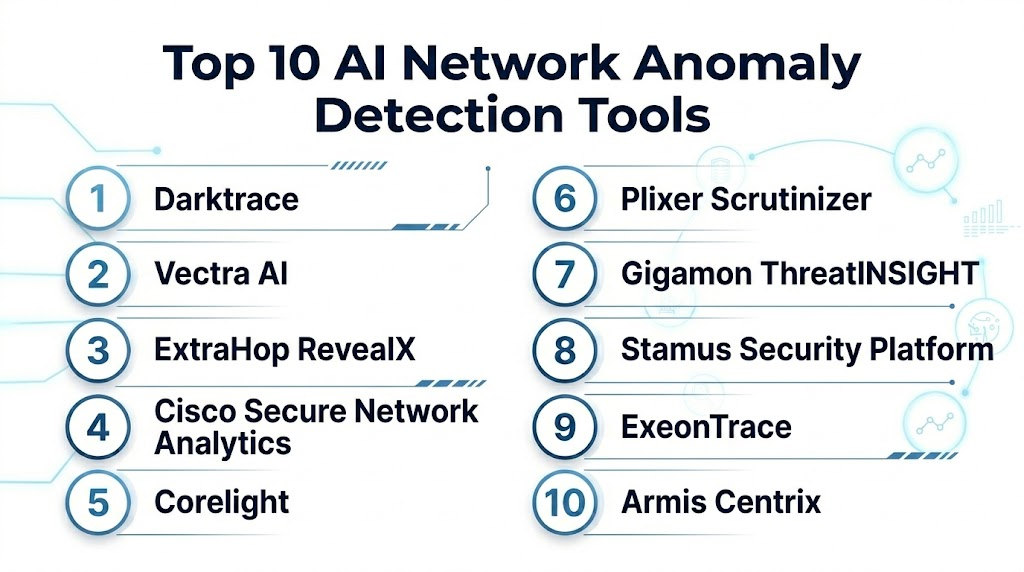
Top 10 AI Network Anomaly Detection Tools
1- Darktrace
2- Vectra AI
3- ExtraHop RevealX
4- Cisco Secure Network Analytics
5- Corelight
6- Plixer Scrutinizer
7- Gigamon ThreatINSIGHT
8- Stamus Security Platform
9- ExeonTrace
10- Armis Centrix
1- Darktrace
One-line verdict: Best for organizations seeking self-learning AI for network anomaly detection and autonomous response.
Short description:
Darktrace uses self-learning AI to understand normal behavior across networks, users, devices, cloud systems, and digital environments. It is useful for security teams that need behavior-based detection, anomaly investigation, and response support across complex and changing infrastructure.
Standout Capabilities
- Self-learning AI for behavioral baselining
- Network anomaly detection across users and devices
- Detection of unusual internal and external traffic
- Support for cloud, email, endpoint, and network signals depending on product scope
- Autonomous response capabilities in supported deployments
- Investigation dashboards and attack visualization
- Detection of insider threats, lateral movement, and unusual data transfer
- Risk-based alerts for SOC workflows
AI-Specific Depth
- Model support: Proprietary self-learning AI models
- RAG and knowledge integration: Varies / N/A
- Evaluation: Not publicly stated
- Guardrails: Response controls, thresholds, and policy settings vary by configuration
- Observability: Behavior baselines, anomaly alerts, investigation views, entity activity, and response logs
Pros
- Strong AI-based anomaly detection approach
- Useful for unknown and subtle behavior changes
- Broad digital environment coverage depending on package
Cons
- Requires tuning and analyst review for best results
- Autonomous response must be carefully governed
- Pricing and packaging vary by deployment
Security and Compliance
Darktrace provides enterprise security monitoring and response capabilities. Exact SSO, RBAC, audit logs, encryption, data retention, residency, and certifications should be verified during procurement. If not confirmed, write Not publicly stated.
Deployment and Platforms
- Cloud, appliance, virtual, and hybrid options may vary
- Web-based management console
- Network sensors and integrations depending on environment
- Supports on-premises, cloud, and hybrid monitoring use cases
Integrations and Ecosystem
Darktrace integrates network anomaly detection with broader security operations workflows.
- SIEM integrations
- SOAR workflows
- Firewall and network security tools
- Endpoint and identity context depending on configuration
- Cloud platforms
- APIs and automation workflows
- Incident response workflows
Pricing Model
Typically subscription-based and enterprise-oriented. Exact pricing depends on deployment scope, modules, traffic volume, and contract. Exact pricing is Not publicly stated.
Best-Fit Scenarios
- Enterprises needing self-learning network anomaly detection
- SOC teams investigating unknown and insider threats
- Organizations that want AI-driven detection and controlled response
2- Vectra AI
One-line verdict: Best for AI-driven detection of attacker behavior across network, identity, cloud, and SaaS environments.
Short description:
Vectra AI focuses on detecting attacker behavior using AI-driven threat detection and response. It is useful for security teams that need to detect lateral movement, privilege abuse, command-and-control, cloud threats, and identity-related attack behavior across hybrid environments.
Standout Capabilities
- AI-driven attacker behavior detection
- Network detection and response capabilities
- Detection for lateral movement and command-and-control
- Identity and cloud threat context depending on product scope
- Prioritized threat scoring
- Security analyst investigation workflows
- Integration with SIEM, SOAR, EDR, and XDR tools
- Focus on high-fidelity detections
AI-Specific Depth
- Model support: Proprietary AI and behavioral detection models
- RAG and knowledge integration: Varies / N/A
- Evaluation: Not publicly stated
- Guardrails: Detection policies and response workflow controls vary by configuration
- Observability: Threat scores, detection timelines, entity behavior, attack progression views, and investigation dashboards
Pros
- Strong focus on attacker behavior detection
- Useful for lateral movement and post-compromise activity
- Good fit for SOC teams needing prioritized detections
Cons
- Best value depends on correct sensor and data source coverage
- Requires trained analysts for deeper investigations
- Pricing and packaging vary
Security and Compliance
Vectra AI provides enterprise threat detection capabilities. Exact SSO, RBAC, audit logs, encryption, retention, residency, and certifications should be verified directly. If details are not confirmed, use Not publicly stated.
Deployment and Platforms
- Cloud and sensor-based options may vary
- Network detection and response workflows
- Web console
- Supports hybrid network and cloud security use cases depending on deployment
Integrations and Ecosystem
Vectra AI connects AI-driven threat detection with security operations workflows.
- SIEM integrations
- SOAR integrations
- EDR and XDR tools
- Identity systems
- Cloud security tools
- Ticketing workflows
- APIs and automation options
Pricing Model
Typically subscription-based and enterprise-oriented. Exact pricing depends on deployment scope, sensors, modules, and agreement. Exact pricing is Not publicly stated.
Best-Fit Scenarios
- SOC teams detecting lateral movement and command-and-control
- Enterprises needing AI-driven NDR
- Organizations correlating network, identity, and cloud threat signals
3- ExtraHop RevealX
One-line verdict: Best for deep network visibility, packet-level investigation, and high-fidelity anomaly detection.
Short description:
ExtraHop RevealX provides network detection and response with deep traffic visibility, behavior analytics, and investigation workflows. It is useful for organizations that need packet-level context, encrypted traffic insights, lateral movement detection, and network evidence for incident response.
Standout Capabilities
- Network detection and response
- Deep packet and protocol analysis
- Machine learning-based anomaly detection
- Encrypted traffic analysis using metadata
- Lateral movement and command-and-control detection
- Investigation workflows and forensic context
- Cloud and hybrid network visibility
- Integration with SIEM, SOAR, and EDR tools
AI-Specific Depth
- Model support: Proprietary machine learning and behavioral analytics
- RAG and knowledge integration: Varies / N/A
- Evaluation: Not publicly stated
- Guardrails: Detection tuning and workflow policies vary by configuration
- Observability: Network transactions, entity behavior, packet context, detections, timelines, and dashboards
Pros
- Strong network traffic visibility
- Useful packet and protocol-level investigation depth
- Good fit for incident response and forensic workflows
Cons
- Requires traffic visibility and deployment planning
- Can be more advanced than smaller teams need
- Pricing and deployment details vary
Security and Compliance
ExtraHop provides enterprise network detection and response capabilities. Exact SSO, RBAC, audit logs, encryption, retention, residency, and certifications should be verified during procurement. If not verified, write Not publicly stated.
Deployment and Platforms
- Cloud and enterprise deployment options may vary
- Sensors and appliances depending on environment
- Web-based management console
- Supports data center, cloud, and hybrid traffic visibility
Integrations and Ecosystem
ExtraHop RevealX supports network detection, investigation, and response workflows.
- SIEM integrations
- SOAR workflows
- EDR and XDR tools
- Cloud platforms
- Network infrastructure
- Ticketing systems
- APIs and automation workflows
Pricing Model
Typically subscription-based and enterprise-oriented. Exact pricing depends on traffic volume, deployment scope, modules, and contract. Exact pricing is Not publicly stated.
Best-Fit Scenarios
- Enterprises needing deep network visibility
- Incident response teams requiring packet-level evidence
- SOC teams monitoring lateral movement and encrypted traffic anomalies
4- Cisco Secure Network Analytics
One-line verdict: Best for enterprises needing network telemetry analytics and anomaly detection across Cisco environments.
Short description:
Cisco Secure Network Analytics provides network visibility, behavioral analytics, and threat detection using telemetry from network infrastructure. It is useful for enterprises that need anomaly detection, policy violation monitoring, traffic analysis, and visibility across large network environments.
Standout Capabilities
- Network behavior analytics
- Flow-based anomaly detection
- Enterprise network visibility
- Threat detection using network telemetry
- Policy violation and suspicious activity monitoring
- Integration with Cisco security ecosystem
- Support for encrypted traffic analytics depending on environment
- Dashboards for network and security teams
AI-Specific Depth
- Model support: Proprietary analytics and behavioral detection capabilities
- RAG and knowledge integration: Varies / N/A
- Evaluation: Not publicly stated
- Guardrails: Policy controls and alert settings vary by configuration
- Observability: Flow records, anomaly alerts, entity behavior, traffic dashboards, and investigation views
Pros
- Strong fit for Cisco network environments
- Useful flow-based network visibility
- Good for large enterprise network monitoring
Cons
- Best value depends on Cisco infrastructure alignment
- May require network expertise for tuning
- Deployment complexity varies by environment
Security and Compliance
Cisco provides enterprise security controls across its security portfolio. Exact SSO, RBAC, audit logs, encryption, retention, residency, and certifications for this specific product should be verified during procurement. If unverified, use Not publicly stated.
Deployment and Platforms
- Cloud and enterprise options may vary
- Network telemetry-based monitoring
- Web management console
- Works with supported network infrastructure and collectors
- Deployment depends on network architecture
Integrations and Ecosystem
Cisco Secure Network Analytics fits best inside Cisco-centered network and security workflows.
- Cisco security ecosystem
- Network infrastructure telemetry
- SIEM workflows
- SOAR workflows
- Firewall integrations
- Identity and access context
- Security operations reporting
Pricing Model
Typically enterprise subscription or licensing-based. Exact pricing depends on deployment scope, telemetry volume, and contract. Exact pricing is Not publicly stated.
Best-Fit Scenarios
- Enterprises using Cisco network infrastructure
- Network security teams needing flow-based anomaly detection
- SOC teams monitoring large distributed networks
5- Corelight
One-line verdict: Best for teams needing open network evidence, Zeek-powered visibility, and high-quality network telemetry.
Short description:
Corelight provides network security monitoring and detection built around rich network evidence and Zeek-based telemetry. It is useful for security teams that need high-quality network logs, anomaly detection support, threat hunting data, and incident response evidence.
Standout Capabilities
- Rich network telemetry based on Zeek
- Network detection and response workflows
- High-fidelity logs for threat hunting
- Support for Suricata and packet evidence depending on deployment
- Encrypted traffic metadata visibility
- Cloud and enterprise network monitoring options
- Integrations with SIEM and data platforms
- Useful for incident response and detection engineering
AI-Specific Depth
- Model support: Proprietary analytics may vary, with strong telemetry support for analytics workflows
- RAG and knowledge integration: Varies / N/A
- Evaluation: Not publicly stated
- Guardrails: Detection and logging policies vary by configuration
- Observability: Network logs, detections, protocol metadata, traffic evidence, and investigation data
Pros
- Strong network evidence and telemetry quality
- Good fit for threat hunting and detection engineering
- Useful for teams that value transparent network data
Cons
- May require skilled analysts and detection engineers
- Full AI anomaly depth may depend on integrations and selected offerings
- Deployment and data storage planning are important
Security and Compliance
Corelight provides enterprise network security monitoring capabilities. Exact SSO, RBAC, audit logs, encryption, retention, residency, and certifications should be verified directly. If not confirmed, write Not publicly stated.
Deployment and Platforms
- Sensor-based and cloud options may vary
- Network security monitoring workflows
- Integrates with data lakes and SIEM platforms
- Supports enterprise and cloud network visibility depending on deployment
Integrations and Ecosystem
Corelight is strong for teams that want network evidence flowing into existing analytics platforms.
- SIEM integrations
- Data lakes
- SOAR workflows
- Threat intelligence tools
- Cloud environments
- Packet and network telemetry workflows
- Detection engineering pipelines
Pricing Model
Typically subscription-based and enterprise-oriented. Exact pricing depends on sensors, data volume, deployment, and contract. Exact pricing is Not publicly stated.
Best-Fit Scenarios
- Threat hunting teams needing rich network telemetry
- Enterprises using SIEM or data lake analytics
- Detection engineering teams building network anomaly detections
6- Plixer Scrutinizer
One-line verdict: Best for flow-based network anomaly detection, traffic analytics, and performance-security visibility.
Short description:
Plixer Scrutinizer analyzes network flow data to help teams detect abnormal traffic patterns, suspicious communication, policy violations, and performance issues. It is useful for organizations that want flow-based visibility across routers, switches, firewalls, cloud networks, and enterprise infrastructure.
Standout Capabilities
- Flow-based network traffic analytics
- Anomaly detection using traffic patterns
- NetFlow, IPFIX, and related flow visibility
- Security and performance monitoring
- Suspicious communication detection
- Network behavior reporting
- Dashboards for network and security teams
- Integration with SIEM and incident workflows
AI-Specific Depth
- Model support: Proprietary analytics and anomaly detection capabilities
- RAG and knowledge integration: Varies / N/A
- Evaluation: Not publicly stated
- Guardrails: Alert thresholds and policy rules vary by configuration
- Observability: Flow analytics, traffic dashboards, anomaly alerts, bandwidth views, and entity communication patterns
Pros
- Strong flow-based visibility
- Useful for both network performance and security anomalies
- Good fit for distributed enterprise networks
Cons
- Flow data may not provide full packet-level evidence
- Detection quality depends on telemetry coverage
- May need SIEM or NDR pairing for deeper incident context
Security and Compliance
Plixer provides enterprise network traffic analytics capabilities. Exact SSO, RBAC, audit logs, encryption, retention, residency, and certifications should be verified during procurement. If details are not confirmed, write Not publicly stated.
Deployment and Platforms
- Enterprise deployment options vary
- Flow collector and analytics platform
- Web-based dashboards
- Works with network infrastructure exporting flow data
- Cloud visibility varies by configuration
Integrations and Ecosystem
Plixer Scrutinizer fits into network operations and security workflows.
- Routers and switches
- Firewalls
- SIEM integrations
- Network performance workflows
- Security operations workflows
- APIs and reporting
- Incident response workflows
Pricing Model
Typically subscription or licensing-based. Exact pricing depends on flow volume, deployment scope, and contract. Exact pricing is Not publicly stated.
Best-Fit Scenarios
- Teams needing flow-based anomaly detection
- Network operations and security collaboration
- Enterprises monitoring traffic behavior across distributed networks
7- Gigamon ThreatINSIGHT
One-line verdict: Best for teams needing managed NDR and network anomaly detection with guided investigation.
Short description:
Gigamon ThreatINSIGHT provides network detection and response capabilities focused on detecting suspicious activity and supporting investigations. It is useful for teams that want network anomaly detection with expert support, traffic intelligence, and security operations alignment.
Standout Capabilities
- Network detection and response
- Suspicious traffic and anomaly detection
- Managed detection support depending on package
- Network metadata and behavior analytics
- Threat hunting support
- Investigation workflows
- Integration with Gigamon visibility ecosystem
- Alert prioritization and context
AI-Specific Depth
- Model support: Proprietary analytics and detection capabilities
- RAG and knowledge integration: Varies / N/A
- Evaluation: Not publicly stated
- Guardrails: Detection workflow and response controls vary by configuration
- Observability: Network detections, metadata, investigation context, alert details, and analyst workflows
Pros
- Useful managed NDR approach for lean teams
- Good fit for organizations using Gigamon visibility fabric
- Helps reduce investigation burden with guided analysis
Cons
- Best value depends on traffic visibility and service model
- May not fit teams wanting fully self-managed analytics only
- Pricing and packaging vary
Security and Compliance
Gigamon provides enterprise network visibility and security capabilities. Exact SSO, RBAC, audit logs, encryption, data retention, residency, and certifications should be verified directly. If not confirmed, use Not publicly stated.
Deployment and Platforms
- Cloud and enterprise options may vary
- Network visibility and detection workflows
- Web-based console
- Deployment depends on traffic visibility architecture and product package
Integrations and Ecosystem
Gigamon ThreatINSIGHT fits into network visibility and security operations workflows.
- Gigamon visibility fabric
- SIEM integrations
- SOAR workflows
- EDR and XDR tools
- Network security tools
- Cloud traffic visibility
- Incident response workflows
Pricing Model
Typically subscription-based and enterprise-oriented. Exact pricing depends on deployment scope, service package, and contract. Exact pricing is Not publicly stated.
Best-Fit Scenarios
- Lean SOC teams needing managed NDR support
- Enterprises using Gigamon network visibility
- Teams needing guided network anomaly investigation
8- Stamus Security Platform
One-line verdict: Best for teams needing open detection foundations with network threat hunting and anomaly context.
Short description:
Stamus Security Platform provides network detection and response using open detection technologies and analytics to help teams identify threats, investigate suspicious behavior, and improve network visibility. It is useful for organizations that value transparent detections, threat hunting workflows, and network evidence.
Standout Capabilities
- Network detection and response
- Threat hunting workflows
- Open detection foundation using network security data
- Alert enrichment and prioritization
- Protocol and traffic visibility
- Suspicious behavior detection
- Integration with SIEM and security tools
- Investigation dashboards
AI-Specific Depth
- Model support: Proprietary analytics with open detection foundations, details vary by deployment
- RAG and knowledge integration: Varies / N/A
- Evaluation: Not publicly stated
- Guardrails: Detection policies, rule controls, and workflow settings vary by configuration
- Observability: Network detections, protocol evidence, alert context, investigation views, and threat hunting data
Pros
- Strong fit for teams that value detection transparency
- Useful for network threat hunting
- Good integration potential with existing SOC workflows
Cons
- May require skilled analysts for full value
- Advanced AI anomaly capabilities may vary by use case
- Deployment and tuning require planning
Security and Compliance
Stamus provides enterprise network detection capabilities. Exact SSO, RBAC, audit logs, encryption, retention, residency, and certifications should be verified during procurement. If unverified, write Not publicly stated.
Deployment and Platforms
- Enterprise deployment options may vary
- Network sensor-based workflows
- Web console
- Integrates with SIEM and security operations tools
- Deployment depends on network architecture
Integrations and Ecosystem
Stamus Security Platform supports SOC and threat hunting workflows.
- SIEM integrations
- SOAR workflows
- Threat intelligence tools
- Network sensors
- Incident response workflows
- APIs and exports
- Detection engineering workflows
Pricing Model
Typically subscription-based and enterprise-oriented. Exact pricing depends on deployment scope, sensors, and contract. Exact pricing is Not publicly stated.
Best-Fit Scenarios
- Threat hunting teams needing network evidence
- SOC teams wanting transparent detection logic
- Enterprises combining open detection with commercial support
9- ExeonTrace
One-line verdict: Best for metadata-based AI network anomaly detection with lightweight deployment needs.
Short description:
ExeonTrace focuses on AI-driven network detection and response using network metadata rather than full packet payloads. It is useful for organizations that need scalable anomaly detection, privacy-conscious monitoring, and network visibility without heavy packet capture requirements.
Standout Capabilities
- AI-driven network anomaly detection
- Metadata-based traffic analytics
- Network detection and response workflows
- Lightweight deployment approach
- Suspicious behavior and communication pattern detection
- Enterprise network visibility
- Support for privacy-conscious monitoring
- Investigation dashboards and risk context
AI-Specific Depth
- Model support: Proprietary AI models for network metadata analysis
- RAG and knowledge integration: Varies / N/A
- Evaluation: Not publicly stated
- Guardrails: Detection thresholds and workflow controls vary by configuration
- Observability: Metadata analytics, anomaly alerts, network behavior dashboards, and investigation context
Pros
- Lightweight metadata-based approach
- Good fit for privacy-sensitive environments
- Useful for scalable network anomaly detection
Cons
- Metadata approach may not provide full packet evidence
- Requires flow and metadata coverage
- Pricing and deployment details vary
Security and Compliance
Exeon provides enterprise network detection capabilities with a privacy-conscious metadata approach. Exact SSO, RBAC, audit logs, encryption, retention, residency, and certifications should be verified directly. If not confirmed, write Not publicly stated.
Deployment and Platforms
- Enterprise deployment options may vary
- Metadata-based network monitoring
- Web console
- Designed for network detection and response workflows
- Deployment depends on network telemetry sources
Integrations and Ecosystem
ExeonTrace can connect network anomaly detection with security operations workflows.
- SIEM integrations
- SOAR workflows
- Network telemetry sources
- Security operations tools
- Reporting workflows
- APIs and exports
- Incident response processes
Pricing Model
Typically subscription-based and enterprise-oriented. Exact pricing depends on scope, monitored environment, and agreement. Exact pricing is Not publicly stated.
Best-Fit Scenarios
- Privacy-conscious enterprises
- Teams needing lightweight AI network anomaly detection
- Organizations that prefer metadata over full packet inspection
10- Armis Centrix
One-line verdict: Best for anomaly detection across unmanaged, IoT, OT, medical, and connected assets.
Short description:
Armis Centrix helps organizations discover, monitor, and analyze behavior across connected assets, including unmanaged devices, IoT, OT, medical systems, and enterprise devices. It is useful for environments where network anomaly detection depends on understanding device identity, behavior, communication patterns, and risk context.
Standout Capabilities
- Asset discovery and classification
- Behavior analytics for connected devices
- IoT, OT, medical, and unmanaged device visibility
- Anomaly detection based on asset behavior
- Risk scoring and exposure analytics
- Communication pattern monitoring
- Integration with security and IT workflows
- Support for complex enterprise and industrial environments
AI-Specific Depth
- Model support: Proprietary analytics and asset intelligence models
- RAG and knowledge integration: Varies / N/A
- Evaluation: Not publicly stated
- Guardrails: Administrative controls and workflow policies vary by configuration
- Observability: Asset inventory, behavior profiles, anomaly alerts, communication patterns, and risk dashboards
Pros
- Strong visibility into unmanaged and connected assets
- Useful for healthcare, industrial, and large enterprise environments
- Helps detect abnormal behavior from non-traditional devices
Cons
- Best value depends on complex device environments
- May be more than small IT teams need
- Pricing and deployment scope vary
Security and Compliance
Armis provides enterprise asset intelligence and exposure management capabilities. Exact SSO, RBAC, audit logs, encryption, retention, residency, and certifications should be verified during procurement. If details are not confirmed, write Not publicly stated.
Deployment and Platforms
- Cloud-based platform
- Asset intelligence and behavior analytics workflows
- Supports IT, IoT, OT, medical, and connected asset environments
- Deployment details vary by environment and integrations
Integrations and Ecosystem
Armis Centrix connects connected asset behavior with security operations.
- CMDB tools
- SIEM workflows
- SOAR workflows
- EDR and XDR tools
- Network security tools
- Vulnerability management systems
- ITSM and ticketing systems
Pricing Model
Typically enterprise subscription-based. Exact pricing varies by asset scope, modules, and contract. Exact pricing is Not publicly stated.
Best-Fit Scenarios
- Enterprises with unmanaged and connected device risk
- Healthcare and industrial organizations needing network behavior analytics
- Security teams monitoring IoT, OT, and medical device anomalies
Comparison Table
| Tool Name | Best For | Deployment | Model Flexibility | Strength | Watch Out | Public Rating |
|---|---|---|---|---|---|---|
| Darktrace | Self-learning network anomaly detection | Cloud, appliance, virtual, hybrid varies | Hosted proprietary | AI behavioral baselining | Response needs governance | N/A |
| Vectra AI | Attacker behavior detection | Cloud and sensor options vary | Hosted proprietary | Lateral movement and C2 detection | Needs sensor coverage | N/A |
| ExtraHop RevealX | Deep traffic investigation | Cloud and enterprise options vary | Hosted proprietary | Packet and protocol visibility | Advanced deployment planning | N/A |
| Cisco Secure Network Analytics | Cisco network environments | Cloud and enterprise options vary | Hosted proprietary | Flow-based network analytics | Cisco fit matters | N/A |
| Corelight | Network evidence and threat hunting | Sensor and cloud options vary | Hosted proprietary plus open telemetry foundation | Zeek-powered telemetry | Requires skilled analysts | N/A |
| Plixer Scrutinizer | Flow-based anomaly detection | Enterprise options vary | Hosted proprietary | NetFlow and traffic analytics | Limited packet evidence | N/A |
| Gigamon ThreatINSIGHT | Managed NDR workflows | Cloud and enterprise options vary | Hosted proprietary | Guided investigation | Service model fit matters | N/A |
| Stamus Security Platform | Transparent network detection | Enterprise options vary | Hosted proprietary plus open detection foundation | Threat hunting evidence | Needs tuning | N/A |
| ExeonTrace | Metadata-based AI NDR | Enterprise options vary | Hosted proprietary | Lightweight metadata analytics | Less packet detail | N/A |
| Armis Centrix | Connected asset anomaly detection | Cloud | Hosted proprietary | IoT and unmanaged asset behavior | Best for complex assets | N/A |
Scoring and Evaluation
This scoring is comparative, not absolute. It helps buyers compare AI network anomaly detection tools based on detection depth, AI reliability, guardrails, integrations, usability, performance, security controls, and support. Scores may vary based on traffic visibility, deployment architecture, analyst skill, network size, cloud adoption, and investigation needs. Public ratings are not guessed. Buyers should validate shortlisted platforms with real network traffic, realistic attack scenarios, and existing SOC workflows.
| Tool | Core | Reliability and Eval | Guardrails | Integrations | Ease | Performance and Cost | Security and Admin | Support | Weighted Total |
| Darktrace | 9.0 | 8.6 | 8.5 | 8.5 | 8.3 | 8.3 | 8.6 | 8.5 | 8.6 |
| Vectra AI | 9.0 | 8.7 | 8.4 | 8.8 | 8.2 | 8.4 | 8.6 | 8.6 | 8.6 |
| ExtraHop RevealX | 9.1 | 8.6 | 8.4 | 8.8 | 8.1 | 8.2 | 8.6 | 8.5 | 8.6 |
| Cisco Secure Network Analytics | 8.7 | 8.3 | 8.4 | 8.7 | 8.0 | 8.4 | 8.7 | 8.6 | 8.5 |
| Corelight | 8.8 | 8.4 | 8.2 | 8.8 | 7.8 | 8.3 | 8.4 | 8.4 | 8.4 |
| Plixer Scrutinizer | 8.3 | 8.1 | 8.1 | 8.3 | 8.2 | 8.5 | 8.3 | 8.2 | 8.3 |
| Gigamon ThreatINSIGHT | 8.5 | 8.2 | 8.2 | 8.6 | 8.2 | 8.2 | 8.4 | 8.5 | 8.4 |
| Stamus Security Platform | 8.4 | 8.2 | 8.1 | 8.4 | 7.9 | 8.2 | 8.3 | 8.3 | 8.2 |
| ExeonTrace | 8.4 | 8.3 | 8.2 | 8.2 | 8.4 | 8.5 | 8.3 | 8.2 | 8.4 |
| Armis Centrix | 8.6 | 8.2 | 8.3 | 8.6 | 8.1 | 8.2 | 8.5 | 8.4 | 8.4 |
Top 3 for Enterprise
1- ExtraHop RevealX
2- Vectra AI
3- Darktrace
Top 3 for SMB
1- Plixer Scrutinizer
2- ExeonTrace
3- Gigamon ThreatINSIGHT
Top 3 for Developers
1- Corelight
2- Stamus Security Platform
3- ExtraHop RevealX
Which AI Network Anomaly Detection Tool Is Right for You
Solo / Freelancer
Solo consultants usually do not need a large enterprise NDR platform unless they manage client networks or perform incident response services. For packet and telemetry-driven investigation, Corelight or Stamus Security Platform may be useful in technical environments. For lightweight network traffic anomaly projects, ExeonTrace or Plixer Scrutinizer may fit better depending on available telemetry.
SMB
SMBs should focus on tools that provide clear alerts, manageable deployment, and useful network visibility without heavy tuning. Plixer Scrutinizer can help teams monitor flow-based anomalies, while ExeonTrace can support metadata-based AI detection. Gigamon ThreatINSIGHT may be useful for teams that want managed support around network detection.
Mid-Market
Mid-market organizations usually need stronger NDR capabilities, SIEM integration, and investigation workflows. Darktrace, Vectra AI, ExtraHop RevealX, and Cisco Secure Network Analytics can be strong candidates depending on whether the team values self-learning AI, attacker behavior detection, packet-level visibility, or Cisco network telemetry.
Enterprise
Large enterprises should prioritize high-throughput scalability, east-west traffic visibility, cloud and hybrid coverage, governance, integrations, and investigation depth. ExtraHop RevealX, Vectra AI, Darktrace, Cisco Secure Network Analytics, and Corelight are strong enterprise options. The best fit depends on network architecture, analyst skill, and existing security stack.
Regulated Industries
Finance, healthcare, government, manufacturing, and critical infrastructure teams should prioritize auditability, access controls, retention settings, privacy, forensic evidence, and network segmentation visibility. ExtraHop RevealX, Corelight, Cisco Secure Network Analytics, Armis Centrix, and Darktrace may be strong options depending on the environment. Buyers should verify all compliance claims directly.
Budget vs Premium
Budget-conscious teams should begin with the telemetry they already have, such as flow records, firewall logs, DNS logs, and SIEM data. Plixer Scrutinizer and ExeonTrace may fit teams that want lighter-weight approaches. Premium enterprise teams may benefit from deeper NDR platforms like ExtraHop RevealX, Darktrace, Vectra AI, or Corelight when they need rich investigation and high-scale detection.
Build vs Buy
Building network anomaly detection internally can work for advanced security engineering teams with strong packet analysis, data engineering, machine learning, and threat hunting skills. Most organizations should buy because production-grade NDR requires reliable baselines, protocol decoding, scalable sensors, detection content, alert workflows, integrations, and support. A hybrid model can work where commercial tools provide network telemetry and internal teams build custom detections on top.
Implementation Playbook
First 30 Days
- Define the main network anomaly detection goals.
- Identify key traffic sources such as core switches, firewalls, cloud networks, DNS, proxies, VPNs, and data center segments.
- Select two or three tools for pilot testing.
- Connect a limited set of high-value network segments.
- Establish initial traffic baselines.
- Test detections for command-and-control, lateral movement, beaconing, scanning, and data exfiltration.
- Review false positives and alert explanations.
- Validate privacy, retention, RBAC, audit logs, and administrative controls.
- Define success metrics such as improved detection coverage, reduced investigation time, fewer blind spots, and faster response.
- Create a pilot team with SOC, network, cloud, and incident response stakeholders.
First 60 Days
- Expand visibility to cloud, remote access, data center, and internal network traffic.
- Configure anomaly thresholds and risk scoring rules.
- Integrate alerts with SIEM, SOAR, EDR, XDR, firewalls, ticketing, and incident response tools.
- Create workflows for high-risk detections such as beaconing, exfiltration, lateral movement, and rogue device activity.
- Validate AI and ML detections with analyst review.
- Build dashboards for SOC analysts, network teams, security architects, and leadership.
- Define escalation rules for critical assets and sensitive network segments.
- Train analysts on packet evidence, flow records, entity behavior, and network timelines.
- Create exception workflows for known business processes and expected traffic spikes.
- Document response actions for high-confidence anomalies.
First 90 Days
- Scale monitoring across more sites, cloud accounts, workloads, and network segments.
- Tune anomaly models and alert logic based on analyst feedback.
- Automate response actions for high-confidence threats where appropriate.
- Review data retention, privacy, and governance policies.
- Track metrics such as detection quality, false positives, investigation time, and response outcomes.
- Add recurring reviews for risky devices, unusual traffic patterns, and exposed services.
- Improve dashboards based on stakeholder needs.
- Create executive reporting around network risk trends and anomaly reduction.
- Review IoT, OT, and unmanaged device behavior.
- Establish continuous improvement for network anomaly detections, traffic coverage, and incident response workflows.
Common Mistakes and How to Avoid Them
- Monitoring only perimeter traffic: Many attacks move laterally inside the network, so east-west visibility is important.
- Ignoring encrypted traffic: Use metadata and behavioral analytics to detect suspicious encrypted communication.
- Using anomaly detection without baselines: Poor baselines create noisy alerts and missed detections.
- Over-trusting AI alerts: Analysts should validate high-impact anomalies before taking disruptive actions.
- Not involving network teams: Network anomaly detection works best when SOC and network teams collaborate.
- Skipping cloud traffic: Cloud workloads and virtual networks can hide important attack paths.
- Ignoring DNS traffic: DNS can reveal command-and-control, tunneling, beaconing, and unusual destinations.
- No response process: Alerts should connect to clear investigation and remediation workflows.
- Not tuning false positives: Untuned anomaly systems can overwhelm analysts.
- Forgetting unmanaged devices: IoT, OT, printers, cameras, and medical devices can create blind spots.
- Buying without traffic testing: Always test with real network traffic and realistic attack simulations.
- Not integrating with SIEM or SOAR: Network alerts are more useful when connected to broader incident response.
- Ignoring data retention: Packet and flow data can grow quickly, so retention planning matters.
- Measuring alert count instead of risk reduction: Track detection quality, investigation speed, and response outcomes.
FAQs
1- What is AI Network Anomaly Detection?
AI Network Anomaly Detection uses machine learning and behavioral analytics to identify unusual network activity. It learns normal traffic patterns and flags deviations that may indicate compromise, data exfiltration, lateral movement, or policy violations.
2- How is it different from traditional intrusion detection?
Traditional intrusion detection often relies on rules and signatures. AI network anomaly detection focuses on behavior changes, unknown threats, traffic baselines, and suspicious patterns that may not match known signatures.
3- What threats can AI network anomaly detection find?
It can help detect command-and-control traffic, lateral movement, beaconing, data exfiltration, malware propagation, rogue devices, suspicious encrypted traffic, and abnormal cloud or internal network communication.
4- Does network anomaly detection require packet capture?
Not always. Some tools use full packet capture or protocol analysis, while others use flow records, metadata, DNS logs, TLS metadata, or network telemetry. The right approach depends on privacy, scale, and investigation needs.
5- Can these tools analyze encrypted traffic?
Yes, many tools can analyze encrypted traffic using metadata, flow behavior, TLS fingerprints, destination reputation, timing patterns, and communication anomalies. They may not need to decrypt payloads for every detection.
6- Which tool is best for deep packet investigation?
ExtraHop RevealX and Corelight are strong options when deep packet, protocol, and network evidence are important. ExtraHop is strong for NDR investigations, while Corelight is strong for rich network telemetry and threat hunting.
7- Which tool is best for AI-driven attacker behavior detection?
Vectra AI and Darktrace are strong options for AI-driven behavioral detection. Vectra AI focuses heavily on attacker behavior detection, while Darktrace emphasizes self-learning AI and anomaly detection across digital environments.
8- Which tool is best for Cisco environments?
Cisco Secure Network Analytics is a strong fit for organizations using Cisco network infrastructure and wanting flow-based visibility, anomaly detection, and security monitoring across enterprise networks.
9- Is AI network anomaly detection useful for cloud security?
Yes. Cloud workloads, virtual networks, containers, and APIs create network patterns that need monitoring. Tools with cloud visibility can help detect unusual communication, exposed workloads, and suspicious traffic paths.
10- Can these tools replace SIEM or EDR?
No. AI network anomaly detection tools complement SIEM and EDR. SIEM provides log correlation, EDR provides endpoint visibility, and network anomaly tools provide traffic behavior context that can reveal threats missed by other controls.
11- What data should buyers collect for a pilot?
Buyers should collect network flows, DNS logs, firewall logs, cloud network logs, packet samples where appropriate, endpoint context, identity context, and known incident examples. A pilot should include real traffic and realistic attack scenarios.
12- How should teams reduce false positives?
Teams should start with focused network segments, tune baselines, add asset context, whitelist known business behavior, review alerts with analysts, and integrate findings with identity, endpoint, and threat intelligence data.
Conclusion
AI Network Anomaly Detection tools help security teams find suspicious behavior that signature-based tools and perimeter controls may miss. The best platform depends on your network architecture, traffic visibility, cloud maturity, analyst skills, privacy requirements, and response workflow. Darktrace is strong for self-learning AI and broad anomaly detection, Vectra AI is excellent for attacker behavior detection, ExtraHop RevealX provides deep network visibility and forensic context, Cisco Secure Network Analytics fits Cisco-centered networks, Corelight is powerful for threat hunting and network evidence, Plixer Scrutinizer is practical for flow-based analytics, Gigamon ThreatINSIGHT supports guided NDR workflows, Stamus Security Platform is useful for transparent detection and threat hunting, ExeonTrace fits metadata-based AI detection, and Armis Centrix is valuable for IoT, OT, medical, and unmanaged device anomaly monitoring. To choose wisely, shortlist tools based on your traffic sources and detection goals, pilot them with real network data, verify security and evaluation controls, then scale with governance, tuning, integrations, and continuous detection improvement.

Find Trusted Cardiac Hospitals
Compare heart hospitals by city and services — all in one place.
Explore Hospitals
One practical challenge that deserves more attention in AI network anomaly detection discussions is model drift and alert fatigue in real production environments. Many tools look impressive in demos, but network behavior changes constantly due to cloud autoscaling, seasonal traffic, remote work patterns, or new services being deployed. Without continuous tuning, anomaly detection can quickly become noisy and reduce analyst trust. I’d also be curious to see a comparison around explainability—when an AI flags suspicious behavior, how well can SOC teams actually understand why the alert fired and confidently act on it? In practice, explainable detections and low operational overhead often matter as much as raw detection accuracy.