
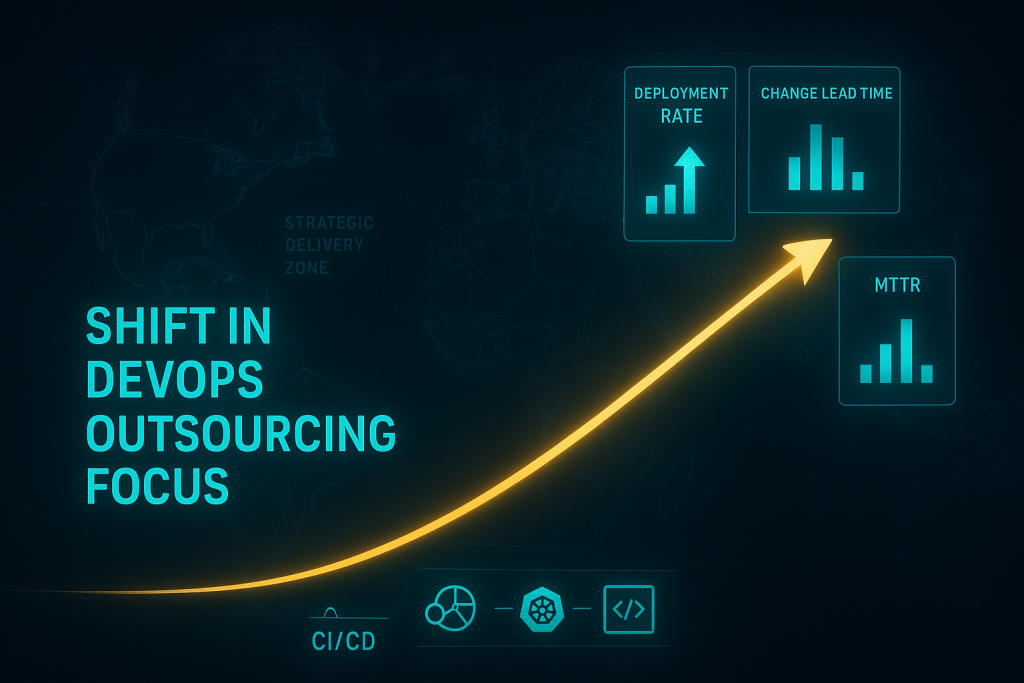
DevOps outsourcing is shifting from cost-reduction programs to delivery capability and performance-driven partnerships. Those who seek reduced CI/CD cycles, improved SRE coverage, and closer collaboration are increasingly considering nearshore models. A highly plausible option is nearshoring Latin America, which combines time-zone alignment, deep cloud expertise, and competitive cost structures. In this article, we’ll present fresh market data, insights from industry leaders, and actionable steps CTOs and engineering leaders can take to capture nearshore value efficiently.
Why Latin America — The Data That Changes Your Hiring Calculus
It is no longer merely a low-cost option; it’s increasingly becoming a strategic tech center. Industry publications and latest research indicate a strong trend:
- The region is producing millions of software engineers and building expertise in cloud and AI technology at a rapid pace, with approximately 2 million developers in the LATAM markets.
- Latin American enterprise software revenue is predicted to reach US$14.1 billion by 2024, which evidences maturity and strong domestic demand for skilled engineers.
- Corporates invest in the following human capital. Salesforce invested US$1 billion in Mexico in 2026 in AI initiatives and expanding delivery centers.
These trends make nearshore hires not junior stand-ins but seasoned engineers that can just be plugged into production DevOps flows, where they pick up CI/CD, containerization, and cloud automation work.
Actual Issues Nearshore DevOps Resolves — and How to Prove ROI
Engineering managers usually must ask themselves: What actual issues will a nearshore DevOps team resolve? Nearshore teams provide measurable metrics:
- Overlap and coverage: Offer daily overlap and near-24/7 operating coverage without the expense of salary.
- Accelerating the pipeline: Help onshore SREs decrease CI queue time, deployment rate, and MTTR.
- Absence of expert skills: Tap into automation, Infrastructure-as-Code (IaC), and Kubernetes skills without multi-quarter hiring cycles.
How to Validate ROI:
- Note three metrics before and after engagement: deployment rate, change lead time, and MTTR.
- Test a 60–90 day pilot on one particular pipeline issue (e.g., reduce rollback rates by 20%). Grow the engagement if it proves successful.
Nearshore collaboration will pay quantifiable dividends rather than nebulous cost savings through this action.
Successful Engagement Models for DevOps Outsourcing
There are three successful models that allow organizations to engage nearshore DevOps professionals successfully:
- Staff Augmentation: Engineers are integrated into existing teams to close specific SRE or IaC skills gaps immediately.
- Dedicated Nearshore DevOps Teams: Nearshore pod owns platform engineering, monitoring, and pipeline activities, optimal for long-term capacity building.
- Managed DevOps Services: Vendors deliver outcomes with SLA management for uptime, incident resolution, and platform performance.
Best Practice: Establish runbooks, MTTA/MTTR SLAs, and shared dashboards on day one. Employ a standard KPI model by both onshore and nearshore teams to ensure continuous alignment.
Avoiding Common Traps — A Practical Checklist
Nearshore DevOps success is anticipating common risks:
- Friction onboarding: Having access control documentation, secrets management, and observability ownership in place prior to onboarding.
- Security and compliance: Having SOC 2/ISO certifications in place and contractual clarity on data residency and escalation processes.
- Toolchain incompatibility: Having CI/CD, IaC, and ticketing tool integration (GitHub Actions, Terraform, Jira) to avoid workflow fragmentation.
- Communication cadence: Having daily standups with overlapping times and weekly architecture syncs. Having one single source of truth for runbooks.
Vendor Shortlisting Checklist:
- Do they have DevOps/SRE references and published runbooks?
- Can they provide a 30/60/90-day plan aligned to CI/CD metrics?
- Do they have cloud cost optimization visibility?
- Are compliance certifications up to date and verifiable?
These criteria distinguish mature nearshore partners from cost commodities providers.
Market Signals and Expert Opinions
Latest 2026 hiring statistics show that U.S. firms are speeding up the hiring of DevOps and engineering staff in Latin America, which is evidence that nearshoring has transitioned from pilot to mass practice. Latin America is named by experts as a “strategic delivery zone” for digital transformation — and not just a cheaper option.
Market sources reflect double-digit annual percentage growth in local demand for DevOps and cloud engineers. AI-ready, multi-cloud resilient, and agile-based companies are increasingly shifting towards nearshore rather than offshore models so that they can cooperate better and iterate rapidly.
Implementation Roadmap — First 90 Days
Weeks 0–2: Procurement & Access
Impose NDAs and security addendums.
Provide least-privilege onboarding documentation and access.
Weeks 2–6: Ramp & Alignment
Pass two-week knowledge transfer about CI/CD pipelines, postmortem analysis, and architecture review.
Implement shadow rotations for SRE on-call.
Weeks 6–12: Deliver & Measure
Track deployment rate, lead time for changes, and MTTR.
Maintain bi-weekly retrospectives and continuously refine runbooks.
Successful pilots can be replicated to dedicated pods with well-defined RACI (roles and responsibilities) structures for platform ownership.
Conclusion
Latin America’s nearshore collaborations are not the afterthought cost reduction approach anymore, but a strategic facilitator. With talent pools still thriving, increasing enterprise investment, and cultural closeness, the region provides the talent and proximity needed to manage today’s DevOps complexity — greater release speed, great SRE coverage, and cloud automation at scale.
For businesses seeking quantifiable return on DevOps delivery, the secret sauce ingredients are the right nearshore partner, a well-designed pilot, and well-defined KPIs. To begin learning more about this tactic, visit nearshoring Latin America and see how nearshore partnership can give your DevOps strategy a boost.

I’m Rajesh Kumar, a DevOps, SRE, DevSecOps, Cloud, and Platform Engineering expert passionate about sharing practical knowledge, real-world experiences, and industry best practices. I have worked at Cotocus and regularly write about technology, travel, investing, health, product reviews, and digital marketing through my various platforms.
I publish technical articles at DevOps School, travel stories at Holiday Landmark, stock market insights at Stocks Mantra, health and fitness guidance at My Medic Plus, product reviews at TrueReviewNow, and SEO and digital marketing strategies at Wizbrand.
Find Trusted Cardiac Hospitals
Compare heart hospitals by city and services — all in one place.
Explore Hospitals

This article gives a very clear and forward-looking perspective on why nearshore outsourcing to Latin America is rapidly becoming a strategic choice — not just a cost-cutting move. I like how it highlights that LATAM now boasts a large, growing pool of cloud- and DevOps-ready engineers, making it possible for companies to plug in experienced DevOps or SRE talent and immediately benefit from reduced CI/CD bottlenecks and faster deployment cycles. The discussion around delivery-capability models — whether staff-augmentation, dedicated nearshore teams or managed services — offers a realistic roadmap for organizations evaluating nearshore collaboration. For engineering leaders aiming to scale reliably in 2026 and beyond, this article makes a compelling case to seriously consider Latin-American nearshore teams.
This article offers a compelling perspective on why nearshore outsourcing to Latin America is increasingly becoming attractive for DevOps services — the combination of overlapping time zones, cultural affinity, and competitive pricing can truly make collaboration smoother and more efficient. By emphasizing factors such as bilingual communication, agile‑friendly practices, and a growing pool of skilled professionals, it realistically portrays Latin America as a viable alternative to traditional outsourcing destinations. The point about reduced coordination friction and improved real‑time collaboration resonates, especially for teams aiming for fast delivery and continuous integration/deployment cycles. Overall — a timely and insightful read for companies exploring global DevOps partnerships and scaling their operations with minimal latency overhead.