
Introduction
AI Industrial Anomaly Detection tools help factories, plants, utilities, and asset-heavy organizations detect unusual behavior in machines, processes, production lines, and operational systems before small issues become expensive failures. These platforms use artificial intelligence, machine learning, sensor analytics, time-series data, computer vision, and predictive models to identify abnormal patterns that human teams may miss during routine monitoring.
In industrial environments, anomalies can appear in many forms. A motor may vibrate differently, a pump may show unusual pressure behavior, a production line may produce more defects, a machine may consume more energy than expected, or a visual inspection system may detect surface defects on finished products. AI anomaly detection platforms help teams identify these issues faster and respond with better context.
These tools matter because industrial downtime, quality failures, energy waste, and equipment breakdowns can create major operational and financial losses. Instead of waiting for failures to happen, organizations can use AI to monitor operational signals continuously, detect early warning signs, and support faster maintenance, quality, and production decisions.
Why It Matters
Industrial operations generate large volumes of data from sensors, machines, control systems, inspection cameras, maintenance logs, and production software. However, many teams still depend on fixed thresholds, manual checks, scheduled inspections, and operator experience to identify abnormal behavior. These methods can work, but they often miss subtle signals that appear before equipment failure, quality drift, or process instability.
AI Industrial Anomaly Detection improves this approach by learning normal operating behavior and identifying deviations automatically. Instead of only reacting to alarms, teams can detect early warning patterns and investigate root causes before they affect production. This is especially valuable in manufacturing, oil and gas, energy, mining, chemicals, pharmaceuticals, utilities, and logistics environments.
The value is not only technical. Better anomaly detection can reduce downtime, improve asset reliability, increase product quality, lower maintenance costs, support worker safety, and improve customer delivery performance. For leaders, these platforms provide a practical way to move from reactive operations toward predictive and proactive operations.
Real World Use Cases
- Detecting abnormal vibration in motors, pumps, compressors, and turbines
- Identifying early signs of equipment failure before breakdowns occur
- Monitoring production lines for quality drift and process instability
- Detecting visual defects in manufactured parts and finished goods
- Finding abnormal energy consumption across industrial assets
- Monitoring chemical, temperature, pressure, and flow anomalies
- Reducing false alarms in traditional control systems
- Supporting predictive maintenance programs
- Improving asset reliability across multiple facilities
- Detecting abnormal behavior in industrial IoT sensor networks
- Supporting root cause analysis for recurring production issues
- Helping operators prioritize critical alerts
Evaluation Criteria for Buyers
When evaluating AI Industrial Anomaly Detection tools, buyers should consider:
- Ability to detect anomalies across sensor, machine, process, and visual data
- Support for time-series data and industrial historian systems
- False positive reduction capabilities
- Explainability of alerts and recommendations
- Predictive maintenance and reliability features
- Computer vision support for visual inspection use cases
- Real-time monitoring and alerting capabilities
- Integration with industrial systems and maintenance platforms
- Security, access control, and audit features
- Deployment flexibility across cloud, edge, hybrid, and on-premises environments
- Model monitoring and retraining workflows
- Ease of use for engineers, operators, and maintenance teams
- Support for multi-site industrial operations
- Cost visibility and scalability
- Vendor experience in industrial environments
Best For
AI Industrial Anomaly Detection tools are best for manufacturers, energy companies, utilities, mining operators, chemical plants, pharmaceutical manufacturers, logistics operators, equipment-heavy enterprises, reliability engineers, maintenance teams, plant managers, process engineers, and digital transformation leaders who want to detect abnormal behavior earlier and reduce operational risk.
Not Ideal For
These tools may not be ideal for very small organizations with limited machine data, businesses without sensor-connected equipment, or teams that only need basic dashboard reporting. If a company does not have enough operational data or does not have a clear maintenance, quality, or reliability problem, simpler monitoring or business intelligence tools may be a better starting point.
What’s Changing in AI Industrial Anomaly Detection
- AI models are moving beyond simple threshold alerts toward pattern-based anomaly detection.
- Industrial teams are using more real-time sensor data to detect early warning signals.
- Computer vision is expanding anomaly detection from machines to product quality inspection.
- Predictive maintenance workflows are becoming more closely connected with anomaly detection.
- Edge AI is helping teams analyze machine data closer to the equipment.
- Multimodal AI is combining sensor data, images, maintenance logs, and operator notes.
- Explainable AI is becoming important because engineers need to understand why an alert was triggered.
- False positive reduction is now a major buyer requirement.
- Governance and auditability are becoming more important for regulated industrial environments.
- AI copilots are beginning to help maintenance and operations teams interpret abnormal events.
- Integration with enterprise asset management systems is becoming more valuable.
- Industrial anomaly detection is shifting from isolated pilots to enterprise reliability programs.
Quick Buyer Checklist
Before selecting an AI Industrial Anomaly Detection platform, verify:
- It supports your main asset types and process data
- It can connect with your existing industrial systems
- It can analyze time-series sensor data effectively
- It can reduce false alarms and alert fatigue
- It provides clear explanations for anomaly alerts
- It supports real-time or near-real-time monitoring
- It can integrate with maintenance and reliability workflows
- It supports your preferred deployment model
- It includes role-based access and audit controls
- It can scale across plants, production lines, or facilities
- It supports model monitoring and continuous improvement
- It provides clear dashboards for engineers and operators
- It can support both predictive maintenance and quality use cases
- It does not create unnecessary vendor lock-in
- It has strong support for industrial implementation
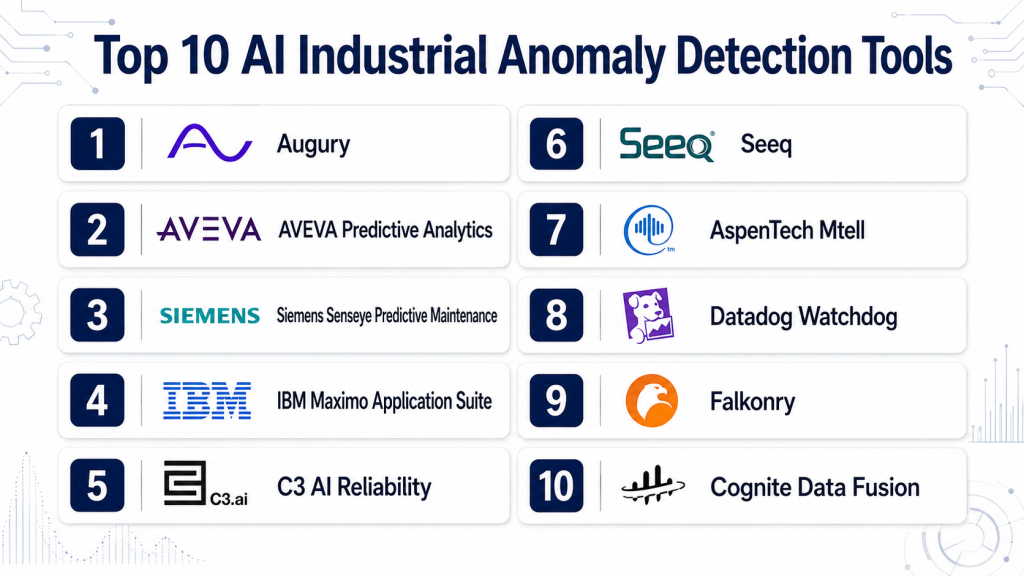
Top 10 AI Industrial Anomaly Detection Tools
1- Augury
One-Line Verdict: Best for industrial teams focused on machine health, vibration analytics, and predictive maintenance.
Short Description
Augury is an industrial AI platform focused on machine health, equipment monitoring, and predictive maintenance. It helps organizations detect abnormal machine behavior, identify early failure signals, and prioritize maintenance actions before equipment breakdowns disrupt production.The platform is especially useful for manufacturers and asset-heavy organizations that want practical machine health insights without relying only on manual inspections or fixed maintenance schedules.
Standout Capabilities
- Machine health monitoring for industrial equipment
- AI-based anomaly detection from machine signals
- Predictive maintenance recommendations
- Sensor-driven equipment monitoring
- Failure pattern identification
- Maintenance prioritization workflows
- Fleet-level asset visibility
- Support for reliability teams
AI-Specific Depth
- Model support: Proprietary industrial AI models
- Knowledge integration: Varies
- Evaluation: Machine health model validation and alert review
- Guardrails: Alert prioritization and maintenance workflow controls
- Observability: Asset health dashboards and anomaly trend monitoring
Pros
- Strong focus on machine health
- Useful for predictive maintenance programs
- Helps reduce unplanned downtime
Cons
- Best suited for equipment-focused anomaly detection
- May not cover every process optimization use case
- Requires sensor and asset data readiness
Security and Compliance
Enterprise security features are available, but specific certifications and controls vary by deployment and contract. Buyers should verify access control, audit logging, encryption, data retention, and integration security during vendor evaluation.
Deployment and Platforms
- Cloud
- Edge-supported industrial environments
- Mobile and web access may vary
Integrations and Ecosystem
Augury typically fits into maintenance, reliability, and operations workflows.
- Enterprise asset management systems
- Maintenance management platforms
- Industrial sensor environments
- Operational dashboards
- Reliability workflows
- Plant maintenance processes
Pricing Model
Pricing is typically subscription or enterprise contract based. Exact pricing is not publicly stated.
Best-Fit Scenarios
- Predictive maintenance for rotating equipment
- Machine health monitoring across plants
- Reducing unplanned equipment downtime
2- AVEVA Predictive Analytics
One-Line Verdict: Best for industrial enterprises that need predictive anomaly detection and asset reliability improvement.
Short Description
AVEVA Predictive Analytics helps industrial organizations monitor asset behavior, detect abnormal patterns, and identify potential failures before they cause downtime. It is commonly evaluated by organizations that already operate complex industrial systems and need enterprise-scale reliability insights.The platform supports maintenance, operations, and reliability teams by turning operational data into early warnings and actionable insights.
Standout Capabilities
- Predictive analytics for industrial assets
- Early fault detection
- Asset reliability monitoring
- Industrial process anomaly detection
- Maintenance planning support
- Operational risk reduction
- Enterprise dashboards
- Integration with industrial data environments
AI-Specific Depth
- Model support: Proprietary industrial AI and predictive models
- Knowledge integration: Varies
- Evaluation: Predictive model monitoring and validation
- Guardrails: Operational thresholds and reliability workflows
- Observability: Asset health and anomaly dashboards
Pros
- Strong industrial focus
- Useful for asset reliability programs
- Suitable for large industrial operations
Cons
- Implementation may require mature data systems
- Advanced use cases need engineering involvement
- Enterprise deployments can be complex
Security and Compliance
Enterprise security capabilities are generally available. Buyers should verify role-based access, encryption, audit logging, data governance, data retention, and compliance requirements for their environment.
Deployment and Platforms
- Cloud
- Hybrid
- Enterprise industrial environments
Integrations and Ecosystem
AVEVA fits well in industrial operations environments where process data, asset data, and maintenance workflows need to be connected.
- Industrial historians
- SCADA systems
- Manufacturing execution systems
- Enterprise asset management tools
- Operations dashboards
- Maintenance workflows
Pricing Model
Enterprise subscription and licensing models. Exact pricing is not publicly stated.
Best-Fit Scenarios
- Asset reliability improvement
- Predictive maintenance programs
- Enterprise industrial monitoring
3- Siemens Senseye Predictive Maintenance
One-Line Verdict: Best for manufacturers seeking scalable predictive maintenance and industrial anomaly detection.
Short Description
Siemens Senseye Predictive Maintenance is designed to help industrial organizations monitor equipment health, identify abnormal behavior, and improve maintenance planning. It supports teams that want to move away from reactive maintenance and toward predictive reliability workflows.The platform is especially relevant for manufacturers with connected equipment, production assets, and maintenance teams seeking scalable anomaly detection.
Standout Capabilities
- Predictive maintenance workflows
- Equipment anomaly detection
- Asset health monitoring
- Maintenance prioritization
- Industrial data analysis
- Scalable deployment across equipment fleets
- Support for reliability improvement programs
- Integration with broader Siemens industrial ecosystem
AI-Specific Depth
- Model support: Proprietary and industrial machine learning models
- Knowledge integration: Varies
- Evaluation: Model performance monitoring and maintenance validation
- Guardrails: Reliability workflows and alert review processes
- Observability: Asset health dashboards and anomaly trends
Pros
- Strong manufacturing relevance
- Good fit for predictive maintenance
- Backed by a broad industrial ecosystem
Cons
- Best value often comes within Siemens-aligned environments
- May require industrial data preparation
- Advanced deployment can need specialist support
Security and Compliance
Enterprise security controls are typically available. Buyers should verify identity management, access controls, audit logging, encryption, and data governance requirements before deployment.
Deployment and Platforms
- Cloud
- Hybrid
- Industrial environments
Integrations and Ecosystem
Siemens Senseye fits into manufacturing and maintenance environments where equipment reliability is a priority.
- Industrial automation systems
- Maintenance systems
- Asset management tools
- Production data environments
- Siemens ecosystem solutions
- Industrial IoT platforms
Pricing Model
Subscription or enterprise licensing. Exact pricing is not publicly stated.
Best-Fit Scenarios
- Predictive maintenance across factories
- Machine anomaly detection
- Reliability improvement programs
4- IBM Maximo Application Suite
One-Line Verdict: Best for enterprises combining asset management, reliability, anomaly detection, and maintenance workflows.
Short Description
IBM Maximo Application Suite supports enterprise asset management, maintenance planning, reliability monitoring, and AI-assisted asset performance use cases. For industrial organizations, it can help connect anomaly signals with maintenance workflows and asset lifecycle management.It is well suited for teams that want anomaly detection to be part of a broader asset management and reliability strategy rather than a standalone monitoring tool.
Standout Capabilities
- Enterprise asset management
- Asset performance monitoring
- AI-assisted maintenance insights
- Reliability management workflows
- Work order integration
- Asset lifecycle visibility
- Industrial IoT data support
- Maintenance decision support
AI-Specific Depth
- Model support: Proprietary and configurable AI capabilities
- Knowledge integration: Varies
- Evaluation: Asset performance and model monitoring workflows
- Guardrails: Maintenance approval and governance workflows
- Observability: Asset dashboards, alerts, and operational reports
Pros
- Strong asset management foundation
- Good fit for large maintenance organizations
- Connects anomaly detection with work execution
Cons
- May be broader than needed for simple anomaly detection
- Implementation can be complex
- Requires process alignment across teams
Security and Compliance
Enterprise security features are available. Buyers should verify SSO, role-based access, audit logging, encryption, data residency, and governance requirements based on deployment.
Deployment and Platforms
- Cloud
- Hybrid
- Enterprise environments
Integrations and Ecosystem
IBM Maximo is often used as part of broader enterprise asset and maintenance operations.
- Enterprise asset management workflows
- Industrial IoT platforms
- Work order systems
- ERP systems
- Maintenance planning tools
- Asset performance analytics
Pricing Model
Enterprise licensing and subscription models. Exact pricing is not publicly stated.
Best-Fit Scenarios
- Enterprise asset reliability programs
- Maintenance workflow modernization
- Anomaly detection connected with work orders
5- C3 AI Reliability
One-Line Verdict: Best for large enterprises seeking scalable AI for asset reliability and anomaly detection.
Short Description
C3 AI Reliability is designed to help enterprises detect asset anomalies, predict failures, and improve operational reliability. It is suited for organizations with large asset fleets, complex data environments, and enterprise-scale AI transformation goals.The platform can support predictive maintenance, reliability analytics, and anomaly detection across industrial operations.
Standout Capabilities
- Enterprise AI for asset reliability
- Anomaly detection for equipment behavior
- Predictive failure analytics
- Cross-facility deployment support
- Large-scale data integration
- AI application framework
- Operational risk reduction
- Reliability dashboards
AI-Specific Depth
- Model support: Multi-model enterprise AI architecture
- Knowledge integration: Varies
- Evaluation: Model performance tracking
- Guardrails: Policy-based governance controls
- Observability: AI monitoring and operational analytics
Pros
- Strong enterprise scalability
- Good fit for complex data environments
- Supports broad AI transformation programs
Cons
- Implementation can be resource-intensive
- Better suited to large enterprises
- Requires strong data and IT maturity
Security and Compliance
Enterprise identity, governance, access control, audit logging, and security features are available. Buyers should verify exact security and compliance needs during procurement.
Deployment and Platforms
- Cloud
- Hybrid
- Enterprise deployments
Integrations and Ecosystem
C3 AI Reliability can connect with enterprise and industrial data environments.
- ERP systems
- Industrial systems
- Data lakes
- Asset management systems
- Maintenance platforms
- Enterprise analytics tools
Pricing Model
Enterprise licensing and subscription-based pricing. Exact pricing is not publicly stated.
Best-Fit Scenarios
- Large-scale asset reliability programs
- Enterprise anomaly detection
- Predictive maintenance across many facilities
6- Seeq
One-Line Verdict: Best for process engineers who need advanced industrial analytics and anomaly investigation.
Short Description
Seeq helps industrial teams analyze time-series data, detect abnormal process behavior, investigate root causes, and improve operational performance. It is especially useful for engineers working with process data from plants, production lines, and industrial systems.The platform is strong for anomaly investigation because it allows users to explore patterns, compare operating conditions, and identify process deviations without depending only on traditional dashboards or fixed threshold alerts.
Standout Capabilities
- Advanced time-series analytics
- Process anomaly investigation
- Root cause analysis workflows
- Industrial data visualization
- Collaboration for engineering teams
- Support for operational performance monitoring
- Analytics for process stability
- Fast exploration of abnormal events
AI-Specific Depth
- Model support: Machine learning and statistical models
- Knowledge integration: Varies
- Evaluation: Analytics validation and process review
- Guardrails: User-defined workflows and review processes
- Observability: Process intelligence dashboards and anomaly trends
Pros
- Strong fit for process engineers
- Excellent for investigating abnormal behavior
- Useful for continuous improvement programs
Cons
- Less focused on fully automated anomaly response
- Advanced workflows may require process expertise
- Best value depends on strong data connectivity
Security and Compliance
Enterprise security features are available. Buyers should verify role-based access, audit logging, encryption, identity management, and data governance controls based on their deployment needs.
Deployment and Platforms
- Cloud
- Hybrid
- Enterprise industrial environments
Integrations and Ecosystem
Seeq is commonly used with industrial data systems and operational analytics environments.
- Industrial historians
- Process data platforms
- Manufacturing systems
- Cloud data platforms
- Analytics workflows
- Engineering collaboration tools
Pricing Model
Enterprise subscription pricing. Exact pricing is not publicly stated.
Best-Fit Scenarios
- Process anomaly investigation
- Root cause analysis for production issues
- Operational analytics for engineers
7- AspenTech Mtell
One-Line Verdict: Best for industrial teams focused on early equipment failure detection and asset reliability.
Short Description
AspenTech Mtell supports predictive maintenance and industrial anomaly detection by identifying early warning signs of equipment degradation. It helps reliability teams detect abnormal asset behavior before failures occur and supports better maintenance planning.The platform is useful for asset-intensive industries where unplanned downtime can create major production losses, safety risks, and maintenance costs.
Standout Capabilities
- Early warning failure detection
- Predictive maintenance analytics
- Asset anomaly detection
- Industrial equipment monitoring
- Failure pattern recognition
- Maintenance prioritization
- Asset reliability improvement
- Operational risk reduction
AI-Specific Depth
- Model support: Proprietary industrial machine learning models
- Knowledge integration: Varies
- Evaluation: Model validation and failure pattern review
- Guardrails: Maintenance workflows and operational constraints
- Observability: Asset health dashboards and anomaly monitoring
Pros
- Strong reliability-focused anomaly detection
- Useful for critical asset monitoring
- Good fit for predictive maintenance initiatives
Cons
- Best suited for asset failure detection
- Requires good historical maintenance and sensor data
- Enterprise implementation may require specialist support
Security and Compliance
Enterprise security capabilities are available. Buyers should confirm identity management, access control, audit logging, encryption, and data retention policies before deployment.
Deployment and Platforms
- Cloud
- Hybrid
- Industrial enterprise environments
Integrations and Ecosystem
AspenTech Mtell fits into asset reliability, maintenance, and industrial operations ecosystems.
- Industrial historians
- Asset management systems
- Maintenance workflows
- Reliability dashboards
- Process data platforms
- Operational technology systems
Pricing Model
Enterprise subscription and licensing model. Exact pricing is not publicly stated.
Best-Fit Scenarios
- Predictive maintenance for critical assets
- Early failure detection
- Reliability improvement across plants
8- Datadog Watchdog
One-Line Verdict: Best for teams monitoring industrial software, cloud systems, IoT platforms, and operational applications.
Short Description
Datadog Watchdog uses machine learning to detect anomalies across infrastructure, applications, logs, metrics, and digital services. While Datadog is not purely an industrial operations platform, it can be useful for organizations monitoring industrial IoT systems, connected equipment platforms, edge applications, and manufacturing software environments.It is especially valuable when anomaly detection must include both operational technology data flows and modern digital infrastructure.
Standout Capabilities
- Machine learning anomaly detection
- Infrastructure monitoring
- Log and metric analysis
- Application performance monitoring
- Alert correlation
- Incident investigation support
- Cloud and IoT platform observability
- Automated abnormal behavior detection
AI-Specific Depth
- Model support: Proprietary machine learning models
- Knowledge integration: Varies
- Evaluation: Monitoring rules and alert review
- Guardrails: Alert thresholds, access controls, and incident workflows
- Observability: Metrics, logs, traces, dashboards, and anomaly alerts
Pros
- Strong observability ecosystem
- Useful for connected industrial software
- Good anomaly detection across digital systems
Cons
- Not focused on core industrial process optimization
- Requires careful configuration for industrial use cases
- May not replace dedicated predictive maintenance tools
Security and Compliance
Enterprise security and administration features are available. Buyers should verify role-based access, audit logs, encryption, data retention, and compliance needs for their environment.
Deployment and Platforms
- Cloud
- Agent-based monitoring
- Hybrid infrastructure environments
Integrations and Ecosystem
Datadog integrates broadly across software, cloud, and infrastructure environments.
- Cloud platforms
- IoT platforms
- Log systems
- Application stacks
- Infrastructure monitoring agents
- Incident management tools
Pricing Model
Usage-based and subscription pricing models. Exact pricing depends on modules and usage.
Best-Fit Scenarios
- Industrial IoT platform monitoring
- Connected factory software observability
- Anomaly detection across cloud and edge infrastructure
9- Falkonry
One-Line Verdict: Best for manufacturers seeking AI-based anomaly detection from operational time-series data.
Short Description
Falkonry focuses on AI-driven anomaly detection and operational intelligence for industrial environments. It helps teams monitor process and machine data to identify abnormal conditions, reduce downtime, and improve production reliability.The platform is useful for manufacturers and industrial operators that need anomaly detection across complex production systems and sensor streams.
Standout Capabilities
- Time-series anomaly detection
- Industrial process monitoring
- Machine behavior analysis
- Early warning alerts
- Operational pattern recognition
- Support for manufacturing reliability
- Reduced alert noise
- Scalable monitoring across assets
AI-Specific Depth
- Model support: Proprietary industrial AI models
- Knowledge integration: Varies
- Evaluation: Alert review and anomaly validation
- Guardrails: Operational thresholds and review workflows
- Observability: Anomaly dashboards and time-series monitoring
Pros
- Focused on industrial anomaly detection
- Good fit for time-series sensor data
- Helps detect abnormal operating conditions early
Cons
- Requires good sensor and process data
- May need integration effort
- Best suited for industrial data environments
Security and Compliance
Enterprise security features vary by deployment. Buyers should verify access control, audit logging, encryption, retention controls, and data governance before selection.
Deployment and Platforms
- Cloud
- Hybrid
- Industrial environments
Integrations and Ecosystem
Falkonry works with industrial data sources and operational monitoring workflows.
- Sensor data streams
- Industrial historians
- Manufacturing systems
- Process data platforms
- Operational dashboards
- Maintenance workflows
Pricing Model
Enterprise subscription pricing. Exact pricing is not publicly stated.
Best-Fit Scenarios
- Manufacturing anomaly detection
- Process monitoring from sensor data
- Early warning systems for production issues
10- Cognite Data Fusion
One-Line Verdict: Best for industrial companies building anomaly detection on top of contextualized operational data.
Short Description
Cognite Data Fusion is an industrial data platform that helps organizations collect, contextualize, and use operational data for analytics, AI, and digital operations. While it is not only an anomaly detection tool, it provides a strong foundation for building anomaly detection workflows across assets, sensors, documents, and industrial systems.It is especially useful for companies that need high-quality industrial data context before scaling AI models across complex operations.
Standout Capabilities
- Industrial data contextualization
- Time-series data management
- Asset hierarchy mapping
- AI-ready industrial data foundation
- Support for anomaly detection workflows
- Operational analytics enablement
- Data integration across systems
- Digital operations support
AI-Specific Depth
- Model support: Bring-your-own models and ecosystem-based AI workflows
- Knowledge integration: Strong industrial data contextualization
- Evaluation: Varies based on connected AI workflows
- Guardrails: Governance and access controls vary by deployment
- Observability: Operational data visibility and analytics dashboards
Pros
- Strong industrial data foundation
- Useful for scaling AI across complex assets
- Supports flexible anomaly detection development
Cons
- Not a standalone anomaly detection product for every use case
- Requires AI model and workflow design
- Best value comes with data maturity
Security and Compliance
Enterprise security and governance capabilities are available. Buyers should verify identity controls, audit logging, encryption, data residency, and data retention requirements.
Deployment and Platforms
- Cloud
- Hybrid industrial environments
Integrations and Ecosystem
Cognite Data Fusion connects industrial systems and makes operational data easier to use for AI and analytics.
- Industrial historians
- Asset systems
- Sensor data platforms
- Maintenance systems
- Documents and engineering data
- Analytics and AI workflows
Pricing Model
Enterprise subscription pricing. Exact pricing is not publicly stated.
Best-Fit Scenarios
- Building industrial anomaly detection pipelines
- Contextualizing operational data for AI
- Scaling industrial analytics across assets
Comparison Table
| Tool Name | Best For | Deployment | Model Flexibility | Strength | Watch-Out | Public Rating |
|---|---|---|---|---|---|---|
| Augury | Machine health monitoring | Cloud and edge | Proprietary | Equipment anomaly detection | Best for asset-focused use cases | N/A |
| AVEVA Predictive Analytics | Asset reliability | Cloud and hybrid | Proprietary | Predictive industrial analytics | Needs mature operational data | N/A |
| Siemens Senseye Predictive Maintenance | Manufacturing maintenance | Cloud and hybrid | Proprietary | Predictive maintenance workflows | Best in industrial ecosystems | N/A |
| IBM Maximo Application Suite | Enterprise asset management | Cloud and hybrid | Configurable | Work order and asset lifecycle connection | Broad platform complexity | N/A |
| C3 AI Reliability | Large enterprise reliability | Cloud and hybrid | Multi-model | Enterprise AI scalability | Resource-heavy implementation | N/A |
| Seeq | Process anomaly investigation | Cloud and hybrid | Machine learning and statistical | Time-series analysis | Less focused on full automation | N/A |
| AspenTech Mtell | Early failure detection | Cloud and hybrid | Proprietary | Failure pattern recognition | Requires strong asset data | N/A |
| Datadog Watchdog | Industrial software observability | Cloud | Proprietary | Digital system anomaly detection | Not a core industrial process tool | N/A |
| Falkonry | Manufacturing time-series anomaly detection | Cloud and hybrid | Proprietary | Industrial sensor analytics | Needs good process data | N/A |
| Cognite Data Fusion | Industrial data foundation | Cloud and hybrid | Bring-your-own model | Data contextualization | Requires AI workflow design | N/A |
Scoring and Evaluation
The following scores are comparative and practical, not absolute. They are based on industrial relevance, anomaly detection strength, reliability support, integrations, usability, governance readiness, and deployment flexibility. Buyers should use these scores as a starting point, then validate each tool through a focused pilot with their own data and operational goals.
| Tool | Core Features | Reliability and Evaluation | Guardrails | Integrations | Ease of Use | Performance and Cost | Security and Admin | Support | Weighted Total |
| Augury | 9 | 8 | 8 | 8 | 8 | 8 | 8 | 8 | 8.3 |
| AVEVA Predictive Analytics | 9 | 9 | 8 | 8 | 7 | 8 | 9 | 8 | 8.4 |
| Siemens Senseye Predictive Maintenance | 9 | 8 | 8 | 8 | 8 | 8 | 8 | 8 | 8.3 |
| IBM Maximo Application Suite | 8 | 8 | 9 | 9 | 7 | 8 | 9 | 9 | 8.4 |
| C3 AI Reliability | 9 | 8 | 8 | 9 | 7 | 8 | 9 | 8 | 8.4 |
| Seeq | 8 | 8 | 7 | 8 | 9 | 8 | 8 | 8 | 8.1 |
| AspenTech Mtell | 9 | 9 | 8 | 8 | 7 | 8 | 8 | 8 | 8.3 |
| Datadog Watchdog | 8 | 8 | 8 | 10 | 9 | 8 | 9 | 9 | 8.7 |
| Falkonry | 8 | 8 | 7 | 8 | 8 | 8 | 7 | 7 | 7.8 |
| Cognite Data Fusion | 8 | 7 | 8 | 9 | 7 | 8 | 8 | 8 | 8.0 |
Top 3 for Enterprise
- IBM Maximo Application Suite
- C3 AI Reliability
- AVEVA Predictive Analytics
Top 3 for SMB
- Augury
- Siemens Senseye Predictive Maintenance
- Seeq
Top 3 for Developers
- Datadog Watchdog
- Cognite Data Fusion
- Seeq
Which AI Industrial Anomaly Detection Tool Is Right for You
Solo and Freelancer
Solo consultants and independent reliability specialists usually do not need a large enterprise anomaly detection platform unless they are working on client implementation projects. Tools with easier analytics workflows, flexible dashboards, and fast investigation capabilities are more practical. Seeq can be useful for process analysis, while Datadog Watchdog may fit software-heavy industrial monitoring use cases. For custom data projects, Cognite Data Fusion may be useful when the goal is to build an industrial data foundation.
SMB
Small and medium-sized manufacturers should prioritize tools that are practical, focused, and easier to adopt. Augury and Siemens Senseye Predictive Maintenance are strong options for machine health and predictive maintenance use cases. Seeq is also valuable when engineers need to investigate abnormal process behavior from time-series data. SMBs should avoid overly broad enterprise platforms unless they have strong IT, data, and reliability teams.
Mid-Market
Mid-market industrial companies often need a balance of scalability, integration, and usability. AVEVA Predictive Analytics, AspenTech Mtell, and Falkonry can support anomaly detection across equipment, processes, and sensor data. These organizations should focus on solutions that integrate with existing historians, maintenance systems, and production workflows. The best choice depends on whether the main problem is asset failure, process instability, or production quality drift.
Enterprise
Large enterprises need platforms that can scale across plants, regions, assets, and business units. IBM Maximo Application Suite is strong when anomaly detection must connect with asset management and maintenance execution. C3 AI Reliability is suitable for enterprise AI programs with large data environments. AVEVA Predictive Analytics and AspenTech Mtell are strong for industrial reliability and predictive maintenance programs.
Regulated Industries
Regulated industries should prioritize auditability, access control, explainability, and strong governance. Pharmaceutical manufacturing, utilities, energy, and critical infrastructure operators should verify data retention, user permissions, alert approval workflows, and model monitoring. A tool should not only detect anomalies but also explain alerts clearly and support review processes. IBM Maximo, AVEVA, Siemens, and C3 AI are often strong candidates for governance-heavy environments.
Budget vs Premium
Budget-conscious teams should begin with a focused use case rather than attempting a full enterprise rollout. Machine health tools or analytics-focused platforms may provide faster value for specific assets or production lines. Premium platforms are better when the organization needs multi-site scaling, deep integrations, enterprise governance, and long-term reliability transformation. The right choice depends on operational risk, downtime cost, and data maturity.
Build vs Buy
Organizations with strong data engineering, AI, and industrial domain expertise may build anomaly detection workflows using platforms such as Cognite Data Fusion, Datadog, or internal data science stacks. This approach provides flexibility but requires more ownership. Buying a dedicated platform is better when the organization needs faster deployment, vendor support, proven industrial models, and reliability workflows. Many enterprises use a hybrid approach by buying core anomaly detection tools while building custom analytics around them.
Implementation Playbook
Implementing AI Industrial Anomaly Detection requires more than installing a monitoring tool. Industrial environments include machines, sensors, control systems, maintenance records, production workflows, and safety requirements. A successful rollout must connect the right data, define clear business outcomes, validate model performance, reduce false alarms, and build trust among operators, engineers, maintenance teams, and leadership.
First Phase
The first phase should focus on selecting a focused use case, preparing operational data, and defining measurable success criteria. Avoid starting with every machine or every production line at once. Choose one process, asset group, facility area, or production workflow where abnormal behavior is common enough to measure and important enough to create business value.
Key activities include:
- Select one high-value anomaly detection use case
- Identify critical assets, machines, or process areas
- Define what normal and abnormal behavior means
- Collect historical sensor and maintenance data
- Review data quality, missing values, and timestamp issues
- Identify existing alarm rules and false positive problems
- Define baseline downtime, defect, and maintenance metrics
- Align operations, engineering, maintenance, IT, and security teams
- Choose the first pilot asset group or production line
- Define expected business outcomes before model deployment
AI-specific tasks include:
- Create a clean baseline dataset
- Label known failures or abnormal events where possible
- Define model evaluation criteria
- Set thresholds for alert severity
- Create human review workflows for early alerts
- Document model assumptions and limitations
- Set up initial dashboards for anomaly trends
- Define how alerts will be validated by engineers
Success metrics should include:
- Reduction in unplanned downtime
- Reduction in false alarms
- Faster anomaly investigation
- Earlier detection of equipment issues
- Improved maintenance planning
- Better production stability
- Reduced defect rates
- Increased operator trust in alerts
Second Phase
The second phase should focus on validation, security, workflow integration, and controlled rollout. During this phase, the organization should test whether anomaly alerts are accurate, useful, explainable, and actionable. The goal is not only to detect unusual behavior but also to make sure the right person receives the right alert at the right time with enough context to act.
Key activities include:
- Validate anomaly alerts against real operational events
- Review alerts with engineers and maintenance teams
- Tune alert sensitivity to reduce noise
- Connect alerts with maintenance workflows
- Create escalation rules for critical anomalies
- Train operators on how to interpret AI alerts
- Review security and access controls
- Build reporting dashboards for leadership
- Expand monitoring to additional assets where results are strong
- Document alert handling procedures
AI-specific tasks include:
- Monitor model drift and alert quality
- Compare AI alerts with traditional alarm systems
- Test edge cases and unusual operating conditions
- Review false positives and false negatives
- Add explainability details to alerts
- Create feedback loops for operator comments
- Track accepted, rejected, and ignored alerts
- Establish version control for models and rules
- Review data retention and governance policies
- Create incident review workflows for missed anomalies
Success metrics should include:
- Alert precision improvement
- Reduction in alert fatigue
- Number of validated early warnings
- Maintenance actions triggered by AI insights
- Time saved in root cause investigation
- Improved mean time to detect issues
- Improved mean time to respond
- User adoption across operations and maintenance teams
Third Phase
The third phase should focus on scaling, governance, continuous improvement, and business value measurement. Once the pilot proves value, teams can expand anomaly detection to more assets, lines, facilities, or operational domains. Scaling should be structured because each asset type, production process, and facility may have different operating behavior.
Key activities include:
- Expand anomaly detection to additional production lines
- Standardize data pipelines and alert workflows
- Create repeatable templates for asset groups
- Integrate alerts with enterprise maintenance systems
- Establish a reliability analytics center of excellence
- Create monthly performance reviews
- Track business value from avoided failures and improved quality
- Improve model documentation and governance
- Train new users as adoption grows
- Build executive dashboards for multi-site visibility
AI-specific tasks include:
- Automate model retraining where appropriate
- Monitor long-term drift across assets
- Compare model performance across facilities
- Improve latency for real-time monitoring
- Strengthen role-based access and audit logs
- Expand anomaly detection to multimodal data
- Add visual inspection models where relevant
- Create model risk review processes
- Maintain change logs for model and workflow updates
- Review vendor performance and support quality
Long-term success metrics should include:
- Lower unplanned downtime
- Higher asset reliability
- Lower maintenance cost
- Better product quality
- Fewer production interruptions
- Reduced safety risks
- Improved energy efficiency
- Higher production consistency
- Faster engineering investigations
- Stronger reliability program maturity
Common Mistakes and How to Avoid Them
1. Starting Without a Clear Use Case
Many teams begin with a broad goal like improving reliability but do not define the exact asset, process, or anomaly they want to detect. This creates confusion and makes success difficult to measure. Start with a focused use case such as pump failure detection, abnormal vibration monitoring, visual defect detection, or process instability detection.
2. Ignoring Data Quality
AI anomaly detection depends heavily on reliable data. Sensor gaps, noisy signals, incorrect timestamps, inconsistent sampling rates, and missing maintenance records can weaken model performance. Before deployment, teams should clean the data, validate key signals, and document known data limitations.
3. Treating Every Alert as Equal
Not all anomalies have the same operational importance. Some are early warning signals, while others require immediate action. Teams should classify alert severity and create clear escalation rules so operators are not overwhelmed by low-value notifications.
4. Creating Too Many False Alarms
False alarms reduce trust quickly. If engineers and operators receive too many irrelevant alerts, they may ignore the system. Tune alert sensitivity, validate outputs with domain experts, and use operator feedback to improve alert quality.
5. Skipping Human Review
AI should support industrial decision-making, not remove accountability. Human review is especially important in safety-critical, regulated, or high-cost environments. Early deployments should keep engineers and operators involved in validating recommendations.
6. Focusing Only on Equipment Failure
Anomaly detection is not limited to machine breakdowns. It can also detect process drift, quality issues, energy waste, abnormal production behavior, and software system problems. Buyers should define the full range of anomalies they want to monitor.
7. Weak Integration With Maintenance Workflows
An anomaly alert has limited value if it does not lead to action. Connect alerts with maintenance systems, work orders, inspection tasks, and escalation processes. The best implementations turn anomaly detection into operational response.
8. Not Explaining Alerts Clearly
Operators need to understand why an alert was triggered. A simple warning without context may not be trusted. Include affected variables, trend changes, severity, related assets, and recommended investigation steps.
9. Ignoring Model Drift
Industrial conditions change over time due to equipment aging, process changes, material variation, seasonal behavior, and maintenance actions. Models should be monitored and updated so they continue to reflect current operating conditions.
10. Underestimating Change Management
Anomaly detection changes how teams work. Maintenance teams may shift from scheduled maintenance to condition-based maintenance. Operators may need to interpret new alerts. Training, communication, and feedback loops are essential for adoption.
11. Overlooking Security Requirements
Industrial systems often connect to sensitive production environments. Buyers should review identity controls, data retention, audit logs, encryption, network architecture, and operational technology security before deployment.
12. Using Only Generic Dashboards
Dashboards are useful, but anomaly detection needs workflow context. Teams should know who owns each alert, how it should be investigated, what action should follow, and how outcomes will be tracked.
13. Scaling Too Quickly
A successful pilot does not guarantee immediate success across every facility. Asset behavior may vary by site, equipment type, operating pattern, and data quality. Scale gradually and validate each new environment.
14. Measuring Only Technical Accuracy
Accuracy matters, but business outcomes matter more. Track downtime reduction, maintenance savings, defect reduction, faster investigation, lower energy waste, and improved reliability. These metrics prove whether the platform creates value.
FAQs
1. What is AI Industrial Anomaly Detection?
AI Industrial Anomaly Detection is the use of artificial intelligence and machine learning to identify unusual behavior in machines, production lines, industrial processes, and operational systems. It learns patterns from sensor data, process data, images, logs, and maintenance history. When behavior moves away from normal patterns, the system generates alerts or insights. This helps teams detect problems earlier and respond before failures, defects, or downtime occur.
2. Why is AI anomaly detection important for industrial companies?
Industrial companies operate expensive assets and complex processes where small issues can quickly become costly failures. Traditional monitoring often depends on fixed thresholds and manual inspections, which may miss early warning signals. AI can detect subtle changes in vibration, temperature, pressure, quality, energy usage, or production behavior. This helps organizations reduce downtime, improve safety, lower maintenance costs, and increase production reliability.
3. How is AI anomaly detection different from traditional alarms?
Traditional alarms usually trigger when a measurement crosses a fixed limit. AI anomaly detection learns normal behavior across multiple variables and detects unusual patterns even when individual values remain within normal ranges. This makes it better at identifying early warning signals and complex process deviations. However, it still requires validation and human review to ensure alerts are useful and accurate.
4. Which industries benefit most from AI Industrial Anomaly Detection?
Manufacturing, energy, utilities, chemicals, pharmaceuticals, oil and gas, mining, metals, food processing, logistics, and transportation can benefit strongly. These industries rely on equipment, sensors, and continuous operations where downtime and quality problems are costly. AI anomaly detection is especially valuable when assets are critical, processes are complex, and early issue detection can prevent major losses.
5. What types of anomalies can these tools detect?
These tools can detect abnormal vibration, unusual temperature behavior, pressure changes, flow irregularities, quality drift, visual defects, energy spikes, software system issues, sensor failures, and production bottlenecks. Some tools focus on machine health, while others focus on process data, visual inspection, or industrial software monitoring. The best tool depends on the type of anomaly the organization needs to detect.
6. Do companies need large amounts of data to use these tools?
Data requirements vary by use case and tool. Some solutions can start with moderate sensor history, while complex process models may need larger datasets covering different operating conditions. Clean and representative data is more important than simply having large volumes. Teams should review sensor quality, missing values, maintenance records, and known failure history before deployment.
7. Can AI anomaly detection reduce downtime?
Yes, reducing downtime is one of the most common goals. AI can detect early signs of equipment failure or process instability before they cause production stoppages. Maintenance teams can then inspect, repair, or adjust equipment before a breakdown happens. The actual improvement depends on data quality, alert accuracy, maintenance response, and how well the system is integrated into daily operations.
8. Can AI anomaly detection improve product quality?
Yes, AI can help identify process drift and abnormal conditions that may lead to defects. In manufacturing, computer vision can detect visual defects, while sensor analytics can identify abnormal process behavior that affects product quality. By detecting issues earlier, teams can reduce scrap, rework, and customer complaints. Quality use cases are especially valuable when defects are expensive or difficult to identify manually.
9. What is the role of computer vision in industrial anomaly detection?
Computer vision helps detect visible defects, surface issues, assembly errors, missing components, shape differences, and other visual abnormalities. It is commonly used in manufacturing inspection, packaging checks, and quality control. When combined with sensor analytics, computer vision can provide a more complete view of product and process health. It is most useful when visual inspection is repetitive, time-consuming, or inconsistent.
10. How important is explainability in anomaly detection?
Explainability is very important because engineers and operators must understand why an alert was triggered. If a system only says something is abnormal without context, users may ignore it. Good anomaly detection tools show affected variables, trend changes, severity levels, related assets, and possible causes. Explainability improves trust, adoption, and operational decision-making.
11. What security features should buyers check?
Buyers should check role-based access control, audit logging, encryption, identity management, data retention policies, data residency options, and administrative controls. Industrial environments may involve sensitive production data and critical infrastructure. Security should be reviewed before connecting AI tools to operational systems. IT, security, and operations teams should evaluate risk together.
12. Can these tools work in real time?
Many AI anomaly detection tools support real-time or near-real-time monitoring. This allows teams to detect abnormal behavior as it happens and respond quickly. Real-time capability is important for critical assets, fast-moving production lines, and safety-sensitive operations. Actual performance depends on data pipelines, infrastructure, model latency, and deployment architecture.
13. How can companies reduce false alarms?
Companies can reduce false alarms by improving data quality, tuning alert sensitivity, using domain expert feedback, classifying severity levels, and validating model outputs against real events. It is also useful to compare AI alerts with traditional alarm systems and maintenance outcomes. Continuous feedback from operators and engineers helps the model become more practical over time.
14. Should companies build or buy anomaly detection tools?
Companies with strong data science, data engineering, and industrial expertise may build custom anomaly detection workflows. This gives flexibility but requires more responsibility for maintenance, security, evaluation, and support. Buying a dedicated platform is often better when teams need faster deployment, proven workflows, and vendor support. Many organizations combine both approaches by buying a platform and building custom analytics around it.
15. What is the future of AI Industrial Anomaly Detection?
AI Industrial Anomaly Detection will become more connected, explainable, and proactive. Future systems will combine sensor data, images, maintenance records, operator notes, and enterprise data to provide richer insights. AI copilots will help teams investigate anomalies faster, while edge AI will support faster detection near machines. The strongest results will come from combining AI detection with human expertise, strong governance, and clear operational workflows.
Conclusion
AI Industrial Anomaly Detection is becoming an important capability for organizations that want to improve reliability, reduce downtime, increase product quality, and strengthen operational resilience. The right platform depends on the company’s assets, data maturity, industrial systems, maintenance workflows, and technical capabilities. Tools such as Augury, AVEVA Predictive Analytics, Siemens Senseye Predictive Maintenance, IBM Maximo Application Suite, C3 AI Reliability, Seeq, AspenTech Mtell, Datadog Watchdog, Falkonry, and Cognite Data Fusion each serve different needs across machine health, predictive maintenance, process investigation, observability, and industrial data foundations.The best approach is to avoid choosing a tool only by brand name or feature list. Start by identifying the most valuable anomaly detection use case, then shortlist platforms that match your asset types, deployment needs, and operational workflows. Run a focused pilot with real industrial data, validate alert accuracy, review security and governance controls, and measure business outcomes such as downtime reduction, maintenance efficiency, defect reduction, and faster investigation. Once the pilot proves value, scale carefully across additional assets, processes, and facilities with strong monitoring, training, and continuous improvement.

Find Trusted Cardiac Hospitals
Compare heart hospitals by city and services — all in one place.
Explore Hospitals
AI anomaly detection tools work best when baseline behavior is well-defined and sensor data is clean, time-synchronized, and context-rich across systems.