
Introduction
AI-Powered SIEM Analytics tools help security teams collect, normalize, analyze, correlate, and investigate security events across cloud, endpoint, network, identity, application, and business systems. Traditional SIEM platforms were mainly used for log management, compliance reporting, and rule-based alerting. Modern AI-powered SIEM platforms go further by using behavioral analytics, machine learning, automation, threat intelligence, anomaly detection, risk scoring, and AI-assisted investigation to help security teams identify threats faster.
These tools are especially important because security operations centers now face massive alert volumes, complex hybrid environments, identity-based attacks, cloud misconfigurations, insider threats, ransomware, and limited analyst capacity. AI-powered SIEM analytics helps reduce alert fatigue, prioritize high-risk incidents, automate repetitive investigation steps, and provide better visibility across the enterprise.
Why It Matters
Security teams can no longer depend only on static rules and manual investigation. Attackers move quickly across identity systems, cloud workloads, endpoints, SaaS applications, and third-party tools. Without AI-assisted analytics, SOC teams may miss weak signals, waste time on false positives, or respond too slowly to active threats.
AI-powered SIEM analytics matters because it helps teams connect signals across different systems, identify unusual behavior, enrich alerts automatically, and guide analysts toward faster decisions. It also supports compliance, audit reporting, threat hunting, incident response, and continuous security monitoring.
Real World Use Cases
- Threat detection across cloud, endpoint, identity, and network logs
- Insider threat detection using behavioral analytics
- Ransomware detection and response support
- Alert triage and prioritization
- Security incident investigation
- User and entity behavior analytics
- Compliance log management and reporting
- Cloud security monitoring
- Threat hunting and anomaly detection
- SOC automation and analyst assist workflows
Evaluation Criteria for Buyers
Before selecting an AI-powered SIEM analytics tool, buyers should evaluate:
- Data ingestion and normalization depth
- AI and machine learning detection capabilities
- UEBA and behavior analytics
- Threat intelligence integration
- Alert prioritization and risk scoring
- Investigation and case management workflows
- SOAR and response automation
- Cloud, endpoint, identity, and SaaS visibility
- Detection engineering flexibility
- Query language and search performance
- Cost control and data storage model
- Security compliance reporting
- Deployment flexibility
- Integration ecosystem
- Analyst experience and usability
Best for: security operations centers, CISOs, SOC managers, threat hunters, detection engineers, incident response teams, compliance teams, cloud security teams, and enterprises needing centralized security analytics.
Not ideal for: very small teams without enough log volume, organizations that only need basic endpoint protection, or companies that cannot maintain data pipelines, detection logic, and incident response workflows.
What’s Changed in AI-Powered SIEM Analytics
- SIEM platforms are shifting from log storage systems to AI-driven security operations platforms.
- AI-assisted investigation is helping analysts summarize alerts, correlate events, and suggest next steps.
- UEBA is becoming central for detecting insider threats, compromised accounts, and abnormal access patterns.
- Cloud-native SIEM platforms are becoming more common as organizations move workloads to cloud environments.
- Modern SIEM tools increasingly combine SIEM, SOAR, XDR, UEBA, and threat intelligence.
- Agentic AI is emerging for guided investigations, alert enrichment, detection engineering, and workflow automation.
- Cost control is now a major buying factor because high-volume log ingestion can become expensive.
- Detection-as-code and rule lifecycle management are becoming important for mature SOC teams.
- Security data lakes are becoming popular for scalable storage and long-term analytics.
- Identity threat detection is now a major SIEM priority because many attacks begin with stolen credentials.
- Compliance teams expect stronger audit trails, retention policies, and reporting dashboards.
- Buyers are demanding better integrations with cloud platforms, endpoint tools, ticketing systems, and threat intelligence feeds.
Quick Buyer Checklist
Use this checklist before shortlisting any AI-powered SIEM analytics tool:
- Can it ingest logs from cloud, endpoint, identity, SaaS, network, and applications?
- Does it include AI or machine learning based anomaly detection?
- Does it support UEBA for users, devices, and entities?
- Does it provide threat intelligence enrichment?
- Can it prioritize alerts by risk and business context?
- Does it support investigation timelines and case management?
- Does it integrate with SOAR or response automation tools?
- Can it support compliance reporting and retention needs?
- Does it offer flexible storage and cost controls?
- Is the query language easy enough for your analysts?
- Can detection engineers create and tune custom rules?
- Does it support APIs, integrations, and automation?
- Can admins manage RBAC, audit logs, and data access?
- Does it support hybrid, cloud, or self-managed deployment needs?
- Does it reduce alert fatigue without hiding important threats?
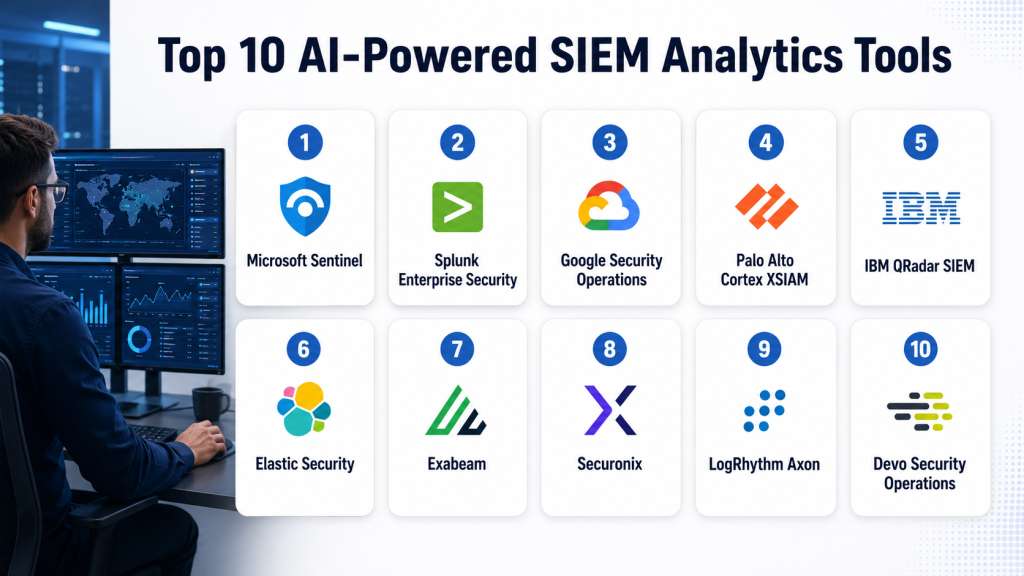
Top 10 AI-Powered SIEM Analytics Tools
1- Microsoft Sentinel
One-line verdict: Best for Microsoft-centric organizations needing cloud-native SIEM with strong security ecosystem integration.
Short description:
Microsoft Sentinel is a cloud-native SIEM and security analytics platform designed to collect, analyze, and respond to security signals across Microsoft and non-Microsoft environments. It is especially useful for organizations using Microsoft Defender, Microsoft Entra, Microsoft cloud services, and hybrid enterprise environments.
Standout Capabilities
- Cloud-native SIEM architecture
- Integrated security analytics
- Built-in automation and orchestration
- Strong identity and cloud visibility
- Threat intelligence integration
- UEBA and anomaly detection support
- Security data lake capabilities
- Deep Microsoft security ecosystem alignment
AI-Specific Depth
- Model support: Microsoft AI ecosystem
- RAG / knowledge integration: Security data and knowledge integration through Microsoft ecosystem
- Evaluation: Analytics, detection tuning, and investigation workflows available
- Guardrails: Enterprise access controls and governance available
- Observability: Security dashboards, incident views, and operational monitoring available
Pros
- Strong fit for Microsoft security environments
- Cloud-native scalability
- Good integration with identity, endpoint, and cloud tools
Cons
- Best value depends on Microsoft ecosystem adoption
- Cost management requires careful data planning
- Advanced use cases may require skilled security engineers
Security & Compliance
Supports enterprise security controls such as RBAC, audit logging, identity integration, encryption, and administrative governance. Compliance features vary by configuration and environment.
Deployment & Platforms
- Cloud deployment
- Web-based security operations console
- Works across cloud and hybrid environments
- Integrates with Microsoft security platforms
Integrations & Ecosystem
Microsoft Sentinel has a large ecosystem for cloud, endpoint, identity, threat intelligence, and workflow automation.
- Microsoft Defender
- Microsoft Entra
- Microsoft cloud services
- Third-party log sources
- Threat intelligence feeds
- Automation playbooks
- APIs and connectors
Pricing Model
Usage-based cloud pricing. Costs depend on data ingestion, storage, retention, and related cloud services.
Best-Fit Scenarios
- Microsoft-focused SOC teams
- Cloud-native security monitoring
- Enterprise SIEM modernization
2- Splunk Enterprise Security
One-line verdict: Best for mature SOC teams needing powerful search, analytics, customization, and detection engineering.
Short description:
Splunk Enterprise Security is a widely used SIEM platform built on Splunk data analytics. It helps security teams ingest large volumes of machine data, correlate events, investigate threats, build detections, and manage security operations across complex environments.
Standout Capabilities
- Powerful search and investigation
- Advanced correlation and detection rules
- Flexible dashboards and reporting
- Threat intelligence enrichment
- Risk-based alerting
- Strong ecosystem of security integrations
- Custom detection engineering support
- Scalable analytics foundation
AI-Specific Depth
- Model support: Varies / N/A
- RAG / knowledge integration: Security data and app ecosystem integration available
- Evaluation: Detection tuning and analytics validation available
- Guardrails: RBAC, workflow controls, and governance available
- Observability: Dashboards, searches, alerts, and operational monitoring available
Pros
- Very flexible analytics and search
- Strong for advanced detection engineering
- Large security ecosystem
Cons
- Can become costly at high data volume
- Requires skilled administrators and analysts
- Query and architecture complexity can be challenging
Security & Compliance
Supports enterprise access controls, audit logging, encryption options, role-based permissions, and compliance reporting workflows. Specific controls depend on deployment and configuration.
Deployment & Platforms
- Cloud deployment
- Self-managed deployment
- Hybrid architecture possible
- Web-based interface
Integrations & Ecosystem
Splunk has a broad ecosystem of apps, add-ons, connectors, and integrations for enterprise security operations.
- Endpoint tools
- Cloud platforms
- Identity systems
- Network security tools
- Threat intelligence feeds
- Ticketing systems
- APIs and custom apps
Pricing Model
Subscription and usage-based models may vary by deployment. Costs depend on data volume, workload, and licensing structure.
Best-Fit Scenarios
- Large SOC environments
- Detection engineering programs
- Complex enterprise log analytics
3- Google Security Operations
One-line verdict: Best for teams needing cloud-scale security analytics, threat intelligence, and fast investigation workflows.
Short description:
Google Security Operations, formerly associated with Chronicle capabilities, provides cloud-scale security analytics for collecting, searching, and analyzing security telemetry. It is useful for organizations needing fast investigation, threat intelligence context, and large-scale detection across enterprise environments.
Standout Capabilities
- Cloud-scale security data analytics
- Fast search across large telemetry volumes
- Threat intelligence enrichment
- Detection engineering support
- Security data normalization
- Investigation timelines
- Cloud and enterprise visibility
- Integration with Google security ecosystem
AI-Specific Depth
- Model support: Google AI ecosystem
- RAG / knowledge integration: Security telemetry and threat intelligence integration available
- Evaluation: Detection testing and investigation workflows available
- Guardrails: Enterprise security and access controls available
- Observability: Dashboards, search, alerts, and investigation views available
Pros
- Strong cloud-scale analytics
- Useful for high-volume security telemetry
- Good threat intelligence alignment
Cons
- Best fit may depend on Google ecosystem strategy
- Advanced configuration requires skilled teams
- Pricing and architecture should be validated carefully
Security & Compliance
Supports enterprise security controls, access management, encryption, logging, and governance through cloud configuration. Specific compliance requirements should be validated during procurement.
Deployment & Platforms
- Cloud deployment
- Web-based security operations interface
- API-based integrations
- Enterprise telemetry ingestion
Integrations & Ecosystem
Google Security Operations connects with security telemetry, cloud systems, threat intelligence, and response workflows.
- Cloud platforms
- Endpoint security data
- Identity logs
- Network telemetry
- Threat intelligence
- APIs
- Security operations tools
Pricing Model
Enterprise and usage-based pricing may vary. Exact pricing depends on deployment scope, data volume, and contract terms.
Best-Fit Scenarios
- High-volume security telemetry analysis
- Cloud-scale threat detection
- Threat intelligence driven investigations
4- Palo Alto Cortex XSIAM
One-line verdict: Best for enterprises consolidating SIEM, XDR, automation, and AI-driven SOC workflows.
Short description:
Palo Alto Cortex XSIAM is positioned as an AI-driven security operations platform that combines security analytics, automation, endpoint and network visibility, incident response, and SOC workflow support. It is designed for organizations seeking to reduce tool fragmentation and accelerate threat response.
Standout Capabilities
- AI-driven SOC analytics
- SIEM and XDR-style visibility
- Security automation and orchestration
- Incident response workflows
- Threat detection and prioritization
- Endpoint and cloud signal correlation
- Case management support
- SOC consolidation approach
AI-Specific Depth
- Model support: Palo Alto AI ecosystem
- RAG / knowledge integration: Security telemetry and platform data integration available
- Evaluation: Varies / N/A
- Guardrails: Enterprise security workflow controls available
- Observability: Incident, alert, and response dashboards available
Pros
- Strong platform consolidation vision
- Good fit for AI-driven SOC modernization
- Useful for response automation and investigation
Cons
- Best value depends on Palo Alto ecosystem adoption
- Migration from legacy SIEM can require planning
- Enterprise deployment may be complex
Security & Compliance
Supports enterprise security operations controls, access management, auditability, and administrative governance. Specific certifications and retention controls should be validated with the vendor.
Deployment & Platforms
- Cloud-based platform
- Web-based SOC console
- Integrated security operations environment
- Enterprise deployment model
Integrations & Ecosystem
Cortex XSIAM integrates with Palo Alto security products and broader enterprise security telemetry.
- Cortex ecosystem
- Endpoint telemetry
- Network security data
- Cloud security signals
- Threat intelligence
- Automation workflows
- APIs
Pricing Model
Enterprise pricing. Exact pricing varies based on deployment scope, data volume, and platform components.
Best-Fit Scenarios
- SOC platform consolidation
- AI-driven incident response
- Large enterprise threat operations
5- IBM QRadar SIEM
One-line verdict: Best for enterprises needing mature SIEM capabilities with strong correlation, compliance, and hybrid support.
Short description:
IBM QRadar SIEM is a mature security information and event management platform used for log collection, event correlation, threat detection, compliance support, and incident investigation. It is widely recognized in enterprise security environments and remains relevant for organizations with complex monitoring needs.
Standout Capabilities
- Event correlation and threat detection
- Log management and normalization
- Compliance reporting support
- Risk-based alerting
- Network and endpoint visibility
- Investigation workflows
- Security analytics dashboards
- Hybrid enterprise support
AI-Specific Depth
- Model support: IBM security and AI ecosystem may vary
- RAG / knowledge integration: Security data and investigation integrations available
- Evaluation: Detection tuning and rule validation available
- Guardrails: RBAC and security governance available
- Observability: Dashboards, offenses, reports, and monitoring available
Pros
- Mature SIEM platform
- Strong compliance and correlation capabilities
- Useful for hybrid enterprise environments
Cons
- Deployment and upgrades can be complex
- User experience may feel heavy for some teams
- Cloud strategy and product roadmap should be reviewed carefully
Security & Compliance
Supports enterprise access controls, encryption options, audit logging, compliance reports, and administrative permissions. Specific capabilities vary by deployment and configuration.
Deployment & Platforms
- Self-managed deployment
- Cloud options may vary by product strategy
- Hybrid enterprise environments
- Web-based console
Integrations & Ecosystem
QRadar integrates with security tools, network devices, endpoint platforms, identity systems, and enterprise data sources.
- Network devices
- Endpoint tools
- Identity platforms
- Threat intelligence feeds
- Compliance reporting workflows
- APIs
- Security apps and extensions
Pricing Model
Enterprise licensing. Exact pricing varies by deployment, data volume, and contract.
Best-Fit Scenarios
- Compliance-heavy enterprises
- Hybrid security monitoring
- Mature SOC operations
6- Elastic Security
One-line verdict: Best for teams wanting flexible, open security analytics with SIEM, search, and AI-assisted investigation.
Short description:
Elastic Security combines SIEM, endpoint security, search, analytics, and detection workflows on the Elastic platform. It is well suited for teams that want flexible security data analytics, strong search performance, open architecture, and customization.
Standout Capabilities
- SIEM and security analytics
- Search-driven investigations
- Machine learning anomaly detection
- Detection rules and alerting
- Endpoint and cloud visibility
- AI-assisted security workflows
- Open ecosystem and flexible data model
- Custom dashboards and visualizations
AI-Specific Depth
- Model support: Elastic AI ecosystem and integrations
- RAG / knowledge integration: Security data and knowledge workflows available
- Evaluation: Detection testing and rule tuning available
- Guardrails: RBAC and workflow controls available
- Observability: Dashboards, alerts, timelines, and investigation views available
Pros
- Flexible and scalable analytics foundation
- Strong search and visualization experience
- Good option for technical teams
Cons
- Requires tuning and operational expertise
- Cost depends on scale and architecture
- Advanced use cases may need engineering support
Security & Compliance
Supports role-based access, encryption options, audit logging, spaces, and administrative controls depending on deployment. Compliance features vary by configuration.
Deployment & Platforms
- Cloud deployment
- Self-managed deployment
- Hybrid support possible
- Web interface and APIs
Integrations & Ecosystem
Elastic Security integrates with logs, metrics, endpoints, cloud platforms, identity systems, and custom data pipelines.
- Elastic integrations
- Cloud platforms
- Endpoint telemetry
- Network logs
- Identity data
- APIs
- Detection content libraries
Pricing Model
Tiered subscription and cloud pricing. Exact costs depend on deployment, data volume, and features.
Best-Fit Scenarios
- Search-heavy security investigations
- Technical SOC teams
- Flexible SIEM and data analytics programs
7- Exabeam
One-line verdict: Best for behavior analytics, insider threat detection, and AI-assisted threat investigation.
Short description:
Exabeam provides SIEM, behavioral analytics, security log management, and threat detection capabilities. It is especially known for UEBA-style analytics that help identify abnormal user and entity behavior across enterprise environments.
Standout Capabilities
- Behavioral analytics and UEBA
- Security log management
- Threat detection and investigation
- Automated attack timelines
- Risk scoring and prioritization
- Insider threat detection
- Compliance reporting support
- AI-assisted security operations
AI-Specific Depth
- Model support: Exabeam AI and analytics ecosystem
- RAG / knowledge integration: Security data and contextual enrichment available
- Evaluation: Detection analytics and investigation review available
- Guardrails: Governance and role-based controls available
- Observability: Dashboards, timelines, alerts, and case views available
Pros
- Strong UEBA capabilities
- Useful for insider threat and compromised account detection
- Good investigation timeline support
Cons
- Requires quality identity and log data
- Advanced analytics need tuning
- Deployment value depends on use case maturity
Security & Compliance
Supports enterprise security controls, user permissions, auditability, and compliance reporting features. Specific certifications and residency options should be validated.
Deployment & Platforms
- Cloud-native options
- Self-hosted options may be available
- Web-based SOC interface
- Enterprise security analytics platform
Integrations & Ecosystem
Exabeam integrates with log sources, identity systems, endpoint platforms, cloud systems, and response workflows.
- Identity platforms
- Endpoint tools
- Cloud logs
- Network devices
- Threat intelligence
- Ticketing systems
- APIs
Pricing Model
Enterprise subscription pricing. Exact pricing varies by data volume, deployment, and feature scope.
Best-Fit Scenarios
- Insider threat detection
- UEBA-driven SOC workflows
- Behavior-based threat investigation
8- Securonix
One-line verdict: Best for cloud-native SIEM analytics, UEBA, and advanced threat detection at enterprise scale.
Short description:
Securonix provides cloud-native SIEM, UEBA, security analytics, and threat detection capabilities. It is suitable for organizations that need scalable analytics, behavior-based detection, compliance reporting, and risk-driven investigation workflows.
Standout Capabilities
- Cloud-native SIEM analytics
- UEBA and behavior analytics
- Threat detection and prioritization
- Insider threat monitoring
- Risk scoring
- Threat intelligence enrichment
- Compliance reporting
- Security data analytics
AI-Specific Depth
- Model support: Securonix analytics and AI ecosystem
- RAG / knowledge integration: Security data enrichment and contextual analytics available
- Evaluation: Detection tuning and analytics review available
- Guardrails: Enterprise governance and RBAC available
- Observability: Dashboards, risk views, and alert monitoring available
Pros
- Strong behavior analytics
- Good for cloud-scale detection
- Useful for insider threat and identity-based risk
Cons
- Requires thoughtful data onboarding
- Advanced tuning may require expertise
- Pricing transparency is limited
Security & Compliance
Supports enterprise access controls, auditability, encryption, governance, and compliance reporting workflows. Specific certifications should be verified during procurement.
Deployment & Platforms
- Cloud-native platform
- Web-based SOC console
- Enterprise analytics environment
- Hybrid data source support
Integrations & Ecosystem
Securonix integrates with enterprise telemetry, identity platforms, cloud systems, endpoint tools, and response workflows.
- Identity systems
- Endpoint security tools
- Cloud platforms
- Network telemetry
- Threat intelligence feeds
- Ticketing tools
- APIs
Pricing Model
Enterprise pricing. Exact pricing varies by data volume, modules, and deployment scope.
Best-Fit Scenarios
- Cloud-native SIEM modernization
- Insider threat analytics
- Large enterprise behavior-based detection
9- LogRhythm Axon
One-line verdict: Best for teams needing streamlined SIEM analytics, threat detection, and security operations workflows.
Short description:
LogRhythm Axon is a cloud-native SIEM platform designed to help security teams detect, investigate, and respond to threats with improved usability and streamlined workflows. It is suitable for organizations seeking modern SIEM capabilities without unnecessary operational complexity.
Standout Capabilities
- Cloud-native SIEM analytics
- Threat detection workflows
- Security data ingestion
- Investigation and alert management
- Dashboard-based visibility
- Compliance reporting support
- Workflow-driven operations
- Analyst-focused experience
AI-Specific Depth
- Model support: Varies / N/A
- RAG / knowledge integration: Security data and contextual enrichment available
- Evaluation: Detection tuning and review workflows available
- Guardrails: RBAC and administrative governance available
- Observability: Dashboards, alerts, and operational views available
Pros
- Streamlined SOC experience
- Good for threat detection and compliance
- Easier operational model than some legacy SIEMs
Cons
- Advanced AI capabilities may vary by module
- Ecosystem depth should be validated
- Best fit depends on log source requirements
Security & Compliance
Supports enterprise-grade access controls, auditability, permissions, and compliance reporting workflows. Specific security details should be confirmed with the vendor.
Deployment & Platforms
- Cloud-native platform
- Web-based interface
- Enterprise security operations environment
- Integration with security data sources
Integrations & Ecosystem
LogRhythm Axon integrates with security tools, log sources, and operational workflows used by SOC teams.
- Endpoint tools
- Network logs
- Cloud telemetry
- Identity sources
- Threat intelligence
- Ticketing systems
- APIs
Pricing Model
Enterprise subscription pricing. Exact pricing varies.
Best-Fit Scenarios
- Modern SIEM replacement
- Mid-market SOC operations
- Compliance and threat detection workflows
10- Devo Security Operations
One-line verdict: Best for high-volume security analytics teams needing scalable data ingestion and real-time investigation.
Short description:
Devo Security Operations provides cloud-native security analytics, SIEM capabilities, data ingestion, threat detection, and investigation workflows. It is useful for organizations with high-volume telemetry and teams that need fast analytics across large datasets.
Standout Capabilities
- Cloud-native security analytics
- High-volume data ingestion
- Real-time search and investigation
- Threat detection workflows
- Security dashboards
- Alert prioritization
- Case and incident support
- Scalable data analytics architecture
AI-Specific Depth
- Model support: Varies / N/A
- RAG / knowledge integration: Security data enrichment available
- Evaluation: Detection analytics and tuning workflows available
- Guardrails: Enterprise access controls available
- Observability: Dashboards, alerts, and analytics visibility available
Pros
- Strong for high-volume security telemetry
- Fast analytics experience
- Useful for data-driven SOC teams
Cons
- Requires data onboarding planning
- Advanced tuning may need skilled analysts
- AI feature depth should be validated by use case
Security & Compliance
Supports enterprise access controls, auditability, data security, and administrative governance. Specific compliance and residency details should be reviewed during procurement.
Deployment & Platforms
- Cloud-native platform
- Web-based analytics console
- Enterprise security operations environment
- API-based integrations
Integrations & Ecosystem
Devo integrates with enterprise security data sources, cloud services, endpoint tools, and operational systems.
- Cloud telemetry
- Endpoint logs
- Network security tools
- Identity systems
- Threat intelligence
- APIs
- Ticketing systems
Pricing Model
Enterprise pricing. Exact pricing varies by data volume, retention, modules, and contract.
Best-Fit Scenarios
- High-volume SOC analytics
- Real-time threat investigation
- Cloud-native SIEM modernization
Comparison Table
| Tool Name | Best For | Deployment | Model Flexibility | Strength | Watch-Out | Public Rating |
|---|---|---|---|---|---|---|
| Microsoft Sentinel | Microsoft-centric SOC teams | Cloud | Microsoft AI ecosystem | Cloud-native SIEM | Cost planning needed | N/A |
| Splunk Enterprise Security | Mature SOC teams | Cloud and self-managed | Varies / N/A | Search and customization | Can be expensive at scale | N/A |
| Google Security Operations | Cloud-scale analytics | Cloud | Google AI ecosystem | Large telemetry search | Requires skilled setup | N/A |
| Palo Alto Cortex XSIAM | SOC consolidation | Cloud | Palo Alto AI ecosystem | AI-driven SOC platform | Ecosystem dependency | N/A |
| IBM QRadar SIEM | Hybrid enterprise SIEM | Cloud and self-managed | Varies / N/A | Correlation and compliance | Complex management | N/A |
| Elastic Security | Flexible analytics teams | Cloud and self-managed | Elastic AI ecosystem | Search and open architecture | Needs tuning expertise | N/A |
| Exabeam | UEBA and insider threat | Cloud and self-hosted options | Exabeam AI ecosystem | Behavior analytics | Data quality dependent | N/A |
| Securonix | Cloud-native UEBA | Cloud | Securonix AI ecosystem | Risk-based analytics | Pricing transparency limited | N/A |
| LogRhythm Axon | Streamlined SIEM workflows | Cloud | Varies / N/A | Analyst usability | Validate AI depth | N/A |
| Devo Security Operations | High-volume analytics | Cloud | Varies / N/A | Real-time data scale | Needs onboarding planning | N/A |
Scoring & Evaluation
The scoring below is comparative, not absolute. It reflects how each platform may support AI-powered SIEM analytics based on detection depth, AI-assisted investigation, guardrails, integrations, usability, cost control, security administration, and support ecosystem. Actual results depend on log quality, architecture, detection engineering maturity, analyst skills, and response workflows. Buyers should use this table as a shortlist guide and validate each platform through a pilot.
| Tool | Core | Reliability | Guardrails | Integrations | Ease | Performance | Security | Support | Weighted Total |
| Microsoft Sentinel | 9 | 8 | 8 | 9 | 8 | 8 | 9 | 8 | 8.4 |
| Splunk Enterprise Security | 10 | 8 | 8 | 10 | 6 | 8 | 9 | 9 | 8.6 |
| Google Security Operations | 9 | 8 | 8 | 8 | 7 | 9 | 8 | 8 | 8.3 |
| Palo Alto Cortex XSIAM | 9 | 8 | 8 | 9 | 7 | 8 | 9 | 8 | 8.3 |
| IBM QRadar SIEM | 8 | 8 | 8 | 8 | 6 | 7 | 9 | 8 | 7.8 |
| Elastic Security | 9 | 8 | 8 | 9 | 7 | 8 | 8 | 8 | 8.2 |
| Exabeam | 8 | 9 | 8 | 8 | 7 | 8 | 8 | 8 | 8.1 |
| Securonix | 8 | 9 | 8 | 8 | 7 | 8 | 8 | 8 | 8.1 |
| LogRhythm Axon | 8 | 7 | 7 | 7 | 8 | 7 | 8 | 8 | 7.5 |
| Devo Security Operations | 8 | 8 | 7 | 8 | 7 | 9 | 8 | 7 | 7.9 |
Top 3 for Enterprise
- Splunk Enterprise Security
- Microsoft Sentinel
- Palo Alto Cortex XSIAM
Top 3 for SMB
- Microsoft Sentinel
- LogRhythm Axon
- Elastic Security
Top 3 for Developers
- Elastic Security
- Splunk Enterprise Security
- Google Security Operations
Which AI-Powered SIEM Analytics Tool Is Right for You
Solo / Freelancer
Solo security consultants usually do not need a full enterprise SIEM unless they manage security monitoring for clients. Lightweight log analysis, endpoint detection, or managed detection services may be more practical. Elastic Security can be attractive for technical users who want hands-on control, while Microsoft Sentinel may work well for consultants serving Microsoft-based clients.
SMB
Small and mid-sized businesses should avoid overbuying a complex SIEM before they have clear detection and response processes. Microsoft Sentinel, LogRhythm Axon, and Elastic Security can be practical choices depending on budget, existing tools, and analyst skill level. SMBs should prioritize ease of deployment, clear dashboards, managed connectors, and predictable costs.
Mid-Market
Mid-market organizations often need a balance of scalability, integrations, detection coverage, and usability. Microsoft Sentinel, Elastic Security, Securonix, Exabeam, and Devo can fit well depending on whether the team needs cloud-native monitoring, behavior analytics, or high-volume data analytics. The key is to choose a SIEM that matches the team’s maturity and response process.
Enterprise
Large enterprises need strong data ingestion, detection engineering, correlation, compliance reporting, case management, automation, and governance. Splunk Enterprise Security, Microsoft Sentinel, Palo Alto Cortex XSIAM, Google Security Operations, and IBM QRadar SIEM are strong options for complex enterprise environments. Enterprises should evaluate architecture, cost control, data retention, and SOC workflow integration before committing.
Regulated Industries
Financial services, healthcare, public sector, energy, and telecom organizations should prioritize auditability, retention controls, access management, compliance reporting, data residency, and incident evidence. IBM QRadar SIEM, Splunk Enterprise Security, Microsoft Sentinel, and Elastic Security can be strong candidates depending on compliance needs and internal expertise.
Budget vs Premium
Budget-focused teams should start with clear log priorities and avoid ingesting everything without purpose. Premium buyers should invest in advanced detection engineering, UEBA, response automation, and long-term data retention. A lower license cost does not always mean a lower total cost if the tool requires heavy engineering or produces too many false positives.
Build vs Buy
Building a SIEM internally can work for highly technical teams with strong data engineering and detection engineering maturity. Buying is better for organizations that need faster deployment, vendor support, built-in content, compliance reporting, and operational reliability. Most teams benefit from buying a SIEM platform and customizing detection logic rather than building everything from scratch.
Implementation Playbook
First 30 Days
- Define the top security use cases such as ransomware, identity compromise, cloud threats, and insider risk
- Identify required log sources across endpoint, identity, cloud, network, and applications
- Create a data ingestion priority list
- Define success metrics such as false positive rate, detection coverage, response time, and alert quality
- Configure basic dashboards and alert routing
- Map roles for SOC analysts, detection engineers, and administrators
- Start with a limited pilot instead of ingesting all logs immediately
- Document baseline investigation workflows
Days 31 to 60
- Tune detection rules and reduce noisy alerts
- Add UEBA or risk scoring where available
- Integrate threat intelligence sources
- Connect ticketing, case management, and response tools
- Build investigation playbooks for common alert types
- Configure RBAC, audit logs, and retention policies
- Validate compliance reporting requirements
- Train analysts on query language, dashboards, and triage process
Days 61 to 90
- Expand log ingestion to more business-critical systems
- Add advanced threat hunting workflows
- Review alert quality and adjust detection logic
- Automate enrichment and repetitive response steps
- Measure mean time to detect and mean time to respond
- Add executive and compliance reporting dashboards
- Create detection lifecycle governance
- Review cost, storage, and performance trends before scaling further
Common Mistakes & How to Avoid Them
- Ingesting every log source without a clear use case
- Ignoring data quality and normalization
- Treating SIEM deployment as only a tool project
- Not tuning detections after deployment
- Failing to define alert ownership
- Allowing too many false positives
- Ignoring cloud and identity logs
- Not integrating SIEM with response workflows
- Underestimating storage and ingestion costs
- Skipping role-based access control
- Not documenting detection logic
- Using default rules without validation
- Ignoring analyst training
- Not measuring detection and response performance
FAQs
1- What is AI-Powered SIEM Analytics
AI-Powered SIEM Analytics uses artificial intelligence, machine learning, behavior analytics, and automation to detect, prioritize, and investigate security threats across enterprise systems. It helps SOC teams move beyond rule-based alerting.
2- How is AI-powered SIEM different from traditional SIEM
Traditional SIEM focuses mainly on log collection, correlation, and compliance reporting. AI-powered SIEM adds anomaly detection, UEBA, risk scoring, automated enrichment, and AI-assisted investigation.
3- What is UEBA in SIEM
UEBA means user and entity behavior analytics. It helps detect unusual behavior from users, devices, accounts, and systems, such as impossible travel, abnormal access, or suspicious privilege use.
4- Can AI reduce false positives in SIEM
Yes, AI can help reduce false positives by correlating signals, learning behavior patterns, prioritizing risk, and enriching alerts. However, tuning and human review are still required.
5- Does AI-powered SIEM replace SOC analysts
No. AI helps analysts investigate faster, prioritize alerts, and automate repetitive work. Human analysts are still needed for judgment, threat hunting, response decisions, and business context.
6- What data sources should a SIEM collect first
Most teams should start with identity logs, endpoint telemetry, cloud activity, firewall logs, DNS data, authentication events, and critical application logs. The exact priority depends on risk and business environment.
7- Is cloud SIEM better than on-prem SIEM
Cloud SIEM is often easier to scale and manage, while on-prem or self-managed SIEM may offer more control. The best choice depends on compliance, data residency, team skills, and architecture.
8- Why is SIEM cost control important
SIEM costs can grow quickly when organizations ingest too much low-value data. Teams should prioritize high-value telemetry, manage retention carefully, and monitor storage and query costs.
9- What is SOAR in SIEM workflows
SOAR means security orchestration, automation, and response. It automates investigation steps, enrichment, notifications, ticket creation, and response actions connected to SIEM alerts.
10- How should buyers evaluate AI detection quality
Buyers should test detections using real logs, simulated attacks, red team exercises, historical incidents, and false positive analysis. Vendor claims should be validated through a pilot.
11- What is the biggest SIEM implementation mistake
The biggest mistake is deploying the SIEM without clear use cases, data priorities, ownership, and tuning processes. A SIEM needs operational discipline, not just technology.
12- Which SIEM is best for regulated industries
There is no universal winner. Regulated organizations should prioritize audit logs, retention controls, compliance reporting, RBAC, data residency, and investigation evidence when choosing a SIEM.
Conclusion
AI-Powered SIEM Analytics tools are becoming essential for modern security operations because they help teams detect threats faster, reduce alert fatigue, improve investigation quality, and manage security visibility across complex environments. The best platform depends on existing infrastructure, cloud strategy, analyst skill level, compliance requirements, data volume, and automation maturity.Microsoft Sentinel is strong for Microsoft-centric environments, Splunk Enterprise Security is powerful for advanced analytics and customization, Google Security Operations is suited for cloud-scale telemetry, Cortex XSIAM supports AI-driven SOC consolidation, and Elastic Security is attractive for flexible search-driven teams. Exabeam and Securonix stand out for behavior analytics, while IBM QRadar SIEM, LogRhythm Axon, and Devo support different enterprise and mid-market needs.The right next step is to shortlist tools based on your top detection use cases, run a focused pilot with real logs, validate cost and alert quality, confirm compliance controls, and then scale gradually. A successful SIEM program depends on people, process, data quality, and governance as much as the platform itself.

Find Trusted Cardiac Hospitals
Compare heart hospitals by city and services — all in one place.
Explore Hospitals
A missing but critical angle in AI-powered SIEM analytics is how these tools handle signal-to-noise scaling in real high-volume, multi-cloud environments where log ingestion can reach billions of events per day. In practice, detection quality is less of an issue than query performance, cost of retention, and tuning overhead, especially when AI-driven correlation starts generating secondary alerts that increase analyst fatigue instead of reducing it. Another gap is the lack of strong focus on analyst-in-the-loop learning systems, where feedback from investigations continuously improves correlation rules and reduces false positives over time. It would also be useful to assess how well these SIEMs integrate with upstream DevSecOps pipelines and downstream SOAR systems, since without tight integration, “AI analytics” often remains siloed rather than operationally actionable.