
MYHOSPITALNOW.COM

Find Trusted Doctors & Hospitals

Discover healthcare providers, compare hospitals, and explore treatment options worldwide.

Free Treatment Quotes • Doctor Search • Hospital Comparison

Find Healthcare Options

www.myhospitalnow.com

Workflow of Knative eventing

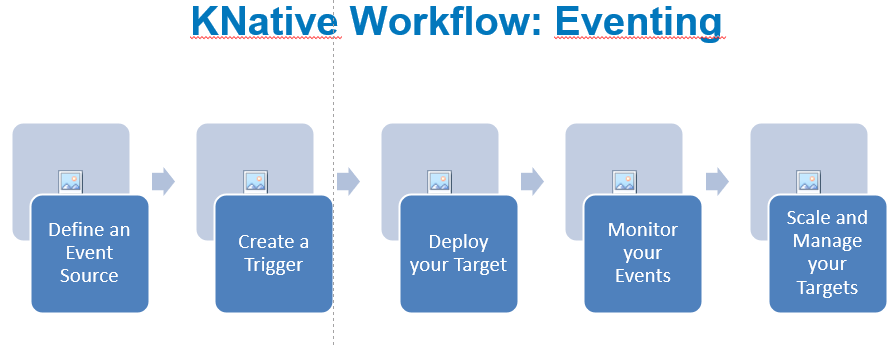
Knative Eventing workflow: define event source, create trigger, deploy target, monitor events, scale targets

Here is a step-by-step workflow for Knative Eventing:

  1. Define an Event Source: The first step in using Knative Eventing is to define an Event Source. An Event Source is a component that emits events, such as a Kubernetes resource or an external system like GitHub or Cloud Pub/Sub. You can define an Event Source using a YAML configuration file that specifies the type of source and its configuration.
  2. Create a Trigger: Once you have defined an Event Source, you need to create a Trigger that defines how to route events from the source to your target. A Trigger is defined using a YAML configuration file that specifies the filter criteria for matching events and the target that should receive the events.
  3. Deploy your Target: Next, you need to deploy your target, which is the component that will receive and process the events. A target can be any containerized application, such as a microservice, a function, or a streaming data pipeline. You can deploy your target using Knative Serving or any other Kubernetes deployment mechanism.
  4. Monitor your Events: Knative Eventing provides a set of tools for monitoring and troubleshooting your event flows. You can use the kubectl command-line tool to list and view events, as well as view detailed logs and metrics for your Event Sources, Triggers, and Targets.
  5. Scale and Manage your Targets: Knative Eventing provides built-in support for scaling and managing your event-driven applications. You can use Knative Serving to scale your targets automatically based on incoming event traffic, and use advanced traffic management features like canary releases and A/B testing to manage your application at scale.

Overall, the workflow for Knative Eventing involves defining an Event Source, creating a Trigger to route events to your target, deploying your target, monitoring and troubleshooting your event flows, and using advanced scaling and traffic management features to manage your application at scale.

Find Trusted Cardiac Hospitals

Compare heart hospitals by city and services — all in one place.

Explore Hospitals
I'm Rajesh Kumar, a DevOps, SRE, DevSecOps, Cloud, and Platform Engineering expert passionate about sharing practical knowledge, real-world experiences, and industry best practices. I have worked at Cotocus and regularly write about technology, travel, investing, health, product reviews, and digital marketing through my various platforms. I publish technical articles at DevOps School, travel stories at Holiday Landmark, stock market insights at Stocks Mantra, health and fitness guidance at My Medic Plus, product reviews at TrueReviewNow, and SEO and digital marketing strategies at Wizbrand.

Related Posts

Wiring Image Generation Into a CI/CD-Era Product Stack: What Platform Teams Actually Have to Solve

Image generation arrived in most engineering backlogs the same way object storage once did — as somebody else’s feature request that turned out to be an infrastructure…

Read More

Ruby on Rails vs Node.js: Performance, Speed, and Scalability Compared

Choosing between Ruby on Rails and Node.js is a common decision when building modern web applications. Both frameworks power large-scale products, but they approach performance, concurrency, and…

Read More

Senior Integration Consultant: Role Blueprint, Responsibilities, Skills, KPIs, and Career Path

The **Senior Integration Consultant** designs, delivers, and governs enterprise-grade integrations that connect business applications, data platforms, and external partner systems reliably and securely. The role blends hands-on technical execution (APIs, middleware, messaging, data mapping, automation) with consulting responsibilities (discovery, requirements translation, stakeholder alignment, delivery leadership) to ensure integrations meet business outcomes and operational standards.

Read More

Principal Integration Consultant: Role Blueprint, Responsibilities, Skills, KPIs, and Career Path

The **Principal Integration Consultant** is a senior, hands-on consulting and delivery leader responsible for designing, governing, and enabling enterprise-grade integrations across applications, data platforms, and business processes. This role translates business outcomes into integration strategies and reference architectures, then drives delivery through technical leadership, stakeholder alignment, and quality governance.

Read More

Integration Consultant: Role Blueprint, Responsibilities, Skills, KPIs, and Career Path

The **Integration Consultant** designs, builds, and stabilizes integrations between enterprise applications, SaaS platforms, data sources, and customer/partner systems using modern API- and event-driven integration patterns. The role translates business and technical requirements into reliable integration solutions, ensuring data quality, security, observability, and operational readiness from day one.

Read More

Senior Integration Architect: Role Blueprint, Responsibilities, Skills, KPIs, and Career Path

The **Senior Integration Architect** designs, governs, and continuously improves the integration landscape that connects applications, data, and external partners across the enterprise. This role ensures integration solutions are secure, scalable, maintainable, and aligned to business capabilities—enabling product teams to deliver features faster without creating brittle point-to-point dependencies.

Read More
Subscribe
Notify of
guest
0 Comments
Newest
Oldest Most Voted
0
Would love your thoughts, please comment.x
()
x