
Introduction
Emergency response systems are the backbone of public safety infrastructure, handling millions of calls related to medical emergencies, fire incidents, accidents, crime reporting, and disaster situations. However, traditional emergency call centers often face challenges such as high call volumes, limited dispatcher capacity, stress-induced human errors, language barriers, and delays in prioritizing critical cases. AI Emergency Call Triage Assistants are transforming this landscape by using artificial intelligence, natural language processing, speech-to-text, and predictive analytics to analyze incoming emergency calls, classify severity, and assist dispatchers in making faster and more accurate decisions.
Modern AI triage systems do not replace human emergency operators; instead, they act as intelligent assistants that listen, transcribe, interpret, and prioritize calls in real time. These systems can detect urgency levels, identify keywords related to life-threatening conditions, extract key information such as location and incident type, and recommend appropriate response actions. Some platforms also support multilingual understanding, emotion detection, and integration with Computer-Aided Dispatch (CAD) systems to streamline emergency workflows.
As emergency response systems evolve into AI-augmented command centers, triage assistants are becoming critical for improving response times, reducing dispatcher overload, and ensuring that the most urgent cases receive immediate attention.
Common use cases include:
- Medical emergency triage
- Fire and rescue call prioritization
- Crime reporting classification
- Disaster response coordination
- Suicide and mental health crisis detection
- Traffic accident response prioritization
- Multi-language emergency interpretation
- Non-emergency call filtering
When evaluating AI Emergency Call Triage Assistants, organizations should consider:
- Speech recognition accuracy
- Real-time call analysis speed
- Emergency severity classification
- Multilingual support
- Integration with CAD systems
- NLP and intent detection quality
- Emotion and distress detection
- Human-in-the-loop workflows
- Data privacy and compliance
- Scalability under high call volumes
- Auditability and logging
- API and system integration capabilities
Best for: Emergency dispatch centers (911/112/100 systems), police control rooms, fire departments, ambulance services, disaster management authorities, smart city command centers, and national public safety agencies.
Not ideal for: Small organizations without emergency response infrastructure, low-call-volume environments, or systems that do not require real-time classification and dispatch prioritization.
What’s Changed in AI Emergency Call Triage Assistants
AI-powered emergency call systems have evolved from basic transcription tools into intelligent real-time decision support systems.
Key trends include:
- Real-time speech-to-text with near-zero latency for emergency calls.
- AI-based urgency scoring for faster dispatch prioritization.
- Emotion detection to identify panic, distress, or aggression.
- Multilingual and accent-adaptive speech recognition.
- Integration with CAD (Computer-Aided Dispatch) systems.
- AI-assisted location extraction from spoken conversations.
- Predictive analytics for incident severity estimation.
- Agentic AI supporting dispatch decision recommendations.
- Automated call categorization (medical, fire, police, etc.).
- Noise filtering for chaotic emergency environments.
- AI summarization of live calls for responders.
- Continuous learning from historical emergency response data.
Quick Buyer Checklist
Before selecting an AI Emergency Call Triage Assistant, ensure it includes:
- ✔ Real-time speech-to-text processing
- ✔ Emergency severity classification
- ✔ NLP-based intent detection
- ✔ Multilingual support
- ✔ CAD system integration
- ✔ Emotion and distress detection
- ✔ Human-in-the-loop escalation
- ✔ Low-latency processing
- ✔ Call transcription and summarization
- ✔ Secure data handling and encryption
- ✔ Audit logs for compliance
- ✔ Scalable architecture for peak call loads
- ✔ API-based integration support
- ✔ Explainable AI decision support
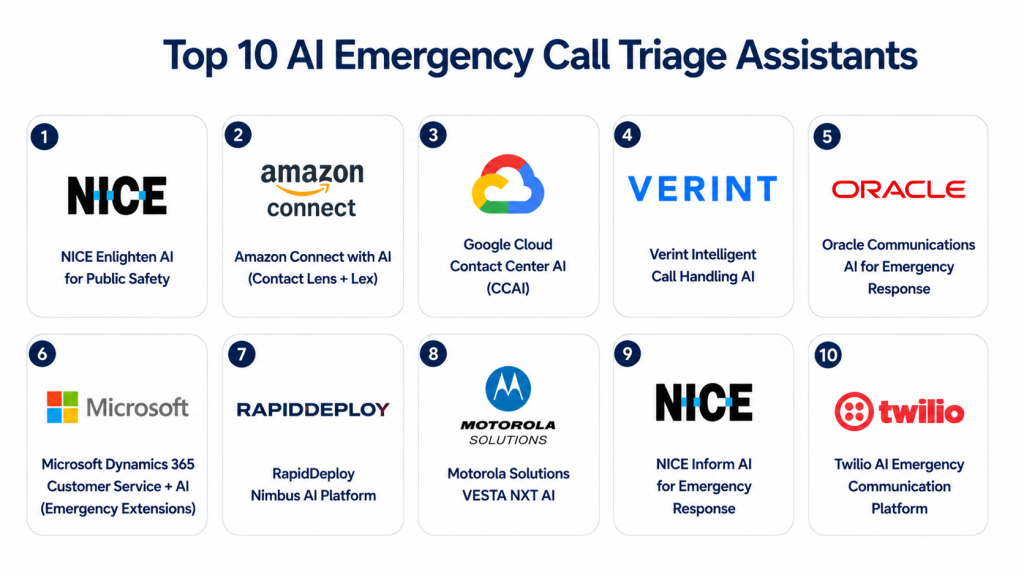
Top 10 AI Emergency Call Triage Assistants
1 — NICE Enlighten AI for Public Safety
One-line verdict: Best for enterprise emergency response centers requiring AI-powered call analysis and dispatch optimization.
Short description
NICE Enlighten AI enhances emergency call centers by analyzing voice interactions in real time, detecting urgency, extracting key details, and supporting dispatchers with AI-driven recommendations for faster response decisions.
Standout Capabilities
- Real-time call transcription
- AI urgency scoring
- Emotion detection
- Call summarization
- Dispatch prioritization
- Incident classification
- Multilingual support
- Workflow automation
AI-Specific Depth
- Model support: Proprietary conversational AI models
- RAG / Knowledge integration: Emergency response knowledge bases
- Evaluation: Continuous call accuracy validation and feedback loops
- Guardrails: Compliance controls, human-in-the-loop decisioning
- Observability: Call analytics dashboards, performance metrics, latency tracking
Pros
- Strong public safety AI focus
- Excellent real-time analytics
- Proven enterprise scalability
Cons
- Enterprise implementation complexity
- Requires integration with existing CAD systems
- Premium pricing
Security & Compliance
- SSO/SAML: Supported
- RBAC: Supported
- Audit logs: Supported
- Encryption: Supported
- Certifications: Not publicly stated
Deployment & Platforms
- Cloud
- Hybrid
- Contact center integrations
Integrations & Ecosystem
- Computer-Aided Dispatch (CAD) systems
- Emergency call center platforms
- CRM and case management tools
- Voice communication systems
- Public safety dashboards
Pricing Model
Enterprise subscription.
Best-Fit Scenarios
- National emergency call centers
- Police dispatch optimization
- Smart city emergency response systems
2 — Amazon Connect with AI (Contact Lens + Lex)
One-line verdict: Best for cloud-native emergency call centers requiring scalable AI triage and transcription.
Short description
Amazon Connect combined with Amazon Lex and Contact Lens provides AI-powered call analysis, real-time transcription, sentiment detection, and intelligent routing for emergency and public safety call centers.
Standout Capabilities
- Real-time call transcription
- AI speech understanding
- Sentiment and emotion detection
- Intelligent call routing
- Voice bot triage
- Multilingual support
- Call analytics
- Workflow automation
AI-Specific Depth
- Model support: AWS AI/ML models (Lex, Transcribe, Comprehend)
- RAG / Knowledge integration: AWS knowledge bases and Lambda workflows
- Evaluation: Call quality scoring and model monitoring
- Guardrails: AWS compliance controls and IAM policies
- Observability: CloudWatch dashboards, call analytics
Pros
- Highly scalable cloud infrastructure
- Strong AI service integration
- Flexible deployment model
Cons
- Requires AWS ecosystem expertise
- Needs configuration for emergency-specific workflows
- Not purpose-built exclusively for public safety
Security & Compliance
- SSO/SAML: Supported via AWS IAM
- RBAC: Supported
- Audit logs: Supported
- Encryption: Supported
- Certifications: AWS compliance standards (varies by region)
Deployment & Platforms
- Cloud-native
- Web-based dashboards
- API-driven architecture
Integrations & Ecosystem
- AWS services (Lambda, S3, Lex, Transcribe)
- CAD systems via APIs
- CRM platforms
- Emergency communication systems
- Analytics tools
Pricing Model
Usage-based cloud pricing.
Best-Fit Scenarios
- Cloud emergency call centers
- Scalable triage automation
- Multi-region dispatch systems
3 — Google Cloud Contact Center AI (CCAI)
One-line verdict: Best for AI-powered conversational triage with strong NLP and multilingual understanding.
Short description
Google CCAI leverages advanced natural language understanding and speech recognition to analyze emergency calls, detect intent, prioritize incidents, and assist dispatchers with real-time recommendations.
Standout Capabilities
- Advanced speech-to-text
- Natural language understanding
- Intent detection
- Real-time transcription
- Multilingual support
- Call summarization
- AI-powered routing
- Analytics dashboards
AI-Specific Depth
- Model support: Google NLP + Gemini-based AI services
- RAG / Knowledge integration: Vertex AI Search and knowledge bases
- Evaluation: Continuous model evaluation and tuning tools
- Guardrails: Google AI safety and governance controls
- Observability: Cloud monitoring dashboards and call analytics
Pros
- Strong NLP accuracy
- Excellent multilingual support
- Highly scalable infrastructure
Cons
- Requires Google Cloud expertise
- Configuration complexity for emergency workflows
- Not fully out-of-the-box for public safety
Security & Compliance
- SSO/SAML: Supported via Google Cloud IAM
- RBAC: Supported
- Audit logs: Supported
- Encryption: Supported
- Certifications: Google Cloud compliance standards
Deployment & Platforms
- Cloud-native
- API-first architecture
- Contact center integrations
Integrations & Ecosystem
- Google Cloud services (Vertex AI, Speech-to-Text)
- CAD systems via APIs
- CRM platforms
- Communication systems
- Analytics tools
Pricing Model
Usage-based cloud pricing.
Best-Fit Scenarios
- Multilingual emergency call centers
- AI-assisted dispatch systems
- Large-scale public safety operations
4 — Verint Intelligent Call Handling AI
One-line verdict: Best for enterprise-grade emergency call analytics and workforce optimization in dispatch centers.
Short description
Verint provides AI-driven call analysis, workforce optimization, and intelligent triage capabilities that help emergency response centers improve call handling efficiency and prioritize critical incidents.
Standout Capabilities
- AI call transcription
- Sentiment analysis
- Call categorization
- Workforce optimization
- Incident prioritization
- Speech analytics
- Real-time dashboards
- Compliance tracking
AI-Specific Depth
- Model support: Proprietary speech and analytics AI models
- RAG / Knowledge integration: Contact center knowledge systems
- Evaluation: Quality assurance scoring and feedback loops
- Guardrails: Compliance frameworks and audit controls
- Observability: Call analytics dashboards and operational KPIs
Pros
- Strong contact center optimization tools
- Mature analytics capabilities
- Good enterprise integration support
Cons
- Less specialized for emergency-only workflows
- Complex deployment
- Enterprise-focused pricing
Security & Compliance
- SSO/SAML: Supported
- RBAC: Supported
- Audit logs: Supported
- Encryption: Supported
- Certifications: Not publicly stated
Deployment & Platforms
- Cloud
- Hybrid
- Enterprise contact center platforms
Integrations & Ecosystem
- CAD systems
- CRM platforms
- Contact center infrastructure
- Workforce management systems
- Analytics platforms
Pricing Model
Enterprise subscription.
Best-Fit Scenarios
- Large dispatch centers
- Emergency call optimization
- Workforce management in public safety
5 — Oracle Communications AI for Emergency Response
One-line verdict: Best for government-grade emergency communication systems integrated with Oracle infrastructure.
Short description
Oracle provides AI-enhanced communication and analytics tools that help emergency call centers classify incidents, route calls, and improve dispatch efficiency through intelligent automation.
Standout Capabilities
- AI call classification
- Emergency routing optimization
- Real-time analytics
- Incident detection
- Communication orchestration
- Call transcription
- Workflow automation
- Dashboard reporting
AI-Specific Depth
- Model support: Oracle AI services and analytics models
- RAG / Knowledge integration: Oracle enterprise knowledge systems
- Evaluation: Call validation and performance tracking
- Guardrails: Governance and compliance frameworks
- Observability: Communication analytics dashboards
Pros
- Strong enterprise communication integration
- Reliable scalability
- Good governance and compliance features
Cons
- Oracle ecosystem dependency
- Complex implementation
- Not standalone emergency-focused AI
Security & Compliance
- SSO/SAML: Supported
- RBAC: Supported
- Audit logs: Supported
- Encryption: Supported
- Certifications: Not publicly stated
Deployment & Platforms
- Cloud
- Hybrid
- Oracle enterprise systems
Integrations & Ecosystem
- Oracle cloud services
- CAD systems
- Emergency communication networks
- CRM and case management tools
- Government platforms
Pricing Model
Enterprise licensing
Best-Fit Scenarios
- Government emergency systems
- Integrated communication platforms
- Large-scale dispatch modernization
6 — Microsoft Dynamics 365 Customer Service + AI (Emergency Extensions)
One-line verdict: Best for organizations already using Microsoft ecosystem for integrated emergency case handling and AI triage.
Short description
Microsoft Dynamics 365 Customer Service, combined with Azure AI services, enables emergency call centers to triage incoming calls, classify incidents, and route cases using AI-driven insights, speech intelligence, and workflow automation.
Standout Capabilities
- AI-powered call transcription
- Incident classification and routing
- Real-time case creation
- Multilingual support
- Sentiment detection
- Workflow automation
- Knowledge base integration
- Dashboard analytics
AI-Specific Depth
- Model support: Azure OpenAI + Microsoft AI services
- RAG / Knowledge integration: Microsoft Dataverse + knowledge bases
- Evaluation: Continuous model tuning and feedback loops
- Guardrails: Responsible AI policies, compliance controls
- Observability: Power BI dashboards, Azure monitoring logs
Pros
- Strong Microsoft ecosystem integration
- Highly customizable workflows
- Good enterprise scalability
Cons
- Requires configuration for emergency use cases
- Not purpose-built for 911-style systems
- Dependency on Microsoft stack
Security & Compliance
- SSO/SAML: Supported
- RBAC: Supported
- Audit logs: Supported
- Encryption: Supported
- Certifications: Not publicly stated
Deployment & Platforms
- Cloud (Azure)
- Hybrid
- Web-based dashboards
Integrations & Ecosystem
- Azure AI services
- CAD systems via APIs
- CRM and ERP systems
- Power Platform automation
- Government case systems
Pricing Model
Subscription-based (enterprise licensing)
Best-Fit Scenarios
- Government digital service centers
- Integrated emergency case workflows
- Microsoft-based public safety systems
7 — RapidDeploy Nimbus AI Platform
One-line verdict: Best for next-generation cloud-native emergency call handling and dispatch intelligence.
Short description
RapidDeploy Nimbus is a cloud-native public safety platform that enhances emergency call triage using real-time mapping, AI-assisted dispatch, and situational awareness tools for first responders.
Standout Capabilities
- Real-time emergency mapping
- AI-assisted dispatch recommendations
- Call triage automation
- Location intelligence
- Incident visualization
- Multi-agency coordination
- Mobile-first dashboards
- Live situational awareness
AI-Specific Depth
- Model support: Proprietary AI dispatch models
- RAG / Knowledge integration: GIS and emergency data layers
- Evaluation: Dispatch performance analytics
- Guardrails: Role-based access and dispatch protocols
- Observability: Real-time incident dashboards and tracking
Pros
- Strong real-time situational awareness
- Excellent dispatch optimization
- Cloud-native scalability
Cons
- Focused mainly on dispatch, not full call center AI
- Requires integration with telephony systems
- Premium enterprise pricing
Security & Compliance
- SSO/SAML: Supported
- RBAC: Supported
- Audit logs: Supported
- Encryption: Supported
- Certifications: Not publicly stated
Deployment & Platforms
- Cloud-native
- Mobile + Web dashboards
- API-based integrations
Integrations & Ecosystem
- CAD systems
- GIS mapping platforms
- Emergency call systems
- First responder mobile apps
- Public safety databases
Pricing Model
Enterprise subscription
Best-Fit Scenarios
- Emergency dispatch modernization
- Smart city emergency coordination
- Real-time incident response systems
8 — Motorola Solutions VESTA NXT AI
One-line verdict: Best for mission-critical 911 call centers requiring ultra-reliable AI-assisted triage.
Short description
Motorola Solutions VESTA NXT integrates AI-assisted call handling with emergency dispatch systems, enabling faster triage, better call classification, and improved response coordination in 911 environments.
Standout Capabilities
- AI-assisted emergency call handling
- Real-time call classification
- Location detection support
- Multilingual call support
- Incident prioritization
- Integrated dispatch workflows
- Emergency routing
- Call recording and analysis
AI-Specific Depth
- Model support: Proprietary emergency response AI models
- RAG / Knowledge integration: Public safety databases
- Evaluation: Call quality assurance workflows
- Guardrails: Strict compliance and safety protocols
- Observability: Emergency call analytics dashboards
Pros
- Designed specifically for 911 systems
- Extremely reliable for mission-critical use
- Strong dispatch integration
Cons
- Limited flexibility outside public safety
- Hardware/system dependency
- High enterprise cost
Security & Compliance
- SSO/SAML: Supported
- RBAC: Supported
- Audit logs: Supported
- Encryption: Supported
- Certifications: Not publicly stated
Deployment & Platforms
- On-premises
- Hybrid
- Mission-critical infrastructure
Integrations & Ecosystem
- CAD systems
- Emergency dispatch systems
- Law enforcement databases
- Fire and rescue systems
- Public safety networks
Pricing Model
Enterprise + infrastructure licensing
Best-Fit Scenarios
- 911 emergency call centers
- National emergency dispatch systems
- High-reliability public safety environments
9 — NICE Inform AI for Emergency Response
One-line verdict: Best for AI-powered call recording, triage analytics, and public safety intelligence.
Short description
NICE Inform uses AI to analyze emergency calls, identify critical incidents, improve call handling efficiency, and provide post-event intelligence for emergency response agencies.
Standout Capabilities
- AI call transcription
- Incident classification
- Emergency call analytics
- Real-time monitoring
- Post-event analysis
- Multimedia evidence linking
- Call prioritization
- Compliance reporting
AI-Specific Depth
- Model support: NICE AI analytics models
- RAG / Knowledge integration: Public safety knowledge systems
- Evaluation: Continuous call analytics and validation
- Guardrails: Compliance frameworks and audit controls
- Observability: Emergency analytics dashboards and reports
Pros
- Strong post-call intelligence
- Good compliance and audit capabilities
- Reliable enterprise analytics
Cons
- Not purely real-time dispatch focused
- Complex deployment
- Enterprise pricing model
Security & Compliance
- SSO/SAML: Supported
- RBAC: Supported
- Audit logs: Supported
- Encryption: Supported
- Certifications: Not publicly stated
Deployment & Platforms
- Cloud
- Hybrid
- Enterprise systems
Integrations & Ecosystem
- CAD systems
- Emergency call recording systems
- Public safety analytics platforms
- CRM and case systems
- Law enforcement databases
Pricing Model
Enterprise subscription
Best-Fit Scenarios
- Emergency call analytics
- Post-incident investigation
- Public safety intelligence
10 — Twilio AI Emergency Communication Platform
One-line verdict: Best for programmable AI-powered emergency call routing and communication automation.
Short description
Twilio enables organizations to build AI-powered emergency communication and triage systems using programmable voice, SMS, and conversational AI integrated with NLP models and routing logic.
Standout Capabilities
- Programmable voice AI
- Emergency call routing
- Speech-to-text processing
- SMS-based triage support
- Conversational AI bots
- Real-time communication APIs
- Workflow automation
- Multi-channel communication
AI-Specific Depth
- Model support: Twilio AI + external LLM integrations
- RAG / Knowledge integration: API-based knowledge systems
- Evaluation: Call flow analytics and performance tracking
- Guardrails: API security policies and rate limiting
- Observability: Communication logs, analytics dashboards
Pros
- Highly flexible and programmable
- Strong API ecosystem
- Easy integration with custom workflows
Cons
- Requires developer expertise
- Not a turnkey emergency system
- Needs significant customization
Security & Compliance
- SSO/SAML: Supported
- RBAC: Supported
- Audit logs: Supported
- Encryption: Supported
- Certifications: Not publicly stated
Deployment & Platforms
- Cloud
- API-first architecture
- Multi-channel communication
Integrations & Ecosystem
- CAD systems via APIs
- CRM platforms
- Emergency communication systems
- AI/ML platforms
- Third-party LLMs
Pricing Model
Usage-based API pricing
Best-Fit Scenarios
- Custom emergency triage systems
- AI-powered call routing automation
- Developer-built public safety solutions
Comparison Table
| Tool Name | Best For | Deployment | AI Model Type | Strength | Watch-Out | Public Rating |
|---|---|---|---|---|---|---|
| NICE Enlighten AI | Enterprise emergency centers | Cloud / Hybrid | Proprietary AI | Call intelligence | Integration complexity | N/A |
| Amazon Connect | Cloud call centers | Cloud | AWS AI models | Scalability | AWS dependency | N/A |
| Google CCAI | Multilingual triage | Cloud | NLP + Gemini AI | Language accuracy | Setup complexity | N/A |
| Verint | Contact center optimization | Cloud / Hybrid | Speech AI | Workforce optimization | Not emergency-specific | N/A |
| Oracle Communications AI | Government systems | Cloud / Hybrid | Oracle AI | Enterprise integration | Oracle dependency | N/A |
| Microsoft Dynamics 365 | Microsoft ecosystems | Cloud | Azure AI | Workflow customization | Setup required | N/A |
| RapidDeploy Nimbus | Dispatch intelligence | Cloud | AI dispatch models | Real-time mapping | Limited call focus | N/A |
| Motorola VESTA NXT | 911 systems | On-prem / Hybrid | Emergency AI | Mission-critical reliability | Limited flexibility | N/A |
| NICE Inform | Call intelligence | Cloud / Hybrid | Analytics AI | Post-event analysis | Not real-time focused | N/A |
| Twilio AI Platform | Custom systems | Cloud API | Programmable AI | Flexibility | Developer-heavy | N/A |
Scoring & Evaluation (Transparent Rubric)
These scores evaluate AI Emergency Call Triage Assistants based on real-time performance, call understanding accuracy, integration capability, scalability, governance, and reliability in mission-critical environments. Scores are comparative and should be validated through live emergency simulation testing before production deployment.
| Tool | Core | Reliability / Eval | Guardrails | Integrations | Ease | Perf / Cost | Security / Admin | Support | Weighted Total |
|---|---|---|---|---|---|---|---|---|---|
| Motorola VESTA NXT | 9.8 | 9.8 | 9.7 | 9.6 | 8.7 | 9.0 | 9.8 | 9.6 | 9.55 |
| NICE Enlighten AI | 9.7 | 9.6 | 9.5 | 9.5 | 8.8 | 9.1 | 9.6 | 9.5 | 9.45 |
| Amazon Connect | 9.5 | 9.4 | 9.4 | 9.6 | 9.2 | 9.3 | 9.4 | 9.3 | 9.39 |
| Google CCAI | 9.6 | 9.5 | 9.4 | 9.5 | 9.0 | 9.2 | 9.5 | 9.4 | 9.38 |
| RapidDeploy Nimbus | 9.4 | 9.3 | 9.3 | 9.4 | 9.1 | 9.2 | 9.3 | 9.2 | 9.25 |
| Verint | 9.3 | 9.2 | 9.2 | 9.4 | 8.9 | 9.0 | 9.4 | 9.3 | 9.19 |
| NICE Inform | 9.2 | 9.2 | 9.3 | 9.3 | 8.8 | 9.0 | 9.3 | 9.2 | 9.17 |
| Oracle Communications AI | 9.2 | 9.1 | 9.2 | 9.3 | 8.7 | 8.9 | 9.4 | 9.2 | 9.12 |
| Microsoft Dynamics 365 AI | 9.1 | 9.0 | 9.2 | 9.4 | 9.0 | 9.1 | 9.3 | 9.2 | 9.10 |
| Twilio AI Platform | 9.0 | 8.9 | 9.0 | 9.5 | 9.4 | 9.3 | 9.1 | 9.0 | 9.08 |
Top 3 for National Emergency Systems
- Motorola VESTA NXT
- NICE Enlighten AI
- Google CCAI
Top 3 for Cloud-Based Emergency Centers
- Amazon Connect
- Google CCAI
- Twilio AI Platform
Top 3 for Smart City Emergency Response
- RapidDeploy Nimbus
- NICE Enlighten AI
- Microsoft Dynamics 365 AI
Which AI Emergency Call Triage Assistant Is Right for You?
Selecting the right AI Emergency Call Triage Assistant depends on the size of your emergency communication center, expected call volume, response protocols, existing Computer-Aided Dispatch (CAD) infrastructure, regulatory requirements, and long-term digital transformation strategy. While every platform aims to improve emergency response, the most effective solutions combine real-time speech recognition, natural language understanding, intelligent prioritization, multilingual communication, and seamless dispatcher collaboration.
Organizations should evaluate not only transcription accuracy but also latency, reliability, explainability, integration capabilities, operational resilience, and security. Since emergency response directly affects human lives, AI should augment trained dispatchers rather than replace human decision-making.
Small Emergency Communication Centers
Local municipalities and smaller public safety organizations often require AI-assisted call handling without the complexity of large enterprise deployments.
Key priorities include:
- Fast deployment
- Cloud-based operation
- Accurate speech recognition
- Basic incident classification
- Affordable scalability
- Easy administration
Recommended tools
- Amazon Connect with AI
- Twilio AI Emergency Communication Platform
- Microsoft Dynamics 365 Customer Service + AI
These platforms provide flexible AI capabilities while minimizing infrastructure requirements.
Mid-Sized Public Safety Agencies
Regional dispatch centers require intelligent routing, real-time transcription, and AI-assisted prioritization while maintaining efficient operator workflows.
Important evaluation criteria include:
- Real-time transcription
- AI urgency scoring
- Multilingual support
- CAD integration
- Workflow automation
- Performance dashboards
- Human escalation
Recommended tools
- Google Cloud Contact Center AI
- NICE Enlighten AI
- RapidDeploy Nimbus AI Platform
Large Emergency Dispatch Centers
National emergency communication centers handling thousands of simultaneous calls require enterprise-scale AI systems with exceptional reliability and governance.
Priority capabilities include:
- High-volume processing
- Low-latency AI
- Multi-site deployment
- AI-assisted dispatch
- Intelligent routing
- Real-time analytics
- Incident summarization
- Operational dashboards
Recommended tools
- Motorola Solutions VESTA NXT AI
- NICE Enlighten AI
- Google Cloud Contact Center AI
- Amazon Connect with AI
National Public Safety Organizations
Large police, fire, ambulance, and disaster management agencies require integrated AI ecosystems capable of coordinating multiple response organizations.
Essential capabilities include:
- CAD integration
- Multi-agency coordination
- Location intelligence
- AI dispatch recommendations
- Secure communications
- Executive dashboards
- Investigation support
- Operational analytics
Recommended tools
- Motorola Solutions VESTA NXT AI
- RapidDeploy Nimbus AI Platform
- NICE Inform AI
- Oracle Communications AI
Regulated Emergency Services
Emergency communication systems operating within healthcare, public safety, and government environments require strong governance and auditability.
Important evaluation criteria include:
- Encryption
- Audit trails
- Role-based permissions
- Human oversight
- Explainable AI
- Secure communications
- Policy enforcement
- Compliance reporting
Recommended tools
- Motorola Solutions VESTA NXT AI
- NICE Enlighten AI
- Oracle Communications AI
- Verint Intelligent Call Handling AI
Budget vs Premium
Budget-Conscious Organizations
Organizations beginning AI adoption should prioritize flexible cloud platforms with scalable pricing.
Recommended platforms:
- Amazon Connect with AI
- Twilio AI Emergency Communication Platform
- Microsoft Dynamics 365 Customer Service + AI
Premium Enterprise Platforms
Mission-critical emergency response agencies should prioritize specialized public safety solutions.
Recommended platforms:
- Motorola Solutions VESTA NXT AI
- NICE Enlighten AI
- RapidDeploy Nimbus AI Platform
- NICE Inform AI
Build vs Buy
Some emergency response organizations consider developing custom AI call triage systems using cloud AI services and internal development teams.
Consider Building If
- Emergency workflows are highly specialized.
- Internal AI engineering expertise exists.
- Existing commercial products cannot satisfy operational requirements.
- Long-term customization is strategically important.
Consider Buying If
- Rapid deployment is required.
- Mission-critical reliability is essential.
- Proven emergency response workflows are preferred.
- Vendor-supported AI improvements are valuable.
- Regulatory requirements evolve frequently.
For most emergency communication organizations, purchasing a mature AI triage platform reduces implementation risk and accelerates operational readiness.
Implementation Playbook (30 / 60 / 90 Days)
Successfully deploying an AI Emergency Call Triage Assistant requires careful planning, validation, and continuous collaboration between dispatchers, IT teams, and emergency responders.
First 30 Days – Discovery and Pilot
Begin with a controlled pilot using representative emergency call scenarios.
Recommended activities:
- Assess current call center workflows.
- Identify high-priority incident categories.
- Configure user roles.
- Connect telephony systems.
- Integrate CAD platforms.
- Train speech recognition models where applicable.
- Pilot AI-assisted call analysis.
- Validate urgency classifications.
- Train dispatch personnel.
- Establish baseline KPIs.
Success metrics include:
- Speech recognition accuracy
- Call classification accuracy
- Average handling time
- Dispatcher adoption
- AI recommendation quality
Days 31–60 – Expand Operations
Broaden AI capabilities while strengthening governance and operational resilience.
Recommended activities:
- Enable single sign-on.
- Configure role-based permissions.
- Expand multilingual support.
- Improve AI prioritization models.
- Integrate additional emergency services.
- Build operational dashboards.
- Standardize escalation workflows.
- Conduct dispatcher training.
- Improve reporting.
- Strengthen cybersecurity controls.
Days 61–90 – Optimize and Scale
Expand AI-assisted triage across all emergency communication operations.
Recommended initiatives:
- Monitor AI accuracy continuously.
- Optimize response recommendations.
- Improve transcription quality.
- Expand incident classification models.
- Enhance analytics dashboards.
- Review governance policies.
- Improve integration performance.
- Optimize cloud infrastructure.
- Conduct operational reviews.
- Establish continuous improvement processes.
By the end of the first 90 days, organizations should have a production-ready AI-assisted emergency communication platform capable of improving dispatcher efficiency while maintaining human oversight and operational reliability.
Common Mistakes & How to Avoid Them
Avoid these common implementation mistakes:
- Deploying AI without dispatcher involvement.
- Relying solely on AI recommendations.
- Ignoring multilingual call requirements.
- Poor telephony integration.
- Weak CAD connectivity.
- Missing governance policies.
- Failing to validate AI classifications.
- Delaying dispatcher training.
- Ignoring false positives.
- Weak cybersecurity controls.
- Poor incident escalation workflows.
- Missing operational monitoring.
- Neglecting continuous model improvement.
- Failing to maintain human oversight.
Frequently Asked Questions
What is an AI Emergency Call Triage Assistant?
An AI Emergency Call Triage Assistant is an intelligent system that listens to emergency calls, transcribes conversations, identifies incident types, estimates urgency, and supports dispatchers with real-time recommendations.
Does AI replace emergency dispatchers?
No. AI assists dispatchers by analyzing calls, highlighting important information, and recommending priorities, while trained operators remain responsible for final decisions.
How does AI prioritize emergency calls?
AI analyzes speech, keywords, caller behavior, incident descriptions, and contextual information to estimate severity and recommend response priorities.
Can AI support multiple languages?
Yes. Many modern platforms recognize multiple languages and dialects, improving communication with diverse populations during emergencies.
Can AI detect emotional distress?
Many platforms use speech analytics and emotion detection to identify panic, distress, aggression, or other emotional indicators that may influence response prioritization.
Can these platforms integrate with existing CAD systems?
Yes. Most enterprise solutions integrate with Computer-Aided Dispatch systems, telephony platforms, GIS services, and emergency management applications through APIs or native connectors.
How does AI improve emergency response?
AI reduces dispatcher workload, improves call handling consistency, accelerates incident classification, shortens response times, and enhances operational awareness.
Are AI recommendations explainable?
Leading platforms increasingly provide confidence scores, reasoning, call summaries, and audit trails that help dispatchers understand why recommendations were generated.
How difficult is implementation?
Implementation complexity depends on telephony systems, CAD integration, governance requirements, operational processes, and existing technology infrastructure. Most organizations benefit from phased deployments.
What security features should organizations evaluate?
Evaluate encryption, role-based access controls, audit logging, identity integration, governance policies, secure communications, administrative controls, and data retention management.
What should buyers compare before selecting a platform?
Compare speech recognition accuracy, AI prioritization quality, multilingual capabilities, integrations, scalability, governance, analytics, deployment flexibility, usability, and long-term operational costs.
What is the biggest success factor?
Successful AI emergency communication deployments combine accurate speech recognition, experienced dispatch personnel, strong governance, continuous monitoring, and ongoing AI optimization rather than relying solely on automation.
Conclusion
AI Emergency Call Triage Assistants are reshaping emergency communications by helping dispatchers process calls faster, prioritize incidents more accurately, and improve coordination across police, fire, ambulance, and disaster response organizations. Modern platforms combine conversational AI, speech recognition, natural language processing, and intelligent workflow automation to improve operational efficiency while maintaining human oversight for critical decisions.There is no single platform that suits every emergency response organization. National emergency communication centers may benefit most from Motorola Solutions VESTA NXT AI or NICE Enlighten AI, while cloud-native agencies may prefer Amazon Connect with AI or Google Cloud Contact Center AI. Organizations modernizing dispatch operations can also consider RapidDeploy Nimbus AI Platform, Oracle Communications AI, or Microsoft Dynamics 365 Customer Service + AI based on their existing technology ecosystem and operational objectives.

Find Trusted Cardiac Hospitals
Compare heart hospitals by city and services — all in one place.
Explore Hospitals