
Introduction
Artificial intelligence has transformed how information is created, shared, and consumed. While AI enables organizations to automate content creation, improve customer engagement, and accelerate research, it has also made misinformation, manipulated media, and AI-generated fake content significantly more difficult to identify. AI misinformation detection tools help organizations identify misleading text, manipulated images, deepfake videos, synthetic audio, coordinated disinformation campaigns, and fabricated online content before it causes reputational, financial, or societal harm.
Modern AI misinformation detection platforms combine machine learning, natural language processing, computer vision, knowledge verification, media forensics, behavioral analysis, and human review workflows to improve trust in digital information. Instead of relying on simple keyword matching, today’s platforms evaluate credibility signals across multiple sources, analyze media authenticity, identify coordinated campaigns, and provide explainable risk assessments.
Common use cases include:
- Detecting fake news before publication
- Identifying AI-generated or manipulated images and videos
- Monitoring social media for coordinated disinformation campaigns
- Supporting fact-checking teams with AI-assisted verification
- Protecting enterprise brands from misinformation attacks
- Helping governments, healthcare organizations, and financial institutions validate public information
When evaluating AI misinformation detection tools, buyers should consider:
- Detection accuracy
- Explainability of results
- Text, image, video, and audio analysis
- AI-generated content detection
- Deepfake identification
- Human review workflows
- API availability
- Enterprise security controls
- Integration capabilities
- Scalability
- Reporting and audit capabilities
- Cost and deployment flexibility
Best for: News organizations, governments, public sector agencies, cybersecurity teams, social media platforms, enterprises, research institutions, healthcare providers, financial organizations, universities, and trust & safety teams that regularly process large volumes of public information.
Not ideal for: Small businesses with minimal public-facing content, organizations requiring only traditional plagiarism detection, or teams seeking basic spell checking or grammar tools rather than misinformation analysis.
What’s Changed in AI Misinformation Detection Tools in 2026+
AI misinformation detection has evolved rapidly as generative AI models continue producing increasingly realistic text, images, videos, and voice content. Buyers should understand several important trends before selecting a platform.
- AI systems now detect multimodal misinformation by analyzing text, images, videos, and audio together rather than independently.
- Deepfake detection has become a core capability instead of a specialized add-on.
- Many platforms incorporate large language models to assist human fact-checkers rather than fully replacing them.
- Agentic AI workflows automatically investigate suspicious claims by comparing multiple trusted knowledge sources.
- Explainable AI is becoming increasingly important, helping reviewers understand why content was flagged.
- Enterprise deployments increasingly require privacy controls, audit logs, and configurable data retention.
- Detection engines now emphasize real-time social media monitoring instead of only static content analysis.
- Organizations increasingly require human review workflows before high-impact decisions are made.
- APIs and developer SDKs allow misinformation detection to be embedded directly into publishing systems, moderation pipelines, and customer applications.
- Continuous model evaluation and adversarial testing help platforms adapt to rapidly evolving AI-generated content techniques.
- Organizations increasingly prioritize governance, transparency, and documented decision-making to satisfy regulatory expectations.
- Cost optimization has become more important as enterprises analyze millions of documents and media assets every month.
Quick Buyer Checklist (Scan-Friendly)
Before shortlisting any AI misinformation detection platform, verify the following capabilities:
- □ Detects AI-generated text with explainable confidence scoring
- □ Supports image authenticity analysis
- □ Includes deepfake video detection
- □ Detects synthetic voice manipulation where applicable
- □ Supports multimodal analysis
- □ Provides human review workflows
- □ Offers APIs for application integration
- □ Supports enterprise authentication and role-based access
- □ Includes configurable data retention policies
- □ Maintains detailed audit logs
- □ Supports deployment flexibility (Cloud, Hybrid, or Self-hosted where applicable)
- □ Provides model transparency where possible
- □ Supports evaluation and continuous testing
- □ Includes guardrails against adversarial manipulation
- □ Offers reporting dashboards
- □ Provides latency suitable for production workloads
- □ Supports integration with content management and moderation platforms
- □ Minimizes vendor lock-in through APIs and standards
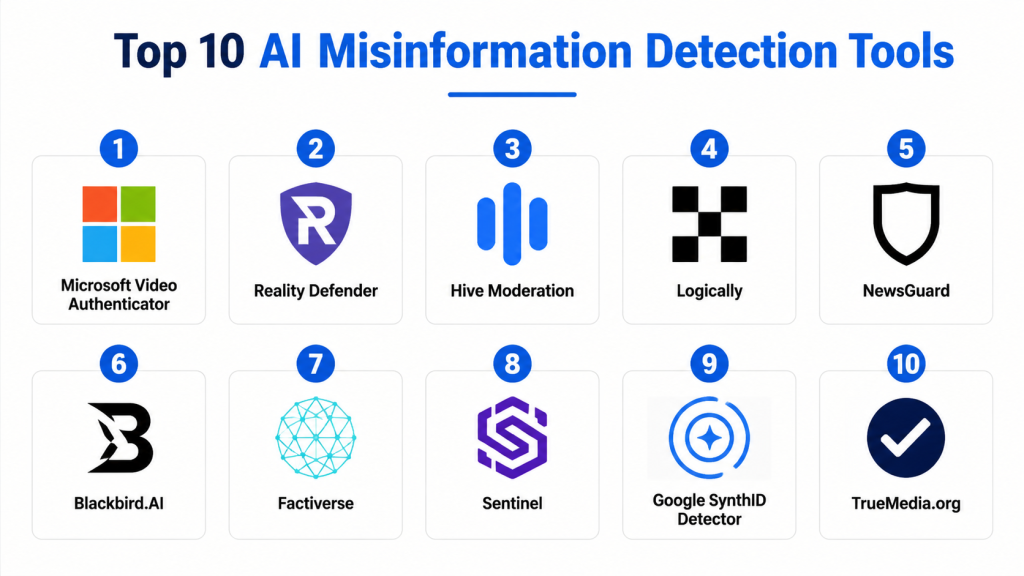
Top 10 AI Misinformation Detection Tools
#1 — Microsoft Video Authenticator
One-line verdict: Best suited for enterprises and public organizations requiring scalable deepfake video analysis and media authenticity assessment.
Short description (2–3 lines):
Microsoft Video Authenticator analyzes images and videos to identify signs of AI-generated manipulation and synthetic media. It is commonly referenced in research, government collaborations, and enterprise trust initiatives focused on combating digital misinformation.
Standout Capabilities
- Detects manipulated video frames
- AI-powered image authenticity assessment
- Confidence scoring for suspected synthetic media
- Supports deepfake identification workflows
- Research-backed media forensic capabilities
- Enterprise-oriented architecture
- Focus on responsible AI development
AI-Specific Depth
- Model support: Proprietary models
- RAG / knowledge integration: N/A
- Evaluation: Human-assisted verification workflows
- Guardrails: Supports media integrity verification; additional controls vary
- Observability: Varies / N/A
Pros
- Strong research foundation
- Effective for visual misinformation detection
- Suitable for government and enterprise initiatives
Cons
- Primarily focused on media authenticity
- Not a complete misinformation management platform
- Public availability varies by deployment
Security & Compliance
- Enterprise authentication capabilities vary by deployment.
- Encryption and administrative controls depend on implementation.
- Certifications: Not publicly stated.
Deployment & Platforms
- Cloud deployment
- Enterprise services
- Platform availability varies
Integrations & Ecosystem
Microsoft’s broader ecosystem enables integration with enterprise productivity and cloud services where applicable.
- Enterprise APIs
- Cloud ecosystem integration
- Microsoft security products
- AI research initiatives
- Developer services
Pricing Model
Enterprise engagement. Public pricing is not publicly stated.
Best-Fit Scenarios
- Government media verification
- Election integrity initiatives
- Enterprise trust and safety teams
#2 — Reality Defender
One-line verdict: Excellent for enterprises requiring real-time detection of AI-generated text, images, audio, and video.
Short description (2–3 lines):
Reality Defender provides enterprise-grade detection for deepfakes and synthetic media across multiple content formats. It focuses on protecting organizations from fraud, impersonation, misinformation, and AI-enabled attacks.
Standout Capabilities
- Multimodal AI detection
- Real-time deepfake identification
- Voice cloning detection
- Image authenticity analysis
- Video forensic capabilities
- Enterprise APIs
- Fraud prevention support
- Continuous model improvements
AI-Specific Depth
- Model support: Proprietary detection models
- RAG / knowledge integration: N/A
- Evaluation: Human review supported
- Guardrails: AI content detection policies
- Observability: Varies / N/A
Pros
- Covers multiple media types
- Strong enterprise focus
- Suitable for fraud and misinformation prevention
Cons
- Enterprise-oriented pricing
- Limited open-source flexibility
- Technical integration may require development effort
Security & Compliance
- Enterprise authentication support
- Administrative controls
- Encryption capabilities
- Certifications: Not publicly stated
Deployment & Platforms
- Cloud
- Enterprise deployment
- API integration
Integrations & Ecosystem
Designed for integration with enterprise security, fraud prevention, and trust platforms.
- REST APIs
- Enterprise applications
- Security workflows
- Fraud detection pipelines
- Developer integrations
Pricing Model
Enterprise licensing. Public pricing not publicly stated.
Best-Fit Scenarios
- Financial institutions
- Identity verification
- Enterprise media authentication
#3 — Hive Moderation
One-line verdict: Best for organizations requiring scalable AI-powered moderation and misinformation detection across multiple media formats.
Short description (2–3 lines):
Hive Moderation provides AI-powered content moderation and media analysis capable of detecting manipulated content, synthetic media, and harmful online material at scale.
Standout Capabilities
- Image analysis
- Video moderation
- AI-generated image detection
- Text moderation
- API-first architecture
- High-volume processing
- Custom moderation workflows
AI-Specific Depth
- Model support: Proprietary
- RAG / knowledge integration: N/A
- Evaluation: Human review supported
- Guardrails: Content policy enforcement
- Observability: Processing metrics vary
Pros
- Handles multiple content types
- Highly scalable APIs
- Strong moderation capabilities
Cons
- Broader moderation focus beyond misinformation
- Enterprise implementation complexity
- Advanced customization may require engineering
Security & Compliance
- Role-based access varies
- Encryption support
- Audit capabilities vary
- Certifications: Not publicly stated
Deployment & Platforms
- Cloud
- API-based
- Enterprise deployment
Integrations & Ecosystem
Widely integrated into moderation and publishing workflows.
- APIs
- SDKs
- Content management systems
- Moderation platforms
- Developer tools
Pricing Model
Usage-based enterprise pricing.
Best-Fit Scenarios
- Social media platforms
- User-generated content moderation
- Digital publishing
#4 — Logically
One-line verdict: Ideal for governments, news organizations, and enterprises combating coordinated misinformation campaigns.
Short description (2–3 lines):
Logically combines artificial intelligence with professional fact-checking to identify misinformation, monitor online narratives, and support investigations into coordinated disinformation activities.
Standout Capabilities
- AI-assisted fact checking
- Narrative monitoring
- Social media intelligence
- Human verification workflows
- Threat intelligence
- Evidence collection
- Campaign analysis
AI-Specific Depth
- Model support: Proprietary
- RAG / knowledge integration: Knowledge databases
- Evaluation: Human-in-the-loop validation
- Guardrails: Editorial verification processes
- Observability: Reporting dashboards
Pros
- Human verification improves reliability
- Strong investigative capabilities
- Effective narrative monitoring
Cons
- Enterprise-focused
- Less suitable for individual creators
- Specialized use cases
Security & Compliance
- Enterprise administrative controls
- Data handling policies vary
- Certifications: Not publicly stated
Deployment & Platforms
- Cloud
- Enterprise platform
- Web interface
Integrations & Ecosystem
Supports intelligence and investigative workflows.
- APIs
- Reporting systems
- Intelligence platforms
- Data exports
- Enterprise integrations
Pricing Model
Enterprise subscription.
Best-Fit Scenarios
- Election monitoring
- Government agencies
- Investigative journalism
#5 — NewsGuard
One-line verdict: Best for organizations and users seeking trusted credibility ratings for online news sources.
Short description (2–3 lines):
NewsGuard evaluates the credibility and transparency of news publishers using trained analysts supported by technology. Rather than detecting individual deepfakes, it helps users assess source reliability and misinformation risk.
Standout Capabilities
- Publisher credibility ratings
- Human analyst review
- Transparency assessments
- Browser integrations
- Educational support
- Source trust scoring
- Enterprise services
AI-Specific Depth
- Model support: AI-assisted analysis with human reviewers
- RAG / knowledge integration: Publisher databases
- Evaluation: Extensive human review
- Guardrails: Editorial verification standards
- Observability: N/A
Pros
- Human-centered methodology
- Easy-to-understand credibility scores
- Valuable educational resource
Cons
- Focuses on publishers rather than individual media files
- Limited deepfake detection
- Not designed for enterprise media forensics
Security & Compliance
- Standard administrative capabilities
- Certifications: Not publicly stated
Deployment & Platforms
- Web
- Browser extensions
- Enterprise services
Integrations & Ecosystem
Useful for publishers, educational institutions, and organizations seeking source credibility insights.
- Browser integrations
- Enterprise access
- APIs where applicable
- Research initiatives
- Educational partnerships
Pricing Model
Subscription model with consumer and enterprise offerings.
Best-Fit Scenarios
- Newsrooms
- Educational institutions
- Media literacy initiatives
#6 — Blackbird.AI
One-line verdict: Best for enterprises and public-sector organizations monitoring large-scale online narrative manipulation and coordinated influence campaigns.
Short description (2–3 lines):
Blackbird.AI specializes in identifying misinformation, disinformation, influence operations, reputational threats, and AI-generated narrative manipulation across digital platforms. It combines artificial intelligence with behavioral analytics to help organizations understand how misleading information spreads and evolves.
Standout Capabilities
- AI-powered narrative intelligence
- Coordinated influence campaign detection
- Cross-platform misinformation monitoring
- Reputation and brand risk analysis
- Social network behavior mapping
- Early warning alerts
- AI-assisted risk prioritization
- Enterprise reporting dashboards
AI-Specific Depth
- Model support: Proprietary AI models
- RAG / knowledge integration: Internal intelligence datasets; external integrations vary
- Evaluation: Analyst-assisted validation and investigation workflows
- Guardrails: Risk scoring, policy-driven detection, configurable alerts
- Observability: Dashboards, historical trends, investigation timelines
Pros
- Excellent for enterprise-scale monitoring
- Strong behavioral and network analysis
- Helps prioritize high-risk misinformation campaigns
Cons
- Designed primarily for enterprise customers
- Less suitable for individual journalists
- Requires analyst expertise for maximum value
Security & Compliance
Enterprise identity management, administrative controls, encryption, and audit capabilities vary by deployment.
Certifications: Not publicly stated.
Deployment & Platforms
- Web
- Cloud
- Enterprise SaaS
Integrations & Ecosystem
Blackbird.AI fits well within enterprise security and risk management environments.
- REST APIs
- Security platforms
- Threat intelligence workflows
- SIEM integrations
- Enterprise reporting tools
Pricing Model
Enterprise subscription. Public pricing is not publicly stated.
Best-Fit Scenarios
- Government intelligence teams
- Brand protection
- Election integrity monitoring
#7 — Factiverse
One-line verdict: Best for newsrooms and fact-checking organizations requiring AI-assisted claim verification workflows.
Short description (2–3 lines):
Factiverse helps journalists, publishers, and research organizations verify claims using AI-assisted fact-checking. Instead of replacing human reviewers, it accelerates evidence gathering and verification processes.
Standout Capabilities
- Automated claim detection
- AI-assisted fact verification
- Evidence collection
- Source comparison
- Editorial workflows
- Real-time monitoring
- Multilingual support
AI-Specific Depth
- Model support: Proprietary AI models
- RAG / knowledge integration: Knowledge sources and evidence repositories
- Evaluation: Human review integrated into verification workflow
- Guardrails: Editorial validation processes
- Observability: Activity dashboards and reporting
Pros
- Built specifically for fact-checking
- Supports editorial review
- Easy collaboration for verification teams
Cons
- Less focused on enterprise security operations
- Deepfake analysis is not its primary strength
- Enterprise deployment options vary
Security & Compliance
Administrative controls and data protection vary by deployment.
Certifications: Not publicly stated.
Deployment & Platforms
- Web
- Cloud
- Browser access
Integrations & Ecosystem
Factiverse supports modern newsroom and publishing environments.
- APIs
- CMS integrations
- Browser tools
- Editorial workflows
- Research platforms
Pricing Model
Subscription-based. Enterprise offerings vary.
Best-Fit Scenarios
- Digital publishers
- Fact-checking organizations
- Research institutions
#8 — Sentinel
One-line verdict: Best for organizations detecting coordinated disinformation campaigns across social platforms.
Short description (2–3 lines):
Sentinel focuses on identifying coordinated misinformation campaigns, bot networks, and influence operations. It combines machine learning with social graph analysis to detect abnormal information propagation.
Standout Capabilities
- Social network analysis
- Bot detection
- Coordinated campaign discovery
- Narrative tracking
- Trend monitoring
- AI-assisted investigation
- Risk visualization
AI-Specific Depth
- Model support: Proprietary detection models
- RAG / knowledge integration: N/A
- Evaluation: Analyst review workflows
- Guardrails: Configurable risk policies
- Observability: Investigation dashboards
Pros
- Strong campaign detection
- Useful visualization capabilities
- Helps identify coordinated behavior
Cons
- Specialized use cases
- Requires investigation expertise
- Limited standalone media forensic capabilities
Security & Compliance
Security controls vary by implementation.
Certifications: Not publicly stated.
Deployment & Platforms
- Cloud
- Web
- Enterprise deployment
Integrations & Ecosystem
Supports investigative intelligence environments.
- APIs
- Reporting tools
- Security platforms
- Data exports
- Analytics systems
Pricing Model
Enterprise licensing.
Best-Fit Scenarios
- Election monitoring
- Public sector intelligence
- Social media investigations
#9 — Google SynthID Detector
One-line verdict: Best for organizations working with AI-generated media that require content provenance and watermark detection.
Short description (2–3 lines):
Google SynthID focuses on identifying AI-generated media containing SynthID watermark technology. It helps organizations determine whether supported AI-generated content originated from compatible generation systems.
Standout Capabilities
- AI watermark detection
- Image authenticity support
- Media provenance
- Integration with supported Google AI services
- Fast content verification
- Research-backed technology
AI-Specific Depth
- Model support: Proprietary Google AI ecosystem
- RAG / knowledge integration: N/A
- Evaluation: Watermark verification
- Guardrails: Content provenance verification
- Observability: Varies / N/A
Pros
- Supports trusted AI provenance
- Lightweight verification workflow
- Useful for supported generated content
Cons
- Detects compatible watermarks rather than all AI-generated media
- Limited coverage outside supported ecosystems
- Not a complete misinformation platform
Security & Compliance
Enterprise security depends on deployment.
Certifications: Not publicly stated.
Deployment & Platforms
- Cloud
- Google ecosystem
- API availability varies
Integrations & Ecosystem
Works alongside Google’s AI ecosystem and supported media generation services.
- APIs
- AI generation workflows
- Cloud ecosystem
- Developer tools
Pricing Model
Varies depending on implementation.
Best-Fit Scenarios
- AI content provenance
- Media verification
- Responsible AI workflows
#10 — TrueMedia.org
One-line verdict: Best for journalists, educators, and researchers needing accessible AI-generated media verification tools.
Short description (2–3 lines):
TrueMedia.org provides AI-powered analysis for identifying manipulated images, audio, and videos. It is designed to support journalists, educators, and fact-checkers in evaluating digital media authenticity.
Standout Capabilities
- Image analysis
- Video authenticity detection
- Audio manipulation detection
- AI-generated media analysis
- Educational workflows
- Simple user interface
- Explainable detection results
AI-Specific Depth
- Model support: Proprietary detection models
- RAG / knowledge integration: N/A
- Evaluation: Human review encouraged
- Guardrails: Media authenticity verification
- Observability: Basic reporting
Pros
- Easy to use
- Designed for media professionals
- Supports multiple media formats
Cons
- Enterprise automation is limited
- Advanced integrations vary
- Less comprehensive than full enterprise intelligence platforms
Security & Compliance
Security features vary by deployment.
Certifications: Not publicly stated.
Deployment & Platforms
- Web
- Cloud
Integrations & Ecosystem
Focused primarily on verification workflows.
- Web interface
- APIs where available
- Research collaboration
- Educational programs
Pricing Model
Varies / Not publicly stated.
Best-Fit Scenarios
- Journalism
- Education
- Digital literacy initiatives
Comparison Table
| Tool Name | Best For | Deployment | Model Flexibility | Primary Strength | Watch-Out | Public Rating |
|---|---|---|---|---|---|---|
| Microsoft Video Authenticator | Government & enterprise media verification | Cloud | Proprietary | Deepfake detection | Limited availability | N/A |
| Reality Defender | Enterprise fraud prevention | Cloud | Proprietary | Real-time multimodal detection | Enterprise focus | N/A |
| Hive Moderation | Content moderation | Cloud | Proprietary | High-volume media analysis | Broader moderation scope | N/A |
| Logically | Government & news organizations | Cloud | Proprietary | Human-assisted fact checking | Enterprise oriented | N/A |
| NewsGuard | Publisher credibility | Cloud | Proprietary | News source trust ratings | Limited deepfake detection | N/A |
| Blackbird.AI | Narrative intelligence | Cloud | Proprietary | Influence campaign detection | Requires analyst expertise | N/A |
| Factiverse | AI-assisted fact checking | Cloud | Proprietary | Claim verification | Limited media forensics | N/A |
| Sentinel | Social campaign monitoring | Cloud | Proprietary | Coordinated disinformation detection | Specialized workflows | N/A |
| Google SynthID Detector | AI content provenance | Cloud | Proprietary | Watermark verification | Limited ecosystem coverage | N/A |
| TrueMedia.org | Journalism & education | Cloud | Proprietary | Media authenticity analysis | Limited enterprise automation | N/A |
Scoring & Evaluation (Transparent Rubric)
The following scores are intended to provide a comparative evaluation rather than an absolute ranking. Every organization has different priorities, including deployment flexibility, media formats, regulatory requirements, budget, workflow maturity, and staffing. Organizations should validate these scores through pilot deployments, proof-of-concept testing, and internal evaluations before making procurement decisions.
| Tool | Core | Reliability / Eval | Guardrails | Integrations | Ease | Perf / Cost | Security | Support | Weighted Total |
|---|---|---|---|---|---|---|---|---|---|
| Reality Defender | 9.5 | 9.4 | 9.2 | 8.8 | 8.5 | 8.7 | 9.1 | 8.7 | 9.05 |
| Blackbird.AI | 9.3 | 9.1 | 9.0 | 8.8 | 8.3 | 8.5 | 9.2 | 8.5 | 8.94 |
| Microsoft Video Authenticator | 9.2 | 9.0 | 8.8 | 8.5 | 8.2 | 8.5 | 9.0 | 8.5 | 8.84 |
| Logically | 9.0 | 9.2 | 8.7 | 8.4 | 8.6 | 8.4 | 8.6 | 8.8 | 8.81 |
| Hive Moderation | 8.9 | 8.6 | 8.8 | 9.2 | 8.8 | 8.7 | 8.7 | 8.6 | 8.80 |
| Factiverse | 8.7 | 9.0 | 8.5 | 8.3 | 9.0 | 8.5 | 8.3 | 8.8 | 8.67 |
| Sentinel | 8.8 | 8.8 | 8.5 | 8.1 | 8.2 | 8.5 | 8.5 | 8.3 | 8.54 |
| Google SynthID Detector | 8.5 | 8.6 | 8.6 | 8.2 | 9.1 | 9.0 | 8.5 | 8.3 | 8.53 |
| TrueMedia.org | 8.3 | 8.4 | 8.2 | 7.8 | 9.2 | 8.8 | 8.0 | 8.2 | 8.32 |
| NewsGuard | 8.1 | 8.9 | 8.4 | 7.9 | 9.3 | 8.7 | 8.3 | 8.8 | 8.31 |
Top 3 for Enterprise
- Reality Defender
- Blackbird.AI
- Microsoft Video Authenticator
These platforms provide strong enterprise capabilities, scalable deployments, advanced AI detection, and support for large-scale operational environments.
Top 3 for SMB
- Hive Moderation
- Factiverse
- NewsGuard
These tools balance usability, practical functionality, and implementation effort while delivering strong misinformation detection capabilities.
Top 3 for Developers
- Hive Moderation
- Reality Defender
- Google SynthID Detector
These platforms provide APIs, developer-friendly integration options, and automation capabilities suitable for embedding misinformation detection into applications and workflows.
Which AI Misinformation Detection Tool Is Right for You?
Selecting the right AI misinformation detection platform depends on your organization’s size, technical capabilities, regulatory requirements, and the type of content you need to verify. No single solution is ideal for every scenario. Some platforms excel at identifying deepfake media, while others specialize in fact-checking, coordinated disinformation campaigns, or enterprise-scale content moderation. The following recommendations can help narrow your shortlist.
Solo / Freelancer
Independent journalists, content creators, researchers, educators, and freelance investigators generally need solutions that are simple to use, affordable, and effective without requiring a dedicated security or data science team.
Recommended tools:
- NewsGuard for evaluating publisher credibility before citing sources.
- TrueMedia.org for verifying images, audio, and videos.
- Factiverse for AI-assisted claim verification during research.
Focus on tools that provide explainable results rather than fully automated decisions. Human judgment remains essential when verifying breaking news or controversial topics.
SMB
Small and medium-sized businesses often need to protect their brand reputation, moderate user-generated content, and verify externally sourced information without building an extensive trust and safety team.
Recommended tools:
- Hive Moderation for scalable content moderation.
- Reality Defender for protecting against AI-generated fraud and impersonation.
- Factiverse for marketing, communications, and editorial verification.
Look for platforms that offer:
- Easy API integration
- Minimal implementation effort
- Cloud deployment
- Usage-based pricing where available
- Administrative dashboards
Mid-Market
Growing organizations typically manage higher content volumes and require stronger governance, reporting, and operational workflows.
Recommended tools:
- Reality Defender
- Logically
- Blackbird.AI
Key priorities include:
- Centralized reporting
- Role-based access controls
- Investigation workflows
- AI-assisted human review
- Integration with existing security and publishing systems
Organizations at this stage should begin measuring detection accuracy, analyst productivity, and false-positive rates.
Enterprise
Large enterprises, government agencies, social media platforms, and multinational organizations require platforms capable of processing millions of media assets while maintaining strong governance and operational resilience.
Recommended tools:
- Reality Defender
- Blackbird.AI
- Microsoft Video Authenticator
- Logically
Enterprise buyers should prioritize:
- High scalability
- Advanced APIs
- Enterprise authentication
- Administrative controls
- Audit logging
- Threat intelligence integration
- Automated workflows
- Human review pipelines
- Global deployment support
Pilot testing across multiple business units before organization-wide deployment is strongly recommended.
Regulated Industries (Finance, Healthcare, Public Sector)
Organizations operating in highly regulated industries face additional responsibilities related to information integrity, compliance, and public trust.
Recommended tools:
- Reality Defender
- Microsoft Video Authenticator
- Blackbird.AI
- Logically
Evaluation criteria should include:
- Data governance
- Auditability
- Administrative controls
- Explainable AI decisions
- Human approval workflows
- Secure deployment options
- Incident response capabilities
Highly regulated organizations should avoid fully automated publishing or decision-making without human oversight.
Budget vs Premium
Budget-Oriented Choices
Organizations with limited budgets should prioritize platforms that deliver the greatest value for their primary use case rather than attempting to solve every misinformation challenge with one solution.
Good options include:
- NewsGuard
- TrueMedia.org
- Factiverse
These tools work well for editorial verification, education, and moderate content volumes.
Premium Enterprise Platforms
Organizations managing high-risk environments should consider:
- Reality Defender
- Blackbird.AI
- Microsoft Video Authenticator
- Logically
Although enterprise implementations require greater investment, they typically provide stronger scalability, automation, security, and investigative capabilities.
Build vs Buy (When to DIY)
Building an internal misinformation detection platform may be appropriate when:
- You have experienced AI engineers.
- Your workflows require extensive customization.
- You must keep sensitive data within your own infrastructure.
- You need proprietary detection models.
Buying a commercial platform is generally preferable when:
- Rapid deployment is important.
- Dedicated vendor support is required.
- Your team lacks AI security expertise.
- Continuous model updates are critical.
- Regulatory expectations require mature governance.
For most organizations, a hybrid approach works best: purchase a mature detection platform and extend it with custom APIs, internal knowledge sources, and organization-specific workflows.
Implementation Playbook (30 / 60 / 90 Days)
Successful AI misinformation detection requires more than installing software. Organizations should gradually expand deployment while continuously measuring effectiveness.
First 30 Days: Pilot and Baseline
Primary objectives:
- Define business goals and success metrics.
- Select representative datasets.
- Identify high-risk workflows.
- Configure user access.
- Establish human review procedures.
Key activities:
- Deploy a pilot environment.
- Evaluate multiple detection models.
- Build an evaluation dataset.
- Measure precision and recall.
- Define acceptable false-positive thresholds.
- Integrate APIs with publishing or moderation systems.
- Train reviewers on interpreting AI-generated risk scores.
- Document incident escalation procedures.
Success metrics:
- Detection accuracy
- Average review time
- False-positive rate
- User adoption
- Processing latency
Next 60 Days: Security, Evaluation, and Rollout
Primary objectives:
- Expand deployment.
- Improve governance.
- Validate operational reliability.
Key activities:
- Strengthen authentication and access controls.
- Conduct adversarial testing.
- Build an evaluation harness.
- Perform red-team exercises.
- Implement prompt and model version tracking where applicable.
- Configure audit logging.
- Create approval workflows.
- Integrate security monitoring.
Organizations should begin measuring:
- Reviewer consistency
- Model drift
- Operational costs
- Detection coverage
- Investigation turnaround time
Final 90 Days: Optimize and Scale
Primary objectives:
- Improve efficiency.
- Reduce costs.
- Prepare for enterprise-wide deployment.
Key activities:
- Optimize API usage.
- Reduce processing latency.
- Improve automated routing.
- Refine detection thresholds.
- Expand integrations.
- Monitor model performance continuously.
- Develop executive dashboards.
- Conduct governance reviews.
- Update incident response playbooks.
Long-term success indicators include:
- Reduced misinformation exposure
- Faster investigations
- Lower operational costs
- Improved public trust
- Better compliance readiness
Common Mistakes & How to Avoid Them
Many AI misinformation detection initiatives fail because organizations underestimate operational complexity. Avoid these common mistakes:
- Relying solely on AI without human verification.
- Assuming one model can detect every type of misinformation.
- Ignoring adversarial attacks against detection systems.
- Skipping evaluation before production deployment.
- Using outdated verification datasets.
- Failing to monitor false positives.
- Ignoring false negatives that allow harmful content through.
- Overlooking privacy and data retention policies.
- Deploying without role-based access controls.
- Neglecting audit logging.
- Failing to monitor API usage and operational costs.
- Not testing new AI-generated content formats.
- Creating vendor lock-in without abstraction layers.
- Treating misinformation detection as a one-time implementation instead of an ongoing program.
Frequently Asked Questions
What are AI misinformation detection tools?
These platforms use artificial intelligence to identify misleading text, manipulated media, deepfakes, fabricated claims, and coordinated disinformation. They assist human reviewers by prioritizing suspicious content rather than replacing editorial judgment.
Can these tools detect every deepfake?
No. Detection technology continues to improve, but no platform can guarantee perfect accuracy against every newly developed deepfake technique. Human verification remains an essential part of high-risk workflows.
Do these platforms replace professional fact-checkers?
No. Most enterprise solutions are designed to accelerate research and evidence collection while allowing trained reviewers to make final decisions.
Can they analyze images, videos, audio, and text together?
Many modern platforms support multimodal analysis, although supported media types vary by vendor. Buyers should confirm coverage for their specific use cases during evaluation.
Is self-hosting available?
Some enterprise vendors offer self-hosted or hybrid deployment options, while others provide cloud-only services. Availability varies by platform and licensing model.
Do these tools support bring-your-own AI models?
Support varies. Some platforms rely entirely on proprietary models, while others provide APIs or integration options that allow organizations to extend functionality with internal AI systems.
How should organizations evaluate detection quality?
Use representative datasets, establish measurable success metrics, compare results across multiple tools, conduct adversarial testing, and continuously monitor performance after deployment.
What security features should buyers prioritize?
Look for strong authentication, administrative controls, encryption, audit logging, configurable retention policies, and comprehensive reporting suitable for compliance and governance requirements.
Are AI misinformation detection tools expensive?
Costs vary considerably depending on deployment model, processing volume, supported media types, and enterprise requirements. Organizations should evaluate total operational cost rather than licensing alone.
How difficult is it to switch vendors later?
Migration difficulty depends on API compatibility, workflow customization, reporting formats, and integration architecture. Using standardized interfaces can reduce long-term vendor lock-in.
Can these platforms monitor social media in real time?
Many enterprise solutions provide continuous monitoring and alerting for public content streams. Capabilities differ across vendors and supported platforms.
What alternatives exist if these tools are not the right fit?
Organizations may combine traditional fact-checking processes, media forensic software, cybersecurity intelligence platforms, human editorial review, and internally developed AI models to create a layered verification strategy.
Conclusion
AI-generated misinformation is becoming increasingly sophisticated, making traditional manual verification methods insufficient for many organizations. Modern AI misinformation detection platforms help identify manipulated content, deepfakes, coordinated influence campaigns, and misleading narratives while supporting faster and more consistent investigations. However, technology alone is not enough. The most successful deployments combine AI-assisted analysis with human expertise, well-defined governance, continuous evaluation, and transparent review processes.There is no universal “best” AI misinformation detection tool. Reality Defender and Blackbird.AI are strong choices for enterprise-scale monitoring and risk management, Logically and Factiverse excel in fact-checking and investigative workflows, Hive Moderation supports high-volume content moderation, while NewsGuard and TrueMedia.org provide valuable capabilities for journalists, educators, and research organizations. The right choice depends on your organization’s content volume, regulatory obligations, technical maturity, and operational priorities.

Find Trusted Cardiac Hospitals
Compare heart hospitals by city and services — all in one place.
Explore Hospitals