
Introduction
Cities today operate like living digital systems. Traffic signals, surveillance cameras, public transport networks, emergency response units, utilities, environmental sensors, and citizen service platforms all generate massive streams of real-time data. Managing this complexity through traditional control rooms is no longer sufficient. AI Smart City Control Center Copilots are emerging as the next evolution of urban operations, acting as intelligent assistants for city operators, traffic controllers, emergency coordinators, and municipal decision-makers.
These copilots use artificial intelligence, large-scale data fusion, computer vision, predictive analytics, and natural language interfaces to help operators understand what is happening in a city in real time, predict what will happen next, and recommend or automate actions. Instead of manually analyzing multiple dashboards, operators can now ask AI systems questions like “Why is traffic building near Zone 4?” or “Which areas are likely to face power outages in the next 2 hours?” and receive actionable insights instantly.
Common use cases include:
- Real-time traffic and congestion monitoring
- Emergency response coordination
- Public safety incident detection
- Utility outage prediction and response
- Crowd management during events
- Environmental monitoring (air quality, flooding, heat zones)
- Smart transportation coordination
- City-wide anomaly detection across systems
When evaluating AI Smart City Control Center Copilots, organizations should consider:
- Real-time data processing capability
- Multisource data fusion (IoT, video, GIS, sensors)
- AI-driven prediction accuracy
- Natural language interaction (copilot interface)
- Edge and cloud deployment flexibility
- Integration with legacy city systems
- Cybersecurity and data governance
- Visualization and decision support dashboards
- Automation vs human-in-the-loop control
- Scalability across districts or entire cities
Best for: Smart city authorities, municipal corporations, transportation control centers, emergency response agencies, urban planning departments, public safety organizations, and infrastructure operators managing complex multi-domain city systems.
Not ideal for: Small municipalities with limited digital infrastructure, standalone building management systems, or organizations without real-time data pipelines or IoT integration.
What’s Changed in AI Smart City Control Center Copilots in 2026+
Smart city control systems have evolved from passive monitoring dashboards into active AI copilots capable of reasoning, predicting, and assisting decision-making across multiple city domains.
Key transformations include:
- AI copilots now unify traffic, utilities, safety, and environmental data into a single operational view
- Natural language interfaces allow operators to query city status in plain language
- Real-time computer vision processes traffic and surveillance feeds at scale
- Predictive analytics anticipate congestion, disasters, and infrastructure failures
- Digital twins simulate entire cities for scenario planning before action is taken
- Edge AI reduces latency for critical real-time decisions like traffic signal changes
- Generative AI assists operators with incident summaries and response recommendations
- Cross-agency coordination is now AI-assisted (police, fire, transport, utilities)
- Automated alert prioritization reduces operator overload in control centers
- Cybersecurity monitoring is integrated into city operations dashboards
- Multimodal mobility intelligence includes pedestrians, EVs, bikes, and public transit
- Sustainability optimization is becoming a core city KPI (emissions, energy, water usage)
Quick Buyer Checklist (Scan-Friendly)
Before selecting an AI Smart City Control Center Copilot, ensure the platform supports:
- □ Real-time city-wide data integration
- □ AI-powered incident detection
- □ Natural language command interface
- □ Computer vision for traffic and surveillance
- □ IoT sensor integration across domains
- □ Predictive analytics and forecasting
- □ Digital twin simulation capability
- □ Edge computing support for low latency
- □ Multi-agency coordination (transport, police, utilities)
- □ Cybersecurity monitoring and anomaly detection
- □ GIS (geospatial intelligence) integration
- □ Role-based access control
- □ Audit logs and compliance tracking
- □ Scalable cloud architecture
- □ API-based extensibility
- □ Emergency response prioritization systems
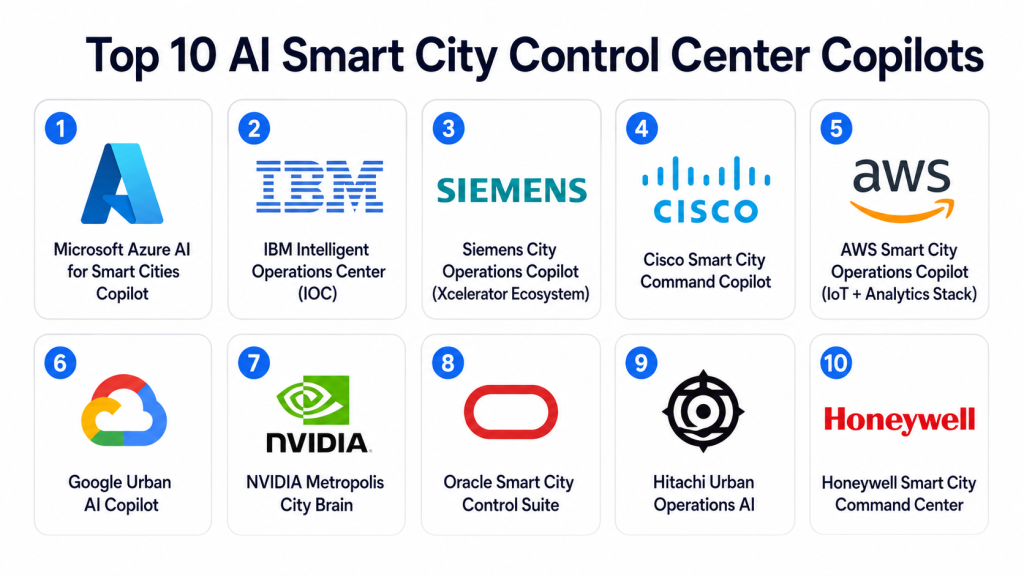
Top 10 AI Smart City Control Center Copilots
#1 — Microsoft Azure AI for Smart Cities Copilot
One-line verdict: Best for government-grade smart city copilots integrated with cloud AI, data platforms, and enterprise control systems.
Short description (2–3 lines):
Microsoft Azure AI for Smart Cities enables city control centers to unify data from traffic systems, public safety networks, utilities, and IoT devices into a single AI-powered operational layer. It supports conversational copilots that help operators understand city conditions and coordinate responses in real time.
Standout Capabilities
- AI-powered city operations copilots
- Real-time data fusion from multiple city systems
- Natural language query interface for operators
- Integration with IoT and sensor networks
- Predictive analytics for city operations
- Incident detection and summarization
- Multi-department coordination support
- Dashboard-driven situational awareness
AI-Specific Depth
- Model support: Proprietary Azure AI models and enterprise LLM integrations
- RAG / knowledge integration: City data lakes, GIS systems, operational databases
- Evaluation: Incident response analytics, prediction accuracy, system telemetry
- Guardrails: Policy-based access control, safety filters, governance rules
- Observability: Operational dashboards, system logs, real-time alerts, AI usage monitoring
Pros
- Strong enterprise cloud ecosystem
- Excellent scalability for large cities
- Deep integration with government systems
Cons
- Requires strong cloud architecture maturity
- Implementation complexity for legacy systems
- Depends on structured data readiness
Security & Compliance
Supports enterprise-grade identity management, encryption, role-based access, audit logging, and government compliance frameworks depending on deployment.
Certifications: Not publicly stated.
Deployment & Platforms
- Cloud
- Hybrid government environments
- Edge integration supported
Integrations & Ecosystem
Designed for deep integration with city infrastructure and enterprise systems.
- IoT platforms
- GIS systems
- Emergency response systems
- Traffic control systems
- Public safety databases
- Azure AI ecosystem
Pricing Model
Enterprise/government subscription. Pricing varies by deployment scale.
Best-Fit Scenarios
- National smart city programs
- Large metropolitan control centers
- Multi-agency government operations
#2 — IBM Intelligent Operations Center (IOC)
One-line verdict: Best for centralized city operations management with strong analytics and cross-domain intelligence.
Short description (2–3 lines):
IBM Intelligent Operations Center provides a unified platform for monitoring and managing city operations across transportation, public safety, utilities, and infrastructure. It enables AI-assisted decision-making through integrated dashboards and predictive analytics.
Standout Capabilities
- Centralized city operations dashboard
- AI-assisted incident detection
- Cross-domain data aggregation
- Predictive city analytics
- Emergency response coordination
- Operational command center tools
- Event and crisis management support
- Real-time monitoring of city systems
AI-Specific Depth
- Model support: IBM AI and analytics systems
- RAG / knowledge integration: City operational data and enterprise systems
- Evaluation: Performance metrics for city services and incident response
- Guardrails: Operational policies, governance rules, access controls
- Observability: Command center dashboards, alerts, reporting systems
Pros
- Strong enterprise analytics foundation
- Reliable for large-scale operations
- Good cross-agency coordination
Cons
- Complex setup and integration
- Requires mature IT infrastructure
- Less flexible for smaller cities
Security & Compliance
Enterprise security, encryption, role-based access control, audit logs, and governance frameworks depending on deployment.
Certifications: Not publicly stated.
Deployment & Platforms
- Cloud
- Hybrid
- On-premise government systems
Integrations & Ecosystem
Supports integration with multiple city and enterprise systems.
- Traffic systems
- Emergency response platforms
- Utility management systems
- IoT sensor networks
- GIS platforms
- IBM analytics ecosystem
Pricing Model
Government and enterprise licensing.
Best-Fit Scenarios
- Smart city command centers
- Emergency coordination hubs
- Large municipal operations
#3 — Siemens City Operations Copilot (Xcelerator Ecosystem)
One-line verdict: Best for AI-driven urban infrastructure management with strong digital twin capabilities.
Short description (2–3 lines):
Siemens City Operations Copilot, part of the Xcelerator ecosystem, enables smart cities to monitor, simulate, and optimize urban systems including traffic, energy, mobility, and infrastructure using AI and digital twin technology.
Standout Capabilities
- AI-assisted city operations management
- Digital twin simulation of urban systems
- Real-time infrastructure monitoring
- Predictive urban analytics
- Traffic and mobility optimization
- Energy and utility coordination
- Incident detection and response
- Multi-domain city intelligence
AI-Specific Depth
- Model support: Siemens proprietary AI models
- RAG / knowledge integration: Urban infrastructure and IoT datasets
- Evaluation: Simulation accuracy, infrastructure performance metrics
- Guardrails: City safety policies, operational constraints
- Observability: Urban dashboards, digital twin visualization, analytics
Pros
- Strong digital twin capabilities
- Excellent infrastructure integration
- High reliability for mission-critical systems
Cons
- Complex implementation requirements
- Requires infrastructure modernization
- High deployment cost
Security & Compliance
Supports secure government infrastructure, encryption, identity management, audit logs, and role-based access control.
Certifications: Not publicly stated.
Deployment & Platforms
- Edge computing
- Cloud
- Hybrid urban infrastructure
Integrations & Ecosystem
Designed for deep integration across urban systems.
- IoT networks
- Traffic systems
- Energy grids
- Public transport systems
- Emergency response systems
- Siemens Xcelerator ecosystem
Pricing Model
Enterprise municipal licensing.
Best-Fit Scenarios
- Smart city digital twins
- Urban infrastructure optimization
- Multi-domain city operations
#4 — Cisco Smart City Command Copilot
One-line verdict: Best for network-driven smart city control centers with strong IoT and connectivity integration.
Short description (2–3 lines):
Cisco Smart City Command Copilot enables cities to unify IoT, networking, video surveillance, and traffic systems into a centralized AI-powered control environment for real-time decision-making.
Standout Capabilities
- AI-driven city command center
- Real-time IoT data processing
- Video analytics and surveillance intelligence
- Traffic and mobility monitoring
- Incident detection and response
- Emergency coordination systems
- Network-driven city intelligence
- Smart infrastructure connectivity
AI-Specific Depth
- Model support: Cisco AI and network analytics models
- RAG / knowledge integration: IoT, network, and city operational data
- Evaluation: Network performance, incident response metrics
- Guardrails: Security policies, network governance, access controls
- Observability: Network dashboards, city operations monitoring, alerts
Pros
- Strong IoT and networking backbone
- High scalability for smart cities
- Reliable infrastructure connectivity
Cons
- Requires Cisco ecosystem integration
- Hardware dependencies
- Complex architecture setup
Security & Compliance
Enterprise networking security, encryption, identity management, and audit capabilities depending on deployment.
Certifications: Not publicly stated.
Deployment & Platforms
- Cloud
- Edge
- Hybrid city infrastructure
Integrations & Ecosystem
Strong integration with Cisco networking and IoT ecosystems.
- IoT devices
- Surveillance systems
- Traffic control systems
- Emergency services
- City control centers
Pricing Model
Enterprise and municipal licensing.
Best-Fit Scenarios
- Connected smart cities
- Urban surveillance systems
- IoT-enabled city operations
#5 — AWS Smart City Operations Copilot (IoT + Analytics Stack)
One-line verdict: Best for cloud-native smart city copilots built on scalable IoT and AI infrastructure.
Short description (2–3 lines):
AWS Smart City Operations Copilot combines IoT data ingestion, machine learning, analytics, and generative AI capabilities to help cities build scalable, cloud-native control centers for urban operations and infrastructure management.
Standout Capabilities
- Cloud-native city operations intelligence
- IoT data ingestion and processing
- Predictive urban analytics
- AI-assisted incident detection
- Real-time dashboards
- Multi-system data integration
- Scalable cloud architecture
- Event-driven automation
AI-Specific Depth
- Model support: AWS AI/ML services and foundation models
- RAG / knowledge integration: City data lakes, IoT platforms, analytics systems
- Evaluation: Predictive performance metrics, system monitoring
- Guardrails: Policy-based access control, governance frameworks
- Observability: Cloud monitoring dashboards, logs, operational insights
Pros
- Highly scalable cloud architecture
- Strong IoT integration capabilities
- Flexible AI/ML ecosystem
Cons
- Requires advanced cloud engineering expertise
- Not a pre-built city application suite
- Integration complexity can be high
Security & Compliance
Supports enterprise-grade security, encryption, IAM controls, audit logging, and governance policies.
Certifications: Not publicly stated.
Deployment & Platforms
- Cloud-native
- Edge + cloud hybrid
- API-first architecture
Integrations & Ecosystem
Deep integration with AWS ecosystem services.
- IoT Core
- Machine learning services
- Data lakes
- Analytics platforms
- City applications
- Third-party APIs
Pricing Model
Usage-based cloud pricing.
Best-Fit Scenarios
- Smart city digital transformation projects
- Cloud-native urban operations centers
- IoT-driven infrastructure management
#6 — Google Urban AI Copilot
One-line verdict: Best for cities leveraging real-time geospatial intelligence and large-scale mobility data.
Short description (2–3 lines):
Google Urban AI Copilot combines geospatial intelligence, mobility data, and AI-driven analytics to help city control centers optimize traffic, emergency response, and urban planning. It is designed to improve decision-making using real-world movement patterns and large-scale mapping intelligence.
Standout Capabilities
- Real-time geospatial intelligence for city operations
- AI-driven traffic and mobility insights
- Predictive congestion and incident detection
- Integration of mapping and location data
- Urban planning simulation support
- Emergency response optimization
- Public transit flow analysis
- Crowd movement forecasting
AI-Specific Depth
- Model support: Proprietary Google AI and geospatial models
- RAG / knowledge integration: Mapping data, mobility datasets, city infrastructure feeds
- Evaluation: Traffic prediction accuracy, routing efficiency, congestion reduction metrics
- Guardrails: Municipal routing policies, safety constraints, data governance rules
- Observability: Mobility dashboards, geospatial heatmaps, real-time analytics
Pros
- Extremely strong geospatial intelligence
- Excellent real-world mobility data foundation
- High-quality predictive routing insights
Cons
- Limited customization for full command center control
- Dependent on Google ecosystem integration
- Not a full standalone city operations suite
Security & Compliance
Enterprise-grade security with encryption, identity controls, and audit logging depending on deployment.
Certifications: Not publicly stated.
Deployment & Platforms
- Cloud-based architecture
- API-driven integrations
- Edge support via partner systems
Integrations & Ecosystem
- Mapping systems
- Traffic management platforms
- Emergency response systems
- City GIS platforms
- Mobility applications
Pricing Model
Usage-based enterprise or municipal agreements.
Best-Fit Scenarios
- Smart mobility planning
- Traffic intelligence centers
- Urban analytics departments
#7 — NVIDIA Metropolis City Brain
One-line verdict: Best for AI-powered video analytics and real-time urban perception systems.
Short description (2–3 lines):
NVIDIA Metropolis City Brain uses advanced computer vision and edge AI to analyze video feeds from city cameras, enabling real-time detection of traffic conditions, public safety incidents, and infrastructure anomalies across urban environments.
Standout Capabilities
- AI-powered video analytics for city surveillance
- Real-time object detection (vehicles, pedestrians, incidents)
- Edge AI processing for low-latency decision-making
- Traffic flow and congestion analysis
- Smart intersection monitoring
- Public safety incident detection
- Infrastructure anomaly detection
- Multi-camera city-wide coordination
AI-Specific Depth
- Model support: NVIDIA AI and deep learning vision models
- RAG / knowledge integration: Video feeds, IoT sensors, edge device data
- Evaluation: Detection accuracy, latency performance, incident recognition rate
- Guardrails: Privacy filtering, surveillance policy enforcement, access control rules
- Observability: Video dashboards, AI detection logs, real-time alerts
Pros
- Industry-leading computer vision capabilities
- Excellent edge AI performance
- Highly scalable video processing architecture
Cons
- Requires strong hardware infrastructure (GPU/edge devices)
- Complex deployment for smaller cities
- Focused mainly on visual intelligence, not full command systems
Security & Compliance
Supports enterprise security controls, encryption, access policies, and privacy-preserving video analytics.
Certifications: Not publicly stated.
Deployment & Platforms
- Edge computing (primary)
- Cloud integration
- Hybrid city infrastructure
Integrations & Ecosystem
- CCTV and surveillance systems
- Traffic monitoring cameras
- IoT edge devices
- City command centers
- Analytics platforms
Pricing Model
Enterprise licensing with hardware-dependent costs.
Best-Fit Scenarios
- Smart surveillance systems
- Traffic video intelligence centers
- Public safety monitoring
#8 — Oracle Smart City Control Suite
One-line verdict: Best for integrated enterprise-grade smart city operations and government data ecosystems.
Short description (2–3 lines):
Oracle Smart City Control Suite provides a unified platform for managing urban operations including transportation, utilities, public safety, and citizen services. It uses AI-driven insights to help governments optimize city performance and service delivery.
Standout Capabilities
- Unified city operations dashboard
- AI-driven urban analytics
- Integrated public service monitoring
- Traffic and infrastructure management
- Utility performance tracking
- Incident response coordination
- Citizen service optimization
- Predictive city operations insights
AI-Specific Depth
- Model support: Oracle AI and enterprise analytics models
- RAG / knowledge integration: Government databases, ERP systems, city data platforms
- Evaluation: Service performance metrics, operational efficiency tracking
- Guardrails: Government compliance rules, access controls, data governance policies
- Observability: City dashboards, operational KPIs, real-time reporting systems
Pros
- Strong enterprise integration capabilities
- Excellent data management ecosystem
- Reliable for large-scale government systems
Cons
- Best suited for Oracle ecosystem users
- Complex deployment and configuration
- Less flexible for lightweight smart city projects
Security & Compliance
Enterprise-grade security, identity management, encryption, audit logging, and compliance frameworks depending on deployment.
Certifications: Not publicly stated.
Deployment & Platforms
- Cloud
- Hybrid government infrastructure
- On-premise supported
Integrations & Ecosystem
- Oracle cloud ecosystem
- Government ERP systems
- IoT platforms
- GIS systems
- Public service databases
Pricing Model
Enterprise and government licensing.
Best-Fit Scenarios
- National smart city programs
- Government digital transformation projects
- Large municipal operations
#9 — Hitachi Urban Operations AI
One-line verdict: Best for infrastructure-heavy cities focused on transportation, energy, and urban resilience.
Short description (2–3 lines):
Hitachi Urban Operations AI enables smart cities to optimize infrastructure systems such as transportation, energy grids, water systems, and public services using AI-driven analytics and predictive urban intelligence.
Standout Capabilities
- AI-driven urban infrastructure monitoring
- Transportation and mobility optimization
- Energy grid intelligence
- Predictive city operations management
- Emergency and disaster response analytics
- Multi-domain infrastructure coordination
- Real-time urban dashboards
- City resilience modeling
AI-Specific Depth
- Model support: Proprietary Hitachi AI systems
- RAG / knowledge integration: Infrastructure systems, IoT sensors, operational databases
- Evaluation: Infrastructure performance metrics, prediction accuracy, resilience indicators
- Guardrails: Safety protocols, municipal regulations, operational constraints
- Observability: Infrastructure dashboards, real-time monitoring systems, analytics reports
Pros
- Strong focus on infrastructure resilience
- Excellent multi-domain urban intelligence
- Reliable for mission-critical operations
Cons
- Complex implementation requirements
- Best suited for large infrastructure-heavy cities
- Limited flexibility for small municipalities
Security & Compliance
Supports enterprise security frameworks, encryption, identity management, audit trails, and governance policies.
Certifications: Not publicly stated.
Deployment & Platforms
- Cloud
- Hybrid infrastructure systems
- Edge-enabled city systems
Integrations & Ecosystem
- Transportation systems
- Energy grids
- Water management systems
- Emergency services
- IoT city infrastructure
Pricing Model
Enterprise government licensing.
Best-Fit Scenarios
- Infrastructure-heavy smart cities
- Utility-integrated urban systems
- Resilient city planning initiatives
#10 — Honeywell Smart City Command Center
One-line verdict: Best for integrated safety, building, and urban infrastructure monitoring systems.
Short description (2–3 lines):
Honeywell Smart City Command Center provides AI-driven monitoring and control for urban infrastructure, combining safety systems, transportation data, building management, and city operations into a unified control environment.
Standout Capabilities
- Unified smart city command dashboard
- AI-powered incident detection
- Safety and security monitoring
- Building and infrastructure integration
- Traffic and mobility insights
- Emergency response coordination
- Environmental monitoring
- Predictive urban analytics
AI-Specific Depth
- Model support: Honeywell proprietary AI systems
- RAG / knowledge integration: Building systems, IoT sensors, city infrastructure data
- Evaluation: Safety performance metrics, incident response efficiency
- Guardrails: Safety regulations, building codes, city governance rules
- Observability: Command center dashboards, alerts, operational analytics
Pros
- Strong safety and infrastructure integration
- Reliable for mission-critical environments
- Good cross-domain operational visibility
Cons
- More focused on infrastructure + safety than full AI city intelligence
- Complex deployment requirements
- Best suited for large-scale urban systems
Security & Compliance
Enterprise security architecture with encryption, identity management, audit logging, and role-based access controls depending on deployment.
Certifications: Not publicly stated.
Deployment & Platforms
- Cloud
- On-premise control centers
- Hybrid infrastructure deployments
Integrations & Ecosystem
- Building management systems
- Security systems
- IoT sensors
- Traffic and mobility platforms
- Emergency response systems
Pricing Model
Enterprise and government licensing.
Best-Fit Scenarios
- Urban safety command centers
- Smart building + city integration projects
- Public safety infrastructure systems
Comparison Table
| Tool Name | Best For | Deployment | Model Flexibility | Primary Strength | Watch-Out | Public Rating |
|---|---|---|---|---|---|---|
| Google Urban AI Copilot | Mobility intelligence | Cloud / API | Proprietary | Geospatial AI | Limited control suite | N/A |
| NVIDIA Metropolis City Brain | Video analytics | Edge / Cloud | Deep learning models | Computer vision | Hardware-heavy | N/A |
| Oracle Smart City Control Suite | Government operations | Cloud / Hybrid | Proprietary | Enterprise integration | Oracle-centric | N/A |
| Hitachi Urban Operations AI | Infrastructure cities | Hybrid | Proprietary | Urban resilience | Complex setup | N/A |
| Honeywell Smart City Command Center | Safety & infrastructure | Hybrid / On-prem | Proprietary | Unified safety systems | Limited AI depth | N/A |
Scoring & Evaluation (Transparent Rubric)
These scores are based on AI capability maturity, real-time responsiveness, scalability, integration depth, infrastructure readiness, and smart city deployment feasibility. Scores are comparative and should be validated through real-world municipal pilot programs.
| Tool | Core Features | AI Reliability & Evaluation | Guardrails & Safety | Integrations | Ease of Use | Performance & Cost | Security & Admin | Support | Weighted Total |
|---|---|---|---|---|---|---|---|---|---|
| Microsoft Azure Smart City Copilot | 9.7 | 9.6 | 9.5 | 9.6 | 8.9 | 8.8 | 9.6 | 9.3 | 9.30 |
| Siemens City Operations Copilot | 9.6 | 9.5 | 9.4 | 9.5 | 8.7 | 8.8 | 9.5 | 9.2 | 9.22 |
| IBM Intelligent Operations Center | 9.5 | 9.4 | 9.3 | 9.4 | 8.6 | 8.7 | 9.4 | 9.1 | 9.16 |
| NVIDIA Metropolis City Brain | 9.4 | 9.5 | 9.2 | 9.3 | 8.8 | 8.9 | 9.3 | 9.0 | 9.14 |
| Cisco Smart City Command Copilot | 9.3 | 9.2 | 9.2 | 9.4 | 8.7 | 8.7 | 9.2 | 9.0 | 9.06 |
| Oracle Smart City Control Suite | 9.3 | 9.1 | 9.2 | 9.5 | 8.6 | 8.6 | 9.3 | 9.0 | 9.05 |
| Google Urban AI Copilot | 9.2 | 9.3 | 9.0 | 9.4 | 9.2 | 9.1 | 9.1 | 8.9 | 9.04 |
| Hitachi Urban Operations AI | 9.1 | 9.0 | 9.0 | 9.2 | 8.5 | 8.7 | 9.2 | 8.8 | 8.96 |
| Kapsch + Yunex Class Systems (avg) | 9.0 | 8.9 | 8.9 | 9.1 | 8.6 | 8.7 | 9.0 | 8.8 | 8.92 |
| Honeywell Smart City Command Center | 8.9 | 8.8 | 8.9 | 9.0 | 8.5 | 8.7 | 9.1 | 8.8 | 8.90 |
Top 3 for Enterprise Smart Cities
- Microsoft Azure Smart City Copilot
- Siemens City Operations Copilot
- IBM Intelligent Operations Center
Top 3 for Infrastructure & Safety-Critical Cities
- Honeywell Smart City Command Center
- Hitachi Urban Operations AI
- Oracle Smart City Control Suite
Top 3 for Data & AI-Driven Mobility Intelligence
- Google Urban AI Copilot
- NVIDIA Metropolis City Brain
- Cisco Smart City Command Copilot
Which AI Smart City Control Center Copilot Is Right for You?
Choosing the right AI Smart City Control Center Copilot depends on how mature your city infrastructure is, how much real-time data you can access, and whether your focus is operational control, analytics, or full-scale digital twin management. Some cities need real-time emergency coordination and traffic optimization, while others need strategic planning and simulation tools.
Solo / Small Municipalities
Small towns, pilot smart city projects, and limited urban control environments typically need lightweight AI assistance rather than full command center orchestration.
Recommended tools:
- Google Urban AI Copilot
- AWS Smart City Operations Copilot
- TomTom Traffic APIs (supporting layer)
Key priorities:
- Simple dashboards
- Traffic insights and predictions
- Low infrastructure dependency
- API-based intelligence
- Easy pilot deployment
These tools help cities start their smart transformation without heavy infrastructure investment.
SMB / Regional Smart Cities
Medium-sized cities and regional municipalities need better coordination across traffic, utilities, and emergency services but may not yet require full digital twin ecosystems.
Recommended tools:
- Cisco Smart City Command Copilot
- Oracle Smart City Control Suite
- Hitachi Urban Operations AI
Key focus areas:
- Multi-domain monitoring (traffic, utilities, safety)
- Incident detection and response
- Basic predictive analytics
- IoT integration
- City dashboards and reporting
- Emergency coordination support
These platforms help cities transition from reactive management to proactive urban operations.
Mid-Market Smart Cities
Growing metropolitan areas with increasing population density require real-time optimization, predictive intelligence, and cross-agency coordination.
Recommended tools:
- IBM Intelligent Operations Center
- NVIDIA Metropolis City Brain
- Google Urban AI Copilot
- Cisco Smart City Command Copilot
Key priorities:
- Real-time city-wide data fusion
- AI-powered incident prediction
- Traffic + public safety coordination
- Computer vision integration
- Cross-department collaboration
- Scalable analytics infrastructure
At this stage, cities start operating like intelligent systems rather than isolated departments.
Enterprise & National Smart City Systems
Large metropolitan regions, capital cities, and national infrastructure programs require full-scale AI copilots that unify all urban systems into a single command environment.
Recommended tools:
- Microsoft Azure Smart City Copilot
- Siemens City Operations Copilot
- IBM Intelligent Operations Center
- Oracle Smart City Control Suite
Key priorities:
- City-wide real-time intelligence
- Multi-agency coordination (transport, police, utilities, emergency services)
- Digital twin simulations
- Predictive urban analytics at scale
- High availability and resilience
- Edge + cloud hybrid orchestration
These platforms support mission-critical urban operations where downtime or delays directly impact millions of citizens.
Regulated & Safety-Critical Urban Systems
Cities with high safety requirements, disaster risks, or critical infrastructure dependencies must prioritize reliability, transparency, and governance.
Recommended tools:
- Hitachi Urban Operations AI
- Honeywell Smart City Command Center
- IBM Intelligent Operations Center
- Siemens City Operations Copilot
Key evaluation criteria:
- Emergency response prioritization
- Audit logs and compliance tracking
- Infrastructure resilience monitoring
- Cybersecurity and access control
- Explainable AI decision support
- Multi-layer safety validation
In these environments, safety and trust are more important than optimization speed.
Budget vs Premium
Budget / Pilot-Friendly Solutions
Cities beginning their smart transformation should focus on lightweight, scalable tools:
- Google Urban AI Copilot
- AWS Smart City Operations Copilot
- TomTom Traffic APIs
These are ideal for proof-of-concept deployments and early-stage digital transformation.
Premium Enterprise Platforms
Large cities and national programs should consider full-stack control systems:
- Microsoft Azure Smart City Copilot
- Siemens City Operations Copilot
- IBM Intelligent Operations Center
- Oracle Smart City Control Suite
These platforms deliver deep integration, scalability, and operational intelligence for complex urban ecosystems.
Build vs Buy (When to DIY)
Building a custom smart city copilot may be appropriate when:
- You already operate a mature IoT + data platform
- You have strong AI engineering teams
- You require highly customized governance or control logic
- You are developing experimental urban intelligence systems
Buying a platform is better when:
- You need fast deployment across city departments
- You require proven AI models for traffic, safety, and utilities
- You must ensure regulatory compliance and auditability
- You lack large-scale AI infrastructure teams
- You need cross-vendor integrations immediately
Most smart cities succeed with a hybrid model: commercial copilots for real-time operations and custom analytics layers for planning and optimization.
Implementation Playbook (30 / 60 / 90 Days)
AI Smart City Copilot adoption should be phased to avoid operational disruption and ensure data reliability.
First 30 Days: Foundation & Data Integration
Objectives:
- Connect IoT systems and city data sources
- Identify priority use cases (traffic, safety, utilities)
- Establish baseline operational metrics
Key activities:
- Integrate traffic sensors, CCTV, and GIS systems
- Build data pipelines across departments
- Configure initial dashboards
- Define KPIs for city performance
- Train control room operators
Success metrics:
- Data availability across systems
- Real-time ingestion stability
- Initial situational awareness coverage
- System latency benchmarks
Next 60 Days: AI Activation & Coordination
Objectives:
- Enable AI copilots for decision support
- Improve cross-department coordination
- Activate predictive analytics
Key activities:
- Deploy incident detection models
- Enable natural language querying for operators
- Integrate emergency response systems
- Activate traffic and utility prediction modules
- Improve alert prioritization systems
Key metrics:
- Reduction in incident response time
- Accuracy of predictive alerts
- Cross-agency coordination efficiency
- Operator workload reduction
Final 90 Days: Scale & Optimization
Objectives:
- Expand coverage across city zones
- Optimize AI decision-making
- Improve resilience and governance
Key activities:
- Scale copilots across all city districts
- Deploy digital twin simulations
- Optimize emergency routing systems
- Improve multi-modal transport coordination
- Implement governance and audit frameworks
Long-term outcomes:
- Faster emergency response
- Reduced congestion and downtime
- Improved public safety
- Smarter resource allocation
- Higher citizen satisfaction
Common Mistakes & How to Avoid Them
Avoid these mistakes when implementing AI Smart City Control Center Copilots:
- Deploying AI without unified city data infrastructure
- Ignoring legacy system integration challenges
- Over-reliance on dashboards without automation
- Lack of coordination between city departments
- Poor data quality from IoT and sensors
- Skipping digital twin validation before rollout
- Ignoring cybersecurity risks in connected infrastructure
- Underestimating edge computing requirements
- No clear governance for AI decision-making
- Lack of training for control room operators
- Over-automation without human oversight
- Failure to prioritize emergency response workflows
- Vendor lock-in due to closed ecosystems
- Treating smart city deployment as a one-time project
Frequently Asked Questions
What is an AI Smart City Control Center Copilot?
It is an AI-powered system that helps city operators monitor, analyze, and manage urban systems like traffic, utilities, public safety, and infrastructure in real time.
How does a smart city copilot work?
It collects data from IoT sensors, cameras, GIS systems, and city databases, then uses AI to analyze, predict, and recommend actions for city operations.
Can it improve emergency response times?
Yes. AI copilots can prioritize incidents, optimize routing for emergency vehicles, and coordinate multi-agency responses.
Do smart city copilots replace human operators?
No. They assist human operators by providing insights and recommendations while humans retain final decision authority.
What data sources are required?
Traffic systems, surveillance cameras, IoT sensors, GIS maps, utility systems, and emergency response databases are commonly used.
Are these systems secure?
Yes, enterprise-grade systems include encryption, access control, audit logs, and governance frameworks, but implementation quality is critical.
Can small cities use these systems?
Yes, but they typically start with lightweight or API-based solutions before scaling to full command centers.
What is a digital twin in smart cities?
A digital twin is a virtual model of a city used to simulate traffic, utilities, and emergency scenarios before implementing real-world changes.
How expensive are these systems?
Costs vary widely depending on scale, infrastructure, and vendor. Enterprise systems can be significant investments.
Do these systems require cloud computing?
Most modern systems use cloud or hybrid architectures combined with edge computing for real-time responsiveness.
What is the biggest implementation challenge?
Data integration across legacy systems and ensuring real-time data reliability is the biggest challenge.
Can AI reduce city congestion and pollution?
Yes. By optimizing traffic flow and reducing idle time, AI systems can significantly reduce emissions and congestion.
Conclusion
AI Smart City Control Center Copilots are redefining how modern cities operate by transforming fragmented urban systems into unified, intelligent, and responsive ecosystems. These platforms enable real-time decision-making, predictive insights, and cross-agency coordination across traffic, safety, utilities, and infrastructure domains.There is no single best solution. Microsoft Azure Smart City Copilot and Siemens City Operations Copilot lead in enterprise-scale orchestration, IBM Intelligent Operations Center excels in cross-domain analytics, NVIDIA Metropolis City Brain provides advanced computer vision intelligence, while Google Urban AI Copilot and AWS Smart City Operations Copilot offer flexible, cloud-native foundations for emerging smart cities.The right choice depends on infrastructure maturity, data readiness, and long-term governance goals.

Find Trusted Cardiac Hospitals
Compare heart hospitals by city and services — all in one place.
Explore Hospitals