
Introduction
AI Robotics SLAM (Simultaneous Localization and Mapping) Toolkits are software frameworks that help robots understand their surroundings, create maps, and determine their own position within an environment. These systems combine artificial intelligence, computer vision, sensor processing, LiDAR data, depth sensing, and machine learning techniques to enable robots to navigate and operate autonomously.
Traditional robotics navigation systems depended on predefined maps and manual programming. Modern AI-powered SLAM technologies allow robots to build maps dynamically, recognize changing environments, improve localization accuracy, and make intelligent navigation decisions.
SLAM has become a critical technology for autonomous robots used in warehouses, manufacturing, healthcare, agriculture, autonomous vehicles, drones, and service robotics. AI-enhanced SLAM toolkits improve perception, navigation reliability, and environmental understanding by combining multiple sensor inputs with advanced algorithms.
Modern Robotics SLAM platforms help developers create robots that can move safely through unknown environments, avoid obstacles, understand spatial relationships, and operate with minimal human intervention.
Real-world use cases:
- 🤖 Enabling autonomous robots to navigate unknown environments.
- 🏭 Supporting warehouse robots for mapping and navigation.
- 🚗 Improving autonomous vehicle localization and environmental awareness.
- 🚁 Helping drones create maps during exploration missions.
- 🏥 Supporting service robots operating in hospitals and public spaces.
- 🗺️ Creating digital maps for industrial and commercial environments.
Evaluation Criteria for Buyers:
- SLAM accuracy and localization performance.
- Support for camera, LiDAR, and sensor fusion.
- Real-time mapping capabilities.
- AI model integration flexibility.
- 2D and 3D mapping support.
- Simulation environment compatibility.
- Hardware platform compatibility.
- Edge deployment capabilities.
- Evaluation and benchmarking support.
- Debugging and visualization tools.
- Security and data protection controls.
- Developer ecosystem and community support.
Best for: Robotics companies, autonomous system developers, AI engineers, industrial automation teams, research organizations, and enterprises building navigation-based robotic solutions.
Not ideal for: Simple automation systems without navigation requirements, teams without robotics expertise, or projects where fixed-path automation is sufficient.
What’s Changed in AI Robotics SLAM in 2026+
AI Robotics SLAM is evolving from traditional mapping algorithms into intelligent spatial understanding systems. Modern solutions combine AI models, sensor fusion, computer vision, and real-time processing to improve robot navigation.
Key changes include:
- 🤖 AI-enhanced localization: Machine learning techniques are improving robot position estimation in complex environments.
- 🧠 Semantic mapping: Robots are moving beyond simple maps by understanding objects, rooms, and environmental context.
- 👁️ Vision-language integration: AI models are helping robots connect visual information with higher-level understanding.
- ⚡ Edge AI processing: More SLAM workloads are running directly on robotic hardware for lower latency.
- 🛰️ Advanced sensor fusion: Modern systems combine cameras, LiDAR, IMU, GPS, and depth sensors.
- 🧪 SLAM evaluation and benchmarking: Robotics teams are focusing on measuring accuracy, drift, and reliability.
- 🔄 Simulation-driven development: Virtual environments are increasingly used to test SLAM systems before deployment.
- 🔐 Robotics cybersecurity improvements: Organizations are protecting maps, sensor data, and robotic systems.
- 📊 Better observability: Developers monitor localization errors, mapping quality, and system performance.
- 💰 Cost optimization: Efficient models and hardware acceleration are reducing robotics deployment costs.
- 🌐 Cloud-edge robotics architectures: Robots increasingly combine local processing with cloud intelligence.
- 🔗 Open robotics ecosystems: Developers are adopting reusable frameworks and community-supported tools.
Quick Buyer Checklist (Scan-Friendly)
Use this checklist before selecting an AI Robotics SLAM Toolkit:
✅ Mapping capabilities
- Does it support 2D and 3D mapping?
- Can it handle dynamic environments?
✅ Localization accuracy
- How well does it maintain robot position?
- Does it reduce mapping drift?
✅ Sensor compatibility
- Camera support.
- LiDAR support.
- Depth sensor support.
- IMU integration.
✅ AI capabilities
- Supports machine learning models.
- Enables semantic understanding.
- Supports perception integration.
✅ Performance requirements
- Real-time processing.
- Low-latency navigation.
- Edge hardware support.
✅ Development ecosystem
- Documentation quality.
- Community support.
- Integration options.
✅ Testing and evaluation
- Simulation support.
- Benchmarking tools.
- Debugging capabilities.
✅ Security and governance
- Data protection.
- Access control.
- Secure deployment.
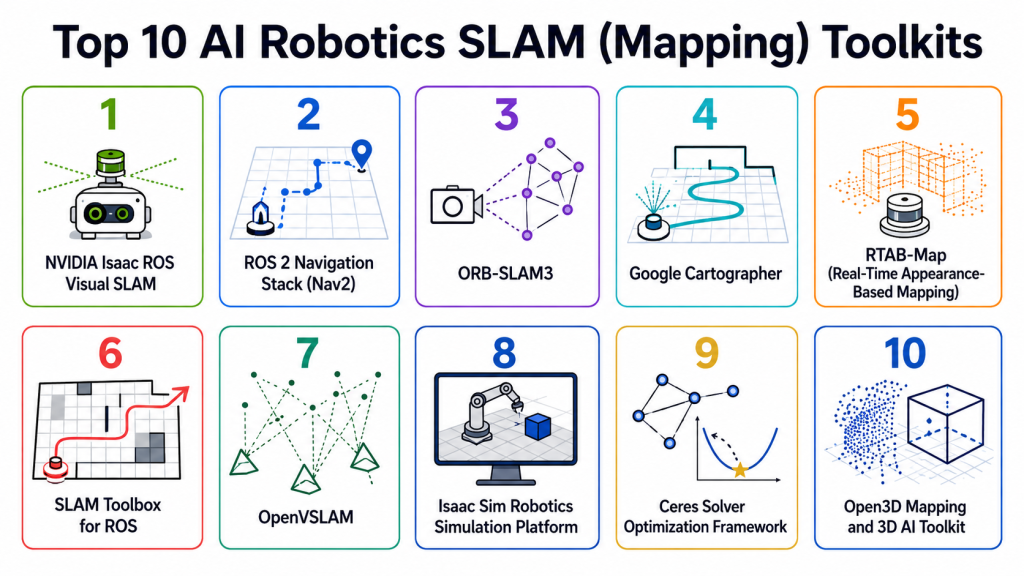
Top 10 AI Robotics SLAM (Mapping) Toolkits
#1 — NVIDIA Isaac ROS Visual SLAM
One-line verdict: Best for developers building high-performance AI-powered robotic mapping and localization systems.
Short description:
NVIDIA Isaac ROS Visual SLAM provides robotics developers with accelerated tools for visual navigation, localization, and mapping workflows. It is designed for robots requiring real-time perception and AI-powered spatial understanding.
Standout Capabilities
- Visual SLAM processing.
- GPU-accelerated robotics workflows.
- Real-time localization.
- Camera-based mapping.
- Robotics middleware integration.
- AI perception support.
- Simulation compatibility.
AI-Specific Depth
- Model support: Supports AI-powered robotics perception workflows.
- RAG / knowledge integration: N/A.
- Evaluation: Supports robotics testing and benchmarking workflows.
- Guardrails: Safety controls depend on application implementation.
- Observability: Performance monitoring depends on integrated tools.
Pros
- High-performance robotics processing.
- Suitable for advanced autonomous systems.
- Strong AI hardware ecosystem.
Cons
- Requires compatible hardware knowledge.
- Learning curve can be high.
- Deployment complexity varies.
Security & Compliance
Security depends on implementation and deployment configuration. Specific certifications are not publicly stated.
Deployment & Platforms
- Edge robotics systems.
- GPU-enabled hardware.
- Simulation environments.
Integrations & Ecosystem
Supports:
- Robotics middleware
- AI frameworks
- Camera sensors
- Simulation platforms
- GPU acceleration tools
Pricing Model
Not publicly stated.
Best-Fit Scenarios
- Autonomous robots.
- Industrial robotics.
- AI navigation systems.
#2 — ROS 2 Navigation Stack (Nav2)
One-line verdict: Best for robotics developers needing an open navigation framework with SLAM support.
Short description:
ROS 2 Navigation Stack provides tools for robot navigation, localization, path planning, and autonomous movement. It works with various SLAM systems to help developers build complete robotic navigation solutions.
Standout Capabilities
- Robot navigation.
- Path planning.
- Localization support.
- SLAM integration.
- Sensor data handling.
- Autonomous movement.
- Robotics middleware support.
AI-Specific Depth
- Model support: Supports integration with AI perception and navigation models.
- RAG / knowledge integration: N/A.
- Evaluation: Requires integrated benchmarking tools.
- Guardrails: Requires application-specific safety implementation.
- Observability: Provides robotics debugging capabilities.
Pros
- Large robotics developer ecosystem.
- Highly customizable.
- Supports many robot platforms.
Cons
- Requires robotics expertise.
- SLAM depends on additional packages.
- Configuration can be complex.
Security & Compliance
Security depends on implementation. Specific certifications are not publicly stated.
Deployment & Platforms
- Linux environments.
- Robotics hardware.
- Simulation platforms.
Integrations & Ecosystem
Supports:
- SLAM libraries
- Robot hardware
- Sensor platforms
- Simulation tools
- AI frameworks
Pricing Model
Open-source framework.
Best-Fit Scenarios
#3 — ORB-SLAM3
One-line verdict: Best for researchers and developers building vision-based localization and mapping systems.
Short description:
ORB-SLAM3 is a visual SLAM framework designed for camera-based localization, mapping, and tracking applications. It supports advanced robotics and autonomous systems that require accurate position estimation using visual information.
Standout Capabilities
- Visual SLAM processing.
- Monocular, stereo, and RGB-D camera support.
- Feature-based tracking.
- Map creation.
- Localization.
- Multi-sensor support.
- Robotics research applications.
AI-Specific Depth
- Model support: Supports integration with computer vision and machine learning workflows.
- RAG / knowledge integration: N/A.
- Evaluation: Uses SLAM accuracy benchmarks and robotics testing methods.
- Guardrails: Requires application-level safety controls.
- Observability: Visualization and debugging depend on implementation.
Pros
- Widely used in robotics research.
- Supports multiple camera configurations.
- Strong localization capabilities.
Cons
- Requires technical expertise.
- Mostly focused on visual SLAM.
- Production deployment requires additional engineering.
Security & Compliance
Security depends on implementation. Specific certifications are not publicly stated.
Deployment & Platforms
- Linux environments.
- Robotics systems.
- Research platforms.
Integrations & Ecosystem
Supports:
- Camera sensors
- Robotics frameworks
- Computer vision libraries
- Autonomous systems
- Simulation environments
Pricing Model
Open-source framework.
Best-Fit Scenarios
- Robotics research.
- Autonomous navigation projects.
- Vision-based robots.
#4 — Google Cartographer
One-line verdict: Best for robots requiring real-time 2D and 3D mapping with sensor fusion.
Short description:
Google Cartographer is a SLAM library designed for building accurate maps using sensor data such as LiDAR and IMU information. It is used in robotics applications requiring mapping and localization capabilities.
Standout Capabilities
- Real-time SLAM.
- 2D mapping.
- 3D mapping.
- LiDAR processing.
- Sensor fusion.
- Localization support.
- Large environment mapping.
AI-Specific Depth
- Model support: Algorithm-based SLAM with integration possibilities.
- RAG / knowledge integration: N/A.
- Evaluation: Supports mapping accuracy evaluation.
- Guardrails: Requires application-specific controls.
- Observability: Provides mapping visualization capabilities.
Pros
- Strong mapping capabilities.
- Supports multiple sensor inputs.
- Suitable for large environments.
Cons
- Requires technical knowledge.
- Development activity varies.
- AI features depend on additional integrations.
Security & Compliance
Security depends on implementation. Specific certifications are not publicly stated.
Deployment & Platforms
- Linux.
- Robotics platforms.
- Simulation environments.
Integrations & Ecosystem
Supports:
- LiDAR sensors
- IMU devices
- Robotics frameworks
- Navigation systems
- Sensor platforms
Pricing Model
Open-source framework.
Best-Fit Scenarios
- Warehouse robots.
- Indoor navigation.
- Mapping applications.
#5 — RTAB-Map (Real-Time Appearance-Based Mapping)
One-line verdict: Best for robots combining visual perception with 3D environment mapping.
Short description:
RTAB-Map is an open-source SLAM approach focused on appearance-based mapping and visual navigation. It supports robots using cameras, depth sensors, and LiDAR systems for creating detailed maps.
Standout Capabilities
- Visual SLAM.
- 3D mapping.
- RGB-D processing.
- Loop closure detection.
- Sensor integration.
- Environment reconstruction.
- Robotics navigation support.
AI-Specific Depth
- Model support: Supports integration with AI perception systems.
- RAG / knowledge integration: N/A.
- Evaluation: Mapping accuracy can be evaluated through SLAM benchmarks.
- Guardrails: Depends on robotic application design.
- Observability: Visualization tools available.
Pros
- Supports multiple sensor types.
- Useful for 3D robotics applications.
- Flexible open-source architecture.
Cons
- Performance depends on hardware.
- Requires configuration expertise.
- Large-scale deployment may need optimization.
Security & Compliance
Security depends on implementation. Specific certifications are not publicly stated.
Deployment & Platforms
- Linux.
- Windows.
- Robotics environments.
Integrations & Ecosystem
Supports:
- RGB-D cameras
- LiDAR sensors
- ROS ecosystem
- Navigation frameworks
- Robotics applications
Pricing Model
Open-source framework.
Best-Fit Scenarios
- Mobile robots.
- 3D mapping projects.
- Autonomous navigation.
#6 — SLAM Toolbox for ROS
One-line verdict: Best for ROS-based robots requiring reliable 2D mapping and localization.
Short description:
SLAM Toolbox is a SLAM solution designed for ROS-based robotics applications. It provides tools for mapping, localization, and navigation workflows in mobile robots.
Standout Capabilities
- 2D SLAM.
- Map management.
- Localization.
- ROS integration.
- Navigation support.
- Real-time mapping.
- Lifecycle management.
AI-Specific Depth
- Model support: Algorithmic SLAM with AI integration possibilities.
- RAG / knowledge integration: N/A.
- Evaluation: Mapping performance can be benchmarked.
- Guardrails: Requires robotics safety implementation.
- Observability: ROS visualization tools support monitoring.
Pros
- Strong ROS ecosystem compatibility.
- Suitable for mobile robots.
- Open-source availability.
Cons
- Primarily focused on 2D SLAM.
- Requires ROS knowledge.
- Limited standalone capabilities.
Security & Compliance
Security depends on implementation. Specific certifications are not publicly stated.
Deployment & Platforms
- Linux.
- ROS environments.
- Robotics hardware.
Integrations & Ecosystem
Supports:
- ROS navigation tools
- Robot sensors
- Mapping systems
- Mobile robots
- Simulation platforms
Pricing Model
Open-source framework.
Best-Fit Scenarios
- Indoor robots.
- Research robots.
- Warehouse automation.
#7 — OpenVSLAM
One-line verdict: Best for developers creating flexible visual SLAM applications.
Short description:
OpenVSLAM is an open-source visual SLAM framework that enables camera-based localization and mapping. It provides flexibility for developers building computer vision-based robotic applications.
Standout Capabilities
- Visual SLAM.
- Camera-based localization.
- Mapping.
- Feature tracking.
- Multiple camera support.
- Localization workflows.
- Computer vision integration.
AI-Specific Depth
- Model support: Integrates with computer vision workflows.
- RAG / knowledge integration: N/A.
- Evaluation: Requires SLAM benchmarking.
- Guardrails: Application-level controls required.
- Observability: Visualization support available.
Pros
- Flexible architecture.
- Useful for research applications.
- Supports visual robotics projects.
Cons
- Requires development expertise.
- Primarily vision-focused.
- Production deployment requires engineering.
Security & Compliance
Security depends on implementation. Specific certifications are not publicly stated.
Deployment & Platforms
- Linux.
- Robotics environments.
- Development systems.
Integrations & Ecosystem
Supports:
- Camera systems
- Computer vision libraries
- Robotics frameworks
- Autonomous applications
- Research workflows
Pricing Model
Open-source framework.
Best-Fit Scenarios
- Vision-based robots.
- Research projects.
- Autonomous navigation.
#8 — Isaac Sim Robotics Simulation Platform
One-line verdict: Best for testing AI SLAM systems through realistic robotics simulation environments.
Short description:
Isaac Sim provides simulation capabilities for developing and testing robotics applications. It helps teams evaluate perception, mapping, navigation, and autonomous behaviors before real-world deployment.
Standout Capabilities
- Robotics simulation.
- Synthetic data generation.
- Sensor simulation.
- AI testing.
- Virtual environments.
- Robot workflow validation.
- Digital testing.
AI-Specific Depth
- Model support: Supports AI robotics workflows.
- RAG / knowledge integration: N/A.
- Evaluation: Enables simulation-based evaluation.
- Guardrails: Testing environments support safety validation.
- Observability: Simulation visualization and analytics available.
Pros
- Reduces physical testing requirements.
- Supports complex robotics scenarios.
- Useful for AI development.
Cons
- Requires computing resources.
- Simulation setup can be complex.
- Not a standalone SLAM algorithm.
Security & Compliance
Security depends on deployment. Specific certifications are not publicly stated.
Deployment & Platforms
- GPU-enabled systems.
- Simulation environments.
- Development platforms.
Integrations & Ecosystem
Supports:
- Robotics frameworks
- AI models
- Sensor simulation
- Robot platforms
- Development workflows
Pricing Model
Not publicly stated.
Best-Fit Scenarios
- Robotics research.
- Autonomous system testing.
- AI simulation workflows.
#9 — Ceres Solver Optimization Framework
One-line verdict: Best for developers improving optimization performance inside SLAM pipelines.
Short description:
Ceres Solver is an optimization library used in robotics and computer vision applications. It helps developers solve complex mathematical optimization problems commonly found in SLAM systems.
Standout Capabilities
- Nonlinear optimization.
- Parameter estimation.
- Robotics mathematics.
- Computer vision optimization.
- SLAM backend support.
- Algorithm development.
AI-Specific Depth
- Model support: Supports integration with AI perception pipelines.
- RAG / knowledge integration: N/A.
- Evaluation: Requires application-specific testing.
- Guardrails: Depends on implementation.
- Observability: Requires additional tools.
Pros
- Strong optimization capabilities.
- Widely used in robotics research.
- Flexible mathematical framework.
Cons
- Not a complete SLAM toolkit.
- Requires advanced expertise.
- Lower-level development needed.
Security & Compliance
Security depends on implementation. Specific certifications are not publicly stated.
Deployment & Platforms
- Linux.
- Development environments.
- Robotics systems.
Integrations & Ecosystem
Supports:
- SLAM frameworks
- Computer vision systems
- Robotics applications
- Optimization workflows
- Research tools
Pricing Model
Open-source framework.
Best-Fit Scenarios
- SLAM research.
- Algorithm development.
- Robotics optimization.
#10 — Open3D Mapping and 3D AI Toolkit
One-line verdict: Best for developers building AI-powered 3D mapping and spatial intelligence applications.
Short description:
Open3D provides tools for 3D data processing, visualization, and machine learning workflows. Robotics teams use it for spatial understanding, mapping, and 3D perception applications.
Standout Capabilities
- 3D data processing.
- Point cloud handling.
- Mapping workflows.
- Visualization.
- Machine learning integration.
- Spatial analysis.
- Sensor data processing.
AI-Specific Depth
- Model support: Supports AI and machine learning integration.
- RAG / knowledge integration: N/A.
- Evaluation: Requires custom testing.
- Guardrails: Application-level controls required.
- Observability: Visualization capabilities available.
Pros
- Strong 3D processing capabilities.
- Useful for robotics research.
- Supports modern AI workflows.
Cons
- Requires technical expertise.
- Not a complete navigation system.
- Production deployment requires additional tools.
Security & Compliance
Security depends on implementation. Specific certifications are not publicly stated.
Deployment & Platforms
- Linux.
- Windows.
- macOS.
- Robotics environments.
Integrations & Ecosystem
Supports:
- 3D sensors
- Robotics frameworks
- AI libraries
- Simulation tools
- Data processing systems
Pricing Model
Open-source framework.
Best-Fit Scenarios
- 3D robotics research.
- Autonomous systems.
- Spatial AI applications.
Comparison Table (Top 10 AI Robotics SLAM Mapping Toolkits)
| Tool Name | Best For | Deployment | Model Flexibility | Strength | Watch-Out | Public Rating |
|---|---|---|---|---|---|---|
| NVIDIA Isaac ROS Visual SLAM | AI robotics mapping | Edge | AI models | GPU acceleration | Hardware requirements | N/A |
| ROS 2 Nav2 | Robot navigation | Local/Edge | Multi-model | Open ecosystem | Requires expertise | N/A |
| ORB-SLAM3 | Vision SLAM | Local | Custom models | Camera localization | Technical complexity | N/A |
| Google Cartographer | Sensor-based mapping | Local | Algorithm integration | LiDAR mapping | Configuration effort | N/A |
| RTAB-Map | 3D mapping | Local | AI integration | RGB-D mapping | Hardware dependency | N/A |
| SLAM Toolbox | ROS mapping | Local | ROS ecosystem | 2D SLAM | Limited scope | N/A |
| OpenVSLAM | Visual mapping | Local | Vision models | Flexible architecture | Development required | N/A |
| Isaac Sim | Simulation testing | GPU/Cloud | AI workflows | Robotics simulation | Resource intensive | N/A |
| Ceres Solver | SLAM optimization | Local | Custom algorithms | Optimization | Not complete SLAM | N/A |
| Open3D | 3D AI mapping | Multi-platform | ML integration | Spatial processing | Requires expertise | N/A |
Scoring & Evaluation (Transparent Rubric)
The following scoring framework compares AI Robotics SLAM (Mapping) Toolkits based on practical robotics development requirements. The evaluation considers mapping accuracy, localization reliability, sensor support, AI integration, performance, developer experience, scalability, security, and ecosystem maturity. Scores are comparative indicators and should be validated according to robot type, environment complexity, sensor configuration, and deployment goals.
| Tool | Core | Reliability/Eval | Guardrails | Integrations | Ease | Perf/Cost | Security/Admin | Support | Weighted Total |
|---|---|---|---|---|---|---|---|---|---|
| NVIDIA Isaac ROS Visual SLAM | 9 | 9 | 8 | 10 | 8 | 9 | 9 | 9 | 8.95 |
| ROS 2 Navigation Stack | 9 | 8 | 8 | 10 | 8 | 8 | 8 | 10 | 8.75 |
| ORB-SLAM3 | 9 | 9 | 8 | 8 | 7 | 9 | 8 | 9 | 8.45 |
| Google Cartographer | 9 | 9 | 8 | 9 | 7 | 8 | 8 | 9 | 8.45 |
| RTAB-Map | 8 | 8 | 8 | 9 | 8 | 8 | 8 | 9 | 8.20 |
| SLAM Toolbox | 8 | 8 | 8 | 9 | 8 | 8 | 8 | 9 | 8.20 |
| OpenVSLAM | 8 | 8 | 8 | 8 | 7 | 8 | 8 | 9 | 8.00 |
| Isaac Sim | 9 | 9 | 9 | 10 | 7 | 8 | 9 | 9 | 8.75 |
| Ceres Solver | 8 | 9 | 8 | 8 | 6 | 9 | 8 | 9 | 8.00 |
| Open3D | 8 | 8 | 8 | 9 | 8 | 8 | 8 | 9 | 8.20 |
Top 3 for Enterprise
1. NVIDIA Isaac ROS Visual SLAM
Best suited for enterprises developing advanced autonomous robots requiring high-performance AI mapping and localization.
2. ROS 2 Navigation Stack
A strong choice for organizations requiring flexible robotics architectures and broad hardware compatibility.
3. NVIDIA Isaac Sim
Suitable for enterprises needing simulation-driven robotics development and SLAM validation.
Top 3 for SMB
1. ROS 2 Navigation Stack
A practical option for startups and smaller robotics teams building customizable robot navigation systems.
2. RTAB-Map
Useful for organizations working on visual mapping and mobile robot applications.
3. Open3D
Suitable for teams developing 3D mapping and spatial intelligence solutions.
Top 3 for Developers
1. ROS 2 Navigation Stack
Best for developers building complete robotics applications with navigation and SLAM integration.
2. ORB-SLAM3
Ideal for developers researching and implementing visual SLAM systems.
3. OpenCV and Open3D Ecosystems
Useful for developers creating custom perception and 3D mapping workflows.
Which AI Robotics SLAM (Mapping) Toolkit Is Right for You?
Choosing the right AI Robotics SLAM toolkit depends on the robot type, operating environment, sensor availability, accuracy requirements, and development resources.
There is no single universal winner because different robotics applications require different approaches. A warehouse robot, autonomous vehicle, drone, and research robot may require completely different SLAM capabilities.
Solo / Freelancer
Individual developers, students, and robotics researchers usually need accessible and flexible tools.
Recommended Options:
- ROS 2 Navigation Stack.
- ORB-SLAM3.
- Open3D.
Best Approach:
- Start with simulation environments.
- Test camera and LiDAR-based mapping.
- Build simple navigation workflows.
- Evaluate localization accuracy.
Important Priorities:
- Documentation.
- Community support.
- Hardware flexibility.
- Learning resources.
SMB
Small robotics companies and startups usually need practical frameworks that support faster development.
Recommended Options:
- ROS 2.
- RTAB-Map.
- Open3D.
Important Priorities:
- Easy integration.
- Lower development effort.
- Sensor compatibility.
- Deployment flexibility.
SMBs should focus on reliable mapping capabilities rather than unnecessary complexity.
Mid-Market
Growing robotics companies require scalable SLAM solutions for production environments.
Recommended Options:
- NVIDIA Isaac ROS.
- Google Cartographer.
- SLAM Toolbox.
Important Evaluation Areas:
- Localization accuracy.
- Real-time performance.
- Hardware support.
- Testing workflows.
- Maintenance requirements.
Mid-market organizations should choose solutions that can support increasing robot fleets and operational complexity.
Enterprise
Large robotics organizations need production-ready architectures with strong performance and governance.
Recommended Options:
- NVIDIA Isaac ROS Visual SLAM.
- ROS 2 Navigation Stack.
- NVIDIA Isaac Sim.
Enterprise Priorities:
- Multi-robot scalability.
- High localization accuracy.
- Security controls.
- Simulation testing.
- AI monitoring.
- Hardware optimization.
Regulated Industries (Finance, Healthcare, Public Sector)
Robotics systems used in sensitive environments may process operational data, environmental information, human interaction data, and facility maps.
Important considerations:
- Secure storage of generated maps.
- Access control policies.
- Protection of sensor data.
- Model security.
- Audit capabilities.
- Human safety validation.
Organizations should evaluate security and governance requirements before deploying AI-powered mapping systems.
Budget vs Premium
Budget-Focused Approach
Suitable for research teams, startups, and organizations experimenting with robotics.
Consider:
- Open-source SLAM frameworks.
- Community-supported robotics tools.
- Simulation-based testing.
Advantages:
- Lower initial cost.
- Greater customization.
- Faster experimentation.
Premium Enterprise Approach
Suitable for industrial robotics companies and autonomous system providers.
Consider:
- AI-accelerated robotics platforms.
- Advanced simulation environments.
- Enterprise robotics ecosystems.
Advantages:
- Better performance.
- Faster development cycles.
- Improved scalability.
- Production support.
Build vs Buy (When to DIY)
Build Custom SLAM Systems When:
- The environment has unique challenges.
- Custom localization accuracy is required.
- The organization has robotics expertise.
- Existing solutions cannot meet requirements.
Use Existing SLAM Toolkits When:
- Faster development is required.
- Standard mapping capabilities are sufficient.
- Engineering resources are limited.
- Proven robotics frameworks are preferred.
A hybrid approach is common, where organizations combine open-source SLAM algorithms with commercial hardware, simulation platforms, and AI acceleration technologies.
Implementation Playbook (30 / 60 / 90 Days)
First 30 Days: Pilot and Define Success Metrics
The first phase focuses on understanding mapping requirements and testing initial SLAM workflows.
Key Activities:
- Identify robot navigation requirements.
- Select sensors.
- Prepare test environments.
- Choose SLAM framework.
Success Metrics:
- Localization accuracy.
- Mapping quality.
- Processing speed.
- System stability.
- Navigation reliability.
AI-Specific Tasks:
- Prepare sensor datasets.
- Define evaluation benchmarks.
- Test mapping scenarios.
- Establish data management practices.
First 60 Days: Security, Evaluation, and Controlled Deployment
The second phase focuses on improving reliability and preparing production workflows.
Key Activities:
- Test robots in realistic environments.
- Evaluate mapping accuracy.
- Optimize sensor configurations.
- Improve navigation workflows.
AI-Specific Tasks:
- Run localization evaluations.
- Test difficult environments.
- Monitor mapping errors.
- Track model and algorithm versions.
- Review failure scenarios.
First 90 Days: Optimization and Scale
The final phase focuses on expanding SLAM capabilities across robotics operations.
Key Activities:
- Deploy across additional robots.
- Improve processing efficiency.
- Optimize hardware usage.
- Expand mapping scenarios.
AI-Specific Tasks:
- Monitor localization drift.
- Improve perception accuracy.
- Optimize latency.
- Track system performance.
- Establish governance processes.
Common Mistakes & How to Avoid Them
- ❌ Selecting a SLAM toolkit without considering sensors.
✅ Match frameworks with cameras, LiDAR, and hardware requirements. - ❌ Ignoring environmental challenges.
✅ Test in real operating conditions. - ❌ Using poor-quality sensor data.
✅ Improve calibration and data quality. - ❌ Focusing only on mapping accuracy.
✅ Consider speed, reliability, and deployment needs. - ❌ Skipping simulation testing.
✅ Validate systems before physical deployment. - ❌ Ignoring hardware limitations.
✅ Optimize models for available computing resources. - ❌ Not measuring localization drift.
✅ Continuously evaluate mapping performance. - ❌ Deploying without safety validation.
✅ Maintain operational safeguards. - ❌ Ignoring cybersecurity.
✅ Protect maps, models, and robot systems. - ❌ Building without future scalability planning.
✅ Select frameworks that support growth. - ❌ Depending on one technology stack.
✅ Maintain flexibility where possible. - ❌ Not involving robotics engineers early.
✅ Combine AI expertise with robotics knowledge.
FAQs
1. What is AI Robotics SLAM?
AI Robotics SLAM is a technology that allows robots to create maps and understand their location using sensors and artificial intelligence.
2. Why is SLAM important for robots?
SLAM enables robots to navigate unknown environments without relying only on predefined maps.
3. What sensors are used in SLAM systems?
Common sensors include cameras, LiDAR, depth sensors, IMU, and GPS systems.
4. Can AI improve SLAM accuracy?
Yes. AI techniques can improve perception, object understanding, and environmental interpretation.
5. Are SLAM toolkits used in autonomous vehicles?
Yes. SLAM is an important technology for localization and environmental understanding in autonomous systems.
6. Can beginners learn SLAM frameworks?
Yes. Open-source tools provide learning opportunities, although advanced SLAM development requires robotics knowledge.
7. What is the difference between mapping and localization?
Mapping creates an understanding of the environment, while localization determines where the robot is within that environment.
8. Are open-source SLAM frameworks reliable?
Many are widely used, but performance depends on implementation, hardware, sensors, and testing.
9. Can SLAM work without AI?
Traditional SLAM algorithms can work without AI, but AI improves perception and environmental understanding.
10. Can SLAM run on edge devices?
Yes. Many SLAM systems are optimized for embedded and edge robotics hardware.
11. How do companies evaluate SLAM performance?
Companies evaluate accuracy, processing speed, localization stability, sensor compatibility, and reliability.
12. What is the future of AI Robotics SLAM?
Future SLAM systems are expected to combine AI reasoning, semantic understanding, multimodal sensors, and autonomous decision-making.
Conclusion
AI Robotics SLAM (Mapping) Toolkits are becoming a foundation for modern autonomous robotics. By combining sensor processing, artificial intelligence, computer vision, and spatial understanding, these technologies allow robots to navigate complex environments more safely and efficiently.The best SLAM toolkit depends on application requirements, hardware configuration, environmental complexity, and development expertise. Research teams may prefer flexible open-source frameworks, while enterprises may require optimized platforms with simulation and production capabilities.Successful SLAM implementation requires accurate sensors, continuous testing, strong evaluation processes, and secure deployment practices. Organizations that choose the right toolkit can build smarter, more reliable, and more capable robotic systems.

Find Trusted Cardiac Hospitals
Compare heart hospitals by city and services — all in one place.
Explore Hospitals