
Almost every comparison guide in this market is published by a company that sells the thing being compared. And funnily enough, that company usually comes out looking pretty good.
So here is where we stand. Nobody on this list is affiliated with this publication, and there is no winner at the end. We set the criteria first, then built the list against them.
The other thing worth saying upfront is that this is written for large organisations. A lot of comparison content quietly assumes you are one company, in one country, with a few hundred laptops. If that were your situation, these questions would be simpler. They are not simple, because you are probably dealing with subsidiaries, an acquisition or two still running on their own infrastructure, several regulators, and a security team that already exists and does not want to be replaced.
The Shortlist at a Glance
| Provider | Model | Response authority | Best fit |
| CrowdStrike Falcon Complete Next-Gen MDR | Own platform | Full containment | Large mixed-OS estates |
| SentinelOne Singularity MDR | Own platform | Full containment | Existing SentinelOne shops |
| Palo Alto Unit 42 MDR | Own platform | Full containment | Palo Alto network estates |
| Trend Service One | Own platform | Full containment | Industrial environments |
| Microsoft Defender Experts | Platform-native | Managed and guided | Microsoft-standardised orgs |
| Sophos MDR | Platform-native and open | Full on higher tier | Mid-market to enterprise |
| ESET MDR Ultimate | Platform-native | Monitoring, triage and response | ESET PROTECT estates |
| Bitdefender MDR | Platform-native | Pre-approved actions | Cost-sensitive enterprises |
| Arctic Wolf | Stack-agnostic | Bounded containment, then guided | Lean internal teams |
| Expel | Stack-agnostic | Automated and guided | Teams wanting visibility |
| Red Canary | Stack-agnostic | Full containment | Multi-vendor estates |
| Secureworks Taegis | Open XDR | Full containment | Heterogeneous estates |
Three things to notice. Response authority is the real dividing line, and “guided response” means your team is the one clicking buttons at 3am. Coverage breadth matters more than detection quality once you are past a certain size. And two names here now share a parent, because Sophos completed its acquisition of Secureworks in February 2025.
How We Built This List
We looked at providers selling managed detection and response to large organisations, then kept the ones commercially available across multiple regions with documented, specific response capability. That left twelve.
Sources were vendor documentation, independent analyst evaluations, MITRE results, and regulatory primary sources.
What we deliberately left out matters as much:
- No pricing comparison. Enterprise pricing here is negotiated, and published figures are not comparable.
- No scores. We do not have consistent enough data across twelve providers to assign honest numbers, and a precise-looking table built on guesswork is worse than no table.
- No ranking. Fit depends on your estate, not on some universal quality order.
- No provider here is affiliated with this publication. That is worth stating plainly, because most guides in this category are written by someone who appears in their own comparison.
What Actually Changes at Scale
Four things, and they are why generic advice keeps missing.
Your org chart is messy. You are not one tenant. You are a parent with regions, plus whatever you bought last year that is still sitting on its own directory.
You answer to several regulators at once. Not one framework. Several, sometimes with conflicting reporting clocks.
You cannot rip things out quickly. Platform commitments run for years and are tangled in licensing agreements nobody wants to reopen.
You already have a security team. You are buying hours, regions or specialist skills, not a first security function. That makes this a different decision from the one a smaller company faces when it first looks at cybersecurity management services, because you are filling defined gaps rather than standing up a capability from zero.
The Six Questions That Decide It
Who is allowed to act, and when
This matters most and gets asked least clearly. When your provider confirms a live intrusion on a Saturday night, what are they contractually allowed to do without waking someone up?
Answers range from full containment, where they isolate the machine and disable the account themselves, down to investigating and emailing you recommendations. There is also a middle ground that is easy to miss: several providers work from a pre-approved list of specific actions they can take autonomously, and hand everything outside that list back to you. That model is genuinely useful, but it is not the same as open-ended authority, and the marketing language for both sounds nearly identical.
Get the exact list of permitted actions into the contract, along with who carries the risk if they contain the wrong thing. This matters more than it did two years ago, because automation widened the gap between the models considerably.
What gets watched
Endpoint monitoring alone stopped being enough a while back. Score endpoint, identity, email, SaaS, cloud workload, network and operational technology separately, because most providers do two or three properly and thin out fast after that.
Identity deserves particular attention. It is now the main escalation path in enterprise intrusions, and an identity attack can run to completion without ever touching a managed laptop in a way endpoint tooling would catch.
How it handles a messy org chart
Can they run separate tenants under one contract? How fast can they onboard something you just acquired? Will they cover part of the estate rather than demanding all of it? Sustained acquisition activity has left plenty of enterprise environments fragmented, and providers differ wildly here.
Where your data lives
You are handing a third party deep visibility into your environment. Where that telemetry rests, which government can compel access to it, and which regulators the provider can produce evidence for are procurement questions, not technical ones.
Treat NIS2, DORA, SEC disclosure and your sector rules as a set. A provider strong on one is not automatically strong on the rest, and plenty of marketing leans hard on whichever one it happens to handle well.
Who is actually on shift
Follow-the-sun coverage across several physical SOCs behaves differently from one SOC with a night shift. Named-team models give you better context and scale worse. Neither is inherently better.
Ask about analyst turnover and who holds knowledge of your environment. Consolidation in this market has made continuity a genuinely live question at more than one provider.
Who says so besides the vendor
Vendor-published metrics are not comparable, because every vendor defines and measures them in whatever way flatters them. Analyst evaluations and MITRE results are imperfect, but they are the only assessments here not written by someone selling you something.
One practical note: check the exact scope of any award a provider cites. Several evaluations in this market are segmented by company size, and a leadership placement in a midmarket study tells you something quite different from one in an enterprise study.
Coverage, Side by Side
Values below reflect the core service. Add-on modules and expanded scope change the picture for several providers, so treat this as a starting point for your questions rather than a final answer.
| Provider | Endpoint | Identity | OT | |
| CrowdStrike | Native | Native | Via SIEM scope | Limited |
| SentinelOne | Native | Add-on | Add-on | Limited |
| Palo Alto | Native | Native | Add-on | Partial |
| Trend | Native | Native | Native | Partial |
| Microsoft | Native | Native | Native | Excluded |
| Sophos | Native | Native | Native | Partial |
| ESET | Native | Not stated | Not stated | Not stated |
| Bitdefender | Native | Native | Add-on | Limited |
| Arctic Wolf | Integration | Integration | Integration | Limited |
| Expel | Integration | Integration | Integration | Limited |
| Red Canary | Multi-EDR | Native | Integration | Limited |
| Secureworks | Multi-EDR | Native | Integration | Included |
Operational technology is where the field thins most. If you have a plant floor or building management systems in scope, that column should probably drive your shortlist, and you should ask whether industrial coverage sits inside the managed service or is sold alongside it. Microsoft excludes its IoT product from the managed service outright.
The Shortlist, Profiled
ESET MDR Ultimate
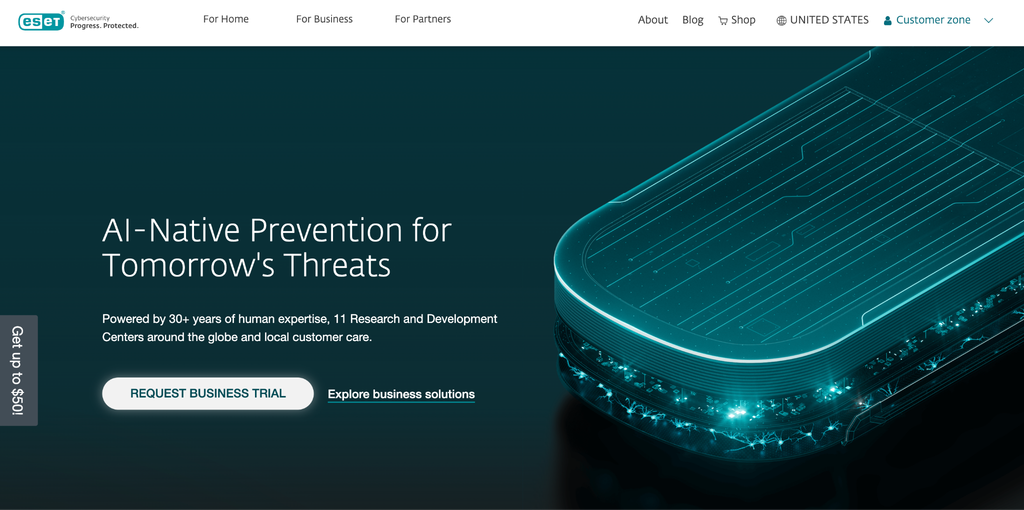
Platform-native, built on ESET PROTECT, with 24/7 threat monitoring, triage and response. The enterprise tier adds retrospective and customised threat hunting, attack vector visibility, forensic incident response support and a dedicated response lead, none of which come with the standard tier. ESET was named a Market Leader in the KuppingerCole Leadership Compass 2026, and its threat intelligence draws on 11 R&D centers and a telemetry network of more than 100 million sensors. Strongest on: independent analyst validation and the depth of the enterprise tier. Weakest on: the gap between the two tiers is wide, so check which one any quoted figure refers to, and industrial coverage is not a stated strength.
CrowdStrike Falcon Complete Next-Gen MDR
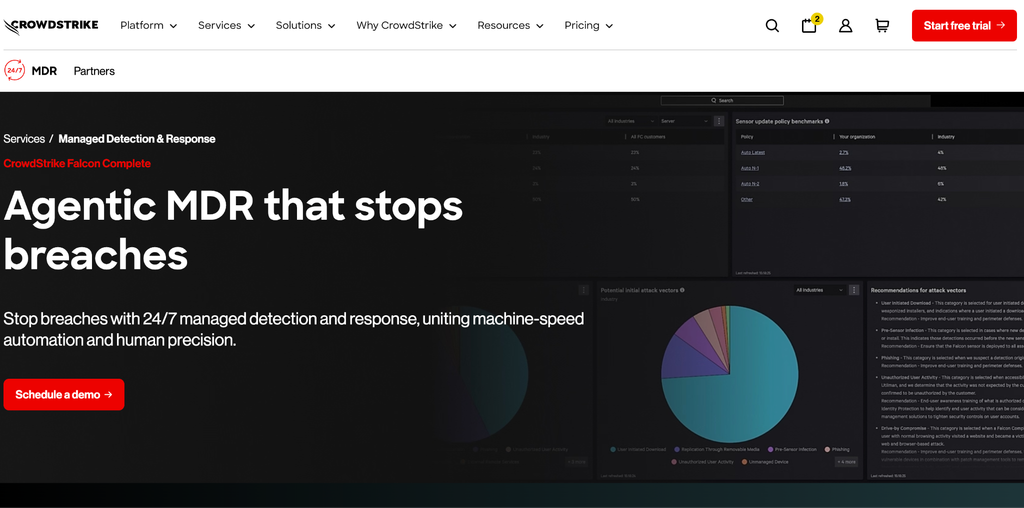
Own agent, full containment across endpoint, identity and cloud telemetry. The threat intelligence depth is genuinely top of market, and the service has participated in MITRE Engenuity’s ATT&CK Evaluations for Managed Services. Analysts contain directly through the platform rather than routing actions back to you. Strongest on: containment speed and intelligence depth. Weakest on: you deploy their agent everywhere, which means paying twice if you already have endpoint protection entitled elsewhere. Email and firewall signals sit outside native scope and require their next-generation SIEM to be included, which changes the commercial picture.
SentinelOne Singularity MDR
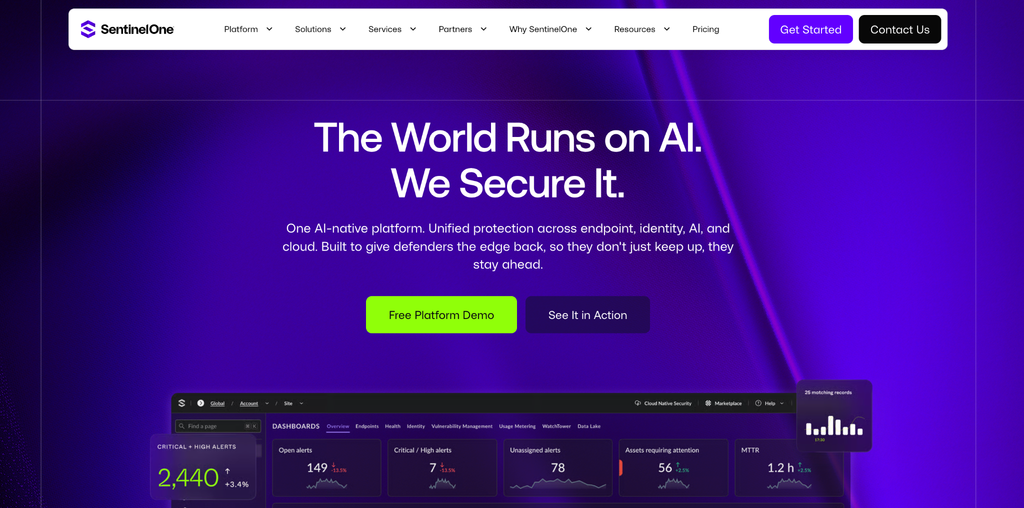
Own agent, full containment. The rollback capability against ransomware encryption is a real differentiator few competitors match, and attack chain reconstruction is strong enough to shorten investigations meaningfully. Strongest on: autonomous response and recovery after encryption. Weakest on: adopting it means displacing your existing endpoint platform rather than layering on top of it, and email and identity coverage need additional modules rather than arriving by default.
Palo Alto Unit 42 MDR

Own platform, full containment. Correlating network and endpoint telemetry in one place surfaces detections neither source produces alone, and the incident response bench sitting behind the service is among the most credible commercially available. The handoff from monitoring into full response is smoother than most competitors manage. Strongest on: network and endpoint correlation, plus the escalation path into full response. Weakest on: value depends heavily on broader platform adoption, so standalone buyers pay for correlation they cannot fully use, and onboarding runs longer than agent-only services.
Trend Service One

Own platform, full containment. Trend has invested in industrial visibility more consistently than most IT-first providers, which matters if control systems are in scope. Strongest on: industrial and mixed IT and OT environments, where the field is thin. Weakest on: confirm what industrial coverage is included in the managed service versus sold alongside it, because the two are easy to conflate, and the breadth of the platform means a longer time to steady state.
Microsoft Defender Experts
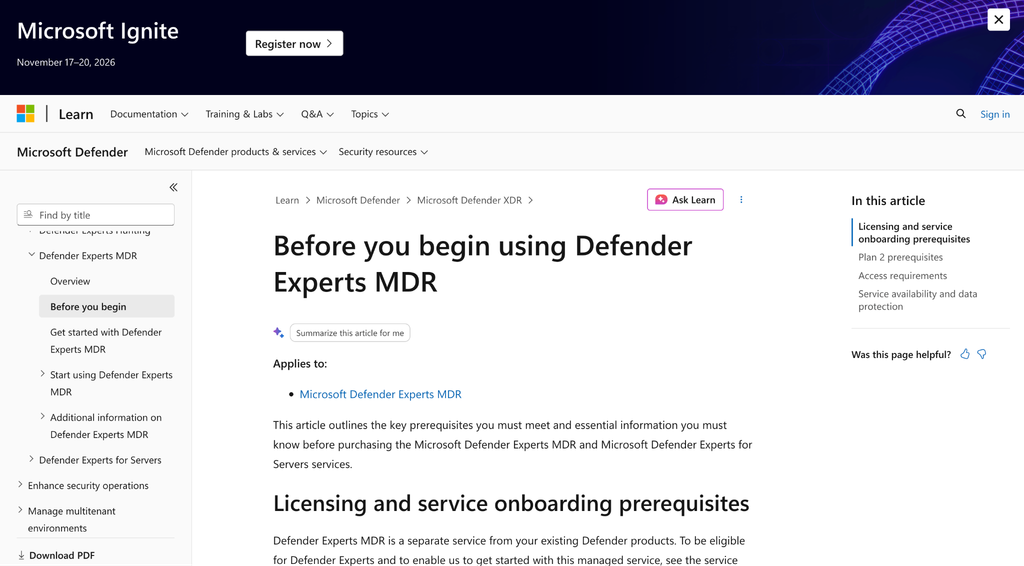
Platform-native, managed and guided. Runs inside Defender with no additional agent. Scoped coverage lets you apply the service to one geography, subsidiary or function rather than the whole tenant, which suits how large organisations are actually structured better than most alternatives. Prerequisites are licensing-based, requiring Defender for Endpoint P2 and Entra ID P1 across the user base. Strongest on: fit with Microsoft-standardised estates, and the scoping flexibility. Weakest on: coverage stops at Microsoft boundaries, so third-party network appliances and non-Microsoft cloud services fall outside it, and the IoT product is excluded from the service entirely.
Sophos MDR
Platform-native and open, full containment on the higher tier. The Secureworks acquisition, completed in February 2025 for $859 million, materially widened what they cover, adding identity threat detection, next-generation SIEM capability and industrial security to what was already a strong service. Strongest on: breadth relative to price, and reach across mid-market and enterprise. Weakest on: the entry tier is notification-only and should not be compared against full-response services, and platform consolidation following the acquisition creates roadmap uncertainty worth asking about directly.
Bitdefender MDR
Platform-native, containment through pre-approved actions. Detection engineering has been consistently well regarded in independent testing, and the service reaches a credible response posture at pricing below the market leaders, which matters once endpoint counts run into five figures. The pre-approved action model lets analysts isolate endpoints and terminate processes without per-incident sign-off, and a security account manager makes contact within thirty minutes of an incident being declared. Strongest on: technical results relative to cost. Weakest on: the brand carries less weight in enterprise procurement than the test results justify, and the global SOC footprint is smaller than the largest competitors, so check coverage in your regions.
Arctic Wolf
Stack-agnostic, with a named concierge team per customer and a defined set of autonomous containment actions. Named a Leader in the 2026 IDC MarketScape for Worldwide Managed Detection and Response Service for Midmarket, which is worth reading precisely: it is a midmarket study, so weight it accordingly if you are larger. The concierge team builds real knowledge of your environment over time and onboarding is unusually well structured. Strongest on: acting as an extension of a small internal team across follow-the-sun SOC coverage. Weakest on: containment is bounded rather than open-ended, so confirm the specific permitted action list during evaluation, and hands-on incident response is sold as a separate retainer.
Expel

Stack-agnostic, automated and guided response. The platform exposes investigation detail in real time, showing what analysts examined and why they concluded what they did. For organisations that need to evidence security operations to auditors or a board, that visibility has practical value beyond reassurance. Strongest on: transparency into the provider’s actual work. Weakest on: you supply the detection tooling, so service quality is bounded by what you already run, and pricing requires sales engagement rather than published rates.
Red Canary

Stack-agnostic, full containment. Supports several endpoint platforms simultaneously, which is exactly what you need when an acquisition left you running two that cannot be consolidated quickly. Detection logic is mapped to MITRE ATT&CK and the service performs active remediation rather than recommendation. Strongest on: genuinely mixed estates. Weakest on: breadth costs some depth on any single platform compared with a vendor-native service, and the operational focus is primarily North American, which affects support hours and regional regulatory familiarity.
Which One Fits Your Situation
You just acquired a company and now run two endpoint platforms. Consolidation will take two years you do not have. Weight coverage breadth and multi-tenant handling hardest. Red Canary and Secureworks Taegis both operate across platforms without demanding a swap first. The trade-off is some detection depth compared with a provider native to one platform.
You operate across several countries under multiple regulators. Weight data residency and regulatory evidence above nearly everything else. Providers headquartered in your primary jurisdiction have a structural advantage here. Sophos and Secureworks have the clearest multi-region footprints. The trade-off is that you may pass over a technically stronger provider on a sovereignty technicality.
You have a plant floor in scope. Coverage is the constraint and the field narrows immediately. Trend and Secureworks Taegis have the strongest industrial stories, with Palo Alto partial. Most others are limited or excluded outright. The trade-off is a shorter list and less negotiating room on price.
You are standardised on one security platform already. Weight integration depth over breadth, because you are buying operators for tooling you already own rather than a second stack. Microsoft Defender Experts, ESET MDR Ultimate and Bitdefender all fit this pattern. The trade-off is that anything outside that platform stays your problem, which is fine until it is not.
You have a small central team and a lot of distributed subsidiaries. Weight onboarding speed and analyst continuity hardest, because your constraint is attention rather than tooling. Arctic Wolf and Expel are both built for this shape, with named teams and structured onboarding. The trade-off is response authority: both lean toward returning decisions to you, which is exactly the thing a stretched team has least of.
What a Comparison Like This Cannot Tell You
Four honest limits.
Detection quality varies by environment more than by vendor, so a published detection rate from someone else’s estate says very little about yours.
Response times are not comparable between providers, because each defines what it is measuring differently. Some measure time to first action, some to containment, some to full resolution. Two figures that look wildly different may be measuring different things entirely.
Analyst quality is regional and shifts with staff turnover. A glowing reference from a customer in another region tells you less than it appears to.
MITRE evaluations test performance against a script. Real incidents are ambiguous, and handling ambiguity well is the actual skill.
The fix is boring but it works. Run a proof of concept against live traffic in one real subsidiary before you sign anything.
Before You Sign
- Permitted actions. The exact list, in writing, plus who carries risk if they contain the wrong thing.
- Coverage, scored separately. One answer per telemetry type, not a single blanket claim.
- Onboarding new entities. How, and how fast.
- Data residency and deletion. Where it rests, and what happens at contract end.
- Regulatory evidence. Can they produce documentation for your specific regimes?
- SOC footprint. How many, where, and follow-the-sun or night shift?
- Analyst continuity. Named team or pooled, and what is turnover?
- Independent validation. Which evaluations, and what was the scope of each one?
- Exit terms. What happens to your detection logic and history if you leave?
- Escalation into full response. What triggers it, who pays, and how fast the bench mobilises.
Common Questions
What is the difference between this and a traditional MSSP?
An MSSP watches and forwards alerts to you. MDR investigates the alert itself and acts on your behalf. The line blurs in practice, which is exactly why the permitted-actions list belongs in the contract rather than the sales conversation.
Do we still need this if we already have a SOC?
Often yes, for different reasons than a smaller company would. Large organisations typically use it to cover hours their team does not staff well, reach regions the central team cannot, or add specialist skills without permanent headcount. It is augmentation, not replacement.
Why is there no pricing comparison here?
Because any number we published would mislead you. Models differ across per endpoint, per user, per volume ingested and flat fee. Enterprise pricing is negotiated individually. And the headline figure rarely includes onboarding, log ingestion or the incident response retainer you would otherwise buy separately.
How much weight should analyst reports carry?
Treat them as one input, not a verdict. Participation is partly self-selected, criteria shift between cycles, and placement captures a single moment. Check the scope too, since several studies are segmented by company size. They remain the only assessment in this market written by someone with nothing to sell you, which makes them useful for building a shortlist even when they should not decide it.
Picking Without a Default Answer
There is no best provider here, which is annoying if you were hoping a table would decide this for you. There is a best fit, and what determines it is your existing platform commitments, your regulators, the shape of your organisation, and how much authority you are genuinely willing to hand over.
The organisations that choose well tend to do two things. They decide what response authority and coverage they need before they start talking to vendors, so the criteria are not quietly reverse-engineered from a preferred answer. And they test against real traffic in a real part of the business, because what separates providers is not how they handle a clean scenario. It is how they handle a confusing one at 3am.

Find Trusted Cardiac Hospitals
Compare heart hospitals by city and services — all in one place.
Explore Hospitals