
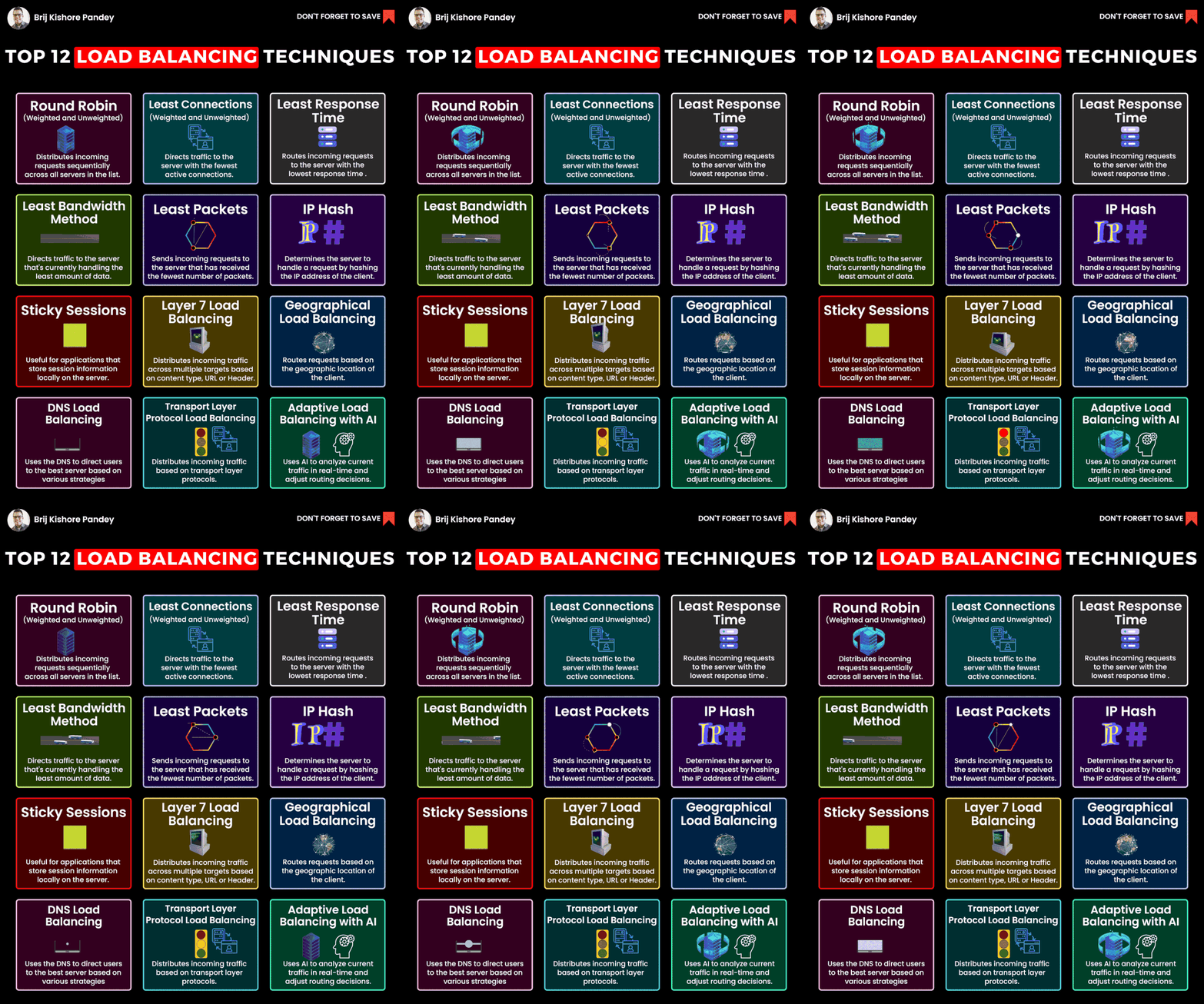
Load balancing techniques are essential for distributing network traffic across multiple servers to ensure optimal performance, high availability, and reliability. Here is a list of popular load balancing techniques:
- Round Robin:
- Requests are distributed to servers in a circular order.
- Simple and easy to implement.
- Doesn’t consider server load or health.
- Least Connections:
- Traffic is sent to the server with the fewest active connections.
- Distributes load based on server capacity.
- Requires constant monitoring of active connections.
- Least Response Time:
- Traffic is sent to the server with the shortest response time.
- Prioritizes faster servers to improve user experience.
- Weighted Round Robin:
- Servers are assigned different weights based on their capacity.
- Higher-weighted servers receive more traffic.
- Useful when servers have varying performance capabilities.
- Weighted Least Connections:
- Similar to weighted round robin, but based on active connections.
- Servers with lower active connections receive more traffic.
- IP Hash:
- Uses a hash function based on the client’s IP address to determine the server.
- Provides session persistence for the same client.
- Random:
- Traffic is directed to a randomly selected server.
- Simple but doesn’t consider server load or capacity.
- Chaffing and Winnowing:
- Authenticates clients by sending a mix of valid and invalid requests.
- Used for security purposes to prevent unauthorized access.
- Content-based Routing:
- Routes traffic based on specific content attributes (e.g., URL, HTTP headers).
- Useful for directing traffic to specialized servers.
- URL Hashing:
- Hashes the URL of the request to determine the server.
- Ensures that requests for the same URL are consistently sent to the same server.
- Geographic Load Balancing:
- Routes traffic based on the geographic location of the client.
- Improves performance by directing users to the nearest server.
- DNS Load Balancing:
- Distributes traffic by modifying DNS responses to point to different IP addresses.
- Can distribute load across multiple data centers.
- Anycast:
- Routes traffic to the closest server in terms of network hops.
- Used for high availability and redundancy.
- Layer 4 Load Balancing:
- Operates at the transport layer (TCP/UDP) and forwards traffic based on IP and port.
- Efficient for distributing network traffic.
- Layer 7 Load Balancing:
- Operates at the application layer (HTTP) and distributes traffic based on application-specific attributes.
- Offers more advanced routing capabilities.
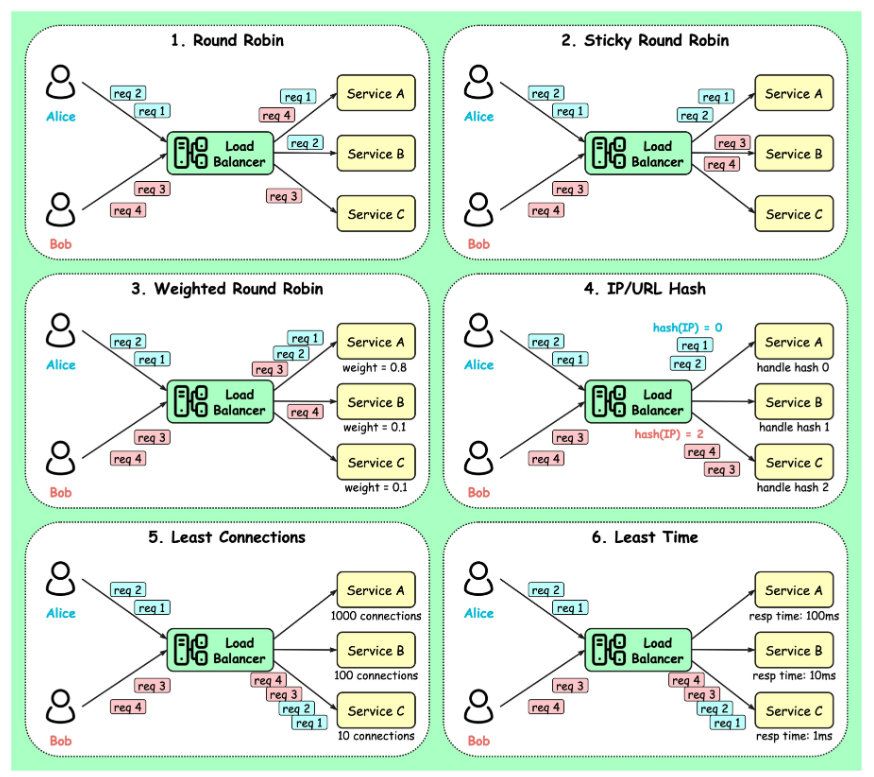
here is a comparison of all load balancing techniques:
| Load Balancing Technique | Description | Pros | Cons |
|---|---|---|---|
| Round robin | This is the simplest load balancing technique. It distributes traffic evenly across all servers in the pool. | Simple to implement and manage. | Does not take into account the health of the servers. |
| Weighted round robin | This is a variation of round robin that allows you to assign weights to servers. This means that some servers can receive more traffic than others. | Can be used to balance traffic based on the capacity of the servers. | More complex to implement and manage than round robin. |
| Least connections | This technique distributes traffic to the server with the fewest connections. This can help to improve performance by ensuring that no server is overloaded. | Can help to prevent overloading of servers. | Does not take into account the health of the servers. |
| Least response time | This technique distributes traffic to the server with the shortest response time. This can help to improve performance by ensuring that users experience the shortest possible wait times. | Can help to improve user experience. | More complex to implement and manage than least connections. |
| Hashing | This technique distributes traffic based on a hash of the request. This can help to ensure that requests are distributed evenly across the servers, even if the number of servers changes. | Can help to distribute traffic evenly across servers. | More complex to implement and manage than round robin. |
| Least bandwidth | This technique distributes traffic to the server with the least bandwidth utilization. This can help to prevent overloading of servers. | Can help to prevent overloading of servers. | Does not take into account the health of the servers. |
| Least latency | This technique distributes traffic to the server with the least latency. This can help to improve user experience. | Can help to improve user experience. | More complex to implement and manage than least connections. |
The best load balancing technique for a particular application will depend on the specific requirements of that application.
Here are some additional considerations when choosing a load balancing technique:
- The number of servers: The number of servers in the pool will affect the performance of the load balancer. A larger pool of servers can handle more traffic, but it can also be more expensive.
- The type of traffic: The type of traffic will also affect the performance of the load balancer. Some load balancing techniques are better suited for certain types of traffic than others.
- The budget: The cost of the load balancer will also be a consideration. Some load balancing techniques are more expensive than others.
- The need for scalability: If the application needs to be able to scale to handle more traffic, then a load balancer that can be scaled up or down is needed.
- The need for security: If the application needs to be secure, then a load balancer that can provide security features is needed.

I’m Rajesh Kumar, a DevOps, SRE, DevSecOps, Cloud, and Platform Engineering expert passionate about sharing practical knowledge, real-world experiences, and industry best practices. I have worked at Cotocus and regularly write about technology, travel, investing, health, product reviews, and digital marketing through my various platforms.
I publish technical articles at DevOps School, travel stories at Holiday Landmark, stock market insights at Stocks Mantra, health and fitness guidance at My Medic Plus, product reviews at TrueReviewNow, and SEO and digital marketing strategies at Wizbrand.
Find Trusted Cardiac Hospitals
Compare heart hospitals by city and services — all in one place.
Explore Hospitals