
Mastering the DevOps Lifecycle: A Practical Guide
Introduction The transition from traditional siloed development to high-velocity delivery is no longer optional; it is a necessity for modern engineering teams. Whether you are searching for…
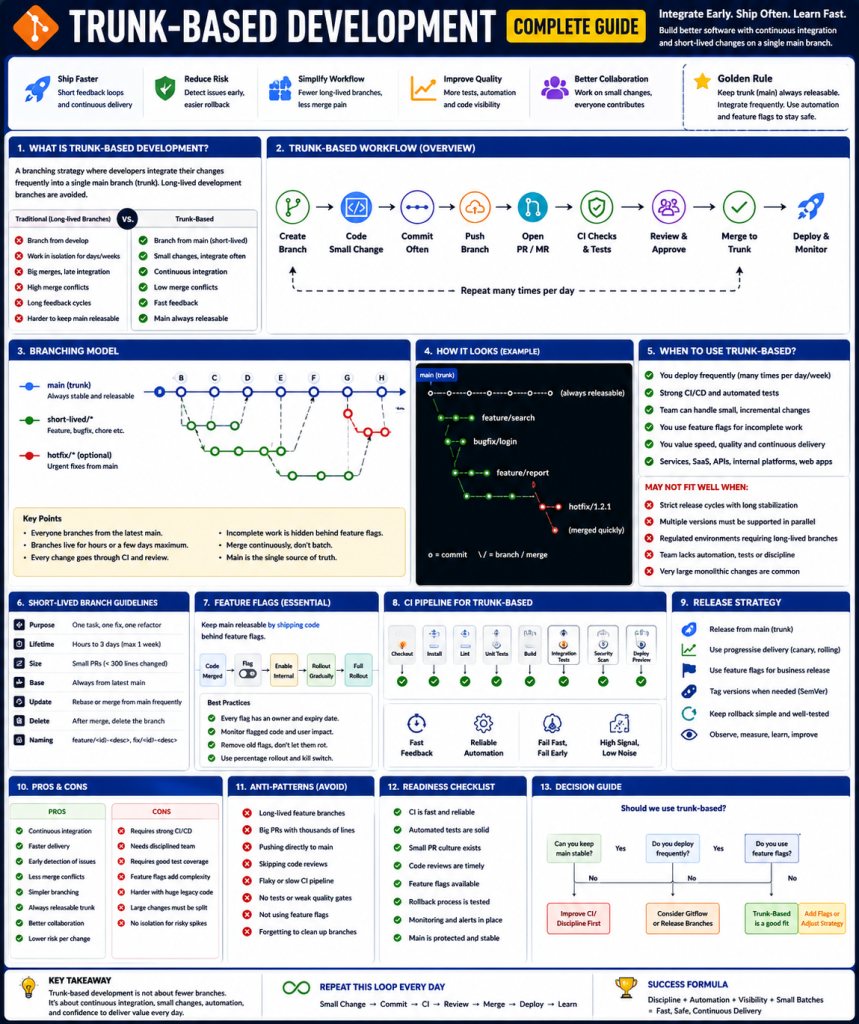
Trunk-Based Development Master Tutorial
From Beginner to Advanced: A Complete One-Stop Guide to Fast, Safe, Continuous Software Delivery 1. What is trunk-based development? Trunk-based development, often shortened as TBD, is a…
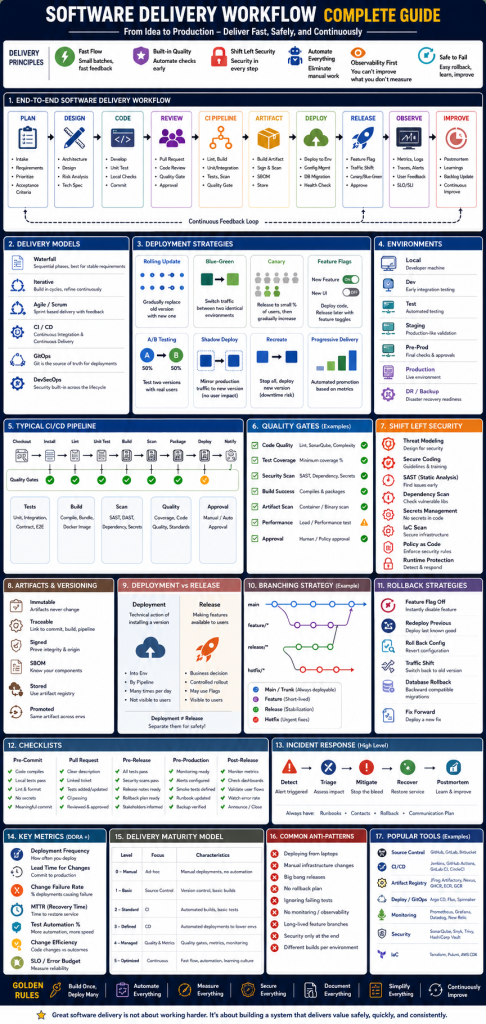
Software Delivery Workflow Master Tutorial
From Beginner to Advanced: A Complete One-Stop Guide to Delivering Software Safely, Fast, and Reliably 1. What is software delivery workflow? A software delivery workflow is the…
Best DevOps Tools in 2024
here’s a clear, structured breakdown of the Best DevOps Tools (grouped by categories), so you can use it for learning, training, or posts. 🚀 Best DevOps Tools…
Bringing DevOps to Web Development: How CI/CD and Automation Reshape Digital Agencies
Web development teams live in two worlds. On one side, client expectations keep rising: faster launches, zero downtime, and the ability to update dozens of sites without…
The Ultimate Guide to Implementing DevOps Automation for Teams
Introduction In the fast-paced world of software development, manual processes are the primary bottleneck that prevents teams from achieving their goals. When developers rely on manual code…
Complete DevOps Toolchain Guide for Software Delivery Automation
Introduction When engineering teams transition from traditional software development to modern cloud-native workflows, they are often blindsided by the sheer volume of technologies they must adopt. Beginners…
Continuous Delivery Explained: A Beginner Guide to Modern Software Deployment
Introduction Software development has changed drastically over the last two decades. I remember a time when releasing software was an event. It was a stressful, manual, all-hands-on-deck…
Continuous Integration for Engineers Guide to Modern Automated Workflows
Introduction Modern software engineering demands speed without sacrificing the underlying structural integrity of the application. Years ago, development teams worked in isolation for weeks or months, merging…
The Role of a DevOps Engineer in Modern IT and Enterprise Software Delivery
Introduction The landscape of modern IT systems has shifted dramatically over the last decade. In the past, software development followed a linear path where developers wrote code…
DevOps Lifecycle Components: CI/CD, Infrastructure, and Observability
Introduction In the current era of software development, the gap between writing code and delivering that code to end-users has narrowed significantly. Gone are the days when…
How DAST Helps Close the Gap Between Code Speed and Production Risk
Modern application teams ship through pipelines that move faster than traditional security review cycles. Feature branches can reach preview environments quickly. APIs may change several times in…
The Evolution of DevOps: Bridging the Gap Between Development and Operations
The Origins of DevOps The concept of DevOps emerged as a response to the traditional separation between software development and IT operations. Historically, these two disciplines operated…
Next-Gen DevOps Tools: Using Automation and AI to Speed Development
Overview Software development is no longer measured solely by code quality but is defined by the following key components. Teams are evaluated based on how quickly they…
Lead Automation Specialist: Role Blueprint, Responsibilities, Skills, KPIs, and Career Path
The **Lead Automation Specialist** is a senior, hands-on technical specialist responsible for designing, implementing, and scaling automation across the software delivery and operations lifecycle—most commonly spanning **CI/CD automation, test automation frameworks, infrastructure/environment automation, and operational runbook automation**. The role exists to reduce manual effort, improve release reliability, and enable faster, safer delivery by turning repeatable work into deterministic, observable, and governed automation.
Automation Specialist: Role Blueprint, Responsibilities, Skills, KPIs, and Career Path
The Automation Specialist designs, builds, and operates automation solutions that reduce manual work across software delivery and IT operations, improving speed, quality, and reliability. This role typically focuses on automating repeatable engineering workflows (e.g., CI/CD, test execution, environment provisioning, release checks, operational runbooks) using scripting, automation frameworks, and platform tooling.
DevOps Manager: Role Blueprint, Responsibilities, Skills, KPIs, and Career Path
The DevOps Manager leads the capability, operating model, and team delivery required to run reliable, secure, and scalable software systems while enabling fast, low-risk product delivery. This role owns the day-to-day excellence of CI/CD, infrastructure automation, observability, incident management, and production readiness, while also shaping the roadmap for platform and operational improvements.
Staff CI/CD Engineer: Role Blueprint, Responsibilities, Skills, KPIs, and Career Path
A **Staff CI/CD Engineer** is a senior individual contributor in the **Developer Platform** organization responsible for designing, evolving, and operating the continuous integration and continuous delivery/deployment (CI/CD) capabilities that enable engineering teams to ship software safely, quickly, and repeatably. The role balances platform architecture, reliability engineering, security-by-design, and developer experience, turning delivery practices into scalable, self-service platform products.
Staff Build Engineer: Role Blueprint, Responsibilities, Skills, KPIs, and Career Path
The Staff Build Engineer is a senior individual contributor in the Developer Platform organization responsible for the reliability, speed, security, and scalability of the company’s build and continuous integration (CI) ecosystem. This role designs and evolves build systems, CI/CD primitives, and artifact/dependency workflows so that product engineering teams can ship code predictably with minimal friction.
Senior CI/CD Engineer: Role Blueprint, Responsibilities, Skills, KPIs, and Career Path
The **Senior CI/CD Engineer** is a senior individual contributor in the **Developer Platform** department responsible for designing, building, operating, and continuously improving the continuous integration and continuous delivery/deployment (CI/CD) ecosystem that software teams rely on to ship changes safely and frequently. The role blends platform engineering, automation, reliability engineering, and secure software supply chain practices to ensure builds, tests, artifact management, and deployments are fast, repeatable, observable, and compliant.
Senior Build Engineer: Role Blueprint, Responsibilities, Skills, KPIs, and Career Path
A **Senior Build Engineer** designs, operates, and continuously improves the build and continuous integration (CI) systems that convert source code into reproducible, testable, and deployable artifacts at scale. The role sits within the **Developer Platform** department and focuses on accelerating engineering throughput while improving build reliability, security, and consistency across repositories, languages, and teams.
Principal CI/CD Engineer: Role Blueprint, Responsibilities, Skills, KPIs, and Career Path
The **Principal CI/CD Engineer** is a senior individual-contributor (IC) who architects, standardizes, and evolves the organization’s continuous integration and continuous delivery/deployment (CI/CD) capabilities as part of the **Developer Platform** department. This role designs secure, scalable, and developer-friendly pipelines and release systems that enable engineering teams to ship frequently with high confidence, low risk, and strong governance.
Principal Build Engineer: Role Blueprint, Responsibilities, Skills, KPIs, and Career Path
The Principal Build Engineer is the senior technical authority responsible for the performance, reliability, security, and scalability of the organization’s build and CI execution ecosystem—spanning build systems, dependency management, artifact generation, caching, and build/test orchestration. This role exists to ensure engineering teams can ship changes quickly and safely by making builds predictable, fast, reproducible, and cost-efficient across local development and CI.
Lead CI/CD Engineer: Role Blueprint, Responsibilities, Skills, KPIs, and Career Path
The **Lead CI/CD Engineer** is a senior, hands-on platform engineer responsible for designing, operating, and evolving the organization’s continuous integration and continuous delivery/deployment capabilities as a core part of the **Developer Platform**. This role ensures that engineering teams can build, test, secure, and ship software reliably and quickly through standardized, observable, and scalable pipeline foundations.
Lead Build Engineer: Role Blueprint, Responsibilities, Skills, KPIs, and Career Path
The **Lead Build Engineer** is accountable for the design, reliability, performance, and security of the organization’s build and continuous integration (CI) capabilities, ensuring that engineering teams can compile, test, package, and publish software artifacts quickly and repeatably. This role sits within the **Developer Platform** department and typically acts as the technical lead for build systems and build infrastructure, driving standards and modernization across repositories, pipelines, tooling, and artifact flows.
Junior CI/CD Engineer: Role Blueprint, Responsibilities, Skills, KPIs, and Career Path
The **Junior CI/CD Engineer** is an early-career engineer within the **Developer Platform** department responsible for building, maintaining, and improving the automated paths that move code from source control to tested, secured, and deployable artifacts. The role focuses on reliable, repeatable CI/CD pipelines, pipeline-as-code practices, and developer experience improvements under the guidance of senior CI/CD, DevOps, Platform, or SRE engineers.
Junior Build Engineer: Role Blueprint, Responsibilities, Skills, KPIs, and Career Path
A **Junior Build Engineer** supports the reliability, speed, and repeatability of software builds by maintaining and improving the build and continuous integration (CI) workflows that developers use every day. The role focuses on keeping build pipelines healthy, reducing build failures and build times, and helping teams produce consistent artifacts (packages, containers, binaries) across environments.
CI/CD Engineer: Role Blueprint, Responsibilities, Skills, KPIs, and Career Path
The CI/CD Engineer designs, builds, and operates the automation systems that reliably take code from commit to production. This role sits within a Developer Platform organization and focuses on enabling engineering teams to ship faster with higher confidence by standardizing build, test, security scanning, and deployment workflows.
Build Engineer: Role Blueprint, Responsibilities, Skills, KPIs, and Career Path
A Build Engineer designs, implements, and operates the build and continuous integration (CI) systems that turn source code into reproducible, testable, and releasable artifacts. Embedded within the Developer Platform department, this role ensures that engineering teams can build, test, and package software reliably at scale—across languages, repositories, and environments.
Associate CI/CD Engineer: Role Blueprint, Responsibilities, Skills, KPIs, and Career Path
The **Associate CI/CD Engineer** designs, builds, and maintains the “delivery automation” that enables engineering teams to reliably build, test, and deploy software. This role focuses on implementing and improving CI/CD pipelines, standardizing reusable templates, and assisting with operational support of the delivery platform under guidance from more senior platform/DevOps engineers.