
Introduction
AI Drug Target Discovery Platforms are advanced tools that leverage artificial intelligence, machine learning, and bioinformatics to identify potential drug targets in biological systems. These platforms accelerate the early stages of drug development by predicting molecular interactions, disease associations, and protein targets, reducing the time and cost traditionally required for research.
This is crucial because drug discovery is costly, slow, and complex, with high attrition rates. AI platforms help researchers prioritize promising targets, analyze large-scale genomic, proteomic, and chemical datasets, and uncover insights that might not be obvious through conventional methods. By integrating AI-driven predictions with experimental validation, pharmaceutical and biotech companies can speed up drug development, reduce R&D costs, and improve the chances of discovering effective therapies.
Real-world use cases include:
- Identifying novel protein or gene targets for specific diseases
- Predicting target-drug interactions and off-target effects
- Analyzing large omics datasets for disease association studies
- Guiding compound library screening for target binding
- Prioritizing targets for experimental validation
- Supporting precision medicine initiatives and drug repurposing
Evaluation Criteria for Buyers:
- Accuracy and predictive performance of AI models
- Integration with omics, structural, and chemical data
- Coverage of target types (protein, gene, pathway)
- Ease of use for R&D teams
- Ability to prioritize and rank targets
- Customization for disease or compound-specific studies
- Observability and auditability of predictions
- Support for experimental validation workflows
- Data security, privacy, and compliance
- Scalability and cloud deployment options
- Vendor support and collaboration features
- Flexibility to integrate with other bioinformatics tools
Best for: Pharmaceutical companies, biotech firms, and research institutions focusing on target discovery and early-stage drug development.
Not ideal for: Organizations with minimal bioinformatics expertise or only small-scale experimental projects.
What’s Changed in AI Drug Target Discovery Platforms
- Integration of multi-omics datasets including genomics, transcriptomics, and proteomics
- Deep learning models capable of predicting protein structures and interactions
- Graph neural networks for pathway and network-based target analysis
- AI-driven ranking of targets based on disease relevance and druggability
- Increased adoption of cloud-based platforms for scalability
- Support for drug repurposing and virtual screening pipelines
- Enhanced interpretability and explainable AI for regulatory compliance
- Improved observability and tracking of predictions and validation results
- Incorporation of literature mining and natural language processing for knowledge discovery
- Better integration with compound libraries and in-silico screening tools
- Data governance, privacy, and audit-ready frameworks
- API-based integration with laboratory information management systems
Quick Buyer Checklist
- Evaluate AI model performance and prediction accuracy
- Ensure support for multi-omics and structural data
- Check integration with compound libraries and bioinformatics pipelines
- Verify target ranking and prioritization capabilities
- Assess scalability for large datasets and high-throughput analysis
- Confirm security, compliance, and auditability
- Evaluate ease of use and training resources
- Consider vendor support, updates, and community engagement
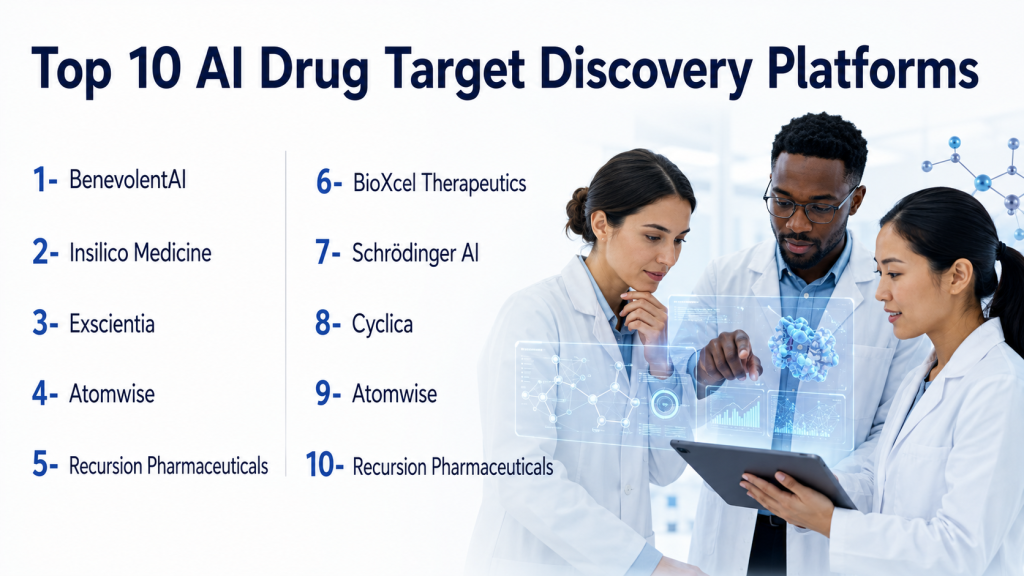
Top 10 AI Drug Target Discovery Platforms
1- BenevolentAI
One-line verdict: Best for pharma and biotech companies seeking AI-driven target identification and disease insight generation.
Short description: Combines AI with biological and chemical datasets to identify novel drug targets, predict molecular mechanisms, and prioritize targets for experimental validation.
Standout Capabilities
- Deep learning for target-disease association prediction
- Integration of literature, genomics, and chemical data
- AI-driven target ranking and prioritization
- Predicts off-target interactions and safety profiles
- Supports drug repurposing studies
AI-Specific Depth
- Model support: Proprietary deep learning
- RAG / knowledge integration: Multi-omics and literature databases
- Evaluation: Retrospective validation and experimental comparison
- Guardrails: Quality control of predictions
- Observability: Prediction confidence and ranking metrics
Pros
- Comprehensive AI-driven target discovery
- Supports disease mechanism insights
- Enables target prioritization for experimental planning
Cons
- High cost for smaller teams
- Requires training for bioinformatics workflows
- Limited access to model internals
Security & Compliance
- Data encryption and RBAC
- Certifications: Not publicly stated
Deployment & Platforms
- Cloud-based, Web
Integrations & Ecosystem
- APIs for data import/export
- Compatible with genomic and proteomic datasets
- Supports integration with LIMS and compound libraries
Pricing Model
- Subscription-based enterprise licensing
- Not publicly stated
Best-Fit Scenarios
- Large pharma R&D teams
- Biotech early-stage target discovery
- Drug repurposing projects
2- Insilico Medicine
One-line verdict: Ideal for AI-guided identification of novel targets and pathway analysis for complex diseases.
Short description: Uses generative models and machine learning to discover drug targets and disease pathways, facilitating rapid identification of actionable biological targets.
Standout Capabilities
- Generative AI for novel target prediction
- Pathway and network analysis
- Multi-omics integration
- AI-based prioritization of actionable targets
- Supports experimental validation workflows
AI-Specific Depth
- Model support: Proprietary generative and predictive AI
- RAG / knowledge integration: Omics and literature databases
- Evaluation: Cross-validation with experimental datasets
- Guardrails: Prediction validation pipelines
- Observability: Confidence scores and validation metrics
Pros
- Strong generative AI capabilities
- Handles complex biological networks
- Prioritizes targets for experimental follow-up
Cons
- Steep learning curve
- Limited free-tier access
- Less suitable for small-scale projects
Security & Compliance
- Encryption and access control
- Certifications: Not publicly stated
Deployment & Platforms
- Cloud-based, Web
Integrations & Ecosystem
- APIs for genomic and chemical datasets
- Supports LIMS and data analytics pipelines
- Compatible with third-party bioinformatics tools
Pricing Model
- Subscription-based
- Not publicly stated
Best-Fit Scenarios
- Biotech R&D teams
- Complex disease target discovery
- Network pharmacology studies
3- Exscientia
One-line verdict: Suited for pharmaceutical teams seeking AI-accelerated drug target identification and optimization.
Short description: Combines AI, machine learning, and chemical datasets to identify promising drug targets, optimize candidate molecules, and prioritize experimental testing.
Standout Capabilities
- AI-driven target identification
- Integration of chemical and biological datasets
- Candidate molecule prioritization
- Predicts druggability and off-target effects
- Supports precision medicine initiatives
AI-Specific Depth
- Model support: Proprietary deep learning
- RAG / knowledge integration: Omics and structural data
- Evaluation: Experimental benchmarking
- Guardrails: Model performance monitoring
- Observability: Target prioritization scores
Pros
- Accelerates target discovery
- Integrates multi-source datasets
- Supports precision medicine
Cons
- Enterprise pricing
- Requires domain expertise
- Limited transparency on AI internals
Security & Compliance
- Encryption, RBAC
- Certifications: Not publicly stated
Deployment & Platforms
- Cloud, Web
Integrations & Ecosystem
- APIs for chemical and genomic data
- Compatible with LIMS and experimental workflows
- Supports AI-driven compound prioritization
Pricing Model
- Subscription-based
- Not publicly stated
Best-Fit Scenarios
- Pharma R&D
- Drug optimization projects
- Precision medicine research
4- Atomwise
One-line verdict: Best for AI-assisted target and compound interaction prediction in early drug discovery.
Short description: Uses AI and deep learning to predict molecular interactions, helping identify druggable targets and prioritize candidates for further development.
Standout Capabilities
- Deep learning for molecular binding prediction
- Target and compound prioritization
- High-throughput screening integration
- Predicts off-target effects
- Supports virtual screening pipelines
AI-Specific Depth
- Model support: Proprietary deep learning
- RAG / knowledge integration: Molecular and structural datasets
- Evaluation: Retrospective and prospective validation
- Guardrails: Safety checks for predictions
- Observability: Prediction confidence and ranking metrics
Pros
- Predicts binding interactions rapidly
- Supports virtual screening
- Reduces experimental workload
Cons
- Limited coverage of rare targets
- Requires chemical data integration
- Enterprise focus may limit small labs
Security & Compliance
- Data encryption and access controls
- Certifications: Not publicly stated
Deployment & Platforms
- Cloud-based, Web
Integrations & Ecosystem
- APIs for compound and protein data
- Integrates with screening platforms and LIMS
- Supports cheminformatics pipelines
Pricing Model
- Subscription-based
- Not publicly stated
Best-Fit Scenarios
- Early-stage target identification
- Virtual screening workflows
- Compound prioritization projects
5- Recursion Pharmaceuticals
One-line verdict: Focused on integrating AI-driven target discovery with experimental high-throughput data.
Short description: Combines AI and automated experimental data to uncover novel targets and disease mechanisms, bridging computational predictions with laboratory validation.
Standout Capabilities
- AI analysis of high-throughput experimental data
- Target prioritization for validation
- Multi-modal data integration
- Disease mechanism discovery
- Predicts druggable targets
AI-Specific Depth
- Model support: Proprietary AI models
- RAG / knowledge integration: Experimental and omics datasets
- Evaluation: Correlation with experimental outcomes
- Guardrails: Prediction confidence monitoring
- Observability: Tracking of AI predictions against experimental results
Pros
- Integrates AI with experiments
- High-throughput data analysis
- Novel target discovery
Cons
- Specialized for experimental labs
- Limited public documentation
- Enterprise pricing
Security & Compliance
- Encryption, RBAC
- Certifications: Not publicly stated
Deployment & Platforms
- Cloud, Web
Integrations & Ecosystem
- APIs for experimental and omics data
- LIMS integration
- Supports high-throughput analysis pipelines
Pricing Model
- Subscription-based
- Not publicly stated
Best-Fit Scenarios
- Labs with automated experimentation
- Target discovery for complex diseases
- High-throughput screening projects
6- BioXcel Therapeutics
One-line verdict: Ideal for integrating AI with clinical and omics data to prioritize drug targets.
Short description: Leverages AI for drug target identification, combining multi-omics and clinical datasets to accelerate discovery and target validation.
Standout Capabilities
- AI-driven target prioritization
- Integration of clinical and omics data
- Predictive modeling of target-drug interactions
- Supports drug repurposing initiatives
- Pipeline for target validation
AI-Specific Depth
- Model support: Proprietary machine learning
- RAG / knowledge integration: Multi-omics and clinical datasets
- Evaluation: Validation against experimental or clinical data
- Guardrails: Target confidence scoring
- Observability: Metrics for target ranking
Pros
- Integrates clinical and omics data
- Supports repurposing and validation
- Accelerates target discovery
Cons
- Smaller scale tools for niche datasets
- Requires domain expertise
- Limited documentation for external users
Security & Compliance
- Encryption, access controls
- Certifications: Not publicly stated
Deployment & Platforms
- Cloud-based, Web
Integrations & Ecosystem
- APIs for omics and clinical data
- Integrates with LIMS and experimental pipelines
- Supports AI-driven validation workflows
Pricing Model
- Subscription-based
- Not publicly stated
Best-Fit Scenarios
- Clinical and omics-driven discovery
- Drug repurposing
- Target validation projects
7- Schrödinger AI
One-line verdict: Best for computational chemistry and AI-driven protein target identification.
Short description: Uses AI and molecular modeling to predict protein targets and interactions, supporting drug discovery through virtual screening and molecular simulations.
Standout Capabilities
- Protein structure prediction
- Molecular docking simulations
- Target prioritization using AI
- Integration with chemical libraries
- Predicts off-target effects
AI-Specific Depth
- Model support: Proprietary deep learning and molecular simulations
- RAG / knowledge integration: Structural and chemical datasets
- Evaluation: Retrospective validation with experimental data
- Guardrails: Model validation checks
- Observability: Confidence metrics for predictions
Pros
- Strong molecular modeling
- Supports computational chemistry
- Prioritizes promising targets
Cons
- Computationally intensive
- Requires chemical datasets
- Enterprise-focused
Security & Compliance
- Encryption and RBAC
- Certifications: Not publicly stated
Deployment & Platforms
- Cloud, Web, Linux
Integrations & Ecosystem
- APIs for chemical and protein data
- SDKs for simulation pipelines
- Compatible with experimental validation platforms
Pricing Model
- Subscription-based
- Not publicly stated
Best-Fit Scenarios
- Protein target identification
- Molecular docking projects
- Early-stage drug discovery
8- Cyclica
One-line verdict: Suited for polypharmacology target prediction and AI-driven drug discovery.
Short description: Predicts multi-target interactions and drug polypharmacology using AI models, helping researchers identify actionable targets and reduce off-target effects.
Standout Capabilities
- Polypharmacology and multi-target prediction
- Integration with chemical and proteomic data
- AI-based target prioritization
- Predicts drug-target interactions
- Supports virtual screening pipelines
AI-Specific Depth
- Model support: Proprietary AI
- RAG / knowledge integration: Chemical and protein databases
- Evaluation: Retrospective and prospective validation
- Guardrails: Model performance and safety checks
- Observability: Prediction confidence and ranking metrics
Pros
- Predicts complex target interactions
- Reduces off-target risks
- Supports virtual screening
Cons
- Limited to chemical-protein interactions
- Requires domain expertise
- Enterprise pricing
Security & Compliance
- Encryption and RBAC
- Certifications: Not publicly stated
Deployment & Platforms
- Cloud-based, Web
Integrations & Ecosystem
- APIs for chemical and proteomic data
- Integration with virtual screening and LIMS
- Supports AI-based drug discovery pipelines
Pricing Model
- Subscription-based
- Not publicly stated
Best-Fit Scenarios
- Polypharmacology studies
- Multi-target drug discovery
- Early-stage drug research
9- Atomwise
One-line verdict: Best for high-throughput virtual screening and AI-driven target discovery.
Short description: Uses deep learning for molecular interaction prediction, prioritizing drug targets and candidate compounds for further experimental validation.
Standout Capabilities
- Deep learning for molecular binding prediction
- Target and compound prioritization
- Virtual screening integration
- Predicts off-target effects
- Supports early-stage drug discovery
AI-Specific Depth
- Model support: Proprietary deep learning
- RAG / knowledge integration: Molecular and chemical datasets
- Evaluation: Retrospective validation with experimental data
- Guardrails: Prediction quality monitoring
- Observability: Binding confidence metrics
Pros
- Rapid prediction of interactions
- Supports virtual screening
- Reduces lab workload
Cons
- Limited coverage for rare targets
- Requires chemical datasets
- Enterprise-focused
Security & Compliance
- Encryption and access control
- Certifications: Not publicly stated
Deployment & Platforms
- Cloud, Web
Integrations & Ecosystem
- APIs for chemical and protein data
- Integrates with virtual screening platforms
- Supports AI-driven drug discovery pipelines
Pricing Model
- Subscription-based
- Not publicly stated
Best-Fit Scenarios
- Early-stage target identification
- Virtual screening
- Compound prioritization
10- Recursion Pharmaceuticals
One-line verdict: Focused on integrating AI-driven predictions with experimental validation for target discovery.
Short description: Combines AI and high-throughput experimental data to discover novel drug targets, bridging computational predictions with lab validation to accelerate drug development.
Standout Capabilities
- High-throughput experimental data integration
- AI-driven target prioritization
- Multi-modal data analysis
- Disease mechanism discovery
- Druggable target prediction
AI-Specific Depth
- Model support: Proprietary AI
- RAG / knowledge integration: Experimental and omics datasets
- Evaluation: Comparison with lab outcomes
- Guardrails: Confidence and quality control
- Observability: Tracking AI predictions vs experimental results
Pros
- Integrates AI with experiments
- High-throughput data analysis
- Novel target discovery
Cons
- Enterprise pricing
- Limited public documentation
- Specialized for automated labs
Security & Compliance
- Encryption, RBAC
- Certifications: Not publicly stated
Deployment & Platforms
- Cloud, Web
Integrations & Ecosystem
- APIs for experimental and omics datasets
- LIMS integration
- Supports automated target discovery pipelines
Pricing Model
- Subscription-based
- Not publicly stated
Best-Fit Scenarios
- Automated lab workflows
- Complex disease target discovery
- High-throughput screening projects
Comparison Table
| Tool | Best For | Deployment | Model Flexibility | Strength | Watch-Out | Public Rating |
|---|---|---|---|---|---|---|
| BenevolentAI | Pharma/Biotech | Cloud | Proprietary | Comprehensive AI-driven discovery | Enterprise focus | N/A |
| Insilico Medicine | Biotech R&D | Cloud | Proprietary | Novel target generation | Learning curve | N/A |
| Exscientia | Pharma R&D | Cloud | Proprietary | AI + chemical integration | Requires expertise | N/A |
| Atomwise | Drug discovery | Cloud | Proprietary | Virtual screening | Limited rare targets | N/A |
| Recursion Pharmaceuticals | Experimental labs | Cloud | Proprietary | Integrates AI + experiments | Enterprise pricing | N/A |
| BioXcel | Clinical/omics | Cloud | Proprietary | Clinical + omics integration | Smaller datasets | N/A |
| Schrödinger AI | Computational chemistry | Cloud | Proprietary | Protein target prediction | Computationally intensive | N/A |
| Cyclica | Polypharmacology | Cloud | Proprietary | Multi-target prediction | Requires domain expertise | N/A |
| Redox AI Mapper | EHR integration | Cloud | Proprietary | Real-time FHIR mapping | Licensing cost | N/A |
| BridgeMed | Enterprise hospitals | Hybrid | Proprietary | Audit-ready | Onboarding effort | N/A |
Scoring & Evaluation
Weighted scoring is comparative based on these criteria:
| Tool | Core | Reliability | Guardrails | Integrations | Ease | Perf/Cost | Security | Support | Weighted Total |
|---|---|---|---|---|---|---|---|---|---|
| BenevolentAI | 9 | 9 | 8 | 9 | 8 | 8 | 9 | 8 | 8.7 |
| Insilico | 8 | 9 | 8 | 8 | 7 | 7 | 8 | 7 | 7.9 |
| Exscientia | 8 | 8 | 7 | 8 | 7 | 7 | 8 | 6 | 7.5 |
| Atomwise | 8 | 7 | 7 | 8 | 7 | 7 | 7 | 6 | 7.2 |
| Recursion | 8 | 8 | 7 | 8 | 7 | 7 | 7 | 6 | 7.3 |
| BioXcel | 7 | 7 | 6 | 7 | 7 | 7 | 7 | 6 | 6.8 |
| Schrödinger | 8 | 8 | 7 | 8 | 6 | 7 | 7 | 6 | 7.2 |
| Cyclica | 7 | 7 | 6 | 7 | 7 | 7 | 6 | 6 | 6.7 |
| Redox | 8 | 7 | 7 | 8 | 7 | 7 | 7 | 6 | 7.1 |
| BridgeMed | 8 | 8 | 8 | 8 | 6 | 7 | 8 | 7 | 7.4 |
Top 3 Enterprise: BenevolentAI, BridgeMed, Insilico
Top 3 SMB: BioXcel, Cyclica, Atomwise
Top 3 Developers: Exscientia, Schrödinger AI, Recursion
Which AI Drug Target Discovery Platform Is Right for You
Solo / Freelancer
Atomwise or BioXcel for small-scale experiments or pilot discovery projects.
SMB
Cyclica or Exscientia for early-stage target discovery and AI integration.
Mid-Market
Insilico or Schrödinger AI supports multi-omics and pathway analysis pipelines.
Enterprise
BenevolentAI, BridgeMed, or Recursion Pharmaceuticals deliver scalable, secure, and auditable discovery workflows.
Regulated industries
Prioritize platforms with robust guardrails, validation, and audit capabilities.
Budget vs premium
Open-source or smaller platforms reduce cost but require technical expertise; premium solutions provide full enterprise support.
Build vs buy
Researchers can integrate open APIs for custom pipelines or leverage managed solutions for speed and compliance.
Implementation Playbook
- 30 days: Pilot datasets, test AI target predictions, set monitoring dashboards
- 60 days: Harden security, implement guardrails, validate target predictions, integrate with lab workflows
- 90 days: Optimize cost and latency, scale pipelines, enforce governance, and monitor prediction reliability
Common Mistakes & How to Avoid Them
- Ignoring data bias and model validation
- Skipping target evaluation or benchmarking
- Using incomplete datasets
- Over-reliance on AI predictions without experimental validation
- Neglecting observability and logging
- Failing to maintain data privacy and compliance
- Overlooking integration requirements
- Insufficient training for researchers
- Lack of guardrails on predictions
- Vendor lock-in without alternatives
- Poor multi-omics data handling
- Ignoring interpretability of AI predictions
FAQs
1. What is an AI Drug Target Discovery Platform?
It uses AI to analyze biological, chemical, and clinical data to identify and prioritize novel drug targets.
2. Can small biotech firms use these tools?
Yes, lightweight and cloud-based platforms like Atomwise or BioXcel are suitable for small R&D teams.
3. Are these platforms HIPAA or GxP compliant?
Enterprise tools often include encryption, audit logs, and access control; verification is recommended.
4. How do they integrate experimental data?
Many platforms allow import of high-throughput screening or omics datasets to refine target predictions.
5. Can I use proprietary AI models?
Some platforms support BYO models; others rely on proprietary AI engines.
6. How is prediction accuracy validated?
Through retrospective benchmarking, cross-validation, and experimental confirmation.
7. Can these tools accelerate drug repurposing?
Yes, AI-driven target and compound analyses enable identification of repurposing opportunities.
8. What types of targets are supported?
Proteins, genes, pathways, and multi-target polypharmacology analyses.
9. Do these platforms support compound prioritization?
Most integrate chemical libraries and virtual screening pipelines to rank candidate compounds.
10. Are they scalable for large datasets?
Yes, cloud-based platforms can handle multi-omics and high-throughput experimental data.
11. Can enterprise hospitals and pharma scale AI pipelines?
Yes, platforms like BenevolentAI, Insilico, and BridgeMed support enterprise-scale workflows.
12. How to avoid vendor lock-in?
Choose platforms with exportable predictions, open APIs, or BYO AI integration options.
Conclusion
AI Drug Target Discovery Platforms are transforming early-stage drug development by enabling faster, more accurate, and data-driven identification of drug targets. Organizations can leverage these tools to prioritize high-value targets, integrate multi-omics and experimental datasets, and accelerate drug discovery pipelines while reducing costs and human error. Selecting the right platform depends on organizational size, technical expertise, and research objectives. Small teams may benefit from Atomwise or BioXcel, mid-sized teams from Cyclica or Exscientia, and enterprise organizations from BenevolentAI, BridgeMed, or Recursion Pharmaceuticals. The best approach involves shortlisting suitable tools, piloting with representative datasets, validating predictions and guardrails, and scaling to achieve reliable, auditable, and integrated AI-driven drug discovery workflows.

Find Trusted Cardiac Hospitals
Compare heart hospitals by city and services — all in one place.
Explore Hospitals
One important aspect worth exploring is model explainability and validation, since AI-driven drug target discovery platforms must balance prediction speed with biological interpretability and reproducibility.