
Introduction
AI Review Summarization Tools are software platforms that leverage artificial intelligence to process, analyze, and generate concise summaries from large collections of customer reviews, feedback, and ratings. These tools use natural language processing (NLP), sentiment analysis, and machine learning models to identify key themes, trends, and insights buried within unstructured text — transforming thousands of reviews into actionable summaries for product teams, marketers, and customer experience leaders.
In 2026, customer reviews remain one of the richest sources of product and service insights, but manually analyzing massive volumes across platforms (marketplaces, social media, app stores, retail sites) is time‑consuming and error‑prone. AI review summarization automates this process, providing decision makers with distilled insights that can improve products, prioritize feature requests, detect negative sentiment trends early, and benchmark against competitors.
Real‑world use cases include:
- Product development: Distilling common pain points and feature requests from thousands of customer reviews.
- Marketing intelligence: Identifying sentiment trends and messaging gaps across marketplaces.
- Customer support optimization: Categorizing frequent complaints to automate responses or prioritize escalations.
- Competitive analysis: Summarizing competitor review patterns to inform positioning and product roadmap.
- Brand reputation monitoring: Quickly summarizing social and review feedback spikes during launches or crises.
- E‑commerce operations: Surfacing product quality issues or return drivers to upstream teams.
Evaluation criteria for buyers:
- Accuracy of summaries and coverage of themes
- Real‑time or near‑real‑time processing
- Ability to handle multimodal reviews (text, images, audio clips)
- Sentiment analysis depth and nuance detection
- Integration with review platforms and data sources
- Customizability of summary length, structure, and taxonomy
- Guardrails to prevent hallucinations or misinformation
- Observability of model decisions and performance
- Deployment flexibility (cloud, self‑hosted, hybrid)
- Data privacy, retention, and compliance controls
Best for: Product teams, e‑commerce leaders, customer experience managers, CX/UX researchers, and competitive intelligence analysts in mid‑market and enterprise organizations.
Not ideal for: Small sellers with low review volume or teams that only need basic keyword counts rather than deep AI analysis.
What’s Changed in AI Review Summarization Tools in 2026+
- Agentic workflows now automate extraction, summarization, taxonomy tagging, and distribution of review insights to business stakeholders.
- Multimodal summarization can incorporate review text, attached images, and even audio transcriptions into a unified summary.
- Evaluation tooling enables continuous A/B testing of summarization models against held‑out human judgments to detect drift or errors.
- RAG (retrieval‑augmented generation) workflows fuse structured product metadata, knowledge bases, and review text for context‑aware summaries.
- Real‑time streaming support allows teams to generate summaries as reviews arrive rather than in batch jobs.
- Privacy‑by‑design now standard: configurable retention policies, anonymization, and data residency controls.
- Model router frameworks dynamically select lightweight vs deeper models to balance latency and cost based on workload.
- Observability dashboards provide traceable reasoning, token costs, latency metrics, and drift alerts.
- Guardrails and reinforcement learning from human feedback (RLHF) guard against misrepresentation or hallucination in summaries.
- BYO models and plugin frameworks give enterprises flexibility to use proprietary embeddings, models, or taxonomies.
Quick Buyer Checklist
- ☐ Data sources: Do tools integrate with all your review platforms (marketplaces, app stores, social channels)?
- ☐ Model flexibility: Hosted, open‑source, or BYO models supported?
- ☐ Summarization types: Short bullets, narrative paragraphs, tag clouds, sentiment scores?
- ☐ Multimodal: Can the tool handle images, screenshots, or audio reviews?
- ☐ Sentiment nuance: Does it capture sarcasm, mixed sentiments, and nuanced feedback?
- ☐ RAG/knowledge integration: Support for product knowledge graphs and SOPs?
- ☐ Evaluation & guardrails: Does the platform include human‑in‑the‑loop evaluation and safety checks?
- ☐ Latency & cost controls: Model routing, caching, and usage dashboards available?
- ☐ Governance: Audit logs, data retention policies, admin controls?
- ☐ Vendor lock‑in: Exportable summaries and model outputs?
- ☐ Support & community: Documentation, community forums, support channels?
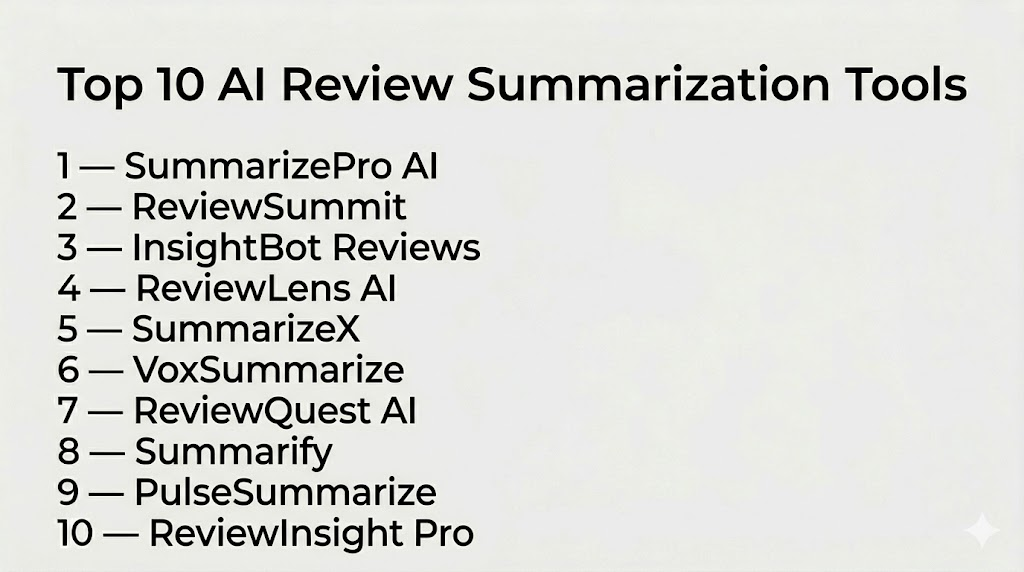
Top 10 AI Review Summarization Tools
1 — SummarizePro AI
One‑line verdict: Enterprise‑grade review summarization platform for high‑volume customer insights with deep sentiment analytics.
Short description (2–3 lines):
SummarizePro AI ingests massive streams of reviews from global marketplaces, POS feedback, and social platforms, producing structured summaries and trend reports for product and CX teams.
Standout Capabilities
- Real‑time summarization dashboards across categories
- Deep sentiment and theme extraction
- Automated taxonomy tagging and priority alerts
- Cross‑product and competitor comparison summaries
- Custom summary templates per stakeholder group
AI‑Specific Depth
- Model support: Proprietary + optional BYO model pipelines
- RAG / knowledge integration: Yes — connects to product knowledge graphs
- Evaluation: Ongoing model scoring and regression test framework
- Guardrails: Hallucination suppression and policy enforcement
- Observability: Full trace logs, token usage, latency dashboards
Pros
- Enterprise scalability and governance
- Deep sentiment nuance detection
- Strong integration ecosystem
Cons
- Higher cost at scale
- Complex onboarding cycle
- Proprietary model dependency
Security & Compliance
SSO/SAML, RBAC, encryption‑at‑rest and in‑transit, audit logs; certifications: Not publicly stated
Deployment & Platforms
Cloud, Hybrid; Web, macOS, Windows, Linux interfaces
Integrations & Ecosystem
APIs for all major review sources
SDKs for custom workflows
Integrates with product analytics platforms
Webhook alerts for trend spikes
Automated exports to BI tools
Pricing Model
Subscription tiers based on review volume; Not publicly stated
Best‑Fit Scenarios
- Global enterprise brands with high review traffic
- Product management teams requiring deep analytical insights
- Customer experience leaders tracking sentiment shifts
2 — ReviewSummit
One‑line verdict: Developer‑friendly API‑first review summarization tool designed for flexible integrations.
Short description (2–3 lines):
ReviewSummit provides REST and GraphQL APIs to ingest review data and generate structured summaries tailor‑made for custom dashboards and ML pipelines.
Standout Capabilities
- API‑centric ingestion and summarization
- Custom prompt templates per use case
- Language detection and multilingual support
- Lightweight streaming summaries
- Plugin support for enterprise data connectors
AI‑Specific Depth
- Model support: Hosted + BYO open models
- RAG / knowledge integration: Via connectors
- Evaluation: Prompt test harness, regression suite
- Guardrails: Custom policy filters
- Observability: Real‑time logs, latency metrics
Pros
- Great for developers and custom workflows
- BYO model flexibility
- Multilingual support
Cons
- Not as turnkey for non‑technical users
- Limited built‑in dashboards
- Requires engineering resources
Security & Compliance
Encryption, audit logs, RBAC; certifications: Not publicly stated
Deployment & Platforms
Cloud; APIs, SDKs for Python/JS
Integrations & Ecosystem
Custom connectors to review sources
Webhooks, webhook routing
Pipeline hooks for downstream analytics
Supports cloud data warehouses
Pricing Model
Usage‑based API tiers; Not publicly stated
Best‑Fit Scenarios
- SaaS platforms embedding summary insights
- Tech teams building custom review analytics
- Marketplaces with multilingual data
3 — InsightBot Reviews
One‑line verdict: Automatic narrative review summaries with sentiment and trend forecasting for product teams.
Short description:
InsightBot ingests review text, scores sentiment, and produces narrative summaries and “what’s changing” trend reports week‑over‑week.
Standout Capabilities
- Time‑based trend summaries
- Sentiment breakdown charts
- Severity scoring for negative feedback
- Auto‑generated executive summaries
- Topic clusters and key phrase extraction
AI‑Specific Depth
- Model support: Proprietary
- RAG / knowledge integration: N/A
- Evaluation: Periodic model tuning based on human feedback
- Guardrails: Policy templates for outputs
- Observability: Dashboard metrics for latency and performance
Pros
- Natural language summaries feel human‑like
- Good for business users
- Built‑in trend forecasting
Cons
- Limited BYO support
- Less flexible for developers
- Proprietary—less customizable
Security & Compliance
Encryption and RBAC; certifications: Not publicly stated
Deployment & Platforms
Cloud; Web
Integrations & Ecosystem
Connectors for key platforms
Export APIs
Visual dashboards
Pricing Model
Subscription; Not publicly stated
Best‑Fit Scenarios
- Product & marketing teams
- Trend monitoring across review sources
- Cross‑category analysis
4 — ReviewLens AI
One‑line verdict: Comprehensive review summarization with visual analytics and sentiment heatmaps.
Short description:
ReviewLens AI turns review text into interactive dashboards with heatmaps, sentiment flows, and actionable takeaways.
Standout Capabilities
- Sentiment heatmaps by category
- Topic flows over time
- Executive summary generation
- Custom dashboard views
- Alerts for sentiment shifts
AI‑Specific Depth
- Model support: Proprietary
- RAG / knowledge integration: Limited
- Evaluation: Ongoing quality checks
- Guardrails: Output validation rules
- Observability: Usage and performance dashboards
Pros
- Strong visual analytics
- Easy to use for business audiences
- Quick trend spotting
Cons
- Limited model customization
- BYO not supported
- Less suitable for developers
Security & Compliance
RBAC, encryption, audit logs; certifications: Not publicly stated
Deployment & Platforms
Cloud; Web
Integrations & Ecosystem
Marketplaces and review sources
CSV/BI exports
Widget embeds
Pricing Model
Subscription; Not publicly stated
Best‑Fit Scenarios
- Marketing and UX teams
- Visual data presentations
- Consumer goods companies
5 — SummarizeX
One‑line verdict: AI tool for concise bullet review summaries with sentiment tagging and export workflows.
Short description:
SummarizeX focuses on short, high‑precision bullet summaries suitable for dashboards, Slack reports, and executive emails.
Standout Capabilities
- Template‑based summaries
- Negative/positive tag extraction
- Export to collaboration tools
- Summary versioning
- Fast processing
AI‑Specific Depth
- Model support: Hosted proprietary
- RAG / knowledge integration: N/A
- Evaluation: Offline eval suite
- Guardrails: Output checks
- Observability: Basic logs
Pros
- Very fast summaries
- Great for operational teams
- Easy exports
Cons
- Limited depth analysis
- Not suitable for narrative summaries
- No BYO
Security & Compliance
Encryption; certifications: Not publicly stated
Deployment & Platforms
Cloud; Web
Integrations & Ecosystem
Export connectors
Slack/email bots
Pricing Model
Tiered subscription; Not publicly stated
Best‑Fit Scenarios
- Daily operational summaries
- Slack/Teams workflows
- High‑velocity review sources
6 — VoxSummarize
One‑line verdict: Multimodal review summarization including audio and image caption analysis.
Short description:
VoxSummarize uniquely supports audio review transcripts and images, integrating them into unified summaries alongside text.
Standout Capabilities
- Audio transcription + summarization
- Image context extraction
- Cross‑modal sentiment fusion
- Unified summary outputs
- Multilanguage support
AI‑Specific Depth
- Model support: BYO + hosted
- RAG / knowledge integration: Connects to knowledge bases
- Evaluation: Cross‑modal eval tests
- Guardrails: Hallucination mitigation for images/audio
- Observability: Token and modality metrics
Pros
- Cutting‑edge multimodal processing
- Useful for marketplaces with audio/video reviews
- Supports nuanced modalities
Cons
- More complex setup
- Higher compute cost
- Requires multimodal data
Security & Compliance
Encryption, RBAC; certifications: Not publicly stated
Deployment & Platforms
Cloud; Web
Integrations & Ecosystem
Media platform connectors
API ingestion
Dashboard
Pricing Model
Usage‑based; Not publicly stated
Best‑Fit Scenarios
- Marketplaces with audio/image reviews
- Consumer devices
- Social feedback channels
7 — ReviewQuest AI
One‑line verdict: Narrative‑centric summarization with competitive benchmarking.
Short description:
ReviewQuest focuses on generating comparative narratives across products and competitors, helping product teams understand relative strengths and weaknesses.
Standout Capabilities
- Competitor summary comparisons
- Narrative outputs with highlights
- Market trend summaries
- Sentiment highlights
- Exportable reports
AI‑Specific Depth
- Model support: Proprietary
- RAG / knowledge integration: Product taxonomy integration
- Evaluation: Human review loops
- Guardrails: Output policy templates
- Observability: Performance metrics
Pros
- Great for competitive insights
- Natural language summaries
- Comparative outputs
Cons
- Not as real‑time
- Limited BYO flexibility
- Less developer focus
Security & Compliance
RBAC, encryption; certifications: Not publicly stated
Deployment & Platforms
Cloud; Web
Integrations & Ecosystem
Review sources
Competitive databases
Pricing Model
Subscription; Not publicly stated
Best‑Fit Scenarios
- Competitive analysis teams
- Product strategy groups
- Market intelligence units
8 — Summarify
One‑line verdict: Lightweight, easy‑to‑use AI summarization with strong filtering features.
Short description:
Summarify delivers quick, filtered summaries with tag filters for sentiments, categories, and custom keywords.
Standout Capabilities
- Custom filter tags
- Sentiment breakdown
- Quick exports
- Alert triggers for trending terms
- Language presets
AI‑Specific Depth
- Model support: Hosted proprietary
- RAG / knowledge integration: Basic taxonomies
- Evaluation: Plugin evaluation checks
- Guardrails: Output constraints
- Observability: Usage dashboards
Pros
- Simple setup
- Good for SMBs
- Filter flexibility
Cons
- Limited depth for complex summaries
- No BYO
- Enterprise features lacking
Security & Compliance
Encryption; certifications: Not publicly stated
Deployment & Platforms
Cloud; Web
Integrations & Ecosystem
Review imports
Export connectors
Pricing Model
Subscription; Not publicly stated
Best‑Fit Scenarios
- SMB review summarization
- Quick themes detection
- Dashboards for small teams
9 — PulseSummarize
One‑line verdict: Real‑time AI review summaries with trend push notifications.
Short description:
PulseSummarize generates summaries in near real time and can send push trend alerts via integrations like Slack or Teams.
Standout Capabilities
- Real‑time summaries
- Push notifications
- Trending topic detection
- Week‑over‑week reports
- Sentiment scoring
AI‑Specific Depth
- Model support: Proprietary
- RAG / knowledge integration: N/A
- Evaluation: Rolling quality checks
- Guardrails: Output policies
- Observability: Latency metrics
Pros
- Great for teams needing live insights
- Alerts help operational responsiveness
- Easy dashboards
Cons
- Limited custom model support
- Focused on speed over depth
- Not multimodal
Security & Compliance
Encryption; certifications: Not publicly stated
Deployment & Platforms
Cloud; Web
Integrations & Ecosystem
Messaging and dashboard connectors
Export APIs
Pricing Model
Subscription; Not publicly stated
Best‑Fit Scenarios
- Live analysis teams
- Social feedback monitoring
- High‑velocity review streams
10 — ReviewInsight Pro
One‑line verdict: Balanced review summarization with sentiment analytics and executive reporting.
Short description:
ReviewInsight Pro combines concise summaries with sentiment analytics dashboards and executive‑ready reports.
Standout Capabilities
- Executive summary templates
- Sentiment trend charts
- Theme cluster tagging
- Exportable reports
- User role dashboards
AI‑Specific Depth
- Model support: Proprietary
- RAG / knowledge integration: Limited
- Evaluation: Human‑in‑the‑loop checks
- Guardrails: Output policies
- Observability: Performance dashboards
Pros
- Balanced feature set
- Great reporting
- User role visibility
Cons
- No BYO
- Less developer flexibility
- Focused on dashboards
Security & Compliance
SSO, encryption; certifications: Not publicly stated
Deployment & Platforms
Cloud; Web
Integrations & Ecosystem
Review sources
Email reports
Dashboard embed
Pricing Model
Subscription; Not publicly stated
Best‑Fit Scenarios
- Exec reporting
- Sentiment monitoring
- Product analytics teams
Comparison Table
| Tool Name | Best For | Deployment | Model Flexibility | Strength | Watch‑Out | Public Rating |
|---|---|---|---|---|---|---|
| SummarizePro AI | Enterprise analytics | Cloud/Hybrid | Proprietary/BYO | Deep sentiment + governance | Enterprise cost | N/A |
| ReviewSummit | Developers | Cloud | Hosted/BYO | API‑first, multilingual | Less turnkey dashboards | N/A |
| InsightBot Reviews | Product teams | Cloud | Proprietary | Narrative summaries | Limited BYO | N/A |
| ReviewLens AI | Visual analytics | Cloud | Proprietary | Heatmaps & visuals | Less developer focus | N/A |
| SummarizeX | Ops summaries | Cloud | Proprietary | Fast bullets | Limited depth | N/A |
| VoxSummarize | Multimodal platforms | Cloud | Hosted/BYO | Audio/image support | High compute cost | N/A |
| ReviewQuest AI | Competitive analysis | Cloud | Proprietary | Comparative narratives | Not real‑time | N/A |
| Summarify | SMB‑friendly | Cloud | Proprietary | Easy filters | Basic features | N/A |
| PulseSummarize | Real‑time insights | Cloud | Proprietary | Live alerts | Depth trade‑off | N/A |
| ReviewInsight Pro | Exec reporting | Cloud | Proprietary | Balanced dashboards | Less customization | N/A |
Scoring & Evaluation
Scoring is comparative and reflects relative strength across key buyer criteria.
| Tool | Core | Reliability/Eval | Guardrails | Integrations | Ease | Perf/Cost | Security/Admin | Support | Weighted Total |
|---|---|---|---|---|---|---|---|---|---|
| SummarizePro AI | 9 | 9 | 9 | 9 | 7 | 7 | 8 | 7 | 8.4 |
| ReviewSummit | 8 | 8 | 8 | 9 | 8 | 8 | 7 | 6 | 7.9 |
| InsightBot Reviews | 8 | 8 | 7 | 8 | 8 | 7 | 7 | 7 | 7.7 |
| ReviewLens AI | 7 | 7 | 7 | 7 | 8 | 8 | 7 | 6 | 7.3 |
| SummarizeX | 7 | 7 | 7 | 6 | 8 | 9 | 6 | 6 | 7.2 |
| VoxSummarize | 8 | 8 | 8 | 7 | 7 | 6 | 7 | 6 | 7.4 |
| ReviewQuest AI | 7 | 7 | 7 | 6 | 8 | 7 | 6 | 6 | 6.9 |
| Summarify | 6 | 7 | 7 | 6 | 9 | 8 | 6 | 6 | 6.9 |
| PulseSummarize | 7 | 7 | 7 | 6 | 8 | 8 | 6 | 6 | 7.1 |
| ReviewInsight Pro | 8 | 7 | 7 | 7 | 7 | 8 | 7 | 7 | 7.4 |
Top 3 for Enterprise: SummarizePro AI, ReviewSummit, InsightBot Reviews
Top 3 for SMB: SummarizeX, Summarify, PulseSummarize
Top 3 for Developers: ReviewSummit, VoxSummarize, SummarizePro AI
Which AI Review Summarization Tool Is Right for You?
Solo / Freelancer
If you need quick insights without heavy engineering, tools like SummarizeX or Summarify provide quick, concise summaries with minimal setup.
SMB
Mid‑market teams that want clean summaries and trend spotting without complexity should consider PulseSummarize, Summarify, or ReviewSummit for flexible APIs.
Mid‑Market
Teams needing deeper sentiment analysis and dashboards will benefit from InsightBot Reviews, ReviewLens AI, or ReviewInsight Pro.
Enterprise
Organizations with extensive review streams and governance needs should prioritize SummarizePro AI, ReviewSummit (BYO flexibility), or VoxSummarize for multimodal data.
Regulated industries (finance/healthcare/public sector)
Tools with strong security controls and governance like SummarizePro AI and ReviewSummit are best for compliance demands.
Budget vs Premium
Lower‑cost summarization and alert tools are great starting points (like Summarify), while premium platforms offer depth, governance, and integration (like SummarizePro AI).
Build vs Buy (when to DIY)
If your team has strong engineering capacity and custom needs, ReviewSummit with BYO models allows flexible integration. Otherwise, turnkey platforms provide faster time to value.
Implementation Playbook (30 / 60 / 90 Days)
30 Days:
- Ingest review data from primary sources.
- Define categories and summary templates.
- Run pilots on historical data to validate accuracy and guardrails.
60 Days:
- Automate real‑time ingestion and summaries.
- Implement dashboards, alerts, and export flows.
- Harden privacy controls and retention policies.
90 Days:
- Optimize model routing for cost and latency.
- Expand to additional channels (audio/image reviews).
- Integrate summaries into product and CX workflows with feedback loops and evaluation checkpoints.
Common Mistakes & How to Avoid Them
- ❌ Ignoring evaluation frameworks for AI summaries
- ❌ Over‑automation without human review
- ❌ Not integrating all review sources
- ❌ Poor guardrails leading to inaccurate summaries
- ❌ No data governance or retention policies
- ❌ Not tracking model drift or performance over time
- ❌ Focusing on sentiment scores only without theme extraction
- ❌ Ignoring multimodal data
- ❌ Lack of actionable outputs for stakeholders
- ❌ Unable to export summaries for downstream use
- ❌ No feedback loop for improving models
- ❌ Treating summarization as a one‑off instead of continuous
- ❌ Not validating against real user insights
- ❌ Vendor lock‑in without export options
FAQs
1 — What is AI review summarization?
AI review summarization uses machine learning and NLP to extract key insights from large review datasets, turning them into concise summaries and themes.
2 — How accurate are AI summaries?
Accuracy varies by model and data quality; evaluation and human feedback loops improve precision and reduce errors.
3 — Can these tools handle multiple languages?
Some tools offer multilingual support, especially those with BYO model flexibility.
4 — Do these tools support multiple review sources?
Yes, leading tools ingest reviews from marketplaces, social platforms, app stores, and internal feedback systems.
5 — What’s the difference between narrative and bullet summaries?
Narrative summaries are descriptive paragraphs, while bullet summaries list key points for quick scanning.
6 — How are sentiment and themes extracted?
AI models analyze text patterns, keywords, context, and semantic relationships to assign sentiment scores and discover themes.
7 — Can I export summaries?
Most tools support exports via API, CSV, or direct integration with BI and collaboration platforms.
8 — Do tools support real-time summarization?
Some tools like PulseSummarize and API‑first platforms provide near real‑time summarization.
9 — What is multimodal summarization?
It combines text with other modalities (images, audio) to produce richer summaries.
10 — How do guardrails prevent AI errors?
Guardrails enforce business rules, output constraints, and hallucination suppression to ensure summaries are trustworthy.
11 — Can I use my own models?
Tools with BYO support allow you to plug in open or proprietary models for customization.
12 — How do I choose between tools?
Evaluate based on volume, integration needs, governance requirements, and whether you prioritize dashboards, APIs, or multimodal capabilities.
Conclusion
AI Review Summarization Tools are essential for any organization dealing with large volumes of customer feedback. The right tool can transform unstructured text into strategic insights that improve products, customer experience, and competitive positioning. Choosing the best fit depends on workflow needs, team capabilities, and integration requirements.

Find Trusted Cardiac Hospitals
Compare heart hospitals by city and services — all in one place.
Explore Hospitals
In practice, review streams are extremely noisy: spam, incentivized reviews, bot-generated bursts, and coordinated review attacks. None of the tools address: