
Introduction
Insurance Claims Management Systems (ICMS) are specialized software platforms designed to digitize, automate, and manage the entire insurance claims lifecycle—from first notice of loss (FNOL) to investigation, settlement, and closure. In a market where speed, accuracy, compliance, and customer satisfaction directly impact profitability and brand trust, these systems have become mission-critical for insurers.
Modern claims platforms help insurers reduce claim cycle time, detect fraud, ensure regulatory compliance, and deliver transparent customer experiences. They replace fragmented manual workflows with unified digital processes that connect policy data, customer communications, adjuster workflows, payments, analytics, and reporting in one place.
Why Insurance Claims Management Systems Matter
- Claims handling is often the largest operational cost for insurers
- Faster and fairer claims improve customer retention and NPS
- Automation reduces human error and leakage
- Regulatory scrutiny demands strong audit trails and compliance controls
Common Real-World Use Cases
- First Notice of Loss (FNOL) intake via web, mobile, or call center
- Automated claim routing and assignment
- Damage assessment and documentation
- Fraud detection and investigation
- Payment processing and settlement tracking
- Regulatory reporting and audits
What to Look for When Choosing a Claims Management System
Key evaluation criteria include:
- End-to-end claim lifecycle coverage
- Ease of configuration for different insurance lines
- Workflow automation and rules engine
- Integration capabilities with policy, billing, CRM, and third-party data
- Security, compliance, and audit readiness
- Scalability and performance
- Vendor support and implementation maturity
Best for:
Insurance Claims Management Systems are ideal for P&C insurers, health insurers, TPAs, reinsurers, self-insured enterprises, and government insurance programs, ranging from fast-growing insurtech startups to global carriers.
Not ideal for:
Very small agencies with minimal claims volume or organizations that fully outsource claims handling may find lightweight case management or outsourced services more cost-effective.
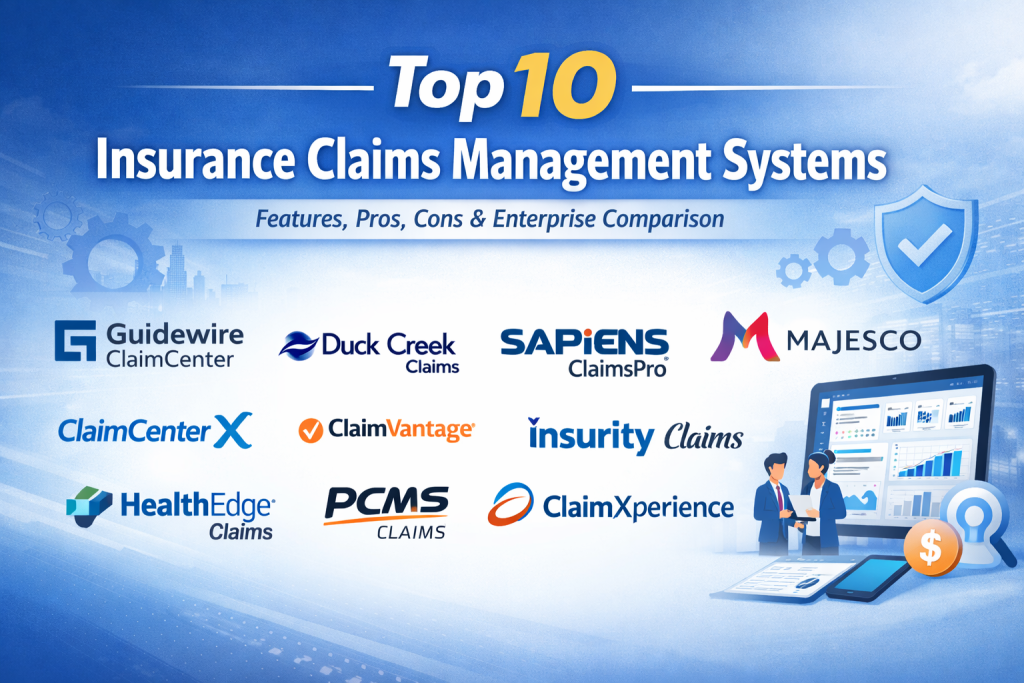
Top 10 Insurance Claims Management Systems Tools
1 — Guidewire ClaimCenter
Short description:
A market-leading enterprise claims platform designed for large insurers managing complex, high-volume claims across multiple lines of business.
Key features:
- End-to-end claims lifecycle management
- Highly configurable workflows and rules engine
- Deep integration with policy and billing systems
- Advanced fraud detection and analytics
- Support for multiple insurance lines
- Cloud and on-prem deployment options
Pros:
- Extremely powerful and scalable
- Trusted by tier-1 global insurers
Cons:
- High implementation cost
- Requires experienced technical teams
Security & compliance:
Strong role-based access, audit logs, encryption, regulatory reporting support
Support & community:
Enterprise-grade support, certified partners, extensive documentation
2 — Duck Creek Claims
Short description:
A flexible, cloud-native claims solution focused on configurability, speed to market, and digital-first claims experiences.
Key features:
- Cloud-native architecture
- Low-code configuration
- Automated claim assignment
- Integrated fraud and analytics
- API-driven ecosystem
Pros:
- Faster implementation than traditional platforms
- Strong digital user experience
Cons:
- Advanced customizations may require partners
- Pricing can scale quickly
Security & compliance:
SOC-aligned controls, encryption, auditability, regulatory support
Support & community:
Strong vendor support, growing ecosystem of partners
3 — Sapiens ClaimsPro
Short description:
A mature claims platform supporting both P&C and life insurance claims with strong compliance and process control.
Key features:
- Multi-line claims processing
- Built-in compliance workflows
- Rules-based automation
- Fraud detection capabilities
- Claims analytics and dashboards
Pros:
- Industry-specific depth
- Reliable for regulated environments
Cons:
- UI can feel dated
- Customization may take time
Security & compliance:
Strong compliance frameworks, audit trails, data protection
Support & community:
Global support teams, detailed documentation
4 — Majesco Claims
Short description:
A cloud-enabled claims system built for agility, digital transformation, and customer-centric insurance operations.
Key features:
- Digital FNOL and self-service portals
- AI-assisted claims processing
- Configurable workflows
- Real-time analytics
- Cloud deployment options
Pros:
- Modern architecture
- Strong customer engagement features
Cons:
- Learning curve for advanced features
- Premium pricing tiers
Security & compliance:
Encryption, access control, regulatory reporting support
Support & community:
Enterprise support, implementation partners available
5 — VCA Software
Short description:
A cloud-based insurance claims management software designed to manage the full claims lifecycle, from first notice of loss (FNOL) through settlement, with customizable workflows, automation, analytics, and real-time claim visibility.
Key features:
- Digital FNOL and policyholder self-service through InsuredConnect
- End-to-end claims lifecycle management with configurable workflows
- Automated claim assignment and task management
- Claims analytics and reporting dashboards
- Document management and real-time claim tracking
- Integrations with policy administration systems and third-party applications
- AI-powered claim file assistance for faster reviews and insights
Pros:
- Highly customizable to fit different insurance workflows
- Supports carriers, MGAs, TPAs, adjusters, captives, and self-insured organizations
- Strong automation and reporting capabilities
- Cloud-based access with scalable architecture
Cons:
- Primarily focused on property and casualty insurance workflows
- May require configuration and onboarding for organizations with complex legacy processes
Security & compliance:
Cloud-based platform with secure data handling, regional data hosting options, and enterprise-grade controls designed for insurance organizations.
Support & community:
Dedicated onboarding assistance, customer support resources, and implementation guidance to help organizations configure and adopt the platform.
6 — ClaimVantage
Short description:
A claims platform focused on disability, life, and health insurance with strong policy integration.
Key features:
- Life and health claims specialization
- Policy and benefit calculations
- Workflow automation
- Compliance tracking
- Analytics and reporting
Pros:
- Deep expertise in life and health claims
- Strong compliance capabilities
Cons:
- Less suited for P&C claims
- Enterprise-oriented pricing
Security & compliance:
HIPAA-aligned controls, audit logs, encryption
Support & community:
Strong onboarding, specialized support teams
7 — Insurity Claims
Short description:
A cloud-based claims system offering flexibility and rapid deployment for small to mid-size insurers.
Key features:
- Cloud deployment
- Configurable workflows
- Claims analytics
- Policy system integration
- API support
Pros:
- Faster go-live
- Lower total cost of ownership
Cons:
- Not ideal for very complex claims
- Advanced analytics may be limited
Security & compliance:
Standard SaaS security, encryption, access controls
Support & community:
Good documentation, customer success teams
8 — PCMS Claims
Short description:
A claims platform built for operational efficiency with emphasis on workflow automation and reporting.
Key features:
- Claims intake and assignment
- Automated workflows
- Document and evidence management
- Reporting dashboards
- Payment tracking
Pros:
- Straightforward and practical
- Lower implementation complexity
Cons:
- Limited AI and predictive tools
- UI is functional but basic
Security & compliance:
Standard security controls, auditability
Support & community:
Smaller vendor support team, adequate documentation
9 — HealthEdge Claims
Short description:
A specialized claims platform designed for health insurers managing complex reimbursement and compliance requirements.
Key features:
- Health claims adjudication
- Provider contract management
- Automated reimbursement rules
- Compliance reporting
- Analytics and cost controls
Pros:
- Strong healthcare domain expertise
- Scales well for large health plans
Cons:
- Narrow focus outside healthcare
- Complex setup
Security & compliance:
HIPAA-ready controls, encryption, audit trails
Support & community:
Enterprise-level support, healthcare-focused user base
10 — ClaimXperience
Short description:
A digital-first claims management solution focused on automation, customer experience, and cost reduction.
Key features:
- Digital FNOL and self-service
- AI-driven workflow automation
- Claims analytics
- Fraud indicators
- Cloud-native design
Pros:
- Modern and user-friendly
- Strong automation capabilities
Cons:
- Smaller ecosystem
- Limited legacy system support
Security & compliance:
Cloud security standards, encryption, role-based access
Support & community:
Growing support resources, onboarding assistance
Comparison Table
| Tool Name | Best For | Platform(s) Supported | Standout Feature | Rating |
|---|---|---|---|---|
| Guidewire ClaimCenter | Large enterprises | Cloud / On-prem | Deep configurability | N/A |
| Duck Creek Claims | Digital insurers | Cloud | Low-code agility | N/A |
| Sapiens ClaimsPro | Regulated insurers | Cloud / On-prem | Compliance strength | N/A |
| Majesco Claims | Customer-centric insurers | Cloud | AI-assisted claims | N/A |
| VCA Software | Mid-market insurers | Cloud | Modular design | N/A |
| ClaimVantage | Life & health insurers | Cloud | Benefit calculations | N/A |
| Insurity Claims | SMB insurers | Cloud | Fast deployment | N/A |
| PCMS Claims | Cost-focused teams | Cloud / On-prem | Workflow simplicity | N/A |
| HealthEdge Claims | Health insurers | Cloud | Healthcare specialization | N/A |
| ClaimXperience | Digital-first insurers | Cloud | Automation & UX | N/A |
Evaluation & Scoring of Insurance Claims Management Systems
| Criteria | Weight | Evaluation Focus |
|---|---|---|
| Core features | 25% | Lifecycle coverage, automation |
| Ease of use | 15% | UI, configuration simplicity |
| Integrations & ecosystem | 15% | APIs, third-party support |
| Security & compliance | 10% | Audit, encryption, regulations |
| Performance & reliability | 10% | Stability, scalability |
| Support & community | 10% | Documentation, support quality |
| Price / value | 15% | ROI, licensing flexibility |
Which Insurance Claims Management Systems Tool Is Right for You?
- Solo users & SMBs: Look for cloud-based, configurable tools with fast deployment and lower cost
- Mid-market insurers: Balance configurability with ease of use and integration depth
- Enterprise insurers: Prioritize scalability, compliance, advanced analytics, and vendor maturity
- Budget-conscious teams: Focus on modular solutions and SaaS pricing models
- Highly regulated environments: Choose platforms with strong audit and compliance controls
Frequently Asked Questions (FAQs)
1. What is an Insurance Claims Management System?
It is software that manages the end-to-end insurance claims lifecycle digitally.
2. Who uses claims management systems?
Insurers, TPAs, adjusters, self-insured enterprises, and government programs.
3. Are these systems cloud-based?
Most modern platforms are cloud-native, though some support hybrid or on-prem models.
4. How long does implementation take?
Anywhere from a few weeks for SaaS tools to several months for enterprise systems.
5. Do these systems support fraud detection?
Many include rule-based or AI-assisted fraud indicators.
6. Are claims systems customizable?
Yes, but the level of customization varies significantly by platform.
7. What security standards are supported?
Encryption, access controls, audit logs, and regulatory compliance are common.
8. Can they integrate with policy systems?
Most leading platforms offer APIs or native integrations.
9. Are these tools expensive?
Costs vary widely based on scale, features, and deployment model.
10. What is the biggest mistake buyers make?
Choosing overly complex systems without aligning them to actual claims volume and needs.
Conclusion
Insurance Claims Management Systems play a central role in operational efficiency, regulatory compliance, and customer satisfaction. The right platform can significantly reduce claim cycle time, prevent leakage, and improve transparency across the claims journey.
There is no single “best” tool for everyone. Large insurers may benefit from deeply configurable enterprise platforms, while smaller or digital-first organizations may prioritize speed, simplicity, and cost efficiency. By carefully evaluating features, usability, integration needs, and compliance requirements, organizations can select a claims management system that truly aligns with their business goals and long-term strategy.

Find Trusted Cardiac Hospitals
Compare heart hospitals by city and services — all in one place.
Explore Hospitals
This article provides a clear and practical comparison of top insurance claims management systems by breaking down key features, strengths, and limitations. I appreciate how it helps readers understand not just what each system offers, but also how those capabilities can impact efficiency and accuracy in real‑world insurance operations. For anyone evaluating software to improve claims processing, this guide makes the decision‑making process much more informed and accessible.