
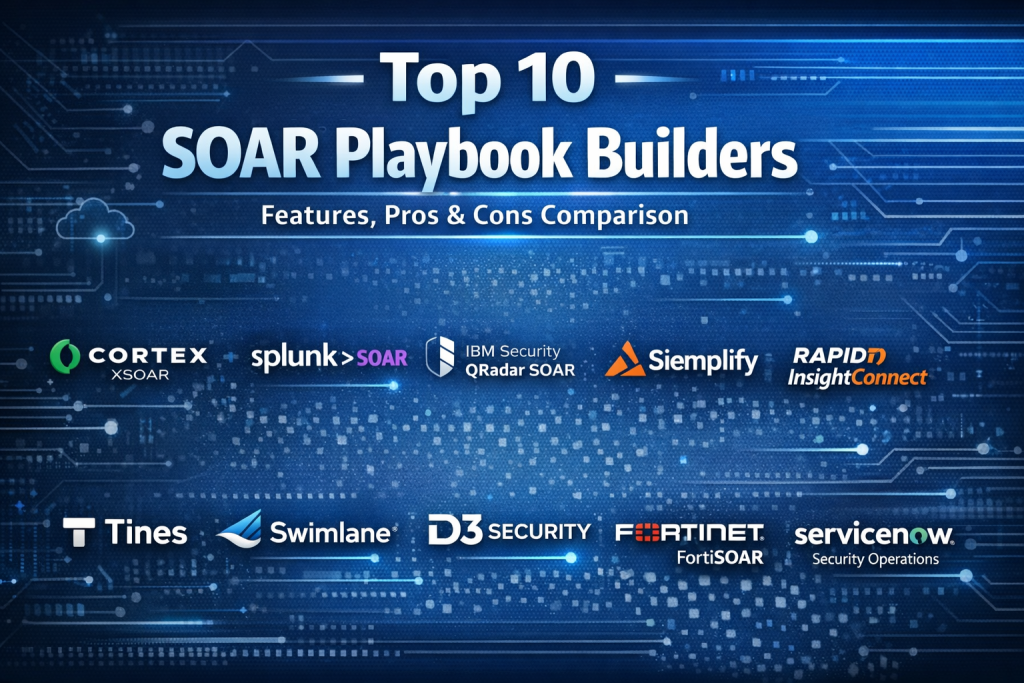
Introduction
Security Operations, Automation, and Response (SOAR) playbook builders are specialized platforms that help security teams design, automate, and orchestrate incident response workflows. Instead of relying on manual steps, emails, and ad-hoc scripts, SOAR playbooks turn best-practice response processes into repeatable, automated actions that trigger consistently when threats are detected.
These tools matter because modern security teams face alert fatigue, limited staffing, and increasingly complex attack chains. A single incident may require enrichment from multiple tools, approvals, containment actions, documentation, and reporting. SOAR playbook builders streamline this complexity, reducing response times while improving accuracy and auditability.
Real-world use cases include phishing triage, malware containment, user account lockdowns, vulnerability response, insider threat investigation, and compliance-driven incident handling. The right playbook builder helps teams standardize responses, reduce human error, and scale security operations without linear headcount growth.
When choosing a SOAR playbook builder, buyers should evaluate automation depth, visual workflow design, integration breadth, governance controls, usability, scalability, and security certifications. Cost transparency and support quality also play a major role in long-term success.
Best for:
Security analysts, SOC teams, MSSPs, and enterprises managing high alert volumes, complex environments, or strict compliance requirements.
Not ideal for:
Very small teams with minimal alerts, organizations without SIEM or security tooling maturity, or teams seeking only basic task automation rather than full incident orchestration.
Top 10 SOAR Playbook Builders Tools
1 — Palo Alto Cortex XSOAR
Short description:
A market-leading SOAR platform offering deep automation, advanced playbook logic, and tight integration with security ecosystems.
Key features:
- Visual and script-based playbook builder
- Prebuilt response templates and content packs
- Case management and incident timelines
- Extensive third-party integrations
- Advanced enrichment and automation logic
- Threat intelligence orchestration
Pros:
- Extremely powerful and flexible
- Mature enterprise-grade features
Cons:
- Steep learning curve
- Higher cost than many alternatives
Security & compliance:
SSO, RBAC, audit logs, encryption, SOC 2, ISO support
Support & community:
Strong documentation, enterprise support, active user community
2 — Splunk SOAR
Short description:
A robust SOAR solution designed to work seamlessly with Splunk’s security and observability ecosystem.
Key features:
- Visual playbook editor
- Native SIEM integration
- Event correlation and enrichment
- Automated containment actions
- Case and evidence management
Pros:
- Excellent for Splunk-centric environments
- Highly scalable architecture
Cons:
- Best value requires Splunk ecosystem
- Interface can feel complex
Security & compliance:
SSO, RBAC, audit logs, encryption, SOC 2
Support & community:
Strong enterprise support, extensive documentation
3 — IBM QRadar SOAR
Short description:
An enterprise-grade SOAR platform emphasizing governance, collaboration, and regulated-industry workflows.
Key features:
- Drag-and-drop playbook builder
- Built-in task and approval flows
- Case management and reporting
- Integration with QRadar SIEM
- Compliance-oriented workflows
Pros:
- Strong governance and auditability
- Well-suited for regulated industries
Cons:
- UI feels dated to some users
- Less flexible scripting than competitors
Security & compliance:
SSO, encryption, audit trails, GDPR, ISO alignment
Support & community:
Enterprise-grade IBM support and training resources
4 — Siemplify
Short description:
A SOAR platform focused on analyst productivity, investigation speed, and visual clarity.
Key features:
- Intuitive visual playbook builder
- Investigation and case mapping
- Automation and enrichment actions
- Metrics and KPI tracking
- Collaboration tools
Pros:
- Analyst-friendly UI
- Fast onboarding
Cons:
- Limited customization for advanced users
- Best features tied to enterprise plans
Security & compliance:
SSO, RBAC, audit logs, SOC 2
Support & community:
Good documentation and responsive support
5 — Rapid7 InsightConnect
Short description:
An automation-focused SOAR tool emphasizing speed, simplicity, and prebuilt integrations.
Key features:
- No-code workflow builder
- Extensive plugin marketplace
- Trigger-based automation
- Integration with Rapid7 tools
- Alert enrichment workflows
Pros:
- Easy to use
- Quick time to value
Cons:
- Less complex playbook logic
- Limited advanced branching
Security & compliance:
SSO, encryption, audit logs, SOC 2
Support & community:
Strong documentation and vendor support
6 — Tines
Short description:
A modern, no-code automation platform popular with lean security teams and MSSPs.
Key features:
- Visual, no-code automation builder
- Event-driven workflows
- API-centric integrations
- Strong logging and observability
- Human-in-the-loop controls
Pros:
- Extremely intuitive
- Fast deployment
Cons:
- Not a traditional SOAR
- Limited native case management
Security & compliance:
SSO, encryption, audit logs, SOC 2
Support & community:
Excellent onboarding and active community
7 — Swimlane
Short description:
A low-code SOAR platform built for customization, scalability, and enterprise automation.
Key features:
- Drag-and-drop playbook designer
- Customizable dashboards
- API-first architecture
- Role-based access control
- Case and incident tracking
Pros:
- Highly flexible
- Strong scalability
Cons:
- Setup can be time-intensive
- Requires technical expertise
Security & compliance:
SSO, encryption, audit logs, SOC 2, ISO
Support & community:
Enterprise support and strong documentation
8 — D3 Security
Short description:
A comprehensive SOAR solution focused on automation depth and threat response maturity.
Key features:
- Visual playbook builder
- Incident lifecycle management
- Extensive integrations
- Threat intelligence automation
- Compliance reporting
Pros:
- Feature-rich platform
- Strong compliance focus
Cons:
- UI complexity
- Longer learning curve
Security & compliance:
SSO, encryption, audit logs, SOC 2
Support & community:
Enterprise-focused support resources
9 — FortiSOAR
Short description:
A SOAR platform tightly integrated with Fortinet’s security ecosystem.
Key features:
- Visual playbook editor
- Incident and case management
- Fortinet product integrations
- Automation and orchestration
- Compliance reporting
Pros:
- Excellent for Fortinet users
- Broad security coverage
Cons:
- Less flexible outside Fortinet stack
- UI can feel crowded
Security & compliance:
SSO, encryption, audit logs, ISO alignment
Support & community:
Strong vendor support for Fortinet customers
10 — ServiceNow Security Operations
Short description:
A SOAR-like platform built on ITSM workflows and enterprise service management.
Key features:
- Workflow-based playbooks
- Native ITSM integration
- Incident and task automation
- Approval and governance flows
- Reporting and dashboards
Pros:
- Strong governance
- Excellent enterprise integration
Cons:
- Not a pure-play SOAR
- High licensing cost
Security & compliance:
SSO, encryption, audit logs, SOC 2, ISO
Support & community:
Extensive documentation and enterprise support
Comparison Table
| Tool Name | Best For | Platform(s) Supported | Standout Feature | Rating |
|---|---|---|---|---|
| Palo Alto Cortex XSOAR | Large enterprises | Cloud / On-prem | Advanced playbook logic | N/A |
| Splunk SOAR | Splunk users | Cloud / On-prem | Native SIEM integration | N/A |
| IBM QRadar SOAR | Regulated industries | On-prem / Hybrid | Governance workflows | N/A |
| Siemplify | Analyst-led SOCs | Cloud | Investigation mapping | N/A |
| Rapid7 InsightConnect | SMBs & mid-market | Cloud | No-code automation | N/A |
| Tines | Lean teams & MSSPs | Cloud | Event-driven automation | N/A |
| Swimlane | Custom-heavy SOCs | Cloud / On-prem | Low-code flexibility | N/A |
| D3 Security | Mature SOCs | Cloud / On-prem | Deep automation | N/A |
| FortiSOAR | Fortinet customers | Cloud / On-prem | Ecosystem integration | N/A |
| ServiceNow SecOps | ITSM-driven orgs | Cloud | ITSM-native workflows | N/A |
Evaluation & Scoring of SOAR Playbook Builders
| Tool | Core Features (25%) | Ease of Use (15%) | Integrations (15%) | Security (10%) | Performance (10%) | Support (10%) | Price/Value (15%) | Total Score |
|---|---|---|---|---|---|---|---|---|
| Cortex XSOAR | 23 | 11 | 14 | 9 | 9 | 9 | 10 | 85 |
| Splunk SOAR | 22 | 10 | 14 | 9 | 9 | 9 | 9 | 82 |
| IBM QRadar SOAR | 21 | 10 | 13 | 9 | 8 | 9 | 10 | 80 |
| Tines | 18 | 14 | 13 | 8 | 9 | 9 | 12 | 83 |
Which SOAR Playbook Builders Tool Is Right for You?
- Solo users & SMBs: Prefer no-code or low-complexity tools like Tines or InsightConnect.
- Mid-market teams: Look for balance between power and usability with Siemplify or Swimlane.
- Enterprises: Choose Cortex XSOAR, Splunk SOAR, or IBM QRadar SOAR for scale and governance.
- Budget-conscious buyers: Prioritize ease of use and fast ROI over maximum feature depth.
- Compliance-heavy environments: Focus on audit logs, approvals, and reporting capabilities.
Frequently Asked Questions (FAQs)
- What is a SOAR playbook?
A predefined, automated workflow that standardizes incident response actions. - Do SOAR tools replace SOC analysts?
No, they augment analysts by removing repetitive tasks. - Is coding required?
Many tools support no-code or low-code builders. - How long does implementation take?
Anywhere from days to several months depending on complexity. - Can SOAR work without a SIEM?
Yes, but SIEM integration greatly increases value. - Are SOAR tools expensive?
Pricing varies widely based on scale and features. - Do they support human approvals?
Most platforms include human-in-the-loop steps. - What are common mistakes?
Over-automation without validation and poor integration planning. - Can MSSPs use SOAR tools?
Yes, many tools are designed for multi-tenant use. - How do I measure ROI?
Reduced response time, fewer incidents, and analyst efficiency gains.
Conclusion
SOAR playbook builders are essential for modern security operations, enabling faster, more consistent, and scalable incident response. While leading platforms offer powerful automation, the best choice depends on team size, technical maturity, integration needs, and compliance requirements. By aligning tool capabilities with real operational goals, organizations can transform security from reactive firefighting into proactive resilience.

Find Trusted Cardiac Hospitals
Compare heart hospitals by city and services — all in one place.
Explore Hospitals
SOAR playbook builders help security teams automate repeatable response steps across alerts and incidents. Automation can save time, but poorly designed workflows may make a problem worse. I would compare integration options, approval steps, error handling, audit logs, and rollback support. Teams should test playbooks with simulated incidents before allowing them to change live systems. Clear conditions should determine when an action runs and when a human must review it. Monitoring should show failed steps and unexpected results. A strong playbook builder should reduce repetitive work while keeping automated actions controlled, explainable, and safe to recover from.
SOAR playbook builders are most useful when they automate repetitive security tasks while still giving analysts control over critical decisions. Starting with common use cases like phishing investigations and alert enrichment can help teams see value without making workflows too complex. It is also important to test playbooks carefully and include clear approval steps for actions that could disrupt business operations. Regularly reviewing automation results helps improve response speed while reducing unnecessary alerts and manual effort.
SOAR playbook builders help security teams automate repetitive incident response tasks and coordinate actions across multiple security tools. Visual workflow design, conditional logic, and reusable response templates can reduce manual effort while improving consistency during investigations. Integrating playbooks with SIEM, threat intelligence, and case management systems also enables faster triage, clearer audit trails, and more efficient handling of security incidents.
Security teams should treat playbook updates like application releases, with proper testing before deployment. A small logic change can accidentally disable user accounts, isolate critical servers, or send incorrect incident data to downstream systems. Using simulated security events, isolated test environments, and controlled rollout stages can help uncover these problems early. Teams should also maintain version history and rollback procedures so analysts can quickly restore a stable workflow after a failed update. Measuring false containment actions and failed automation steps provides useful evidence for improving playbook quality over time. This release discipline helps organizations expand security automation without increasing the risk of operational disruption.
SOAR playbook builders are most useful when security teams can automate repetitive response steps while keeping analysts in control of sensitive actions. Compare how each platform handles approval checkpoints, rollback options, and failures when an integrated security tool stops responding. Testing playbooks against realistic incident scenarios before enabling automatic execution can prevent a small integration error from disrupting the wider response process.
SOAR playbook builders help security teams automate incident response tasks, connect security tools, and standardize actions for common threats. When comparing platforms, consider workflow customization, integration coverage, approval steps, error handling, and audit logs. Start by automating low-risk tasks, such as enriching alerts or gathering evidence, then test each playbook carefully to prevent automation errors from disrupting incident response.
SOAR playbook builders help security teams automate incident response, coordinate investigation steps, and reduce repetitive manual tasks during security incidents. Platforms like Palo Alto Networks Cortex XSOAR offer customizable playbooks, security integrations, and automated workflows, helping organizations respond to threats faster and improve overall security operations.
Choosing the right SOAR playbook builder often comes down to balancing out-of-the-box integration depth with the flexibility of custom code. While enterprise heavyweights like Cortex XSOAR offer unmatched integration libraries, lean teams frequently find that lightweight, API-first builders reduce maintenance overhead significantly. Evaluating your SOC’s specific skill sets and alert volume before committing to a platform is key to avoiding over-engineering.
A good SOAR playbook should do more than automate routine tasks; it should also handle exceptions and prevent risky actions from running unchecked. Testing workflows against past incidents and adding approval checkpoints can improve response reliability without sacrificing speed.