
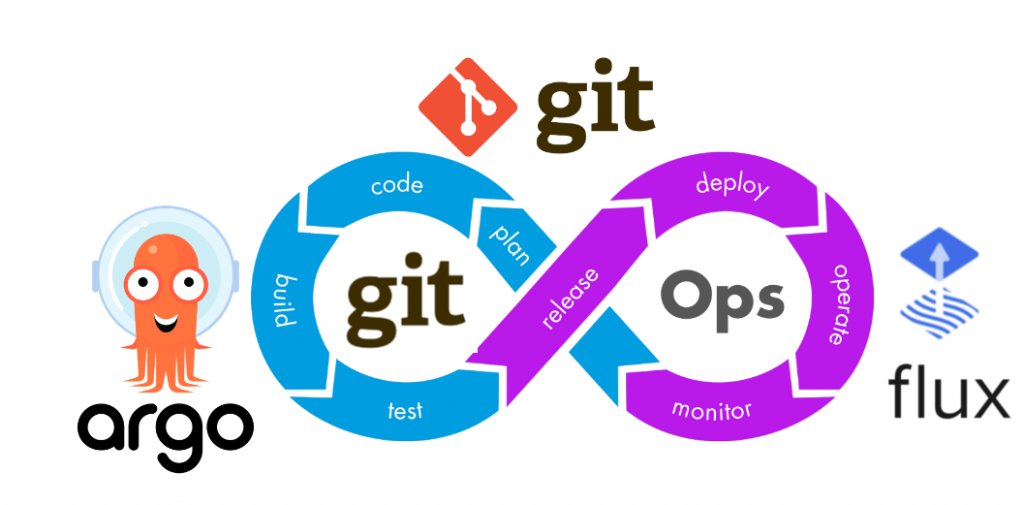
Are you tired of manually deploying code updates and struggling to keep track of all the changes made to your software? GitOps is here to help. This modern approach to software delivery and deployment allows you to manage your infrastructure and applications using Git, the popular version control system. But with so many GitOps tools available, it can be overwhelming to choose the right one for your team. In this article, we’ll explore the top GitOps tools and what makes them stand out.
1. Flux
Flux is a popular GitOps tool that automates the deployment of your Kubernetes cluster. It connects your Git repository to your Kubernetes cluster and automatically deploys changes as soon as they’re pushed to your repository. Flux also allows you to rollback changes quickly if something goes wrong. With Flux, you can easily manage multiple clusters from a single Git repository, making it an ideal tool for teams with complex infrastructure.
2. Argo CD
Argo CD is another GitOps tool that specializes in deploying applications to Kubernetes clusters. It provides a web interface that allows you to manage your applications and deployments easily. Argo CD also supports multiple environments, making it easy to deploy your application to different clusters with different configurations. One of the standout features of Argo CD is its ability to detect drift, where the actual state of your cluster differs from the desired state defined in your Git repository, and automatically reconcile the differences.
3. Jenkins X
Jenkins X is a GitOps tool that focuses on continuous integration and delivery (CI/CD) for cloud-native applications. It uses GitOps principles to manage the entire software delivery process, from development to production. Jenkins X automates the creation of Kubernetes clusters, the deployment of applications, and the creation of pull requests for code changes. It also provides a web interface that allows you to manage your pipelines and deployments easily.
4. GitLab
GitLab is a popular GitOps tool that provides a complete DevOps platform. It includes features for source code management, continuous integration and delivery, and container registry. GitLab supports GitOps principles by allowing you to manage your infrastructure and deployments with Git. It also provides a web interface that allows you to manage your pipelines and deployments easily.
5. Weave Flux
Weave Flux is a GitOps tool that focuses on continuous delivery for Kubernetes clusters. It provides a web interface that allows you to manage your deployments and environments easily. Weave Flux also supports multiple clusters and allows you to deploy applications across different environments. One of the standout features of Weave Flux is its ability to automate the creation of Kubernetes objects, such as services and ingresses, based on changes made to your Git repository.
Conclusion
There are many GitOps tools available, each with its strengths and weaknesses. Choosing the right one for your team depends on your specific needs and preferences. Flux and Argo CD are excellent choices for Kubernetes deployments, while Jenkins X provides a complete CI/CD solution for cloud-native applications. GitLab is a popular all-in-one DevOps platform, and Weave Flux focuses on continuous delivery for Kubernetes clusters. Whichever GitOps tool you choose, it’s important to keep GitOps principles in mind and automate your software delivery process to improve your team’s efficiency and productivity.

👤 About the Author
Ashwani is passionate about DevOps, DevSecOps, SRE, MLOps, and AiOps, with a strong drive to simplify and scale modern IT operations. Through continuous learning and sharing, Ashwani helps organizations and engineers adopt best practices for automation, security, reliability, and AI-driven operations.
🌐 Connect & Follow:
- Website: WizBrand.com
- Facebook: facebook.com/DevOpsSchool
- X (Twitter): x.com/DevOpsSchools
- LinkedIn: linkedin.com/company/devopsschool
- YouTube: youtube.com/@TheDevOpsSchool
- Instagram: instagram.com/devopsschool
- Quora: devopsschool.quora.com
- Email– contact@devopsschool.com
Find Trusted Cardiac Hospitals
Compare heart hospitals by city and services — all in one place.
Explore Hospitals
A point that is often overlooked in “top GitOps tools” discussions is that selecting a tool by itself does not guarantee successful GitOps adoption, since most challenges in real environments come from operational practices rather than the tool’s capabilities. In reality, platforms like Argo CD, Flux, or even Jenkins-based approaches mainly differ in how they implement reconciliation, drift handling, and integration with existing CI/CD and governance structures, but they all require strong discipline to operate effectively at scale. One common issue is the hidden complexity around multi-cluster management, secret lifecycle handling, and repository structuring, which often grows over time and becomes harder to maintain than expected. Another critical factor is observability—engineers need clear visibility into sync status, drift detection, and failure reasons, and without this, troubleshooting becomes difficult regardless of the tool used. Additionally, production readiness depends on how well these tools support progressive delivery, rollback strategies, and policy enforcement, since simple state synchronization is not sufficient for reliable deployments. Ultimately, the success of any GitOps tool is determined less by feature comparison and more by how well it is integrated into a well-governed, scalable operational model with clear ownership and disciplined deployment practices.