
Introduction
Cloud adoption has transformed how organizations operate, collaborate, and scale. From SaaS tools like email and file sharing to IaaS platforms running critical workloads, cloud services are now deeply embedded in daily business operations. However, this shift has also introduced new security challenges—shadow IT, data leakage, misconfigurations, insider threats, and compliance risks. This is where Cloud Access Security Brokers (CASB) play a critical role.
A CASB acts as a security control point between cloud service users and cloud applications. It provides visibility into cloud usage, enforces security policies, protects sensitive data, and ensures compliance across sanctioned and unsanctioned cloud services. Instead of relying solely on traditional perimeter security, CASB solutions focus on securing data wherever it lives—in the cloud.
Why CASB Is Important
- Cloud apps are accessed from anywhere, often outside corporate networks
- Employees frequently use unsanctioned SaaS tools
- Sensitive data is shared, stored, and downloaded across multiple platforms
- Regulatory compliance demands stronger visibility and control
Real-World Use Cases
- Preventing sensitive data uploads to personal cloud storage
- Enforcing access controls based on user role, device, or location
- Detecting risky behavior or compromised accounts
- Monitoring and securing third-party app integrations
What to Look for When Choosing a CASB
When evaluating CASB tools, buyers should consider:
- Visibility across SaaS, IaaS, and PaaS
- Data loss prevention (DLP) capabilities
- Identity and access integration
- API-based vs proxy-based deployment
- Compliance coverage and reporting
- Ease of deployment and ongoing management
Best for:
Cloud Access Security Brokers are ideal for IT security teams, CISOs, compliance officers, and organizations of all sizes that rely heavily on cloud services. Industries such as finance, healthcare, SaaS, education, retail, and government benefit the most due to strict data protection and compliance needs.
Not ideal for:
CASB tools may be excessive for very small teams with minimal cloud usage, or organizations operating mostly on-premise. In such cases, simpler endpoint or identity-based security solutions may be sufficient.
Top 10 Cloud Access Security Brokers (CASB) Tools
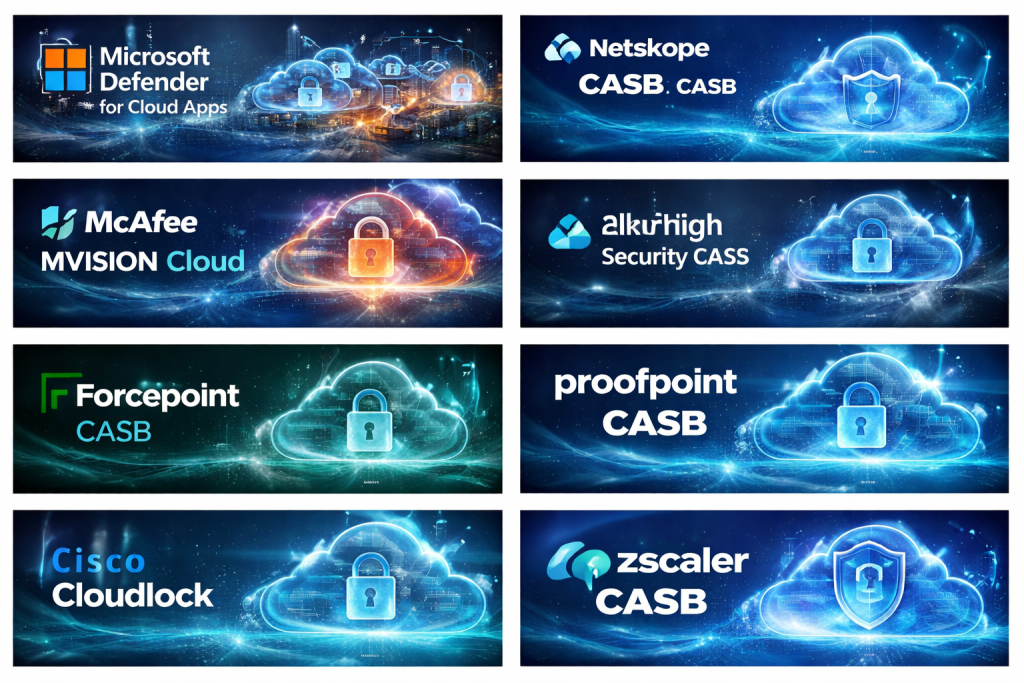
1 — Microsoft Defender for Cloud Apps
Short description:
A comprehensive CASB designed for organizations using Microsoft’s cloud ecosystem, offering deep visibility and control across SaaS applications.
Key features:
- Cloud app discovery and shadow IT detection
- Advanced DLP policies
- Conditional access integration
- User and entity behavior analytics
- API-based monitoring
- Automated policy enforcement
Pros:
- Seamless integration with Microsoft identity tools
- Strong enterprise-grade security controls
Cons:
- Best value mainly for Microsoft-centric environments
- Can feel complex for smaller teams
Security & compliance:
SSO, encryption, audit logs, SOC 2, ISO, GDPR, HIPAA support
Support & community:
Extensive documentation, enterprise support, large user community
2 — Netskope CASB
Short description:
A cloud-native CASB focused on real-time visibility, data protection, and zero-trust security for modern enterprises.
Key features:
- Inline and API-based CASB
- Advanced DLP and encryption
- Real-time policy enforcement
- Cloud app risk assessment
- User behavior analytics
Pros:
- Excellent real-time control
- Strong data protection capabilities
Cons:
- Premium pricing
- Requires skilled configuration
Security & compliance:
SOC 2, ISO, GDPR, HIPAA, audit logs, encryption
Support & community:
Strong enterprise onboarding, dedicated support teams
3 — Palo Alto Networks Prisma SaaS
Short description:
A CASB designed for organizations needing deep security posture management and threat detection across SaaS platforms.
Key features:
- SaaS security posture management
- Threat detection and prevention
- API-based cloud visibility
- Compliance monitoring
- Automated remediation
Pros:
- Strong threat intelligence
- Unified security approach
Cons:
- Less focus on inline controls
- Higher learning curve
Security & compliance:
SOC 2, ISO, GDPR, audit logs
Support & community:
Enterprise-grade support, detailed documentation
4 — McAfee MVISION Cloud
Short description:
A mature CASB solution providing visibility, data protection, and threat prevention across cloud services.
Key features:
- Shadow IT discovery
- DLP and encryption
- Cloud malware protection
- User activity monitoring
- API-based integration
Pros:
- Proven enterprise reliability
- Broad SaaS coverage
Cons:
- UI can feel dated
- Complex policy tuning
Security & compliance:
SOC 2, ISO, GDPR, HIPAA support
Support & community:
Strong enterprise support, long-standing user base
5 — Skyhigh Security CASB
Short description:
A CASB focused on data-centric security, offering strong visibility and policy enforcement across cloud applications.
Key features:
- Data classification and DLP
- Cloud activity monitoring
- Risk assessment for SaaS apps
- Threat protection
- Compliance reporting
Pros:
- Strong data governance
- Mature policy controls
Cons:
- Can be resource-intensive
- Setup complexity
Security & compliance:
SOC 2, ISO, GDPR, HIPAA
Support & community:
Enterprise support, extensive documentation
6 — Forcepoint CASB
Short description:
A behavior-driven CASB emphasizing insider threat detection and contextual access control.
Key features:
- User behavior analytics
- DLP with risk-adaptive policies
- Cloud app visibility
- Compliance enforcement
- API integrations
Pros:
- Strong insider threat detection
- Context-aware security
Cons:
- Less intuitive UI
- Longer deployment cycles
Security & compliance:
SOC 2, ISO, GDPR, audit logs
Support & community:
Enterprise support, guided onboarding
7 — Proofpoint CASB
Short description:
A CASB built around data protection and threat defense, particularly effective for collaboration platforms.
Key features:
- SaaS threat detection
- DLP for cloud apps
- Insider threat monitoring
- API-based controls
- Compliance dashboards
Pros:
- Excellent threat detection
- Strong email and SaaS security synergy
Cons:
- Narrower SaaS focus
- Pricing transparency issues
Security & compliance:
SOC 2, ISO, GDPR
Support & community:
Enterprise support, solid documentation
8 — Cisco Cloudlock
Short description:
An API-based CASB ideal for organizations seeking visibility and compliance without inline traffic interception.
Key features:
- SaaS discovery
- Policy enforcement via APIs
- Compliance monitoring
- Threat detection
- Audit reporting
Pros:
- Easy deployment
- Strong compliance reporting
Cons:
- Limited real-time controls
- Best for post-event enforcement
Security & compliance:
SOC 2, ISO, GDPR
Support & community:
Cisco enterprise support ecosystem
9 — Lookout CASB
Short description:
A CASB optimized for mobile-first and cloud-first environments, focusing on data protection and visibility.
Key features:
- Cloud app visibility
- DLP and encryption
- Mobile-friendly security
- Threat detection
- Policy enforcement
Pros:
- Strong mobile security integration
- Cloud-native design
Cons:
- Smaller ecosystem
- Limited advanced analytics
Security & compliance:
SOC 2, ISO, GDPR
Support & community:
Good documentation, responsive support
10 — Zscaler CASB
Short description:
A CASB tightly integrated with zero-trust network access, providing inline and API-based cloud security.
Key features:
- Inline traffic inspection
- DLP and access control
- Cloud app discovery
- Zero-trust integration
- Compliance monitoring
Pros:
- Strong zero-trust alignment
- Real-time enforcement
Cons:
- Premium pricing
- Requires architectural alignment
Security & compliance:
SOC 2, ISO, GDPR, HIPAA
Support & community:
Enterprise support, strong technical resources
Comparison Table
| Tool Name | Best For | Platform(s) Supported | Standout Feature | Rating |
|---|---|---|---|---|
| Microsoft Defender for Cloud Apps | Microsoft-centric enterprises | SaaS, IaaS | Native identity integration | N/A |
| Netskope CASB | Large enterprises | SaaS, IaaS | Real-time inline control | N/A |
| Palo Alto Prisma SaaS | Security-focused teams | SaaS | Threat intelligence | N/A |
| McAfee MVISION Cloud | Large organizations | SaaS | Mature DLP | N/A |
| Skyhigh Security CASB | Compliance-heavy industries | SaaS | Data governance | N/A |
| Forcepoint CASB | Insider threat prevention | SaaS | Behavior analytics | N/A |
| Proofpoint CASB | Collaboration security | SaaS | SaaS threat defense | N/A |
| Cisco Cloudlock | API-based monitoring | SaaS | Easy deployment | N/A |
| Lookout CASB | Mobile-first teams | SaaS | Mobile security | N/A |
| Zscaler CASB | Zero-trust adopters | SaaS, IaaS | Inline enforcement | N/A |
Evaluation & Scoring of Cloud Access Security Brokers (CASB)
| Criteria | Weight | Evaluation Focus |
|---|---|---|
| Core features | 25% | Visibility, DLP, policy enforcement |
| Ease of use | 15% | UI, deployment, management |
| Integrations & ecosystem | 15% | Identity, SaaS, APIs |
| Security & compliance | 10% | Certifications, auditability |
| Performance & reliability | 10% | Stability, scalability |
| Support & community | 10% | Documentation, enterprise support |
| Price / value | 15% | Cost vs capability |
Which Cloud Access Security Brokers (CASB) Tool Is Right for You?
- Solo users: CASB tools are generally overkill
- SMBs: API-based CASBs with simpler policies work best
- Mid-market: Balanced tools with DLP and identity integration
- Enterprise: Full-featured CASBs with inline controls
Budget-conscious: Look for API-only or bundled solutions
Premium buyers: Choose real-time, zero-trust integrated CASBs
Ease vs depth: Simple dashboards vs advanced policy engines
Scalability: Ensure multi-cloud and global support
Compliance: Match tools to industry regulations
Frequently Asked Questions (FAQs)
1. What problem does a CASB solve?
It secures cloud usage by providing visibility, data protection, and policy enforcement.
2. Is CASB still relevant today?
Yes, especially with growing SaaS adoption and remote work.
3. API-based vs proxy-based CASB?
API is easier to deploy; proxy offers real-time control.
4. Can CASB replace DLP tools?
It complements and often enhances cloud-focused DLP.
5. Do small businesses need CASB?
Only if they handle sensitive data across cloud apps.
6. How long does deployment take?
From a few days (API-based) to several weeks (inline).
7. Does CASB impact performance?
Minimal with API-based; slight latency with inline proxies.
8. Is CASB part of zero-trust?
Yes, it plays a key role in cloud-centric zero-trust models.
9. What are common mistakes when choosing CASB?
Overbuying features or ignoring integration needs.
10. Are there alternatives to CASB?
SSPM, SWG, and identity-based controls can complement or partially replace CASB.
Conclusion
Cloud Access Security Brokers have become essential for organizations that rely on cloud services to operate and grow. They provide the visibility, control, and data protection that traditional security tools cannot deliver in cloud-first environments. While the market offers many capable CASB solutions, there is no single “best” option for everyone.
The right CASB depends on your organization’s size, cloud maturity, compliance needs, budget, and security strategy. By carefully evaluating features, integrations, and real-world use cases, teams can choose a solution that delivers strong protection without unnecessary complexity.

Find Trusted Cardiac Hospitals
Compare heart hospitals by city and services — all in one place.
Explore Hospitals
