
Introduction
Reverse ETL tools have become a critical part of the modern data stack. While traditional ETL tools focus on moving data into a data warehouse, Reverse ETL tools do the opposite—they sync cleaned, modeled data from your warehouse into business applications like CRMs, marketing platforms, support tools, and sales systems.
This shift is important because most companies already centralize their data in a warehouse, but operational teams still work inside SaaS tools. Reverse ETL bridges this gap, ensuring that sales, marketing, customer success, and operations teams act on trusted, analytics-ready data instead of fragmented or outdated records.
Why Reverse ETL Tools Matter
- They eliminate manual data exports and CSV uploads
- They reduce data inconsistencies across tools
- They enable real-time or near-real-time personalization
- They help operational teams use analytics-driven insights directly
Real-World Use Cases
- Syncing customer segments from the warehouse into CRM systems
- Pushing churn-risk scores into customer success tools
- Sending product usage metrics to marketing platforms
- Keeping support and sales tools aligned with a single source of truth
What to Look for When Choosing a Reverse ETL Tool
When evaluating Reverse ETL tools, consider:
- Supported destinations and warehouses
- Ease of setup and usability for non-engineers
- Data freshness and sync reliability
- Security, governance, and compliance
- Pricing and scalability
Best for:
Reverse ETL tools are ideal for data-driven teams, including data engineers, analytics teams, growth marketers, RevOps, and customer success leaders. They are especially valuable for mid-sized to enterprise companies in SaaS, fintech, e-commerce, healthcare, and B2B services.
Not ideal for:
Very small teams without a data warehouse, early-stage startups with minimal data complexity, or organizations relying solely on manual reporting may not need a dedicated Reverse ETL tool yet.
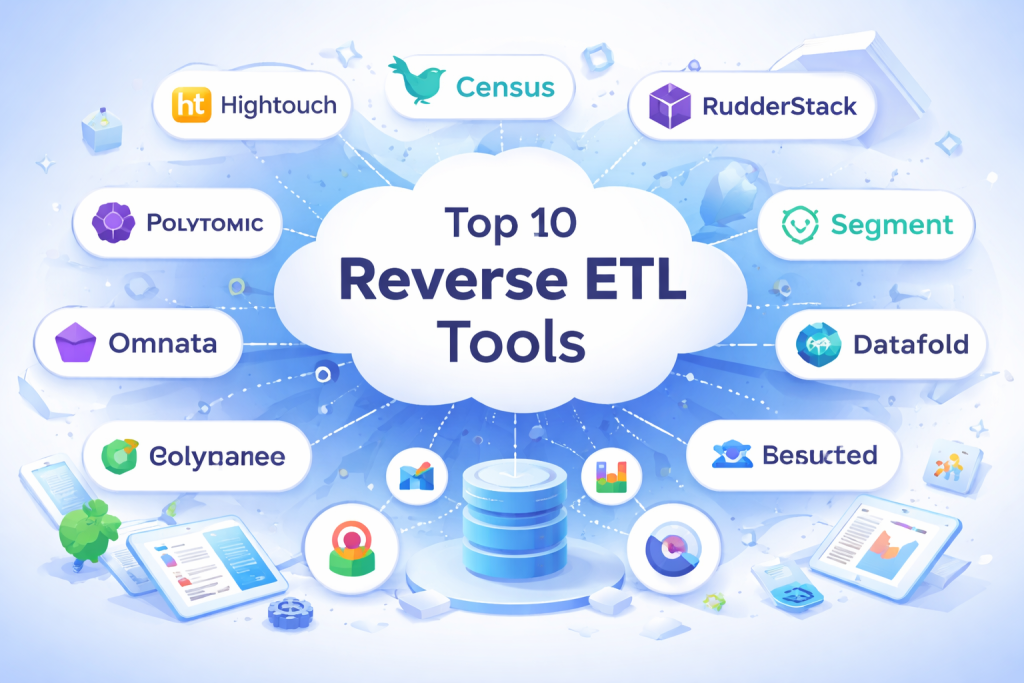
Top 10 Reverse ETL Tools Tools
1 — Hightouch
Short description:
Hightouch is one of the most popular Reverse ETL platforms, designed for modern data teams that want to activate warehouse data across business tools with minimal engineering effort.
Key features
- No-code and low-code sync configuration
- Wide range of CRM, marketing, and support integrations
- Advanced identity resolution and audience syncing
- Near real-time and scheduled syncs
- SQL-based transformations
- Strong role-based access controls
Pros
- Very user-friendly for non-engineers
- Excellent destination coverage
- Strong enterprise adoption
Cons
- Can be expensive at scale
- Advanced features may require higher plans
Security & compliance
SOC 2 Type II, encryption at rest and in transit, SSO, GDPR-ready
Support & community
High-quality documentation, onboarding support, enterprise SLAs, active user community
2 — Census
Short description:
Census focuses on operational analytics by syncing warehouse data into operational tools, with a strong emphasis on data reliability and governance.
Key features
- Declarative data syncing
- Native dbt integration
- Warehouse-native architecture
- Extensive destination support
- Data validation and monitoring
- Fine-grained access controls
Pros
- Excellent data accuracy and consistency
- Deep integration with analytics workflows
- Strong trust among data teams
Cons
- Slight learning curve for beginners
- Less friendly for non-technical users
Security & compliance
SOC 2 Type II, GDPR compliance, SSO, audit logs
Support & community
Strong documentation, responsive support, growing community
3 — RudderStack
Short description:
RudderStack combines customer data infrastructure with Reverse ETL, making it suitable for teams wanting both event collection and data activation.
Key features
- Warehouse-first architecture
- Event streaming and Reverse ETL
- Open-source core
- Flexible deployment options
- Strong privacy controls
Pros
- Highly flexible
- Good for engineering-led teams
- Open-source transparency
Cons
- UI less polished than competitors
- Requires more technical expertise
Security & compliance
SOC 2, GDPR, data residency controls
Support & community
Strong open-source community, enterprise support available
4 — Segment Reverse ETL
Short description:
Segment Reverse ETL extends Segment’s CDP capabilities, enabling warehouse data activation for teams already invested in the Segment ecosystem.
Key features
- Native integration with Segment CDP
- Pre-built connectors
- Identity resolution
- Real-time and batch syncs
- Centralized governance
Pros
- Seamless for existing Segment users
- Strong data consistency
- Enterprise-grade reliability
Cons
- Expensive for smaller teams
- Limited flexibility outside Segment stack
Security & compliance
SOC 2, GDPR, SSO, enterprise security controls
Support & community
Enterprise-level support, extensive documentation
5 — Polytomic
Short description:
Polytomic is a warehouse-native Reverse ETL tool designed to push analytics-ready data into business tools at scale.
Key features
- SQL-based data modeling
- Incremental and full syncs
- Custom object support
- Strong performance optimization
- Schema management
Pros
- Powerful for complex data models
- Scales well for large datasets
- Transparent syncing logic
Cons
- Less beginner-friendly
- Smaller integration catalog
Security & compliance
SOC 2 Type II, encryption, access controls
Support & community
Good documentation, responsive support team
6 — Grouparoo
Short description:
Grouparoo is an open-source Reverse ETL tool focused on flexibility and data ownership.
Key features
- Open-source core
- Warehouse-first design
- Self-hosting option
- Custom destination support
- Flexible data modeling
Pros
- Full control over data
- No vendor lock-in
- Cost-effective for engineers
Cons
- Requires technical expertise
- Limited managed UI features
Security & compliance
Varies depending on deployment
Support & community
Active open-source community, enterprise support available
7 — Omnata
Short description:
Omnata specializes in operationalizing analytics for RevOps and customer-facing teams.
Key features
- Warehouse-native syncing
- CRM and RevOps focus
- Data quality enforcement
- Change tracking
- Scalable pipelines
Pros
- Strong RevOps use cases
- Reliable sync performance
- Clean architecture
Cons
- Smaller ecosystem
- Limited marketing tool integrations
Security & compliance
SOC 2, encryption, role-based access
Support & community
Hands-on onboarding, responsive support
8 — Seekwell
Short description:
Seekwell combines Reverse ETL with analytics workflows, enabling business teams to act on insights faster.
Key features
- SQL-based data syncs
- Embedded analytics workflows
- Data alerts and triggers
- CRM and ops integrations
- Simple setup
Pros
- Good balance of analytics and activation
- Faster insights-to-action loop
- Competitive pricing
Cons
- Limited enterprise features
- Smaller destination library
Security & compliance
SOC 2, GDPR-ready
Support & community
Good documentation, standard support
9 — Datafold (Operational Sync)
Short description:
Datafold focuses on data reliability and observability, with Reverse ETL features designed to prevent data issues before activation.
Key features
- Data diffing and validation
- Warehouse comparisons
- Sync quality monitoring
- Schema change detection
- Risk mitigation
Pros
- Excellent for data quality assurance
- Prevents bad data from spreading
- Strong analytics trust
Cons
- Not a pure-play Reverse ETL tool
- More complementary than standalone
Security & compliance
SOC 2, audit logs, encryption
Support & community
Enterprise-focused support, detailed documentation
10 — Census Embedded Sync
Short description:
An extension of Census designed for embedded use cases where data activation is part of a larger product offering.
Key features
- Embedded Reverse ETL
- White-label options
- Programmatic control
- Secure data sharing
- Scalable infrastructure
Pros
- Ideal for SaaS platforms
- High customization
- Strong performance
Cons
- Not suitable for small teams
- Requires engineering resources
Security & compliance
SOC 2, enterprise security controls
Support & community
Dedicated enterprise support
Comparison Table
| Tool Name | Best For | Platform(s) Supported | Standout Feature | Rating |
|---|---|---|---|---|
| Hightouch | Modern data teams | Cloud warehouses | No-code syncs | N/A |
| Census | Analytics-driven orgs | Warehouse-native | dbt integration | N/A |
| RudderStack | Engineering teams | Cloud & self-hosted | Open-source core | N/A |
| Segment Reverse ETL | Segment users | Cloud | Unified CDP + ETL | N/A |
| Polytomic | Large data models | Cloud warehouses | Performance scaling | N/A |
| Grouparoo | Open-source teams | Self-hosted & cloud | Full data control | N/A |
| Omnata | RevOps teams | Cloud | CRM-focused sync | N/A |
| Seekwell | Business analytics | Cloud | Alerts + activation | N/A |
| Datafold | Data quality teams | Cloud | Data reliability | N/A |
| Census Embedded | SaaS platforms | Cloud | Embedded sync | N/A |
Evaluation & Scoring of Reverse ETL Tools
| Criteria | Weight | Hightouch | Census | RudderStack | Polytomic |
|---|---|---|---|---|---|
| Core features | 25% | 23 | 22 | 21 | 22 |
| Ease of use | 15% | 14 | 12 | 10 | 11 |
| Integrations & ecosystem | 15% | 14 | 13 | 12 | 11 |
| Security & compliance | 10% | 9 | 9 | 8 | 9 |
| Performance & reliability | 10% | 9 | 9 | 8 | 9 |
| Support & community | 10% | 9 | 8 | 9 | 8 |
| Price / value | 15% | 11 | 12 | 13 | 12 |
Which Reverse ETL Tools Tool Is Right for You?
- Solo users: Lightweight tools or open-source options like Grouparoo
- SMBs: Hightouch or Seekwell for ease and speed
- Mid-market: Census or Polytomic for governance and scale
- Enterprise: Segment Reverse ETL or Census Embedded
Budget-conscious: Open-source or usage-based pricing
Premium solutions: Enterprise-grade tools with SLAs
Feature depth vs ease: Choose based on technical maturity
Integration needs: Match destinations carefully
Security requirements: Prioritize SOC 2, SSO, and audit logs
Frequently Asked Questions (FAQs)
- What is Reverse ETL in simple terms?
It moves data from your warehouse into business tools so teams can act on insights. - How is Reverse ETL different from ETL?
ETL loads data into warehouses; Reverse ETL sends it out. - Do I need a data warehouse first?
Yes, Reverse ETL relies on a centralized warehouse. - Is Reverse ETL only for large companies?
No, but it’s most valuable once data complexity grows. - Can non-technical users use these tools?
Many tools offer no-code interfaces. - Is Reverse ETL secure?
Most leading tools follow enterprise security standards. - Does it replace a CDP?
Not entirely, but it overlaps in data activation. - What are common mistakes?
Syncing unvalidated data and ignoring governance. - How often does data sync?
From near real-time to scheduled batches. - Are open-source tools reliable?
Yes, if properly maintained and deployed.
Conclusion
Reverse ETL tools are essential for turning analytics into action. They ensure that insights stored in data warehouses actually reach the tools where decisions are made. When choosing a Reverse ETL tool, focus on data reliability, ease of use, integrations, security, and scalability.
There is no single “best” Reverse ETL tool for everyone. The right choice depends on your team’s size, technical maturity, budget, and business goals. By aligning your needs with the strengths of each tool, you can unlock the full value of your data and build a truly modern, operational analytics stack.

Find Trusted Cardiac Hospitals
Compare heart hospitals by city and services — all in one place.
Explore Hospitals
