
Introduction
Smart City IoT Platforms are the digital backbone that help cities connect, manage, analyze, and act on data coming from millions of sensors, devices, and systems spread across urban environments. These platforms bring together data from traffic signals, streetlights, utilities, surveillance cameras, waste systems, and environmental sensors into a single, intelligent operational view.
Their importance has grown rapidly as cities face challenges such as population growth, traffic congestion, energy efficiency, public safety, climate resilience, and citizen experience. By using IoT platforms, city authorities can move from reactive governance to predictive and data-driven decision-making.
Common real-world use cases include:
- Smart traffic and parking management
- Energy-efficient street lighting
- Water leakage detection
- Waste collection optimization
- Air quality and environmental monitoring
- Public safety and emergency response
When choosing a Smart City IoT Platform, decision-makers should evaluate device scalability, data analytics, security, interoperability, ease of integration, long-term cost, and vendor ecosystem strength.
Best for:
Municipal governments, urban planners, smart infrastructure providers, utility companies, transportation authorities, and large enterprises involved in urban development.
Not ideal for:
Very small towns with minimal digital infrastructure, short-term pilot projects without scale plans, or teams looking for simple device dashboards without city-wide orchestration.
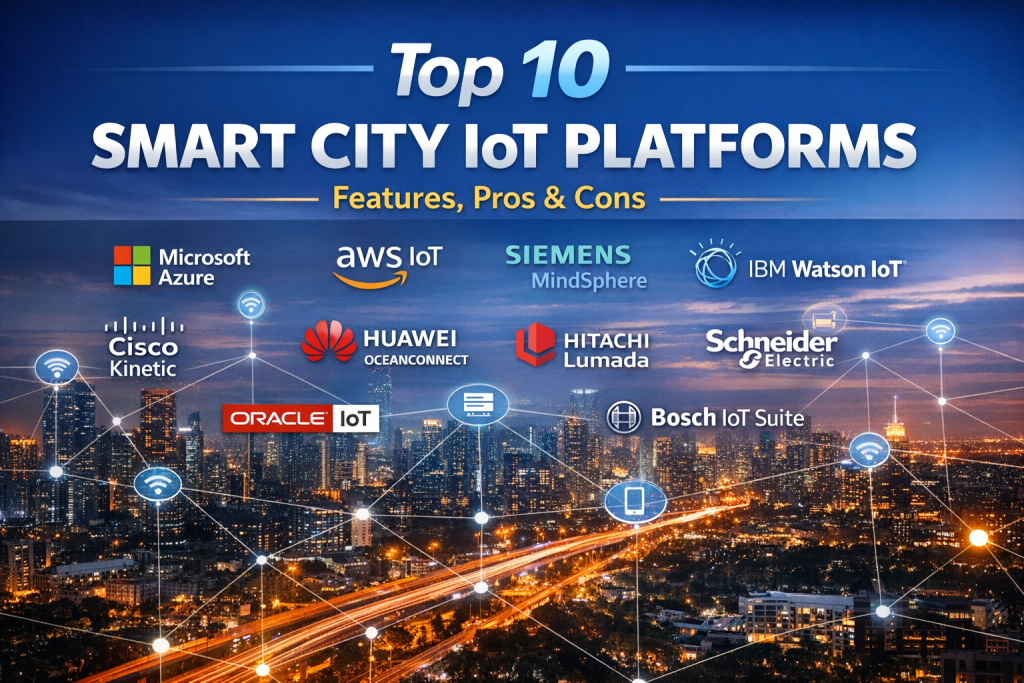
Top 10 Smart City IoT Platforms Tools
1 — Microsoft Azure IoT
Short description:
A highly scalable cloud-based IoT platform designed for large-scale smart city deployments, offering deep analytics and AI integration.
Key features:
- Massive device connectivity and management
- Real-time data ingestion and processing
- Built-in AI and digital twins
- Edge computing support
- Advanced analytics and dashboards
- Strong integration with enterprise systems
Pros:
- Extremely scalable for mega-city deployments
- Rich analytics and AI capabilities
Cons:
- Steep learning curve for beginners
- Cost can rise quickly at scale
Security & compliance:
SSO, encryption at rest and in transit, role-based access, ISO, SOC 2, GDPR support.
Support & community:
Extensive documentation, global enterprise support, very large developer community.
2 — AWS IoT
Short description:
A flexible and powerful IoT platform ideal for cities needing high performance, automation, and cloud-native scalability.
Key features:
- Secure device connectivity
- Real-time data pipelines
- Rules engine and automation
- Edge and cloud integration
- Advanced analytics services
- Strong API ecosystem
Pros:
- High reliability and global infrastructure
- Excellent automation capabilities
Cons:
- Complex pricing structure
- Requires cloud expertise
Security & compliance:
Encryption, IAM-based access, audit logging, SOC, ISO, GDPR-ready.
Support & community:
Strong documentation, enterprise support tiers, vast global community.
3 — Siemens MindSphere
Short description:
An industrial-grade IoT platform tailored for smart infrastructure, utilities, and transportation systems.
Key features:
- Industrial IoT data management
- Asset performance monitoring
- Predictive maintenance
- Digital twin technology
- Integration with operational systems
Pros:
- Excellent for critical infrastructure
- Strong industrial reliability
Cons:
- Less suitable for lightweight use cases
- Higher deployment complexity
Security & compliance:
Industrial security standards, encryption, role-based access, ISO-aligned.
Support & community:
Strong enterprise support, focused industrial partner ecosystem.
4 — IBM Watson IoT Platform
Short description:
A data-centric IoT platform emphasizing AI-driven insights and cognitive analytics for smart cities.
Key features:
- AI-powered analytics
- Real-time monitoring
- Asset management
- Integration with data platforms
- Event-driven automation
Pros:
- Advanced AI and analytics
- Strong enterprise governance
Cons:
- Interface can feel complex
- Slower innovation pace compared to hyperscalers
Security & compliance:
Encryption, IAM, audit logs, GDPR and enterprise compliance options.
Support & community:
Enterprise-grade support, structured onboarding, moderate community size.
5 — Cisco Kinetic
Short description:
An IoT platform focused on secure data movement from edge to cloud for smart city networking use cases.
Key features:
- Edge data processing
- Secure data orchestration
- Network-centric architecture
- Policy-based data control
- Integration with city networks
Pros:
- Strong networking and security foundation
- Ideal for edge-heavy environments
Cons:
- Limited analytics compared to cloud-first platforms
- Best value when using Cisco ecosystem
Security & compliance:
Strong encryption, network security controls, enterprise-grade compliance.
Support & community:
Robust enterprise support, strong partner network.
6 — Huawei OceanConnect IoT
Short description:
A comprehensive IoT platform optimized for large-scale city deployments and telecom-backed infrastructure.
Key features:
- Massive device management
- Telecom-grade reliability
- Data analytics and visualization
- Edge-cloud collaboration
- Industry-specific templates
Pros:
- Excellent scalability
- Strong telecom integration
Cons:
- Ecosystem availability varies by region
- Limited third-party community in some markets
Security & compliance:
Encryption, access control, compliance varies by deployment region.
Support & community:
Strong enterprise and government support, regional partner ecosystem.
7 — Hitachi Lumada
Short description:
A data integration and analytics platform designed for infrastructure-heavy smart city environments.
Key features:
- Advanced data integration
- Predictive analytics
- Asset optimization
- Industry-focused solutions
- Edge analytics support
Pros:
- Strong analytics for infrastructure
- Reliable for long-term projects
Cons:
- Less flexible for rapid experimentation
- Higher implementation effort
Security & compliance:
Enterprise security controls, encryption, compliance varies by solution.
Support & community:
Strong enterprise support, limited open developer community.
8 — Schneider Electric EcoStruxure
Short description:
A smart city and energy-focused IoT platform centered on sustainability and infrastructure efficiency.
Key features:
- Energy and utility monitoring
- Smart building integration
- Grid and water management
- Predictive maintenance
- Sustainability analytics
Pros:
- Excellent for energy-centric cities
- Strong sustainability focus
Cons:
- Narrower scope outside utilities
- Best suited to Schneider ecosystem
Security & compliance:
Encryption, access control, ISO-aligned standards.
Support & community:
Strong enterprise support, focused industry ecosystem.
9 — Oracle IoT Cloud
Short description:
An enterprise IoT platform emphasizing integration with business applications and city operations.
Key features:
- Asset tracking and monitoring
- Integration with enterprise systems
- Real-time alerts
- Analytics and reporting
- Scalable cloud infrastructure
Pros:
- Strong enterprise integration
- Reliable performance
Cons:
- Less innovative UI
- Smaller IoT ecosystem
Security & compliance:
Enterprise-grade security, encryption, compliance-ready.
Support & community:
Enterprise support, moderate community size.
10 — Bosch IoT Suite
Short description:
A modular IoT platform built for flexibility and device-level innovation in smart city solutions.
Key features:
- Device and lifecycle management
- Modular architecture
- Edge-to-cloud support
- API-first design
- Scalable deployments
Pros:
- Flexible and developer-friendly
- Strong IoT engineering roots
Cons:
- Fewer built-in city templates
- Requires customization effort
Security & compliance:
Encryption, IAM, GDPR-aligned options.
Support & community:
Good documentation, growing developer ecosystem.
Comparison Table
| Tool Name | Best For | Platform(s) Supported | Standout Feature | Rating |
|---|---|---|---|---|
| Azure IoT | Mega-scale smart cities | Cloud, Edge | Digital twins & AI | N/A |
| AWS IoT | Cloud-native cities | Cloud, Edge | Automation rules engine | N/A |
| Siemens MindSphere | Industrial infrastructure | Cloud, On-prem | Industrial reliability | N/A |
| IBM Watson IoT | AI-driven insights | Cloud | Cognitive analytics | N/A |
| Cisco Kinetic | Edge-heavy networks | Edge, Cloud | Secure data movement | N/A |
| Huawei OceanConnect | Telecom-backed cities | Cloud, Edge | Massive scalability | N/A |
| Hitachi Lumada | Infrastructure analytics | Cloud, Edge | Data integration | N/A |
| EcoStruxure | Energy-focused cities | Cloud, On-prem | Sustainability focus | N/A |
| Oracle IoT Cloud | Enterprise integration | Cloud | Business app integration | N/A |
| Bosch IoT Suite | Modular IoT projects | Cloud, Edge | API-first design | N/A |
Evaluation & Scoring of Smart City IoT Platforms
| Platform | Core Features (25%) | Ease of Use (15%) | Integrations (15%) | Security (10%) | Performance (10%) | Support (10%) | Price/Value (15%) | Total |
|---|---|---|---|---|---|---|---|---|
| Azure IoT | 24 | 12 | 14 | 9 | 9 | 9 | 12 | 88 |
| AWS IoT | 23 | 11 | 15 | 9 | 9 | 9 | 11 | 86 |
| Siemens MindSphere | 22 | 10 | 12 | 9 | 9 | 9 | 10 | 81 |
| IBM Watson IoT | 21 | 10 | 12 | 9 | 8 | 9 | 10 | 79 |
| Cisco Kinetic | 20 | 10 | 11 | 9 | 8 | 9 | 10 | 77 |
Which Smart City IoT Platforms Tool Is Right for You?
- Solo teams or pilots: Modular platforms with simpler onboarding
- SMBs and mid-market cities: Balanced platforms with manageable costs
- Large enterprises and metros: Hyperscaler or industrial-grade platforms
- Budget-conscious: Start small with modular or usage-based pricing
- Security-focused cities: Platforms with strong compliance and audit controls
The best choice depends on scale, budget, infrastructure maturity, and long-term vision.
Frequently Asked Questions (FAQs)
- What is a Smart City IoT Platform?
It is a system that connects urban devices, manages data, and enables intelligent city operations. - Are these platforms cloud-only?
Most support both cloud and edge deployments. - How long does implementation take?
From weeks for pilots to months for city-wide rollouts. - Are they secure?
Yes, most include enterprise-grade security features. - Do they support legacy systems?
Many offer integration layers for older infrastructure. - Are they expensive?
Costs vary widely based on scale and usage. - Can small cities use them?
Yes, but simpler platforms may be more suitable. - Do they require custom development?
Often yes, especially for city-specific workflows. - What is the biggest mistake buyers make?
Choosing based on features alone, ignoring scalability. - Can platforms be changed later?
Migration is possible but can be complex.
Conclusion
Smart City IoT Platforms are transforming how cities operate, making them more efficient, sustainable, and citizen-centric. The right platform enables real-time insights, predictive decision-making, and long-term resilience.
There is no single “best” platform for every city. The ideal choice depends on scale, infrastructure complexity, security needs, and budget. By focusing on practical requirements rather than hype, cities can build smarter, safer, and more connected urban environments for the future.

Find Trusted Cardiac Hospitals
Compare heart hospitals by city and services — all in one place.
Explore Hospitals
This article offers a very practical and comprehensive overview of the leading Smart City IoT platforms — an essential comparison for urban planners, data engineers, and technology decision‑makers looking to build connected, efficient, and sustainable city services. I appreciate how the guide doesn’t just list tools, but evaluates real‑world considerations such as scalability, analytics capabilities, integration ease, security compliance, and long‑term operational costs — factors that directly influence success in large‑scale deployments. The clear pros and cons for platforms ranging from hyperscale cloud offerings like Azure and AWS to specialized industrial or energy‑focused solutions make it much easier to align platform choice with a city’s unique infrastructure priorities and project goals. For anyone evaluating smart traffic, utilities, environmental monitoring, or citizen services projects, this comparison is a valuable decision‑support resource.