
Introduction
Physics-Informed Machine Learning (Physics-Informed ML) for Robotics combines traditional physics-based modeling with machine learning techniques to help robots understand, predict, and operate in complex real-world environments. Instead of relying only on large amounts of training data, these systems incorporate physical laws, constraints, simulations, and engineering knowledge into AI models.
This approach is becoming increasingly important as robotics moves beyond controlled environments into dynamic spaces such as factories, warehouses, healthcare facilities, autonomous vehicles, aerospace systems, and research laboratories. Modern robotics requires better reliability, faster learning, improved safety, and reduced dependence on expensive real-world data collection.
Physics-Informed ML helps robotic systems improve simulation accuracy, optimize motion planning, predict failures, adapt to changing conditions, and make safer decisions. It is especially valuable where mistakes are costly or dangerous.
Common use cases include:
- Industrial robot control and automation
- Autonomous vehicles and drones
- Robotic manipulation and grasping
- Predictive maintenance for robotic systems
- Digital twins and simulation environments
- Healthcare and assistive robotics
When evaluating Physics-Informed ML for Robotics tools, organizations should consider physics modeling capabilities, simulation support, machine learning framework compatibility, deployment flexibility, scalability, integration options, real-time performance, security controls, developer experience, and long-term ecosystem support.
Best for: Robotics engineers, AI researchers, manufacturing companies, automotive organizations, aerospace teams, universities, and enterprises building intelligent robotic systems.
Not ideal for: Small teams looking for simple automation solutions, businesses without robotics requirements, or projects where traditional machine learning models and standard automation tools are sufficient.
What’s Changed in Physics-Informed ML for Robotics in 2026+
Physics-Informed ML for Robotics is evolving rapidly as AI models, simulation platforms, and autonomous systems become more advanced.
Key trends include:
- AI-driven robotics agents: Robotics systems are increasingly combining physics models with AI agents capable of planning, reasoning, and executing multi-step tasks.
- Multimodal robotic intelligence: Modern robotics platforms integrate vision, sensor data, language instructions, simulation outputs, and physical constraints into unified workflows.
- Simulation-first development: Companies are reducing expensive physical testing by using advanced simulation environments before deploying robots in real-world conditions.
- Digital twins becoming standard: Virtual replicas of robots, factories, and environments are being used for training, testing, and optimization.
- Better evaluation frameworks: Robotics teams are focusing more on repeatable testing, simulation benchmarks, safety validation, and performance measurement.
- Real-time optimization: Physics-informed models are improving robot control loops, motion planning, energy efficiency, and response times.
- Open-source robotics ecosystems: Developers are increasingly using open frameworks combined with custom physics models and machine learning pipelines.
- Privacy-aware robotics: Enterprises require stronger controls around sensor data, operational information, and proprietary manufacturing environments.
- Hybrid AI architectures: Organizations are combining traditional control systems, physics engines, machine learning models, and AI agents.
- Cost and efficiency optimization: Teams are focusing on reducing simulation costs, training requirements, compute usage, and deployment complexity.
Quick Buyer Checklist (Scan-Friendly)
Before selecting a Physics-Informed ML for Robotics platform, evaluate:
- Physics simulation capabilities and supported modeling approaches
- Compatibility with robotics frameworks and ML libraries
- Support for custom physics equations and constraints
- Ability to integrate simulation and real-world data
- Hosted, self-managed, or hybrid deployment options
- Data privacy and retention controls
- Support for open-source models and custom models
- Evaluation and testing capabilities
- Robotics-specific monitoring and observability
- Hardware compatibility
- API and SDK availability
- Developer community and ecosystem maturity
- Scalability for enterprise workloads
- Vendor lock-in risks
- Long-term maintenance requirements
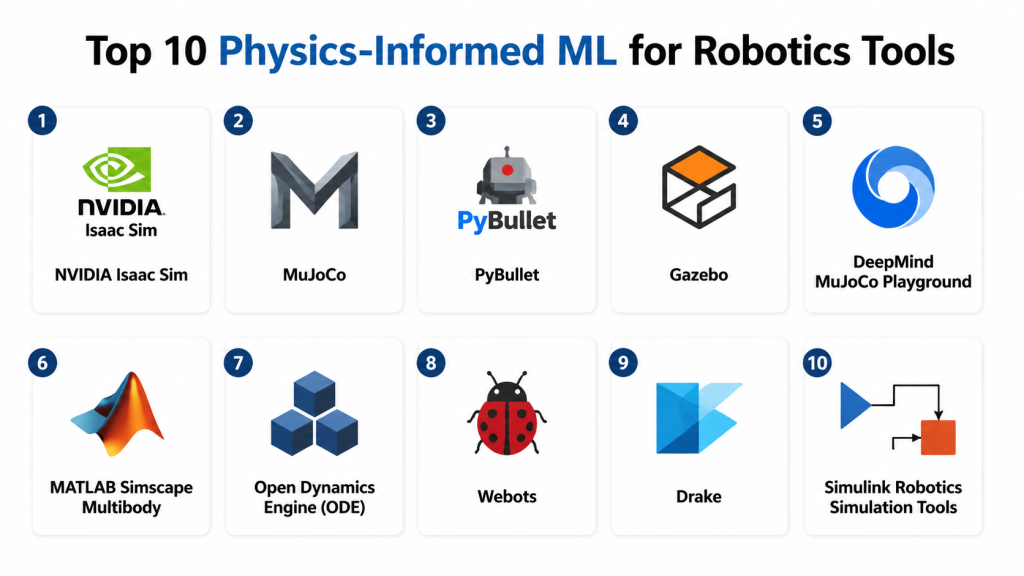
Top 10 Physics-Informed ML for Robotics Tools
#1 — NVIDIA Isaac Sim
One-line verdict: Best for robotics teams needing advanced simulation, AI training, and realistic virtual environments.
Short description:
NVIDIA Isaac Sim is a robotics simulation platform designed for developing, testing, and training intelligent robots. It combines physics simulation, synthetic data generation, robotics workflows, and AI development capabilities.
It is widely used by robotics researchers, autonomous system developers, and industrial automation teams.
Standout Capabilities
- Advanced physics-based robotics simulation
- Synthetic data generation for AI training
- Robot perception and manipulation testing
- Digital twin development
- Sensor simulation support
- Integration with robotics development workflows
- GPU-accelerated simulation environments
AI-Specific Depth (Must Include)
- Model support: Supports integration with various AI and machine learning workflows. Specific model compatibility varies by implementation.
- RAG / knowledge integration: N/A
- Evaluation: Supports simulation-based testing and performance evaluation workflows.
- Guardrails: N/A
- Observability: Simulation metrics and robotics performance monitoring vary by deployment.
Pros
- Strong simulation capabilities for complex robotics applications.
- Useful for training robots before physical deployment.
- Supports realistic testing environments.
Cons
- Requires significant hardware resources for advanced workloads.
- Can have a steep learning curve for beginners.
- Best suited for organizations with robotics expertise.
Security & Compliance
Security controls depend on deployment environment. Specific certifications are not publicly stated.
Deployment & Platforms
- Platforms: Linux-based environments commonly used for robotics development.
- Deployment: Cloud, workstation, and enterprise environments vary.
Integrations & Ecosystem
The platform supports robotics development ecosystems.
- Robotics frameworks
- Simulation workflows
- AI development tools
- Sensor simulation
- Digital twin workflows
Pricing Model
Varies / N/A
Best-Fit Scenarios
- Industrial robotics simulation
- Autonomous machine development
- Research and advanced robotics projects
#2 — MuJoCo
One-line verdict: Best for researchers developing physics-based robot learning and control algorithms.
Short description:
MuJoCo is a physics engine widely used in robotics research, reinforcement learning, and simulation-based control development.
It provides accurate physics modeling for robotic systems.
Standout Capabilities
- Advanced physics simulation
- Robot dynamics modeling
- Reinforcement learning research support
- Contact simulation
- Mechanical system modeling
- Open development ecosystem
AI-Specific Depth
- Model support: Compatible with machine learning frameworks through integrations.
- RAG / knowledge integration: N/A
- Evaluation: Simulation experiments and benchmark testing supported.
- Guardrails: N/A
- Observability: Depends on connected workflows.
Pros
- Popular among robotics researchers.
- Strong physics accuracy.
- Flexible for experimentation.
Cons
- Requires technical expertise.
- Not designed as a complete enterprise robotics platform.
- Deployment workflows require customization.
Security & Compliance
Not publicly stated.
Deployment & Platforms
- Platforms: Desktop development environments.
- Deployment: Self-managed.
Integrations & Ecosystem
- Reinforcement learning libraries
- Robotics research tools
- Custom simulation pipelines
- ML frameworks
Pricing Model
Open-source availability with licensing details varying by use case.
Best-Fit Scenarios
- Academic robotics research
- Algorithm development
- Reinforcement learning experiments
#3 — PyBullet
One-line verdict: Best open-source option for robotics experimentation and rapid prototyping.
Short description:
PyBullet is an open-source physics simulation toolkit used for robotics, reinforcement learning, and robotics education.
It provides accessible physics simulation capabilities for developers.
Standout Capabilities
- Open-source physics engine
- Robot simulation support
- Reinforcement learning experiments
- Rapid prototyping
- Python-based workflows
- Educational robotics support
AI-Specific Depth
- Model support: Depends on connected ML frameworks.
- RAG / knowledge integration: N/A
- Evaluation: Simulation-based evaluation supported.
- Guardrails: N/A
- Observability: Depends on implementation.
Pros
- Free and accessible.
- Large developer usage.
- Good for experimentation.
Cons
- Limited enterprise features.
- Requires engineering effort.
- Advanced simulations may require customization.
Security & Compliance
Not publicly stated.
Deployment & Platforms
- Platforms: Windows, Linux, macOS.
- Deployment: Self-managed.
Integrations & Ecosystem
- Python robotics workflows
- Machine learning libraries
- Research projects
- Simulation environments
Pricing Model
Open-source.
Best-Fit Scenarios
- Robotics learning projects
- Prototype development
- Academic research
#4 — Gazebo
One-line verdict: Best for robotics developers building realistic robot simulation environments.
Short description:
Gazebo is a robotics simulation framework used for testing robot designs, algorithms, sensors, and control systems before physical deployment.
Standout Capabilities
- Robot simulation environments
- Sensor modeling
- Physics engine integration
- Robotics testing workflows
- Autonomous system development
- Community-driven ecosystem
AI-Specific Depth
- Model support: Depends on connected AI frameworks.
- RAG / knowledge integration: N/A
- Evaluation: Simulation testing supported.
- Guardrails: N/A
- Observability: Depends on integrations.
Pros
- Widely used robotics ecosystem.
- Supports realistic simulation.
- Good developer flexibility.
Cons
- Setup can be complex.
- Requires robotics knowledge.
- Enterprise management features vary.
Security & Compliance
Not publicly stated.
Deployment & Platforms
- Platforms: Linux and development environments.
- Deployment: Self-managed.
Integrations & Ecosystem
- Robotics middleware
- Simulation tools
- Sensor platforms
- AI pipelines
Pricing Model
Open-source.
Best-Fit Scenarios
- Robotics engineering teams
- Autonomous robot development
- Simulation testing
#5 — DeepMind MuJoCo Playground
One-line verdict: Best for advanced robot learning research using physics simulation environments.
Short description:
MuJoCo Playground provides simulation environments focused on robot learning and AI experimentation.
Standout Capabilities
- Physics-based learning environments
- Robot training workflows
- Reinforcement learning support
- Research-focused simulations
- Benchmark experimentation
AI-Specific Depth
- Model support: ML framework dependent.
- RAG / knowledge integration: N/A
- Evaluation: Research benchmarking supported.
- Guardrails: N/A
- Observability: Depends on implementation.
Pros
- Useful for AI robotics research.
- Physics-aware learning support.
- Supports experimentation.
Cons
- Research-focused rather than business-focused.
- Requires technical expertise.
- Limited enterprise tooling.
Security & Compliance
Not publicly stated.
Deployment & Platforms
Varies / N/A
Integrations & Ecosystem
- Robotics research tools
- ML frameworks
- Simulation workflows
- AI experiments
Pricing Model
Not publicly stated.
Best-Fit Scenarios
- Robotics AI research
- Experimental learning systems
- University projects
#6 — MATLAB Simscape Multibody
One-line verdict: Best for engineering teams designing physics-based robotic systems.
Short description:
MATLAB Simscape Multibody provides engineering simulation capabilities for mechanical systems, robotics, and physical modeling.
Standout Capabilities
- Mechanical system modeling
- Physics-based simulation
- Control system development
- Engineering workflows
- Digital modeling support
AI-Specific Depth
- Model support: ML integration varies.
- RAG / knowledge integration: N/A
- Evaluation: Engineering simulation testing supported.
- Guardrails: N/A
- Observability: Depends on workflow.
Pros
- Strong engineering foundation.
- Useful for complex mechanical systems.
- Mature simulation environment.
Cons
- Licensing costs can be significant.
- Requires engineering expertise.
- Less focused on modern AI workflows.
Security & Compliance
Not publicly stated.
Deployment & Platforms
- Platforms: Windows, macOS, Linux.
- Deployment: Desktop and enterprise environments.
Integrations & Ecosystem
- Engineering tools
- Control systems
- Simulation workflows
- Robotics projects
Pricing Model
Not publicly stated.
Best-Fit Scenarios
- Engineering organizations
- Robotics design
- Mechanical simulation
#7 — Open Dynamics Engine (ODE)
One-line verdict: Best for developers needing customizable physics simulation components.
Short description:
Open Dynamics Engine is an open-source physics simulation library used for robotics and mechanical simulations.
Standout Capabilities
- Physics calculations
- Collision detection
- Dynamic simulation
- Custom robotics applications
- Developer flexibility
AI-Specific Depth
- Model support: Depends on connected AI systems.
- RAG / knowledge integration: N/A
- Evaluation: Custom testing required.
- Guardrails: N/A
- Observability: Custom implementation required.
Pros
- Flexible open-source option.
- Lightweight.
- Customizable.
Cons
- Requires development effort.
- Limited modern AI features.
- Smaller ecosystem.
Security & Compliance
Not publicly stated.
Deployment & Platforms
Varies / N/A
Integrations & Ecosystem
- Robotics software
- Simulation projects
- Custom applications
- Research environments
Pricing Model
Open-source.
Best-Fit Scenarios
- Custom robotics development
- Simulation experiments
- Engineering prototypes
#8 — Webots
One-line verdict: Best for education, research, and multi-robot simulation projects.
Short description:
Webots is a robotics simulation platform used for designing, testing, and programming robotic systems.
Standout Capabilities
- Robot simulation
- Multi-platform support
- Sensor simulation
- Educational workflows
- Autonomous robotics testing
AI-Specific Depth
- Model support: Depends on external AI frameworks.
- RAG / knowledge integration: N/A
- Evaluation: Simulation testing supported.
- Guardrails: N/A
- Observability: Depends on setup.
Pros
- Easy learning curve.
- Supports many robot models.
- Useful for education.
Cons
- Limited enterprise AI capabilities.
- Advanced users may require customization.
- Smaller ecosystem than major platforms.
Security & Compliance
Not publicly stated.
Deployment & Platforms
- Platforms: Windows, macOS, Linux.
- Deployment: Desktop-based.
Integrations & Ecosystem
- Robotics frameworks
- Simulation tools
- Programming environments
- Research workflows
Pricing Model
Varies / N/A
Best-Fit Scenarios
- Robotics education
- Research labs
- Prototype testing
#9 — Drake
One-line verdict: Best for advanced robotics planning, optimization, and control research.
Short description:
Drake is a robotics toolkit focused on optimization-based control, simulation, and planning.
Standout Capabilities
- Robot dynamics
- Optimization algorithms
- Motion planning
- Control systems
- Mathematical modeling
AI-Specific Depth
- Model support: Integration depends on AI workflow.
- RAG / knowledge integration: N/A
- Evaluation: Simulation-based evaluation.
- Guardrails: N/A
- Observability: Depends on implementation.
Pros
- Strong mathematical foundation.
- Useful for complex robotics.
- Research adoption.
Cons
- Requires advanced knowledge.
- Not beginner-focused.
- Limited commercial packaging.
Security & Compliance
Not publicly stated.
Deployment & Platforms
Varies / N/A
Integrations & Ecosystem
- Robotics research
- Control systems
- Simulation workflows
- Optimization tools
Pricing Model
Open-source.
Best-Fit Scenarios
- Robotics research
- Autonomous systems
- Motion planning
#10 — Simulink Robotics Simulation Tools
One-line verdict: Best for enterprises combining robotics simulation with engineering workflows.
Short description:
Simulink-based robotics workflows support modeling, simulation, testing, and control development for robotic systems.
Standout Capabilities
- Model-based design
- Robotics simulation
- Control development
- Testing workflows
- Engineering collaboration
AI-Specific Depth
- Model support: ML integration varies.
- RAG / knowledge integration: N/A
- Evaluation: Simulation testing available.
- Guardrails: N/A
- Observability: Depends on deployment.
Pros
- Strong engineering ecosystem.
- Enterprise adoption.
- Supports complex workflows.
Cons
- Requires specialized knowledge.
- Licensing considerations.
- Less lightweight than open-source tools.
Security & Compliance
Not publicly stated.
Deployment & Platforms
Varies / N/A
Integrations & Ecosystem
- Engineering platforms
- Robotics workflows
- Control systems
- Simulation environments
Pricing Model
Not publicly stated.
Best-Fit Scenarios
- Enterprise robotics programs
- Industrial engineering
- Simulation-driven development
Comparison Table
| Tool Name | Best For | Deployment | Model Flexibility | Strength | Watch-Out | Public Rating |
|---|---|---|---|---|---|---|
| NVIDIA Isaac Sim | Enterprise robotics simulation | Cloud/Self-managed | Multi-model integration | Realistic simulation | Hardware requirements | N/A |
| MuJoCo | Robotics research | Self-hosted | Open integration | Physics accuracy | Technical complexity | N/A |
| PyBullet | Prototyping | Self-hosted | Open-source | Accessibility | Limited enterprise features | N/A |
| Gazebo | Robotics development | Self-hosted | Framework-based | Robot simulation | Setup complexity | N/A |
| MuJoCo Playground | AI research | Self-hosted | ML integration | Learning environments | Research focus | N/A |
| MATLAB Simscape | Engineering simulation | Desktop/Enterprise | Custom integration | Engineering modeling | Licensing complexity | N/A |
| ODE | Custom simulation | Self-hosted | Open-source | Flexibility | Development effort | N/A |
| Webots | Education and research | Desktop | External models | Ease of use | Enterprise limitations | N/A |
| Drake | Control research | Self-hosted | Open integration | Optimization | Advanced usage | N/A |
| Simulink Robotics Tools | Enterprise engineering | Enterprise | Custom integration | Model-based design | Complexity | N/A |
Scoring & Evaluation (Transparent Rubric)
The following scoring compares tools based on general capability, ecosystem maturity, developer experience, and robotics suitability. Scores are comparative and should be adjusted based on individual project requirements.
| Tool | Core | Reliability/Eval | Guardrails | Integrations | Ease | Perf/Cost | Security/Admin | Support | Weighted Total |
|---|---|---|---|---|---|---|---|---|---|
| NVIDIA Isaac Sim | 9 | 9 | 7 | 9 | 7 | 8 | 8 | 9 | 8.4 |
| MuJoCo | 9 | 8 | 7 | 8 | 6 | 9 | 7 | 8 | 7.9 |
| PyBullet | 8 | 7 | 6 | 8 | 8 | 9 | 6 | 8 | 7.6 |
| Gazebo | 8 | 8 | 7 | 9 | 7 | 8 | 7 | 9 | 8.0 |
| MuJoCo Playground | 8 | 8 | 6 | 7 | 6 | 8 | 6 | 7 | 7.1 |
| MATLAB Simscape | 9 | 8 | 7 | 8 | 7 | 6 | 8 | 8 | 7.8 |
| ODE | 7 | 6 | 6 | 7 | 7 | 9 | 6 | 7 | 6.9 |
| Webots | 7 | 7 | 6 | 7 | 9 | 8 | 6 | 8 | 7.3 |
| Drake | 8 | 8 | 6 | 8 | 5 | 8 | 7 | 8 | 7.3 |
| Simulink Robotics Tools | 9 | 8 | 7 | 8 | 7 | 6 | 8 | 8 | 7.8 |
Top 3 for Enterprise
- NVIDIA Isaac Sim
- MATLAB Simscape
- Simulink Robotics Tools
Top 3 for SMB
- PyBullet
- Webots
- Gazebo
Top 3 for Developers
- MuJoCo
- PyBullet
- Drake
Which Physics-Informed ML for Robotics Tool Is Right for You?
Solo / Freelancer
Individual developers should prioritize open-source tools with strong communities.
Recommended options:
- PyBullet for experimentation
- MuJoCo for research-focused development
- Webots for learning and prototypes
SMB
Small companies should focus on affordable platforms that balance flexibility and capability.
Recommended options:
- Gazebo
- PyBullet
- Webots
Mid-Market
Growing robotics companies need scalable simulation and better engineering workflows.
Recommended options:
- NVIDIA Isaac Sim
- Gazebo
- MATLAB-based solutions
Enterprise
Large organizations require reliability, integration, governance, and long-term support.
Recommended options:
- NVIDIA Isaac Sim
- MATLAB Simscape
- Simulink Robotics workflows
Regulated Industries
Healthcare, aerospace, and public-sector robotics projects should prioritize:
- Simulation validation
- Data governance
- Controlled deployment
- Human oversight
Budget vs Premium
Budget-focused teams should explore open-source frameworks.
Premium platforms provide stronger enterprise workflows, support, and scalability.
Build vs Buy (When to DIY)
Build custom solutions when:
- Robotics requirements are highly specialized
- Internal engineering expertise exists
- Long-term customization is required
Choose established platforms when:
- Faster deployment matters
- Simulation complexity is high
- Enterprise support is required
Implementation Playbook (30 / 60 / 90 Days)
First 30 Days: Pilot + Success Metrics
- Define robotics objectives
- Select simulation environments
- Create baseline performance metrics
- Test physics models
- Validate AI workflows
First 60 Days: Security + Evaluation
- Create evaluation pipelines
- Establish testing processes
- Review data handling
- Implement access controls
- Document model behavior
First 90 Days: Optimization + Scale
- Improve simulation efficiency
- Reduce compute costs
- Add monitoring workflows
- Create governance processes
- Scale successful robotics applications
Common Mistakes & How to Avoid Them
- Using machine learning without physics validation
- Ignoring simulation accuracy
- Skipping evaluation benchmarks
- Deploying without safety testing
- Underestimating compute requirements
- Not monitoring model performance
- Poor sensor data management
- Lack of version control
- Ignoring hardware limitations
- Over-automating critical decisions
- Creating unnecessary vendor dependency
- Failing to document robotics workflows
FAQs
What is Physics-Informed ML for Robotics?
Physics-Informed ML combines machine learning with physical laws and engineering models to improve robotic intelligence and reliability.
Why is Physics-Informed ML important for robotics?
It helps robots learn faster, operate safely, and perform better with less real-world training data.
Can these tools work with existing robots?
Many platforms support integration, but compatibility depends on robot hardware, software frameworks, and deployment requirements.
Are Physics-Informed ML tools open-source?
Some tools are open-source, while others are commercial platforms. Availability varies by platform.
Can companies use their own AI models?
Many platforms allow custom model integration, but specific capabilities vary.
Do these tools support self-hosting?
Several developer-focused platforms support self-managed deployment. Enterprise options vary.
How expensive are Physics-Informed ML tools?
Pricing varies widely. Open-source tools may be free, while enterprise platforms typically use commercial licensing models.
How do teams evaluate robotics AI performance?
Teams usually combine simulation testing, physical validation, benchmarks, and reliability measurements.
Are guardrails needed for robotics AI?
Yes. Safety controls, testing procedures, and human oversight are important for real-world robotic systems.
Can Physics-Informed ML replace traditional robotics engineering?
No. It complements traditional robotics methods by improving learning, prediction, and optimization.
What industries benefit most from these tools?
Manufacturing, automotive, aerospace, healthcare robotics, logistics, and research organizations benefit significantly.
How do organizations avoid vendor lock-in?
Using open standards, portable models, and flexible architectures helps reduce dependency risks.
Conclusion
Physics-Informed ML for Robotics represents an important step toward safer, smarter, and more adaptable robotic systems. By combining physics knowledge with machine learning, organizations can improve simulation accuracy, reduce development costs, and accelerate robotics innovation.There is no single best platform for every robotics project. The right choice depends on engineering requirements, deployment environment, budget, AI maturity, and long-term goals.Organizations should focus on platforms that provide reliable simulation, strong evaluation workflows, flexible integrations, and practical deployment options.

Find Trusted Cardiac Hospitals
Compare heart hospitals by city and services — all in one place.
Explore Hospitals