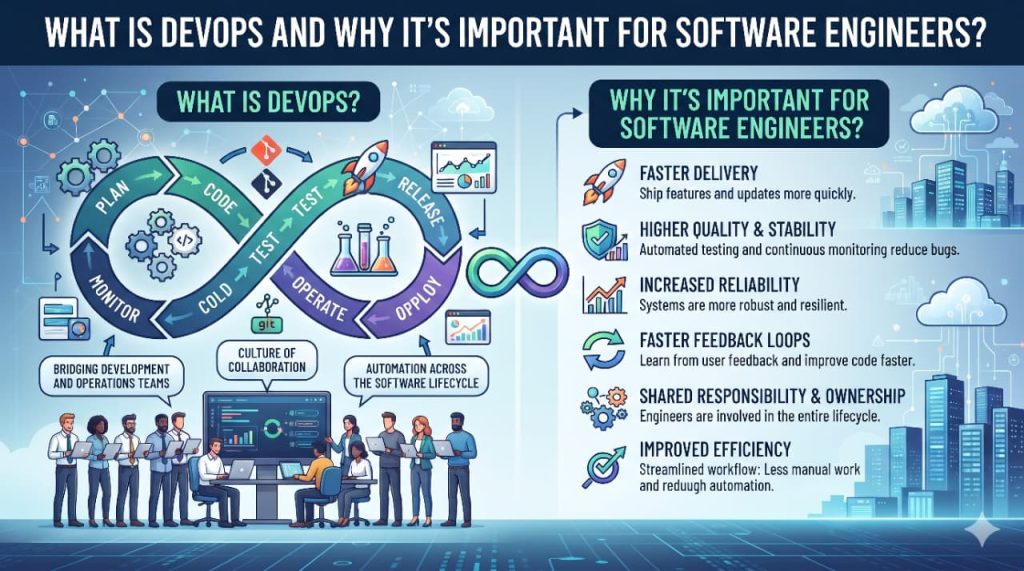
DevOps has become one of the most in-demand career paths in IT, and the demand is not slowing down in 2027. Companies of every size want engineers who can ship software faster, keep systems stable and automate repetitive work. If you are a beginner and wondering where to start, this DevOps roadmap for beginners gives you a clear, step-by-step path from zero to job-ready.
What Is DevOps?
DevOps is a culture and a set of practices that brings development (Dev) and operations (Ops) teams together. The goal is simple: build, test, release and monitor software quickly and reliably. Instead of developers throwing code “over the wall” to operations, both teams share responsibility for the whole lifecycle.
Why Learn DevOps in 2027?
- High demand: Cloud adoption, microservices and AI workloads all need strong automation and infrastructure skills.
- Good salaries: DevOps roles are among the better-paid roles in IT in India and abroad.
- Career flexibility: You can grow into SRE, Platform Engineering, Cloud Architecture or DevSecOps.
- Beginner friendly: You can start from a system admin, developer, tester or even a fresher background.
Step-by-Step DevOps Roadmap for Beginners
Step 1: Learn the Basics of IT and Networking (2 to 3 weeks)
Before tools, understand how computers and networks work. Learn what an operating system, DNS, HTTP/HTTPS, IP addressing, ports, firewalls and load balancers are. This foundation makes every later tool easier.
Step 2: Master Linux and the Command Line (3 to 4 weeks)
Almost all servers run on Linux, so this is non-negotiable. Practice file permissions, processes, package managers, services (systemd), cron jobs, logs and basic troubleshooting.
Step 3: Learn a Scripting Language (3 to 4 weeks)
Start with Bash for quick automation and add Python for larger scripts, API calls and tooling. You do not need to become a software developer, but you must be comfortable writing scripts.
Step 4: Version Control with Git and GitHub/GitLab (2 weeks)
Learn commits, branches, merging, rebasing, pull requests and common branching strategies. Git is the backbone of every modern DevOps workflow, including GitOps.
Step 5: CI/CD Pipelines (3 to 4 weeks)
Continuous Integration and Continuous Delivery automate building, testing and deploying code. Pick one tool first and learn it well:
- GitHub Actions
- GitLab CI/CD
- Jenkins
Build a pipeline that runs tests, builds an artifact and deploys it automatically on every commit.
Step 6: Containers with Docker (3 weeks)
Learn how to write Dockerfiles, build images, use volumes and networks, and run multi-container apps with Docker Compose. Also understand image registries and basic image security.
Step 7: Container Orchestration with Kubernetes (6 to 8 weeks)
Kubernetes is the industry standard for running containers at scale. Learn Pods, Deployments, Services, Ingress, ConfigMaps, Secrets, Persistent Volumes, Helm and basic troubleshooting with kubectl.
Step 8: Learn a Cloud Platform (6 to 8 weeks)
Choose one major cloud: AWS, Microsoft Azure or Google Cloud. Focus on compute, storage, networking (VPC), IAM, load balancers, managed databases and managed Kubernetes services.
Step 9: Infrastructure as Code (4 weeks)
Instead of clicking in a console, define infrastructure in code. Learn Terraform for provisioning and Ansible for configuration management. This makes environments repeatable, reviewable and version controlled.
Step 10: Monitoring, Logging and Observability (3 to 4 weeks)
You cannot fix what you cannot see. Learn Prometheus and Grafana for metrics and dashboards, and a logging stack such as ELK/EFK or Loki. Understand alerts, SLIs, SLOs and incident response.
Step 11: DevSecOps Basics (2 to 3 weeks)
Security should be part of the pipeline, not an afterthought. Learn dependency scanning, container image scanning, secrets management (for example Vault or cloud secret managers) and least-privilege access.
Step 12: Build Projects and a Portfolio (ongoing)
Employers hire proof of skill. Build and publish projects on GitHub, such as:
- A CI/CD pipeline that deploys a web app to Kubernetes
- A complete cloud environment created with Terraform
- A monitoring setup with Prometheus and Grafana dashboards
DevOps Roadmap 2027 at a Glance
| Stage | Skills | Popular Tools | Approx. Time |
|---|---|---|---|
| Foundation | Networking, Linux, scripting | Ubuntu, Bash, Python | 8 to 10 weeks |
| Source and Build | Git, CI/CD | GitHub, GitLab, Jenkins | 5 to 6 weeks |
| Containers | Docker, Kubernetes | Docker, Kubernetes, Helm | 9 to 11 weeks |
| Cloud and IaC | Cloud, Terraform, Ansible | AWS/Azure/GCP, Terraform | 10 to 12 weeks |
| Operate and Secure | Monitoring, DevSecOps | Prometheus, Grafana, Vault | 5 to 7 weeks |
Timelines are estimates for someone studying 1 to 2 hours daily. Your pace may differ.
Recommended Certifications
- AWS Certified Cloud Practitioner or Solutions Architect Associate
- Microsoft Azure Administrator or DevOps Engineer Expert
- Certified Kubernetes Administrator (CKA)
- HashiCorp Terraform Associate
Certifications help, but hands-on projects matter more in interviews.
Common Mistakes Beginners Should Avoid
- Jumping to Kubernetes before learning Linux and Docker
- Learning too many tools at once instead of one tool per category
- Only watching tutorials without building real projects
- Ignoring networking and security basics
- Not documenting projects on GitHub or a blog
Tips to Get Your First DevOps Job
- Keep a strong GitHub profile with well-documented projects.
- Write a simple resume that highlights tools and outcomes, not just a list of names.
- Practice interview topics: Linux troubleshooting, CI/CD flow, Docker, Kubernetes and Terraform.
- Join DevOps communities and contribute to open-source projects.
Frequently Asked Questions (FAQ)
Is DevOps good for beginners in 2027?
Yes. DevOps is beginner friendly if you follow a structured path and practice hands-on. You do not need to be an expert coder, but you do need solid Linux, scripting and cloud basics.
How long does it take to learn DevOps?
Most beginners need around 6 to 9 months of consistent learning to become job-ready. People with prior IT experience may move faster.
Do I need coding for DevOps?
Basic scripting in Bash and Python is enough to start. Deeper programming knowledge becomes useful as you move toward platform engineering or SRE roles.
Which cloud should I learn first?
AWS has the largest market share, so it is a safe first choice. The core concepts transfer easily to Azure and Google Cloud.
Can a fresher become a DevOps engineer?
Yes. Freshers often start in support, system admin or cloud roles, or join as junior DevOps engineers with strong projects and certifications.
Conclusion
The best DevOps roadmap is the one you actually follow. Start with Linux and Git, move to CI/CD, Docker and Kubernetes, add cloud and Infrastructure as Code, and keep building projects along the way. Stay consistent, and in 6 to 9 months you can be ready for your first DevOps role.
Ready to go deeper? Check our DevOps training and certification guide in the next article of this series.

Find Trusted Cardiac Hospitals
Compare heart hospitals by city and services — all in one place.
Explore Hospitals