
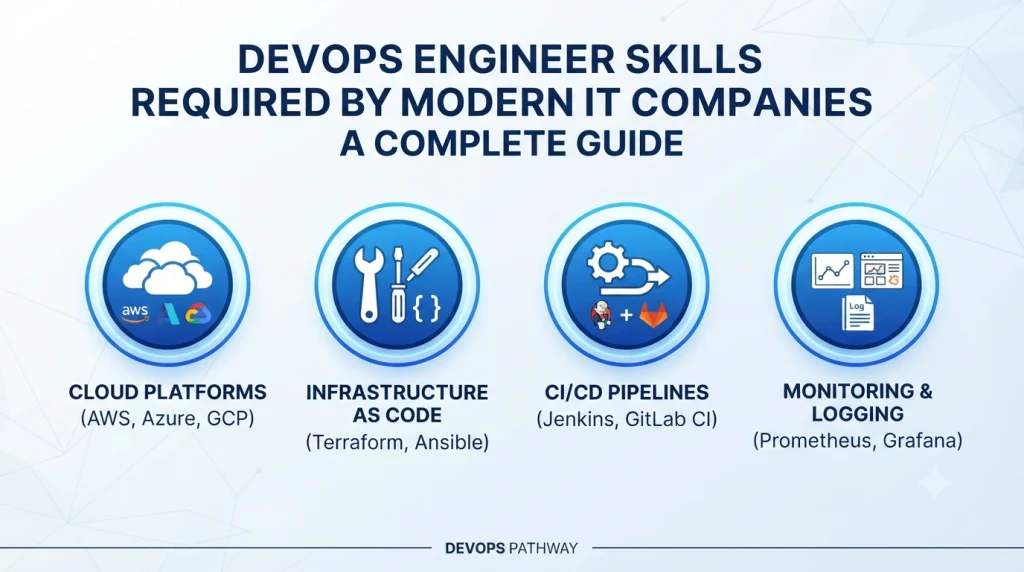
Introduction
The IT industry is evolving rapidly as organizations adopt cloud computing, automation, microservices, artificial intelligence, and modern software development practices. Businesses want to develop applications faster, release updates more frequently, reduce operational costs, and deliver reliable digital services. To achieve these objectives, companies need professionals who can connect software development with IT operations. This is where DevOps engineers play an important role.
A DevOps engineer helps development, testing, security, and operations teams work together throughout the software delivery lifecycle. Their responsibilities include automating infrastructure, managing cloud environments, building CI/CD pipelines, deploying applications, monitoring system performance, troubleshooting production issues, and maintaining security and reliability.
Modern IT companies expect DevOps engineers to have a combination of technical knowledge and practical engineering experience. Understanding Linux, Git, scripting, Docker, Kubernetes, cloud platforms, Terraform, CI/CD, and monitoring tools is increasingly important. However, knowing how to use tools is not enough. Professionals must also understand system architecture, networking, automation principles, security practices, and real-world problem-solving.
The demand for DevOps skills is also expanding beyond traditional infrastructure management. Platform engineering, GitOps, observability, cloud cost optimization, DevSecOps, and AI-assisted operations are becoming important areas of professional development.
This guide explains the essential DevOps engineer skills required by modern IT companies, the tools professionals should learn, the practical projects that can demonstrate their abilities, and how beginners can prepare for successful DevOps careers.
What Is a DevOps Engineer?
A DevOps engineer is an IT professional who helps organizations improve software development, deployment, infrastructure management, and operational reliability through collaboration and automation.
Traditionally, software developers and IT operations teams worked separately. Developers concentrated on creating application features, while operations professionals managed servers, infrastructure, deployments, and production environments. This separation sometimes resulted in communication gaps, slow releases, configuration inconsistencies, and deployment problems.
DevOps reduces these barriers by encouraging shared responsibility throughout the software delivery lifecycle. A DevOps engineer helps establish processes and automation that allow teams to build, test, deploy, monitor, and maintain applications more efficiently.
Typical responsibilities include:
- Creating and maintaining CI/CD pipelines.
- Managing cloud infrastructure and computing resources.
- Automating server configuration and application deployment.
- Managing containers and orchestration platforms.
- Maintaining infrastructure through code.
- Monitoring applications and infrastructure performance.
- Troubleshooting production incidents.
- Integrating security checks into development workflows.
- Improving release management and deployment reliability.
- Collaborating with developers, testers, architects, and security teams.
The exact responsibilities vary depending on company size, technology stack, infrastructure architecture, and engineering maturity.
Why Are DevOps Engineer Skills Important for Modern IT Companies?
Modern IT organizations operate applications that must remain available, secure, scalable, and responsive to customer requirements. Manual processes and disconnected teams can make these objectives difficult to achieve.
DevOps engineering skills help organizations improve their software delivery and infrastructure operations.
1. Faster Software Delivery
Businesses need to release application updates quickly without sacrificing quality. CI/CD automation helps teams build, test, and deploy code changes through repeatable workflows.
2. Improved Infrastructure Management
Cloud infrastructure and automation tools allow organizations to provision resources consistently. DevOps engineers use Infrastructure as Code and configuration management to reduce manual work.
3. Better Application Reliability
Monitoring, logging, observability, and incident management help teams identify problems and restore services quickly.
4. Reduced Operational Errors
Automation reduces dependence on repetitive manual activities. Standardized pipelines and configuration files make infrastructure and deployment processes more consistent.
5. Stronger Security Practices
Modern DevOps teams integrate security into development and deployment workflows. Vulnerability scanning, access management, secrets management, and policy enforcement help reduce security risks.
6. Improved Team Collaboration
DevOps engineers work across multiple technical teams. Their ability to communicate, share information, and coordinate activities helps reduce delays in the software delivery process.
1. Linux and Operating System Administration Skills
Linux is one of the most important technical foundations for DevOps engineers. Many enterprise servers, cloud environments, container platforms, and application hosting systems use Linux-based operating systems.
DevOps professionals regularly work with Linux to configure servers, manage processes, troubleshoot applications, inspect logs, automate system tasks, and maintain infrastructure.
A strong understanding of Linux helps engineers investigate problems that occur in development, testing, staging, and production environments.
Important Linux Skills
Command-line administration: Engineers should be comfortable navigating directories, managing files, searching data, and executing system commands.
User and permission management: Understanding users, groups, ownership, and file permissions is essential for maintaining system access controls.
Process management: DevOps engineers should know how to inspect running processes, identify resource-intensive applications, and manage system services.
Package management: Installing, updating, and removing software through package managers is a regular administration activity.
System monitoring: Professionals should understand how to inspect CPU usage, memory consumption, disk utilization, and running services.
Log management: Reading system and application logs helps identify errors, service failures, and unexpected behavior.
Common Linux Commands
| Command | Purpose |
|---|---|
ls | List files and directories |
cd | Change directories |
pwd | Display the current directory |
grep | Search for matching text |
find | Locate files and directories |
chmod | Change file permissions |
chown | Change file ownership |
ps | Display running processes |
top | Monitor system processes |
df | Check filesystem disk usage |
free | Display memory information |
systemctl | Manage system services |
journalctl | Examine system logs |
Why companies need this skill: DevOps engineers frequently troubleshoot Linux servers and production workloads. Without operating system knowledge, diagnosing application and infrastructure issues becomes difficult.
2. Programming and Scripting Skills
Programming and scripting are essential because DevOps involves automating repetitive activities and connecting different systems.
DevOps engineers may not spend their entire working day developing application software, but they should be able to write scripts, understand code, interact with APIs, and automate operational workflows.
Important Programming and Scripting Languages
Python
Python is widely used for automation, cloud administration, API integration, monitoring scripts, and infrastructure operations. Its readable syntax and extensive libraries make it useful for building automation solutions.
Bash
Bash scripting is particularly valuable in Linux environments. Engineers use shell scripts to automate backups, manage files, configure services, execute deployment commands, and perform routine maintenance.
Go
Go is useful in cloud-native infrastructure, networking, distributed systems, and container-related technologies. Understanding Go can be beneficial for professionals interested in advanced infrastructure engineering.
PowerShell
PowerShell is valuable in Windows-based enterprise environments and Microsoft Azure administration. It supports system configuration, cloud automation, and administrative workflows.
Programming Concepts to Understand
- Variables and data types.
- Conditional statements.
- Loops and functions.
- File handling.
- Error and exception handling.
- JSON and YAML.
- REST API interaction.
- Command-line arguments.
- Basic data structures.
- Logging and debugging.
Why companies need this skill: Automation reduces repetitive manual work and improves operational consistency. Engineers who can write scripts can build customized solutions for infrastructure, deployment, monitoring, and troubleshooting.
3. Git and Version Control Skills
Version control is an essential part of modern software development. It allows teams to track changes, collaborate on code, maintain project history, and manage different versions of applications and infrastructure configurations.
Git is one of the most widely used version control systems. DevOps engineers use it to manage application source code, deployment scripts, pipeline definitions, configuration files, and infrastructure code.
Important Git Skills
- Creating and managing repositories.
- Understanding commits and branches.
- Merging and rebasing.
- Resolving merge conflicts.
- Working with remote repositories.
- Managing tags and releases.
- Reviewing pull requests.
- Understanding branching strategies.
- Maintaining clean commit history.
- Collaborating through code reviews.
Popular Version Control Platforms
- GitHub.
- GitLab.
- Bitbucket.
For example, when a developer pushes a code change to a Git repository, an automated pipeline can start running tests and building the application. This demonstrates how version control becomes the starting point of a modern DevOps workflow.
Why companies need this skill: Version control supports collaboration, traceability, change management, and automation. It is also the foundation for Git-based CI/CD and GitOps workflows.
4. CI/CD Pipeline Automation Skills
Continuous Integration and Continuous Delivery or Deployment are among the most important DevOps practices.
CI/CD pipelines automate the process of integrating code changes, executing tests, building applications, creating deployment packages, and releasing software.
A DevOps engineer should understand how to design, configure, maintain, and troubleshoot these pipelines.
Important CI/CD Concepts
Continuous Integration: Developers frequently integrate changes into a shared repository. Automated builds and tests help identify problems early.
Continuous Delivery: Software is automatically prepared for release and maintained in a deployable state. A release may still require an approval step.
Continuous Deployment: Qualifying changes are automatically released into production after passing the required checks.
Build automation: Source code is converted into application packages or other deployable artifacts.
Automated testing: Pipelines execute relevant unit, integration, and other automated tests.
Deployment automation: Applications are deployed to development, staging, and production environments using repeatable processes.
Rollback strategies: Teams maintain a way to recover from unsuccessful releases.
Popular CI/CD Tools
- Jenkins.
- GitHub Actions.
- GitLab CI/CD.
- Azure Pipelines.
- CircleCI.
Modern IT companies value engineers who can create reliable pipelines, manage credentials securely, integrate automated testing, and investigate build and deployment failures.
Practical example: A developer commits new code to GitHub. A CI/CD pipeline automatically checks out the repository, installs dependencies, runs tests, builds a Docker image, scans it, and deploys the application to a testing environment.
5. Docker and Containerization Skills
Containerization is an important technology for modern application development and deployment. Docker allows applications and their dependencies to be packaged into portable units called containers.
Containers help reduce inconsistencies between development, testing, and production environments.
DevOps engineers should understand how to build, run, manage, secure, and troubleshoot containers.
Important Docker Skills
- Docker architecture.
- Docker Engine.
- Docker images and containers.
- Dockerfiles.
- Image layers and optimization.
- Container networking.
- Persistent storage and volumes.
- Environment variables.
- Container registries.
- Docker Compose.
- Container logs.
- Container troubleshooting.
- Image security fundamentals.
Engineers should know how to create a Dockerfile, build an image, run a container, expose application ports, mount volumes, and connect multiple services.
Benefits of Docker Knowledge
- Consistent application environments.
- Easier application packaging.
- Faster deployment workflows.
- Improved portability.
- Simplified development environments.
- Better integration with CI/CD pipelines.
Why companies need this skill: Organizations increasingly deploy applications using containers. Docker knowledge helps engineers standardize application packaging and prepare workloads for container orchestration platforms.
6. Kubernetes and Container Orchestration Skills
Kubernetes is an open-source container orchestration platform that helps teams deploy, scale, manage, and maintain containerized applications.
As organizations adopt microservices and distributed application architectures, managing containers individually can become difficult. Kubernetes provides mechanisms for coordinating workloads across clusters.
Important Kubernetes Concepts
- Kubernetes architecture.
- Control plane and worker nodes.
- Pods.
- Deployments.
- ReplicaSets.
- Services.
- Namespaces.
- ConfigMaps and Secrets.
- Persistent Volumes.
- Ingress and networking.
- Resource requests and limits.
- Health probes.
- Horizontal Pod Autoscaling.
- Helm charts.
- Cluster monitoring.
- Troubleshooting.
DevOps engineers should also understand how to use kubectl to inspect resources, deploy applications, check logs, investigate failures, and manage workloads.
Kubernetes Tools and Platforms
- Kubernetes.
- Minikube.
- kind.
- Helm.
- Amazon EKS.
- Azure Kubernetes Service (AKS).
- Google Kubernetes Engine (GKE).
Why companies need this skill: Kubernetes helps manage containerized applications at scale. It is particularly valuable in organizations that operate microservices, cloud-native applications, and distributed systems.
7. Cloud Computing Skills
Cloud computing is a major part of modern DevOps engineering. Organizations use cloud platforms to host applications, manage infrastructure, store data, configure networks, and operate scalable services.
DevOps engineers should understand cloud architecture and know how to automate cloud resources.
Major Cloud Platforms
Amazon Web Services (AWS): Provides compute, storage, networking, databases, security, monitoring, and managed container services.
Microsoft Azure: Supports enterprise cloud infrastructure, application hosting, identity management, and Microsoft ecosystem integration.
Google Cloud Platform (GCP): Provides cloud infrastructure, data services, networking, Kubernetes-related services, and application hosting.
Important Cloud Skills
- Virtual machines and compute services.
- Cloud storage.
- Virtual networking.
- Subnets and routing.
- Identity and Access Management.
- Firewalls and security groups.
- Load balancing.
- Managed databases.
- DNS management.
- Autoscaling.
- Cloud monitoring.
- Backup and recovery.
- Cloud security.
- Cost management.
Beginners should select one cloud platform and develop practical experience before attempting to learn several platforms in depth.
Why companies need this skill: Cloud knowledge helps DevOps engineers provision infrastructure, deploy applications, manage resources, and maintain scalable environments.
8. Infrastructure as Code Skills
Infrastructure as Code (IaC) allows teams to define and manage infrastructure through configuration files instead of creating every resource manually.
This approach improves consistency, repeatability, collaboration, and infrastructure change management.
DevOps engineers use IaC to create cloud networks, virtual machines, storage resources, access policies, and other infrastructure components.
Important IaC Concepts
- Declarative and imperative configuration.
- Infrastructure provisioning.
- Variables and outputs.
- Reusable modules.
- State management.
- Infrastructure planning.
- Environment management.
- Change reviews.
- Drift detection.
- Policy enforcement.
Popular Infrastructure as Code Tools
Terraform: Used to define, provision, and manage infrastructure across supported cloud providers and services.
OpenTofu: An open-source infrastructure as code tool that provides a Terraform-compatible workflow.
AWS CloudFormation: Used to define and manage AWS infrastructure through templates.
Azure Bicep: Used to declaratively deploy Azure resources.
Pulumi: Supports infrastructure development using general-purpose programming languages.
Why companies need this skill: IaC allows organizations to manage infrastructure consistently and reduce manual configuration errors. It also supports version-controlled infrastructure changes and automated environments.
9. Configuration Management and Automation Skills
Configuration management helps maintain consistent system configurations across multiple servers and environments.
DevOps engineers use configuration management tools to install software, configure services, manage users, deploy applications, and automate administrative tasks.
Popular Configuration Management Tools
- Ansible.
- Puppet.
- Chef.
- Salt.
Ansible is a common starting point because it uses readable YAML-based playbooks and supports agentless automation through SSH for many Linux administration tasks.
Important Ansible Skills
- Inventory management.
- Playbooks.
- Modules.
- Variables.
- Templates.
- Roles.
- Handlers.
- Task execution.
- Configuration automation.
- Application deployment.
Infrastructure provisioning and configuration management are related but different responsibilities. Terraform or OpenTofu can provision infrastructure, while Ansible can configure operating systems and applications on that infrastructure.
Why companies need this skill: Automated configuration management improves consistency and reduces the time required to maintain large infrastructure environments.
10. Networking and Security Fundamentals
Networking knowledge is essential because applications, containers, servers, and cloud services communicate through networks.
A DevOps engineer must be able to troubleshoot connectivity problems, configure network access, understand traffic flows, and work with secure communication protocols.
Important Networking Concepts
- IP addresses and subnetting.
- TCP and UDP.
- DNS.
- HTTP and HTTPS.
- SSL/TLS.
- Ports and protocols.
- Firewalls.
- Routing and gateways.
- Reverse proxies.
- Load balancers.
- VPN fundamentals.
- Network troubleshooting.
Security Fundamentals
Modern companies also expect DevOps engineers to understand basic security principles.
Important topics include:
- Identity and Access Management.
- Least-privilege access.
- Authentication and authorization.
- SSH security.
- Secrets management.
- Encryption.
- Vulnerability management.
- Secure network configuration.
- Audit logging.
- Access control policies.
Why companies need these skills: Networking and security knowledge help engineers protect infrastructure, troubleshoot communication problems, and maintain secure application environments.
11. Monitoring, Logging, and Observability Skills
Deploying an application is not the end of the DevOps process. Organizations must continuously monitor applications and infrastructure to ensure availability, performance, and reliability.
Monitoring helps engineers identify system health problems. Logging provides information about events, while observability helps explain system behavior through metrics, logs, and traces.
Important Monitoring Concepts
- Infrastructure monitoring.
- Application monitoring.
- CPU and memory metrics.
- Disk and network monitoring.
- Application logs.
- Centralized logging.
- Distributed tracing.
- Alert management.
- Dashboard development.
- Incident investigation.
- Root cause analysis.
- Service-Level Indicators.
- Service-Level Objectives.
Popular Monitoring and Observability Tools
Prometheus: Collects and stores metrics from applications and infrastructure.
Grafana: Provides dashboards and visualizations for monitoring data.
ELK Stack: Elasticsearch, Logstash, and Kibana support log collection, processing, searching, and visualization.
OpenTelemetry: Provides tools and standards for collecting and exporting telemetry data.
Datadog and New Relic: Offer integrated observability and monitoring capabilities.
Why companies need this skill: Monitoring and observability help engineering teams detect failures, understand performance issues, investigate incidents, and maintain reliable applications.
12. DevSecOps and Application Security Skills
DevSecOps integrates security practices into software development and operational workflows.
Instead of waiting until the end of a project to identify security issues, teams introduce security checks during coding, building, testing, deployment, and infrastructure management.
Important DevSecOps Skills
- Secure coding fundamentals.
- Static Application Security Testing.
- Dynamic Application Security Testing.
- Software Composition Analysis.
- Dependency vulnerability scanning.
- Container image scanning.
- Infrastructure security scanning.
- Secrets management.
- Cloud security.
- Identity and access control.
- Software supply chain security.
- Security monitoring.
- Policy as Code.
Popular DevSecOps Tools
- SonarQube.
- Trivy.
- OWASP ZAP.
- Snyk.
- HashiCorp Vault.
- Semgrep.
Why companies need this skill: Security risks can affect application availability, customer information, and business operations. Integrating security into DevOps workflows helps organizations identify vulnerabilities earlier and improve software delivery practices.
13. GitOps and Release Management Skills
GitOps is an approach that uses version-controlled declarative configuration as the source of truth for application and infrastructure management.
It is especially useful in Kubernetes environments, where automated controllers can compare the desired state stored in Git with the actual state of the running environment.
Important GitOps Concepts
- Declarative configuration.
- Git-based deployment workflows.
- Desired and actual state.
- Automated reconciliation.
- Configuration versioning.
- Environment promotion.
- Rollback management.
- Deployment synchronization.
- Change approval and auditing.
Popular GitOps Tools
- Argo CD.
- Flux.
DevOps engineers should also understand deployment strategies such as:
Rolling deployment: Gradually replaces application instances with updated versions.
Blue-green deployment: Maintains two environments and switches traffic from the old version to the new one after validation.
Canary deployment: Releases a new version to a limited portion of users or traffic before expanding the rollout.
Why companies need this skill: GitOps and release management help organizations maintain controlled, traceable, and repeatable deployment workflows.
14. Site Reliability Engineering Skills
Site Reliability Engineering (SRE) applies software engineering principles to operations and system reliability.
DevOps engineers often work with SRE teams or use SRE practices to improve application availability, reduce operational toil, and manage production incidents.
Important SRE Concepts
- Service-Level Indicators (SLIs).
- Service-Level Objectives (SLOs).
- Service-Level Agreements (SLAs).
- Error budgets.
- Incident management.
- Root cause analysis.
- Capacity planning.
- Reliability testing.
- Disaster recovery.
- Performance optimization.
- On-call operations.
For example, a company may define an availability objective for an important application. Engineers use monitoring and incident data to understand whether the application is meeting that objective.
Why companies need this skill: Reliability is essential for applications that support business-critical operations. SRE practices help teams balance software delivery speed with service stability.
15. Database and Data Management Fundamentals
DevOps engineers may not be responsible for designing complete database systems, but they should understand how applications connect to databases and how database infrastructure is deployed, monitored, secured, and backed up.
Important Database Concepts
- Relational and NoSQL databases.
- SQL fundamentals.
- Database connectivity.
- Database backups.
- Restore and recovery.
- Database monitoring.
- Connection pooling.
- Database migrations.
- Access management.
- High availability and replication.
Popular Database Technologies
- PostgreSQL.
- MySQL.
- Microsoft SQL Server.
- MongoDB.
- Redis.
Why companies need this skill: Applications depend on databases to store and retrieve information. DevOps engineers must understand database operations to support deployments, troubleshoot connectivity, and maintain reliable application environments.
16. API Integration and Automation Skills
Modern applications depend on APIs to communicate with cloud services, monitoring platforms, deployment systems, and third-party applications.
DevOps engineers use APIs to automate workflows, retrieve information, manage resources, and connect different tools.
Important topics include:
- REST API fundamentals.
- HTTP methods.
- Status codes.
- JSON and YAML.
- Authentication and authorization.
- API tokens.
- Request and response handling.
- Webhooks.
- API testing.
- Error handling and retries.
Tools such as curl, Postman, Python requests, and platform-specific command-line interfaces can help engineers interact with APIs.
Why companies need this skill: API integration enables automation across different systems and reduces the need for repetitive manual operations.
17. AI-Assisted DevOps and AIOps Awareness
Artificial intelligence is becoming part of modern software engineering and infrastructure operations. DevOps engineers should understand how AI-based tools can support engineering activities without treating generated recommendations as automatically correct.
AI-assisted tools may help with:
- Analyzing logs and error messages.
- Summarizing incidents.
- Suggesting troubleshooting steps.
- Generating documentation.
- Reviewing configuration files.
- Supporting code and script development.
- Identifying unusual monitoring patterns.
- Assisting with infrastructure analysis.
AIOps refers to the use of AI and machine learning techniques to support IT operations through activities such as anomaly detection, event correlation, and predictive analysis.
However, engineers must validate AI-generated scripts, commands, security recommendations, and infrastructure changes before applying them to production systems.
Why companies need this skill: AI literacy can improve engineering productivity, but professionals still need strong fundamentals, technical judgment, and responsibility for operational decisions.
18. Soft Skills Required for DevOps Engineers
Technical knowledge is essential, but modern IT companies also value communication, teamwork, and problem-solving abilities.
DevOps engineers work with developers, testers, project managers, security teams, architects, and business stakeholders. They must communicate technical information clearly and coordinate work across different teams.
Important Soft Skills
Communication: Explain technical problems, deployment plans, and infrastructure changes clearly.
Collaboration: Work effectively with development, QA, security, and operations teams.
Problem-solving: Investigate complex issues and identify practical solutions.
Time management: Prioritize incidents, automation tasks, deployments, and operational responsibilities.
Adaptability: Learn new technologies and adjust to changing infrastructure requirements.
Documentation: Maintain clear records of configurations, procedures, architecture, and troubleshooting steps.
Ownership: Take responsibility for assigned systems, tasks, and improvements.
Continuous learning: Stay updated with relevant engineering practices and tools.
These skills help engineers contribute to technical projects and work effectively in cross-functional teams.
19. DevOps Tools and Skills Comparison
The following table connects important DevOps competencies with commonly used technologies.
| Skill Category | Common Tools | Main Purpose |
|---|---|---|
| Operating Systems | Linux, Ubuntu, RHEL | Server administration |
| Scripting | Bash, Python, Go, PowerShell | Automation |
| Version Control | Git, GitHub, GitLab | Source management |
| CI/CD | Jenkins, GitHub Actions, GitLab CI | Pipeline automation |
| Containers | Docker, Podman | Application packaging |
| Orchestration | Kubernetes, Helm | Container management |
| Cloud | AWS, Azure, GCP | Infrastructure and hosting |
| Infrastructure as Code | Terraform, OpenTofu, Bicep | Infrastructure provisioning |
| Configuration Management | Ansible, Puppet, Chef | System configuration |
| Monitoring | Prometheus, Grafana | Metrics and dashboards |
| Logging | ELK Stack, OpenSearch | Log analysis |
| Observability | OpenTelemetry | Telemetry collection |
| Security | Trivy, SonarQube, OWASP ZAP | Security testing |
| GitOps | Argo CD, Flux | Declarative delivery |
| Collaboration | Jira, Confluence | Project coordination |
Modern companies do not necessarily use every tool listed. The actual technology stack depends on application architecture, cloud provider, team structure, and business requirements.
20. Most Important DevOps Skills for Different Experience Levels
The skills required for DevOps roles vary according to experience and responsibility.
Beginner-Level DevOps Skills
Beginners should focus on foundational knowledge and practical exercises.
Recommended skills include:
- Linux fundamentals.
- Basic networking.
- Git and GitHub.
- Bash scripting.
- Python fundamentals.
- CI/CD concepts.
- Docker basics.
- Cloud fundamentals.
- Basic monitoring.
At this stage, the objective should be to understand how applications are developed, packaged, deployed, and operated.
Intermediate DevOps Skills
Intermediate professionals should develop the ability to build and maintain automated engineering workflows.
Recommended skills include:
- Advanced Linux troubleshooting.
- CI/CD pipeline development.
- Docker and Docker Compose.
- Kubernetes fundamentals.
- Cloud infrastructure management.
- Terraform.
- Ansible.
- Monitoring and logging.
- Deployment strategies.
- Basic DevSecOps practices.
At this stage, engineers should be able to complete end-to-end deployment projects with limited assistance.
Advanced DevOps Skills
Advanced professionals are expected to design, optimize, and maintain complex infrastructure and delivery systems.
Recommended skills include:
- Kubernetes cluster operations.
- Advanced cloud architecture.
- Infrastructure automation at scale.
- GitOps implementation.
- Platform engineering.
- Advanced observability.
- Reliability engineering.
- Security architecture.
- Disaster recovery.
- Performance and cost optimization.
- Distributed systems troubleshooting.
Senior engineers may also be responsible for technical standards, architecture decisions, mentoring, and improving engineering processes across teams.
21. Practical Projects to Demonstrate DevOps Skills
Modern IT companies often want candidates to demonstrate their knowledge through practical experience. Building projects helps learners understand how technologies work together and provides evidence of their abilities.
Project 1: Linux Server Administration
Create a Linux virtual machine and configure users, groups, file permissions, services, storage, and SSH access.
Skills demonstrated: Linux administration, system management, and troubleshooting.
Project 2: Automated Backup System
Write a Bash or Python script that backs up selected directories, creates timestamped archives, and records execution results.
Skills demonstrated: Scripting, automation, scheduling, and error handling.
Project 3: Git-Based Development Workflow
Create a Git repository, use feature branches, commit changes, resolve merge conflicts, and submit pull requests.
Skills demonstrated: Git, collaboration, and version control.
Project 4: Automated CI/CD Pipeline
Create a pipeline that checks out application code, installs dependencies, executes tests, and creates a deployable artifact.
Skills demonstrated: Jenkins or GitHub Actions, automated testing, and CI/CD.
Project 5: Dockerized Web Application
Create a Dockerfile for a web application and use Docker Compose to run it alongside a database.
Skills demonstrated: Containerization, application packaging, and networking.
Project 6: Cloud Infrastructure Deployment
Deploy a web application to AWS, Azure, or GCP. Configure networking, access permissions, compute resources, and monitoring.
Skills demonstrated: Cloud computing and infrastructure management.
Project 7: Terraform Infrastructure Automation
Use Terraform to create cloud networking and compute resources. Organize the configuration into reusable components.
Skills demonstrated: Infrastructure as Code and cloud automation.
Project 8: Kubernetes Application Deployment
Deploy a containerized application to Kubernetes. Configure Deployments, Services, health checks, and resource limits.
Skills demonstrated: Kubernetes and container orchestration.
Project 9: Monitoring and Alerting System
Configure Prometheus and Grafana to collect and display system metrics. Create alerts for selected resource or application conditions.
Skills demonstrated: Monitoring, observability, and incident detection.
Project 10: End-to-End DevOps Implementation
Combine Git, CI/CD, Docker, Kubernetes, cloud infrastructure, Terraform, security scanning, and monitoring in one project.
Skills demonstrated: Complete DevOps workflow design and implementation.
22. How to Develop the Skills Required by Modern IT Companies
Learning DevOps requires a structured approach. Instead of jumping between different tools, beginners should build foundational skills and gradually work toward advanced technologies.
Step 1: Build a Strong Foundation
Start with Linux, networking, operating system fundamentals, and basic programming. These concepts support almost every DevOps responsibility.
Step 2: Learn Version Control and Collaboration
Practice Git and use a platform such as GitHub or GitLab to manage projects and understand collaborative development workflows.
Step 3: Develop Automation Skills
Learn Bash and Python scripting. Automate small tasks before attempting complex infrastructure automation.
Step 4: Understand CI/CD
Build automated workflows that test, package, and deploy an application. Learn how to investigate failed pipeline stages.
Step 5: Learn Containers and Cloud Platforms
Practice Docker and select one cloud platform. Deploy applications and understand how infrastructure resources communicate.
Step 6: Explore Infrastructure as Code
Use Terraform or another IaC technology to provision repeatable infrastructure. Learn configuration management with Ansible.
Step 7: Learn Kubernetes
Understand container orchestration, application deployment, services, storage, and basic cluster troubleshooting.
Step 8: Practice Monitoring and Security
Configure metrics and dashboards, learn log analysis, and integrate security scanning into a CI/CD workflow.
Step 9: Build a Professional Portfolio
Publish projects, scripts, architecture diagrams, and documentation. Explain what each project does and which problems it solves.
Step 10: Prepare for Technical Interviews
Practice Linux commands, networking scenarios, scripting exercises, pipeline troubleshooting, cloud architecture, and container-related questions.
23. A Six-Month Learning Plan for Aspiring DevOps Engineers
The following schedule is an example for learners who can consistently spend around 10–15 hours per week on study and practical exercises.
| Month | Learning Focus | Practical Goal |
|---|---|---|
| Month 1 | Linux, networking, and Git | Manage a Linux server and Git repository |
| Month 2 | Bash, Python, and automation | Build useful system automation scripts |
| Month 3 | CI/CD and build tools | Create an automated build and testing pipeline |
| Month 4 | Docker and cloud fundamentals | Containerize and deploy an application |
| Month 5 | Terraform, Ansible, and Kubernetes | Automate infrastructure and deploy workloads |
| Month 6 | Monitoring, DevSecOps, and projects | Complete and document an end-to-end project |
This is a learning framework, not a guarantee of job readiness. Learners with no previous IT experience may need more time, while experienced developers or system administrators may progress more quickly.
24. DevOps Certifications That Can Support Your Career
Certifications can help professionals structure their learning and demonstrate knowledge of specific technologies. They are most useful when combined with hands-on projects and practical experience.
Cloud Certifications
- AWS Certified Cloud Practitioner.
- AWS Certified Solutions Architect – Associate.
- Microsoft Azure Administrator Associate.
- Google Cloud Associate Cloud Engineer.
Kubernetes Certifications
- Certified Kubernetes Administrator (CKA).
- Certified Kubernetes Application Developer (CKAD).
- Certified Kubernetes Security Specialist (CKS).
Infrastructure and Automation Certifications
- HashiCorp Terraform Associate.
- Relevant Linux administration certifications.
- Cloud-provider DevOps and automation credentials.
Before registering, verify the current certification name, syllabus, examination format, and prerequisites with the official provider.
A beginner should usually start with foundational cloud and Linux knowledge before attempting advanced Kubernetes or infrastructure certifications.
25. Future DevOps Skills Modern IT Companies May Prioritize
DevOps continues to evolve as organizations adopt cloud-native architectures, automation, and AI-supported engineering practices.
Platform Engineering
Platform engineering focuses on building internal developer platforms that provide reusable infrastructure, automation, deployment templates, and self-service capabilities.
AI-Assisted Operations
AI tools can help engineers analyze logs, summarize incidents, generate documentation, and investigate operational patterns. Human review remains essential for security-sensitive and production changes.
Advanced Observability
Distributed applications require deeper visibility into metrics, logs, traces, and system behavior. OpenTelemetry and integrated observability platforms are important technologies to explore.
GitOps and Declarative Infrastructure
GitOps helps organizations manage application and infrastructure configurations through version-controlled workflows and automated reconciliation.
DevSecOps and Software Supply Chain Security
Organizations are increasingly focused on protecting dependencies, container images, credentials, build systems, and software delivery pipelines.
FinOps and Cloud Cost Optimization
Cloud cost management is becoming an important engineering responsibility. DevOps professionals may need to understand resource utilization, cost allocation, scaling efficiency, and infrastructure optimization.
MLOps and AI Infrastructure
As businesses deploy machine learning applications, engineers may work with model deployment, data pipelines, GPU infrastructure, model monitoring, and automated machine learning workflows.
Professionals do not need to master all these areas immediately. They should first develop strong DevOps fundamentals and then specialize according to their career goals.
How DevOpsSchool Supports DevOps Skill Development
Building a successful DevOps career requires a combination of structured learning, technical guidance, and practical experience. Learners need to understand not only individual tools but also how these technologies connect throughout the software delivery lifecycle.
DevOpsSchool provides a platform for exploring professional learning and development in areas such as DevOps, cloud technologies, Site Reliability Engineering, DevSecOps, Kubernetes, and related engineering practices.
When evaluating a DevOps learning program, consider whether it includes:
- Structured learning from fundamental to advanced concepts.
- Practical exercises involving commonly used tools.
- CI/CD pipeline implementation.
- Cloud infrastructure and automation.
- Docker and Kubernetes practice.
- Infrastructure as Code.
- Monitoring and security fundamentals.
- Real-world project implementation.
- Troubleshooting exercises.
- Career-oriented technical preparation.
A combination of guided learning and independent practice can help learners develop stronger technical confidence.
Frequently Asked Questions (FAQs)
1. What are the most important skills required for a DevOps engineer?
The most important DevOps skills include Linux administration, networking, Git, Bash or Python scripting, CI/CD pipeline automation, Docker, Kubernetes, cloud computing, Infrastructure as Code, and monitoring. Security knowledge and problem-solving abilities are also important. The exact skill requirements depend on the organization’s infrastructure, application architecture, and engineering responsibilities.
2. Is programming necessary for a DevOps engineer?
Programming knowledge is important, although DevOps engineers do not always need the same level of programming expertise as application developers. They should be comfortable writing automation scripts, understanding code, working with APIs, and troubleshooting scripts. Bash and Python are useful starting points, while Go and PowerShell can be valuable in specialized environments.
3. Which programming language is best for DevOps?
Python and Bash are two of the most useful starting languages for DevOps professionals. Bash supports Linux administration and command-line automation, while Python is suitable for more complex scripts, API integrations, and cloud automation. Go is useful for cloud-native infrastructure development, and PowerShell is valuable in Windows-based environments.
4. Is Linux mandatory for DevOps engineers?
Linux is one of the most valuable foundational skills for DevOps engineers because many production servers, cloud workloads, and containers use Linux-based systems. Engineers should understand file permissions, process management, system services, networking, SSH, logs, package management, and command-line troubleshooting.
5. Why are Docker and Kubernetes important for DevOps?
Docker helps package applications and dependencies into portable containers. Kubernetes manages containerized applications across clusters by providing deployment, scaling, networking, and recovery capabilities. Together, these technologies help organizations operate modern applications consistently and efficiently.
6. Which cloud platform should a DevOps engineer learn?
AWS, Microsoft Azure, and Google Cloud are all useful platforms. Beginners should select one based on their learning goals and the type of infrastructure they want to work with. Understanding virtual machines, networking, storage, identity management, load balancing, and monitoring is more important initially than memorizing every cloud service.
7. What is the role of CI/CD in DevOps?
CI/CD automates the process of integrating code, running tests, building applications, and delivering software. It helps development teams identify problems earlier, reduce manual deployment activities, and create more consistent release workflows. DevOps engineers design, maintain, secure, and troubleshoot these pipelines.
8. Is Terraform important for DevOps engineers?
Terraform is an important Infrastructure as Code tool because it allows engineers to define and manage infrastructure through version-controlled configuration files. It helps create repeatable environments, review infrastructure changes, and reduce manual provisioning errors. Similar concepts can also be implemented using tools such as OpenTofu and cloud-native IaC services.
9. What soft skills should a DevOps engineer have?
Important soft skills include communication, collaboration, problem-solving, time management, documentation, adaptability, and ownership. DevOps engineers work across multiple teams, so they must be able to explain technical issues, coordinate deployments, investigate incidents, and share knowledge effectively.
10. How can a fresher develop DevOps engineering skills?
A fresher should start with Linux, networking, Git, and basic scripting. Next, learn one CI/CD platform, Docker, and one cloud provider. Progress toward Terraform, Ansible, Kubernetes, monitoring, and security. Build practical projects, publish documentation and code on GitHub, and practice troubleshooting and technical interview questions.
11. Are DevOps certifications enough to get a job?
Certifications can demonstrate theoretical knowledge and provide a structured learning path, but they do not guarantee employment. Employers also look for practical skills, project experience, troubleshooting ability, and an understanding of real software delivery workflows. Combining certifications with hands-on projects and a well-documented portfolio is more effective.
12. What is the difference between DevOps and DevSecOps?
DevOps focuses on collaboration, automation, continuous software delivery, and reliable operations. DevSecOps extends these practices by integrating security throughout the software lifecycle. It includes vulnerability scanning, secure coding, secrets management, container security, infrastructure scanning, and security monitoring.
13. What is the difference between DevOps and SRE?
DevOps is a broad set of cultural and engineering practices that improve collaboration and software delivery. Site Reliability Engineering applies software engineering principles to operational reliability, availability, and performance. SRE teams commonly use concepts such as SLOs, SLIs, error budgets, incident management, and automation.
14. Which DevOps tools are most useful for beginners?
Beginners should focus on Linux, Git, Bash, Python, Jenkins or GitHub Actions, Docker, one cloud platform, Terraform, and basic monitoring tools such as Prometheus and Grafana. Kubernetes and Ansible can be introduced after understanding the fundamentals. Learning a smaller set of tools deeply is more useful than having superficial knowledge of many platforms.
15. What are the future skills for DevOps engineers?
Future-oriented DevOps skills include platform engineering, GitOps, advanced observability, DevSecOps, cloud cost optimization, AI-assisted operations, MLOps, and infrastructure automation. Strong Linux, networking, scripting, cloud, and CI/CD fundamentals will continue to provide the foundation for these advanced areas.
Conclusion
Modern IT companies expect DevOps engineers to combine technical expertise, automation knowledge, cloud infrastructure experience, and strong collaboration skills. Linux, networking, Git, scripting, CI/CD, Docker, Kubernetes, cloud platforms, Terraform, Ansible, monitoring, and DevSecOps are important areas of professional development.
However, successful DevOps engineering is not simply about knowing the names of popular tools. Engineers must understand how software moves from development to production, how infrastructure is managed, how deployments are automated, and how application reliability and security are maintained.
Beginners should focus on foundational skills first and develop practical experience through projects. Experienced professionals can expand their capabilities through platform engineering, GitOps, SRE, advanced cloud architecture, observability, and AI-assisted operations.
By following a structured learning plan, building a portfolio, and continuously improving technical and communication skills, aspiring professionals can prepare for the changing requirements of modern IT companies. DevOpsSchool can be explored as a learning resource for individuals interested in developing DevOps and related engineering capabilities.

Find Trusted Cardiac Hospitals
Compare heart hospitals by city and services — all in one place.
Explore Hospitals