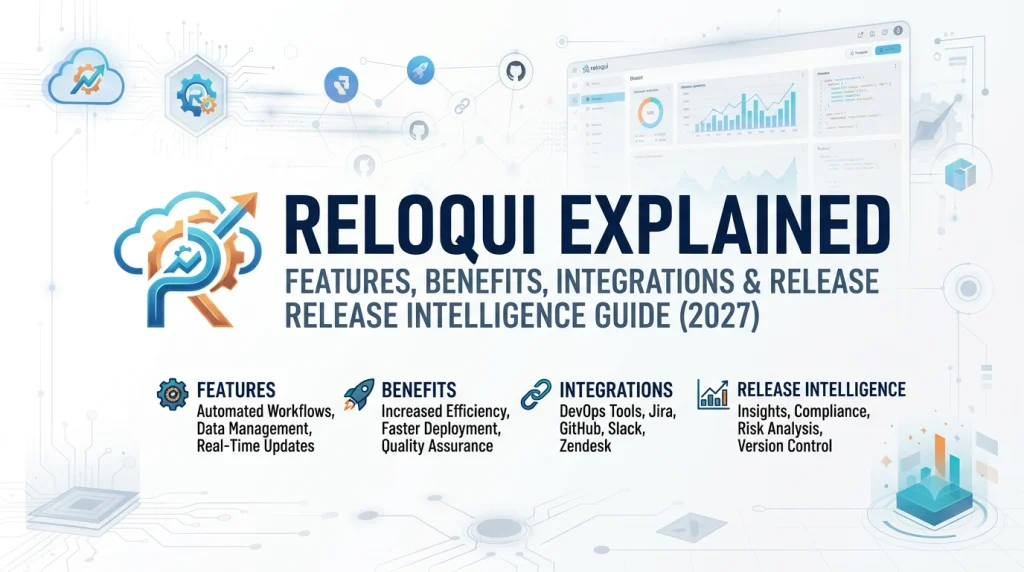
Software releases involve much more than merging code and deploying an application. A single release can involve Git commits, pull requests, project-management tickets, automated builds, software artifacts, infrastructure changes and production deployments.
The challenge is that these activities are recorded in different systems. A successful build does not necessarily mean that the expected code reached production, and a completed Jira ticket does not independently prove that a feature was included in a particular release.
Reloqui is a release intelligence platform designed to solve this visibility problem. It collects and reconciles software delivery evidence from connected engineering systems to establish what actually shipped, where it shipped, and how confident teams can be in that conclusion.
It combines evidence collection, release reconciliation, confidence scoring, governance controls, approval workflows, and audience-specific release notes into one platform.
This guide explains what Reloqui is, how it works, its major features, integrations, practical applications, pricing model, and the factors engineering organizations should evaluate before adopting it.
What Is Reloqui?
Reloqui is a release intelligence platform for engineering organizations that need a reliable and explainable record of their software releases.
It connects information from source-code management (SCM), issue trackers, CI/CD systems, artifact registries, deployment tools, Terraform, and incident-management systems.
Instead of requiring teams to manually collect information from these tools, Reloqui reconciles their delivery signals into a structured release record.
For example, consider an application release involving:
- A Jira ticket describing a new feature.
- A GitHub pull request implementing the feature.
- A successful CI/CD build.
- A container image stored in an artifact registry.
- A deployment to a production environment.
Each system contains an important piece of information. Reloqui attempts to connect these records so stakeholders can understand how the planned change relates to the code, build, artifact and deployment.
Its central concept is evidence-backed release truth.
The platform also calculates a confidence score and provides explanations for its classifications, helping teams understand which evidence supports a release and where exceptions remain.
Why Do Engineering Teams Need Release Intelligence?
Modern software delivery environments generate large volumes of information.
Development teams may use GitHub for source control, Jira for project tracking, Jenkins or other CI/CD systems for automation, container registries for artifacts, and cloud platforms for deployments.
These systems are useful individually, but they do not automatically provide one complete explanation of a release.
1. Release information is fragmented
A developer might merge a pull request, while a project manager updates a ticket and a deployment engineer promotes an artifact.
Without connecting these events, stakeholders must investigate several systems to understand what happened.
2. Manual release reporting takes time
Release managers often collect information from engineering teams, spreadsheets, dashboards and communication channels.
This creates repetitive work and introduces opportunities for missing or inconsistent information.
3. Release notes may not reflect actual delivery
Manually written release notes can describe planned functionality rather than changes supported by deployment evidence.
This creates uncertainty for engineering teams, product managers and customers.
4. Approval decisions need supporting evidence
A release should not be approved simply because someone reports that development is complete.
Teams may need to inspect build status, deployment records, unresolved exceptions, approvals and other evidence before publishing.
5. Audits require traceability
When an organization needs to establish what was released and who approved it, reconstructing the information from disconnected systems can be difficult.
Reloqui addresses these challenges by providing a centralized, explainable view of release evidence.
How Does Reloqui Work?
Reloqui describes its release intelligence workflow through four main stages.
1. Ingest Evidence
The first stage connects Reloqui to the systems involved in software delivery.
Its documented integrations cover source-control systems, issue trackers, CI/CD, registries, deployments, Terraform, and incidents.
The platform receives typed delivery events through webhooks and polling.
Examples include:
- Merged pull requests.
- Tracked issues.
- Build results.
- Generated artifacts.
- Deployment events.
- Infrastructure changes.
- Incident information.
The purpose is to create a common evidence foundation rather than relying on manually assembled release information.
2. Reconcile Release Evidence
Once evidence has been collected, Reloqui attempts to associate the relevant events with the correct service and release version.
Its reconciliation engine uses a deterministic-first and heuristic-second approach.
This distinction is important.
Deterministic attribution uses established relationships and identifiable evidence to associate records.
Heuristic attribution uses additional matching logic when direct relationships are unavailable or incomplete.
The documented platform also accounts for situations such as clock differences, backports and force-pushed commits.
The result is a structured view of which delivery records belong to a release and why.
3. Classify Evidence and Calculate Confidence
Not every collected event should automatically be treated as confirmed release evidence.
Reloqui classifies evidence including:
| Classification | Meaning |
|---|---|
| Included | Evidence associated with the release |
| Included heuristic | Evidence associated through heuristic matching |
| Excluded | Evidence not included in the release |
| Uncertain | Evidence requiring additional attention |
| Orphaned | Evidence that could not be confidently associated |
The platform then calculates a confidence score using weighted evidence components.
Its documented scoring model considers signals such as:
- Release tag anchors.
- Linked pull requests.
- Artifacts.
- Deployments.
- Successful builds.
- Orphaned evidence.
- Force-pushes.
- Rollbacks.
The score is presented on a 0–1 scale, alongside high, medium or low confidence tiers.
Importantly, this is a platform-generated confidence assessment, not a guarantee that a release is correct or a statistically calibrated probability of correctness.
Engineering teams should examine the underlying evidence and scoring explanations before relying on the result for important decisions.
4. Decide, Approve and Publish
The final stage involves release governance.
Organizations can configure policies and approval requirements to determine whether a release is ready to publish.
Depending on the configured rules, the platform supports:
- Minimum confidence requirements.
- N-of-M approval requirements.
- Approval workflows.
- Freeze windows.
- Policy gates.
- Automatic suspension when late evidence reduces confidence.
When a release is published, Reloqui freezes an auditable snapshot of the release information.
This creates a record that stakeholders can inspect later.
Key Features of Reloqui
Reloqui combines several capabilities that support release visibility, evidence management and governance.
1. 11-Stage Reconciliation Engine
The reconciliation engine is central to the platform.
It processes delivery evidence through an 11-stage pipeline covering collection, normalization, attribution, classification, scoring, policy evaluation, and snapshot creation.
Its purpose is to establish relationships between changes and releases while exposing uncertain or exceptional records.
2. Confidence Scoring
Reloqui provides a confidence score for each release.
Rather than showing only a final status, the platform provides a breakdown of evidence components that influence the score.
This can help release managers understand why a release has a high, medium or low confidence tier.
3. Evidence Management
The platform stores typed evidence records and preserves raw payloads alongside normalized events.
This makes it possible to trace important release claims back to supporting records.
It also provides explanations for evidence classifications.
4. Twelve Source Connectors
Reloqui documents twelve source types covering:
- GitHub
- GitLab
- Bitbucket
- Azure DevOps
- Jira
- Linear
- CI/CD
- Deployments
- Registries
- Terraform
- Incidents
- Synthetic evidence
Webhooks and polling support evidence collection.
5. Service Catalog and Dependency Graph
The platform provides a catalog for products, services, components and resources.
It also supports dependency relationships, lineage and blast-radius analysis.
This is useful when teams need to understand how a release affecting one service might influence other connected components.
6. Release Governance
Release governance capabilities help organizations apply consistent publishing rules.
These include confidence thresholds, approvals, freeze windows, and automatic suspension when new evidence affects an approved release.
7. Audience-Specific Release Notes
Different stakeholders require different levels of technical detail.
Reloqui generates release narratives for five audiences:
| Audience | Information focus |
|---|---|
| Executive | High-level delivery status and visibility |
| Engineering | Technical changes and supporting evidence |
| Operations | Operational changes and deployment information |
| Product | Product-related release information |
| Compliance | Evidence and approval traceability |
All five narratives are generated from the same evidence foundation.
8. Release, Service and Product 360 Views
Reloqui provides 360-degree views for releases, services and products.
These views help users investigate delivery information, service relationships, dependencies and release history.
9. REST API and Automation
The platform provides a REST API and a live OpenAPI explorer.
This is relevant for organizations that want to integrate release intelligence into their existing engineering workflows.
10. Enterprise Identity and Security Capabilities
Documented capabilities include:
- Role-based access control (RBAC).
- OpenID Connect (OIDC) single sign-on.
- SCIM provisioning.
- Service tokens.
- Audit logging.
- Multi-tenant isolation.
- PostgreSQL row-level security.
- Data-retention controls.
These features are relevant when evaluating access management and organizational data separation.
Actual security suitability should still be established through technical and security reviews.
Reloqui Integrations: Which Tools Does It Support?
Reloqui is designed to connect with tools that participate in software delivery.
Its documented source types include the following:
| Tool or source | Integration purpose |
|---|---|
| GitHub | Repository and pull-request evidence |
| GitLab | Source-control and merge-request evidence |
| Bitbucket | Repository and code-change evidence |
| Azure DevOps | Development workflow evidence |
| Jira | Issue and project tracking evidence |
| Linear | Issue tracking evidence |
| CI/CD | Build and pipeline evidence |
| Deployments | Environment deployment records |
| Registries | Software artifact information |
| Terraform | Infrastructure-change evidence |
| Incidents | Operational incident information |
| Synthetic | Generated evidence for evaluation |
The integration approach combines webhooks and polling.
However, integration availability alone does not establish that every feature or event is supported equally across all connectors.
Before implementation, teams should confirm the specific events, permissions, authentication requirements, polling behavior, and historical backfill capabilities relevant to their environment.
Practical Use Cases of Reloqui
Reloqui can support different roles within an engineering organization.
1. Release Managers
Release managers need to understand whether a release is ready for publication.
Reloqui provides a centralized release record, confidence scoring, exception visibility and configurable approval gates.
This can help reduce manual evidence collection before release decisions.
2. DevOps and Platform Engineering Teams
Platform engineering teams often manage several services and dependencies.
Reloqui’s service catalog, dependency graph and integration capabilities can help them understand how delivery evidence relates to the wider technical environment.
3. Engineering Leaders
Engineering leaders need reliable delivery visibility across teams and services.
Instead of depending exclusively on manually prepared status reports, they can use portfolio-level dashboards and product-level views.
4. Compliance and Security Teams
Auditors and compliance professionals may need to establish what was shipped, when it was published and who approved it.
Reloqui’s frozen release snapshots, audit records and approval history are designed to support this requirement.
The platform can provide supporting evidence, but it does not automatically establish compliance with every regulatory framework.
5. Multi-Service Software Organizations
Organizations delivering several interconnected services need to understand how changes move through their technical environment.
The dependency graph and release-train capabilities can help coordinate delivery across multiple services.
How to Get Started With Reloqui
Reloqui provides a live demonstration and a workspace-based onboarding process.
Here is a practical starting approach.
Step 1: Explore the live demo
Visit the Reloqui live demo.
The demonstration provides a read-only environment with sample services, integrations and releases.
It allows users to explore the interface without first connecting their own systems.
Step 2: Create a workspace
If you want to evaluate your own delivery environment, create a workspace through the official website.
The workspace provides the organizational context for services, releases, integrations and governance.
Step 3: Add a service
Create a service in the catalog and provide its repository information.
This helps establish the relationship between the service and its source-control evidence.
Step 4: Connect an integration
Start with a source such as GitHub or use the built-in synthetic evidence connector.
For a real integration, configure the required credentials and webhook settings.
Step 5: Create a release
Select the relevant service and define a release version and Git tag.
The release scope and baseline help establish which evidence should be considered.
Step 6: Reconcile the evidence
Run the reconciliation process.
Review the associated pull requests, issues, builds, artifacts, deployments and exceptions.
Step 7: Review confidence and publish
Examine the confidence score and its supporting evidence.
Check policy requirements and approval conditions before publishing the release.
Reloqui Pricing: Is It Free?
Reloqui currently documents two deployment options on its official pricing page.
| Feature | Free | Hosted / Enterprise |
|---|---|---|
| Price | $0 | Contact for pricing |
| Release intelligence | Included | Included |
| Confidence scoring | Included | Included |
| Source connectors | Included | Included |
| Governance | Included | Included |
| API access | Included | Included |
| Hosting | Self-managed | Fully managed |
| Dedicated infrastructure | Not included | Included |
| Uptime SLA | Not included | Included |
| Backups and disaster recovery | Self-managed responsibility | Managed |
| Priority support | Not included | Included |
Free Plan
The self-managed option is listed at $0 forever.
The published offering includes the complete release-intelligence platform, connectors, governance, API, documentation, and live demo.
Organizations are responsible for running and maintaining their own deployment.
Hosted / Enterprise Plan
The hosted option is intended for organizations that want Reloqui to manage the platform.
The published offering includes dedicated infrastructure, uptime SLAs, monitoring, backups, disaster recovery, priority support, and onboarding assistance.
Pricing is available through direct contact with Reloqui.
Reloqui vs Traditional Release Management
Reloqui should be understood as a release intelligence and evidence-reconciliation layer, rather than a replacement for every tool in a software delivery pipeline.
| Area | Traditional approach | Reloqui approach |
|---|---|---|
| Evidence collection | Manual investigation across tools | Connected evidence sources |
| Release tracking | Separate dashboards and records | Reconciled release records |
| Change attribution | Manual correlation or tool-specific links | Deterministic and heuristic attribution |
| Confidence | Often informal judgment | Explainable confidence scoring |
| Release approvals | Separate processes or tools | Configurable governance |
| Release notes | Manually assembled | Evidence-backed audience-specific notes |
| Audit records | Reconstructed from several systems | Frozen release snapshots and audit information |
| Dependencies | Separate documentation or tooling | Service catalog and dependency graph |
This comparison describes the general workflow differences, not a claim that every organization currently uses manual processes or that Reloqui replaces every existing release-management capability.
What Should Organizations Evaluate Before Adopting Reloqui?
A release intelligence platform can become an important part of engineering governance. Therefore, organizations should evaluate more than the feature list.
1. Connector Coverage
Check whether the platform supports the actual tools and event types used by your organization.
2. Evidence Completeness
Determine whether the available evidence is sufficient to establish the release relationships that matter to your workflows.
3. Confidence Score Interpretation
Understand how evidence weights, missing information, exceptions and deductions affect confidence.
Do not interpret a high score as a guarantee of deployment correctness.
4. Security and Access Controls
Review authentication, authorization, tenant isolation, secret management, audit logging and data retention.
5. Deployment Requirements
Compare the operational responsibilities of self-managed hosting with the convenience and commercial requirements of managed hosting.
6. Workflow Compatibility
Evaluate whether Reloqui complements your existing CI/CD pipelines, change-management processes and release approvals.
7. Audit and Compliance Requirements
Confirm whether its evidence exports and audit capabilities satisfy your organization’s specific internal controls and external obligations.
Advantages and Limitations of Reloqui
A balanced evaluation should consider both the platform’s strengths and the work required to implement it successfully.
Potential Advantages
- Connects information from multiple software delivery systems.
- Provides structured release evidence.
- Offers explainable confidence scoring.
- Identifies uncertain and orphaned evidence.
- Supports configurable approval policies.
- Generates release notes for different audiences.
- Provides service and dependency visibility.
- Offers a self-managed free option.
- Includes API and automation capabilities.
Considerations and Limitations
- The usefulness of release intelligence depends on integration quality and evidence availability.
- Heuristic attribution may require human review.
- Confidence scores require interpretation and should not replace engineering judgment.
- Self-managed deployments require infrastructure and operational ownership.
- Hosted pricing requires direct commercial discussion.
- Organizations must verify security and compliance suitability for their own requirements.
- Connecting multiple tools and defining reliable release baselines requires implementation planning.
These considerations are evaluation points, not assertions that Reloqui has a particular undocumented product deficiency.
Frequently Asked Questions About Reloqui
1. What is Reloqui used for?
Reloqui is used to collect, reconcile, and explain software release evidence. It helps engineering organizations understand what shipped, where it was deployed, and how much confidence the available evidence supports.
2. Is Reloqui a CI/CD platform?
No. Reloqui is positioned as a release intelligence platform. It connects to CI/CD and other delivery systems to analyze release evidence rather than replacing the underlying build and deployment tools.
3. Does Reloqui support GitHub and GitLab?
Yes. GitHub and GitLab are among its documented source connectors. The platform also lists Bitbucket, Azure DevOps, and other delivery-related integrations.
4. What is Reloqui confidence scoring?
Confidence scoring is a mechanism for evaluating the evidence associated with a release. It uses weighted evidence components and deductions to produce a score and a high, medium, or low tier.
5. Can Reloqui generate release notes?
Yes. Reloqui supports five audience-specific release-note formats: executive, engineering, operations, product, and compliance.
6. Does Reloqui support release approvals?
Yes. Its documented governance capabilities include confidence thresholds, N-of-M approvals, freeze windows, and automatic suspension under certain confidence-reduction conditions.
7. Is Reloqui free?
Reloqui lists a self-managed free offering at $0 forever. Its hosted enterprise offering is available through direct commercial discussion.
8. Does Reloqui provide a live demo?
Yes. Its website provides a read-only demonstration that can be explored without a login.
9. Is Reloqui suitable for enterprise organizations?
It includes capabilities relevant to enterprise environments, such as OIDC SSO, SCIM, RBAC, audit logging, tenant isolation, and a managed hosting option. Organizations should still perform their own security, integration, and compliance assessments.
10. Does Reloqui replace Jira, GitHub, or deployment tools?
No. Its purpose is to connect and reconcile evidence from these systems, not to replace their primary functions.

Find Trusted Cardiac Hospitals
Compare heart hospitals by city and services — all in one place.
Explore Hospitals