
Introduction
API Aggregators are platforms that collect, standardize, manage, and expose multiple APIs through a unified interface. Instead of integrating dozens of individual APIs from different providers, developers and businesses can rely on a single aggregation layer that simplifies access, authentication, monitoring, and governance.
In today’s API-driven economy, applications rarely operate in isolation. Payment processing, messaging, identity verification, maps, analytics, AI services, and data enrichment all rely on external APIs. Managing these integrations individually increases development time, operational risk, security exposure, and maintenance cost. API Aggregators solve this by acting as a central control plane for API consumption and distribution.
Why API Aggregators Matter
- Reduce integration complexity and time-to-market
- Improve reliability through centralized monitoring and throttling
- Enforce consistent security and compliance policies
- Enable scalability as applications and API usage grow
Common Real-World Use Cases
- Fintech platforms aggregating payments, banking, and KYC APIs
- SaaS products managing multiple third-party service integrations
- Enterprises standardizing internal and external APIs
- Startups launching quickly without heavy backend overhead
What to Look for When Choosing an API Aggregator
- Breadth and quality of available APIs
- Ease of integration and developer experience
- Security, compliance, and governance features
- Performance, reliability, and global availability
- Pricing transparency and scalability
Best for:
Product teams, backend developers, platform engineers, fintech companies, SaaS providers, data-driven startups, and enterprises managing multiple APIs.
Not ideal for:
Very small projects with only one static API, offline-only systems, or organizations requiring fully custom, in-house API orchestration with no third-party dependencies.
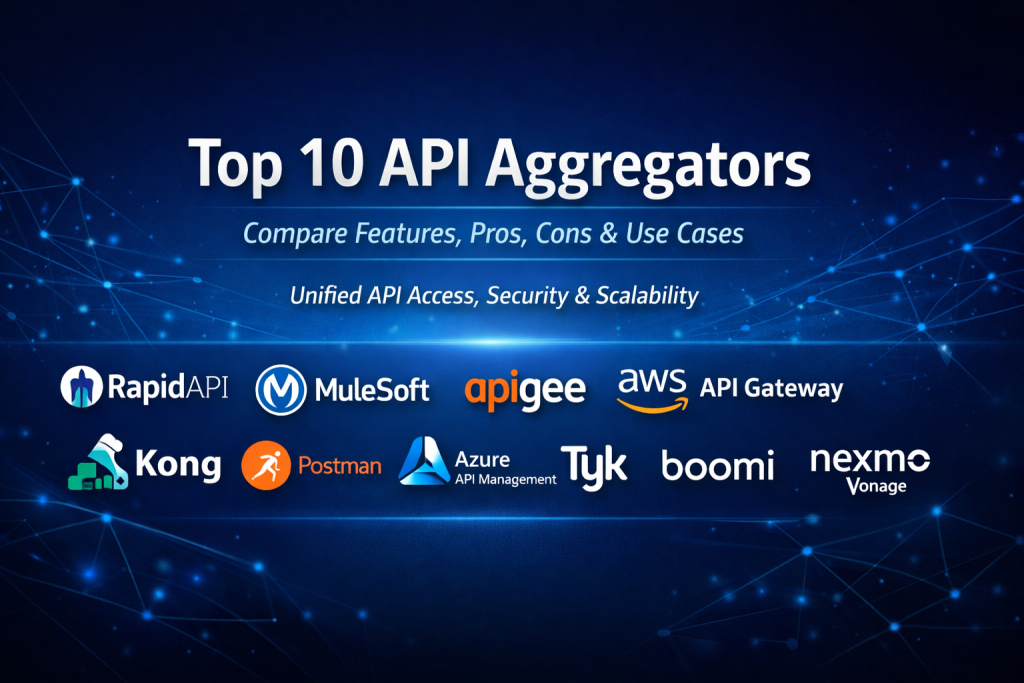
Top 10 API Aggregators Tools
1 — RapidAPI
Short description:
A large API marketplace that allows developers to discover, test, and consume thousands of public APIs through a single platform.
Key features
- Massive API marketplace across categories
- Unified authentication and billing
- Built-in testing and monitoring tools
- Rate limiting and quota management
- Analytics for API usage
- Subscription-based API access
Pros
- Extremely wide API selection
- Fast onboarding for developers
Cons
- Quality varies across API providers
- Less control for enterprise governance
Security & compliance:
API keys, HTTPS, basic access controls; compliance varies by provider.
Support & community:
Strong documentation, active developer community, ticket-based support.
2 — MuleSoft
Short description:
An enterprise-grade API aggregation and integration platform focused on large-scale, mission-critical systems.
Key features
- API management and orchestration
- Integration flows and connectors
- Policy enforcement and governance
- Advanced analytics and monitoring
- Hybrid and multi-cloud support
- Enterprise-grade scalability
Pros
- Powerful enterprise capabilities
- Strong governance and compliance
Cons
- Steep learning curve
- High cost for smaller teams
Security & compliance:
SSO, encryption, audit logs, SOC 2, ISO, GDPR support.
Support & community:
Enterprise support, extensive documentation, training programs.
3 — Apigee
Short description:
A comprehensive API aggregation and management platform designed for performance, analytics, and security at scale.
Key features
- API gateway and aggregation
- Traffic management and caching
- Advanced analytics and monitoring
- Security policy enforcement
- Developer portal
- Cloud-native architecture
Pros
- Excellent performance and scalability
- Deep analytics capabilities
Cons
- Complex setup for beginners
- Premium pricing
Security & compliance:
OAuth, SSO, encryption, audit logging, GDPR-ready.
Support & community:
Enterprise-grade support, strong documentation, global user base.
4 — AWS API Gateway
Short description:
A fully managed API aggregation service tightly integrated with the AWS ecosystem.
Key features
- REST and HTTP API aggregation
- Native AWS service integrations
- Auto-scaling and high availability
- Built-in monitoring
- Usage plans and throttling
- Pay-as-you-go pricing
Pros
- Seamless AWS integration
- Highly scalable and reliable
Cons
- AWS-centric design
- Cost complexity at scale
Security & compliance:
IAM, encryption, audit logs, SOC, ISO, GDPR support.
Support & community:
Extensive documentation, large global community, enterprise AWS support.
5 — Kong
Short description:
An open-core API aggregation and gateway platform focused on performance and extensibility.
Key features
- High-performance API gateway
- Plugin-based architecture
- Service mesh support
- Traffic control and security
- Hybrid and cloud deployment
- Open-source foundation
Pros
- Very fast and lightweight
- Flexible deployment options
Cons
- Advanced features require enterprise edition
- Configuration can be complex
Security & compliance:
OAuth, mTLS, encryption; compliance depends on deployment.
Support & community:
Strong open-source community, commercial enterprise support.
6 — Postman
Short description:
Primarily known for API testing, Postman also serves as a lightweight API aggregation and collaboration layer.
Key features
- API collections and workspaces
- Mock servers and monitoring
- API documentation generation
- Collaboration tools
- Environment and variable management
- Integration with CI/CD pipelines
Pros
- Excellent developer experience
- Easy onboarding and collaboration
Cons
- Not a full enterprise aggregator
- Limited governance features
Security & compliance:
Role-based access, encryption; compliance varies by plan.
Support & community:
Large global community, extensive tutorials, commercial support tiers.
7 — Azure API Management
Short description:
A cloud-based API aggregation and management solution tightly integrated with the Microsoft ecosystem.
Key features
- API gateway and aggregation
- Policy-based traffic control
- Developer portal
- Analytics and monitoring
- Hybrid deployment support
- Azure service integration
Pros
- Strong enterprise governance
- Ideal for Microsoft-centric stacks
Cons
- Azure dependency
- Can be costly at higher tiers
Security & compliance:
SSO, encryption, audit logs, SOC, ISO, GDPR support.
Support & community:
Enterprise Microsoft support, strong documentation.
8 — Tyk
Short description:
An open-source-first API aggregation and management platform focused on control and flexibility.
Key features
- API gateway and aggregation
- Open-source core
- Analytics and monitoring
- Flexible deployment models
- Custom plugins
- Multi-cloud support
Pros
- High level of customization
- Transparent architecture
Cons
- UI less polished than competitors
- Requires operational expertise
Security & compliance:
OAuth, JWT, encryption; compliance depends on setup.
Support & community:
Active open-source community, paid enterprise support available.
9 — Boomi
Short description:
An integration-focused platform that aggregates APIs, data sources, and applications in enterprise environments.
Key features
- API aggregation and integration
- Prebuilt connectors
- Low-code workflows
- Data transformation
- Monitoring and alerts
- Hybrid integration
Pros
- Strong integration ecosystem
- Low-code approach for enterprises
Cons
- Less developer-centric
- Pricing not startup-friendly
Security & compliance:
Enterprise-grade security, SOC, ISO, GDPR support.
Support & community:
Enterprise onboarding, documentation, professional services.
10 — Nexmo
Short description:
A communications-focused API aggregation platform offering messaging, voice, and verification APIs.
Key features
- Unified communications APIs
- Global reach
- Built-in scalability
- Usage analytics
- Developer SDKs
- Pay-as-you-go pricing
Pros
- Strong reliability for communications
- Easy global deployment
Cons
- Narrower API scope
- Not a general-purpose aggregator
Security & compliance:
Encryption, access controls, GDPR-aligned.
Support & community:
Developer-friendly documentation, commercial support plans.
Comparison Table
| Tool Name | Best For | Platform(s) Supported | Standout Feature | Rating |
|---|---|---|---|---|
| RapidAPI | Developers & startups | Cloud | Massive API marketplace | N/A |
| MuleSoft | Large enterprises | Cloud / Hybrid | Enterprise integration | N/A |
| Apigee | High-scale APIs | Cloud | Advanced analytics | N/A |
| AWS API Gateway | AWS users | Cloud | Native AWS integration | N/A |
| Kong | Performance-focused teams | Cloud / On-prem | High-speed gateway | N/A |
| Postman | Dev collaboration | Cloud / Desktop | Developer experience | N/A |
| Azure API Management | Microsoft ecosystems | Cloud / Hybrid | Policy-based control | N/A |
| Tyk | Custom architectures | Cloud / On-prem | Open-source core | N/A |
| Boomi | Enterprise integration | Cloud / Hybrid | Low-code workflows | N/A |
| Nexmo | Communications APIs | Cloud | Global messaging reach | N/A |
Evaluation & Scoring of API Aggregators
| Tool | Core Features (25%) | Ease of Use (15%) | Integrations (15%) | Security (10%) | Performance (10%) | Support (10%) | Price/Value (15%) | Total |
|---|---|---|---|---|---|---|---|---|
| RapidAPI | 22 | 14 | 13 | 7 | 8 | 8 | 13 | 85 |
| MuleSoft | 24 | 10 | 15 | 10 | 9 | 9 | 8 | 85 |
| Apigee | 23 | 11 | 14 | 9 | 10 | 9 | 8 | 84 |
| AWS API Gateway | 22 | 12 | 14 | 9 | 10 | 8 | 9 | 84 |
| Kong | 21 | 11 | 13 | 8 | 10 | 8 | 12 | 83 |
Which API Aggregators Tool Is Right for You?
- Solo developers: RapidAPI or Postman for simplicity and speed
- SMBs: Kong or Tyk for flexibility and cost control
- Mid-market: AWS API Gateway or Azure API Management
- Enterprises: MuleSoft, Apigee, or Boomi
Budget-conscious teams: Open-source or usage-based tools
Premium needs: Enterprise governance and compliance platforms
Scalability focus: Cloud-native, globally distributed solutions
Security-driven environments: Platforms with strong policy enforcement
Frequently Asked Questions (FAQs)
1. What is an API Aggregator?
It is a platform that consolidates multiple APIs into a single interface for easier access and management.
2. Are API Aggregators secure?
Most offer strong security, but compliance depends on configuration and provider.
3. Do API Aggregators replace backend development?
No, they simplify integration but do not replace core business logic.
4. Are they suitable for startups?
Yes, especially marketplaces and usage-based platforms.
5. Can I self-host an API Aggregator?
Some tools support on-prem or hybrid deployments.
6. How do they affect performance?
Good aggregators improve reliability, but misconfiguration can add latency.
7. Are free plans reliable?
They are useful for testing but limited for production workloads.
8. What are common mistakes?
Ignoring rate limits, poor security configuration, and over-aggregation.
9. Do they support internal APIs?
Yes, many are designed for internal and external APIs.
10. Is vendor lock-in a concern?
It can be, especially with cloud-native platforms.
Conclusion
API Aggregators have become essential for building scalable, secure, and maintainable modern applications. They reduce complexity, improve governance, and accelerate development by centralizing API access and management.
There is no universal “best” API Aggregator. The right choice depends on your team size, technical stack, budget, security requirements, and long-term scalability goals. Evaluating tools based on real use cases—not just feature lists—is the key to making the right decision.

Find Trusted Cardiac Hospitals
Compare heart hospitals by city and services — all in one place.
Explore Hospitals