
Introduction
Digital Wallet SDKs are developer toolkits that enable businesses to embed secure digital wallet and payment functionality directly into their applications. Instead of building payments, tokenization, security, and compliance from scratch, teams can integrate ready-made APIs and SDKs to support card payments, stored balances, mobile wallets, peer-to-peer transfers, and in-app checkout experiences.
Their importance has grown rapidly as cashless transactions, mobile commerce, super apps, and embedded finance become standard across industries. From e-commerce and ride-sharing to fintech, healthcare, gaming, and marketplaces, digital wallet SDKs reduce time-to-market while maintaining high security and regulatory compliance.
Real-world use cases include:
- In-app payments and one-tap checkout
- Peer-to-peer money transfers
- Subscription billing and recurring payments
- Marketplace payouts and split payments
- Cross-border and multi-currency transactions
When choosing a Digital Wallet SDK, teams should evaluate security standards, platform support, integration ease, scalability, compliance coverage, and long-term cost structure. A good SDK should grow with your product, not limit it.
Best for:
Product managers, mobile app developers, fintech startups, SaaS platforms, marketplaces, and enterprises building embedded payment experiences.
Not ideal for:
Offline-only businesses, very small static websites, or organizations that only need simple redirect-based payment links without in-app wallet functionality.
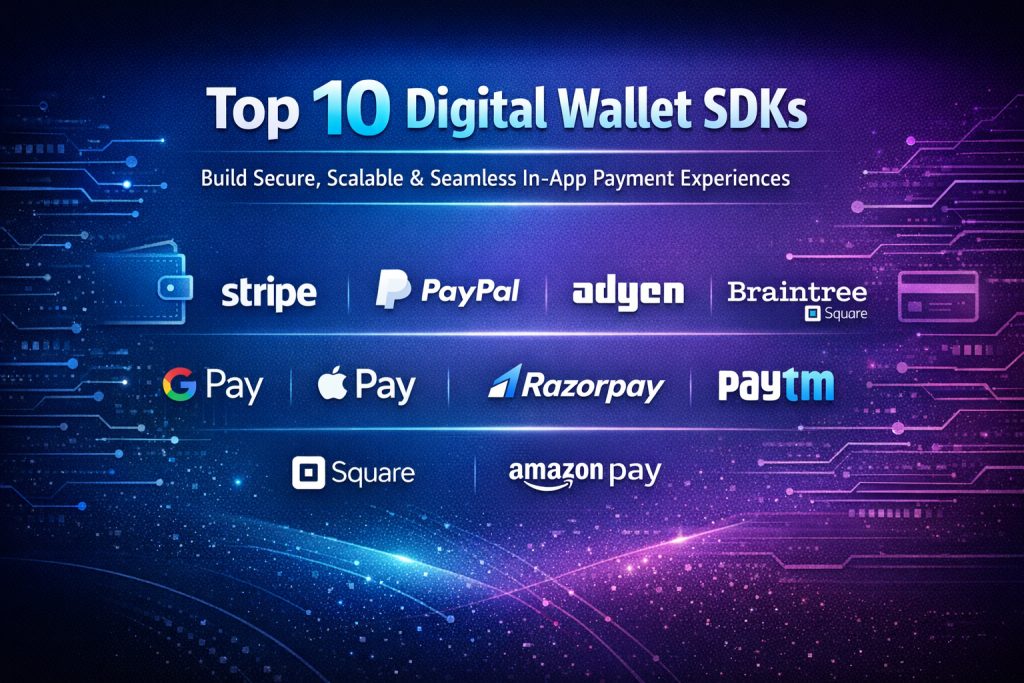
Top 10 Digital Wallet SDKs Tools
1 — Stripe SDK
Short description:
A developer-first digital payments and wallet SDK known for flexibility, scalability, and modern APIs. Ideal for startups and enterprises alike.
Key features:
- Unified wallet and card payment APIs
- Tokenization and encrypted payment methods
- Multi-currency and global payment support
- Mobile SDKs for iOS and Android
- Webhooks and real-time event handling
- Subscription and recurring billing support
Pros:
- Extremely developer-friendly documentation
- Scales seamlessly from MVP to enterprise
Cons:
- Pricing can become complex at scale
- Advanced features may require multiple modules
Security & compliance:
PCI DSS Level 1, encryption at rest and in transit, SOC 2, GDPR.
Support & community:
Excellent documentation, active developer community, enterprise support available.
2 — PayPal SDK
Short description:
A widely trusted wallet SDK focused on global consumer reach and brand recognition.
Key features:
- Built-in PayPal wallet support
- One-touch checkout experiences
- Mobile and web SDKs
- Multi-currency handling
- Buyer and seller protection tools
Pros:
- High consumer trust and familiarity
- Strong international coverage
Cons:
- Less customizable UI flows
- Fees may be higher than competitors
Security & compliance:
PCI DSS, encryption, fraud detection systems, GDPR.
Support & community:
Strong documentation, large global user base, enterprise onboarding.
3— Adyen SDK
Short description:
An enterprise-grade digital wallet SDK designed for large global merchants and omnichannel commerce.
Key features:
- Unified commerce across online and in-store
- Wallets, cards, and local payment methods
- Advanced fraud and risk management
- High-availability global infrastructure
- Real-time transaction analytics
Pros:
- Excellent reliability at scale
- Strong enterprise fraud tools
Cons:
- Less suitable for small startups
- Integration can be complex
Security & compliance:
PCI DSS, ISO 27001, SOC 2, GDPR.
Support & community:
Dedicated account management, enterprise-level support.
4 — Braintree SDK
Short description:
A flexible wallet and payment SDK optimized for mobile-first and subscription-based businesses.
Key features:
- Support for multiple digital wallets
- Native mobile SDKs
- Vaulted payment methods
- Subscription billing
- Drop-in UI components
Pros:
- Simple mobile integration
- Strong subscription features
Cons:
- Limited analytics compared to enterprise tools
- Fewer regional payment options
Security & compliance:
PCI DSS, encryption, fraud prevention tools.
Support & community:
Solid documentation and developer forums.
5 — Square SDK
Short description:
A developer toolkit focused on combining wallet payments with POS and offline-to-online commerce.
Key features:
- Wallet and card payment APIs
- In-app and in-person payments
- Inventory and order APIs
- Offline payment handling
- Simple onboarding
Pros:
- Excellent for retail and SMBs
- Unified online and offline payments
Cons:
- Limited global availability
- Less customizable wallet logic
Security & compliance:
PCI DSS, encryption, SOC compliance.
Support & community:
Clear documentation and responsive SMB support.
6 — Google Pay API / SDK
Short description:
A digital wallet SDK optimized for Android ecosystems and fast, tokenized payments.
Key features:
- Tokenized card payments
- One-tap checkout
- Android-native integration
- Secure element support
- User authentication via device security
Pros:
- Excellent Android user experience
- Strong security model
Cons:
- Limited customization
- Android-centric focus
Security & compliance:
Tokenization, device-level encryption, PCI DSS.
Support & community:
Strong documentation, large Android developer community.
7 — Apple Pay SDK
Short description:
A premium digital wallet SDK designed for seamless payments within Apple’s ecosystem.
Key features:
- Secure biometric authentication
- Tokenized card storage
- iOS and web integrations
- Fast checkout flows
- Strong user privacy controls
Pros:
- Exceptional user trust
- High conversion rates on iOS
Cons:
- Apple-only ecosystem
- Strict design guidelines
Security & compliance:
Secure Enclave, tokenization, PCI DSS.
Support & community:
Comprehensive documentation, Apple developer ecosystem.
8 — Razorpay SDK
Short description:
A region-focused digital wallet SDK ideal for Indian and emerging market applications.
Key features:
- Wallet, UPI, and card payments
- Mobile SDKs and APIs
- Instant settlements
- Subscription billing
- Local compliance support
Pros:
- Excellent local payment coverage
- Competitive pricing
Cons:
- Limited international reach
- Fewer advanced analytics tools
Security & compliance:
PCI DSS, encryption, regional regulatory compliance.
Support & community:
Good documentation and local developer support.
9 — Paytm SDK
Short description:
A consumer-centric wallet SDK popular in mass-market and super-app ecosystems.
Key features:
- Wallet-based payments
- QR and in-app checkout
- Mobile SDKs
- Cashback and loyalty support
- Fast onboarding
Pros:
- Strong consumer adoption
- Ideal for high-volume micro-transactions
Cons:
- Region-specific
- Less flexible for complex use cases
Security & compliance:
Encryption, PCI DSS, local compliance.
Support & community:
Adequate documentation and regional support.
10 — Amazon Pay SDK
Short description:
A wallet SDK leveraging existing Amazon customer accounts for faster checkout.
Key features:
- Wallet and stored card payments
- Seamless Amazon account linking
- Mobile and web SDKs
- Fraud protection
- Subscription payments
Pros:
- High trust among Amazon users
- Reduced checkout friction
Cons:
- Limited customization
- Dependent on Amazon ecosystem
Security & compliance:
PCI DSS, encryption, fraud monitoring.
Support & community:
Strong enterprise documentation and support.
Comparison Table
| Tool Name | Best For | Platform(s) Supported | Standout Feature | Rating |
|---|---|---|---|---|
| Stripe | Startups to enterprises | Web, iOS, Android | Developer flexibility | N/A |
| PayPal | Global consumer apps | Web, Mobile | Brand trust | N/A |
| Adyen | Large enterprises | Web, Mobile, POS | Unified commerce | N/A |
| Braintree | Subscriptions | Web, iOS, Android | Drop-in UI | N/A |
| Square | Retail & SMBs | Web, Mobile, POS | Offline payments | N/A |
| Google Pay | Android apps | Android, Web | Tokenization | N/A |
| Apple Pay | iOS ecosystem | iOS, Web | Biometric security | N/A |
| Razorpay | Indian market | Web, Mobile | Local payments | N/A |
| Paytm | Mass consumer apps | Mobile, Web | Wallet adoption | N/A |
| Amazon Pay | E-commerce | Web, Mobile | Amazon user base | N/A |
Evaluation & Scoring of Digital Wallet SDKs
| Criteria | Weight | Avg Score |
|---|---|---|
| Core features | 25% | High |
| Ease of use | 15% | High |
| Integrations & ecosystem | 15% | Medium-High |
| Security & compliance | 10% | High |
| Performance & reliability | 10% | High |
| Support & community | 10% | Medium-High |
| Price / value | 15% | Medium |
Which Digital Wallet SDKs Tool Is Right for You?
- Solo developers & SMBs: Look for simple SDKs with fast onboarding and transparent pricing.
- Mid-market companies: Balance feature depth with integration flexibility.
- Enterprises: Prioritize compliance, scalability, and dedicated support.
- Budget-conscious teams: Regional SDKs may offer better value.
- Security-focused industries: Choose SDKs with strong tokenization and audit capabilities.
Frequently Asked Questions (FAQs)
- What is a Digital Wallet SDK?
A toolkit that allows developers to embed wallet and payment features into apps. - Do I need PCI compliance if I use an SDK?
Most SDKs reduce scope, but compliance responsibilities still apply. - Are wallet SDKs secure?
Yes, when using encryption, tokenization, and compliant providers. - Can I support multiple wallets with one SDK?
Some platforms offer unified multi-wallet support. - Are these SDKs mobile-only?
No, most support web and mobile platforms. - How long does integration take?
Anywhere from hours to weeks depending on complexity. - Do SDKs handle subscriptions?
Many offer built-in recurring billing features. - Can I customize checkout UI?
Varies by provider; some offer full customization. - Are there hidden costs?
Transaction fees and premium features can add up. - What’s the biggest mistake teams make?
Choosing based only on price instead of long-term scalability.
Conclusion
Digital Wallet SDKs have become foundational infrastructure for modern digital products. The right SDK accelerates development, improves security, and enhances user experience. However, there is no universal “best” solution. The ideal choice depends on your business size, market, compliance needs, and growth plans. Focus on alignment with your long-term strategy, not just short-term convenience.

Find Trusted Cardiac Hospitals
Compare heart hospitals by city and services — all in one place.
Explore Hospitals
