
Introduction
Public Health Surveillance Systems are the backbone of modern public health decision-making. These systems continuously collect, analyze, and interpret health-related data to detect disease outbreaks, monitor population health trends, guide policy decisions, and evaluate the effectiveness of public health interventions. From tracking infectious diseases and vaccination coverage to monitoring chronic conditions and environmental health risks, surveillance systems enable authorities to act early, accurately, and at scale.
In today’s interconnected world, timely and reliable surveillance is more important than ever. Global travel, urban density, climate change, and emerging pathogens mean that outbreaks can spread rapidly if not detected early. Public health surveillance systems help governments, health agencies, research institutions, and NGOs move from reactive response to proactive prevention.
Common real-world use cases include:
- Early outbreak detection and epidemic intelligence
- Monitoring vaccination programs and coverage gaps
- Tracking chronic disease trends (diabetes, cancer, cardiovascular diseases)
- Environmental and syndromic surveillance
- Supporting health policy planning and resource allocation
When choosing a public health surveillance system, users should evaluate data integration capabilities, analytics strength, scalability, ease of use, interoperability, security, compliance, and long-term sustainability.
Best for:
Public health departments, national disease control agencies, epidemiologists, research institutions, NGOs, global health organizations, and large healthcare networks that need population-level insights and real-time surveillance.
Not ideal for:
Very small clinics or individual practitioners with no population-health mandate, or organizations that only require basic reporting rather than continuous surveillance and analytics.
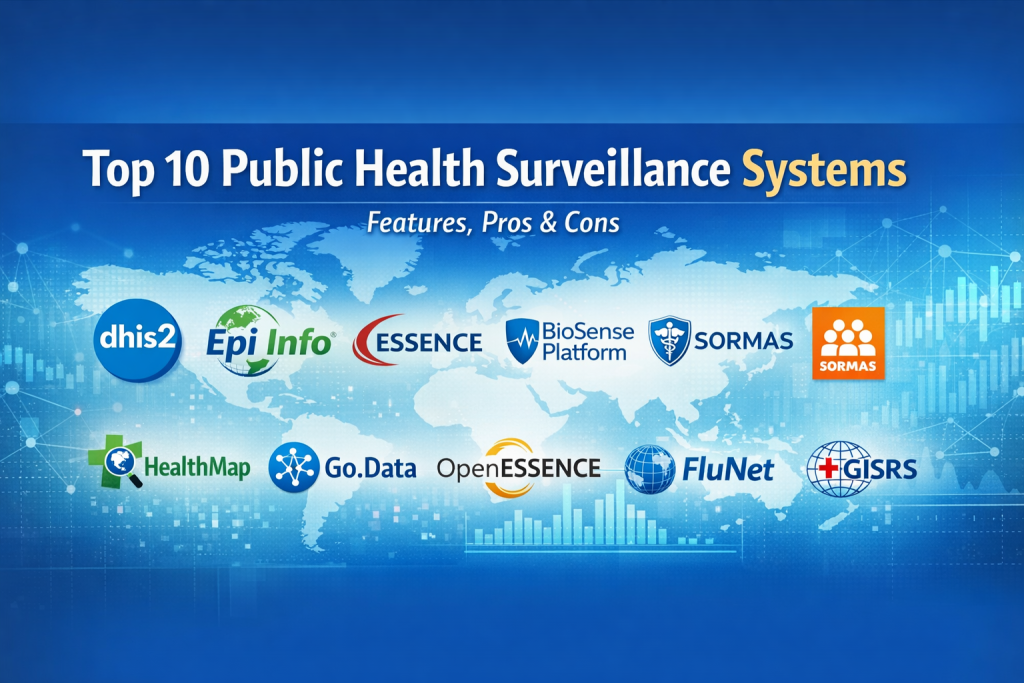
Top 10 Public Health Surveillance Systems Tools
1 — DHIS2
Short description:
A globally adopted, open-source health information and surveillance platform widely used by governments and NGOs for national-scale public health monitoring.
Key features:
- Aggregate and case-based disease surveillance
- Custom dashboards and indicators
- Offline data collection support
- Interoperability with laboratory and EMR systems
- Advanced analytics and visualization
- Strong customization for country-specific workflows
Pros:
- Proven at national and multi-country scale
- Strong global public health adoption
Cons:
- Requires technical expertise for setup
- Customization can be time-consuming
Security & compliance:
Role-based access control, encryption, audit logs; compliance varies by implementation.
Support & community:
Extensive documentation, large global community, NGO and enterprise implementation partners.
2 — Epi Info
Short description:
A statistical and epidemiological toolkit designed primarily for outbreak investigations and public health research.
Key features:
- Data collection and questionnaire design
- Epidemiological statistics and mapping
- Outbreak investigation tools
- Free and lightweight deployment
- Rapid analysis workflows
Pros:
- Easy to learn for epidemiologists
- Cost-effective and widely trusted
Cons:
- Limited enterprise scalability
- Basic integration capabilities
Security & compliance:
Varies; largely dependent on local deployment practices.
Support & community:
Strong documentation, academic and public-sector user base.
3 — ESSENCE
Short description:
A syndromic surveillance system designed for early detection of health threats using real-time data streams.
Key features:
- Real-time anomaly detection
- Syndromic and event-based surveillance
- Advanced alerting mechanisms
- Customizable dashboards
- Data fusion from multiple sources
Pros:
- Strong early-warning capabilities
- Trusted by public health agencies
Cons:
- Requires training for advanced analytics
- Not designed for small teams
Security & compliance:
Enterprise-grade access controls and auditing.
Support & community:
Professional support, training programs, active practitioner community.
4 — BioSense Platform
Short description:
A national syndromic surveillance platform supporting near real-time situational awareness.
Key features:
- Emergency department data ingestion
- National-level health monitoring
- Integrated analytics environment
- Standardized data sharing
- Population health dashboards
Pros:
- Designed for nationwide coordination
- Strong federal backing
Cons:
- Limited customization flexibility
- Access often restricted to government users
Security & compliance:
High security standards, government-grade compliance.
Support & community:
Federal documentation, structured onboarding, limited open community.
5 — SORMAS
Short description:
An outbreak and epidemic management system supporting surveillance, contact tracing, and response workflows.
Key features:
- Case and contact management
- Laboratory integration
- Real-time outbreak dashboards
- Mobile data capture
- Multi-disease support
Pros:
- Excellent for outbreak response
- Strong field-level usability
Cons:
- Focused mainly on infectious diseases
- Requires coordinated implementation
Security & compliance:
Role-based security, encryption; compliance depends on deployment.
Support & community:
Open-source community, institutional support, growing global adoption.
6 — HealthMap
Short description:
A global disease surveillance platform leveraging digital data sources for real-time outbreak intelligence.
Key features:
- Automated data mining from news and reports
- Global outbreak visualization
- Event-based surveillance
- Early signal detection
- Public-facing dashboards
Pros:
- Excellent global situational awareness
- Innovative data sourcing
Cons:
- Limited customization
- Less suitable for internal reporting
Security & compliance:
Primarily informational; compliance varies.
Support & community:
Academic support, research-focused community.
7 — Go.Data
Short description:
A WHO-developed tool for outbreak investigation, focusing on case and contact data management.
Key features:
- Case-based surveillance
- Contact tracing workflows
- Data visualization and mapping
- Offline data entry
- Rapid deployment
Pros:
- Designed for emergency use
- Field-tested in outbreaks
Cons:
- Limited analytics depth
- Not a full surveillance ecosystem
Security & compliance:
Standard access controls; varies by host environment.
Support & community:
WHO guidance, documentation, practitioner community.
8 — OpenESSENCE
Short description:
An open-source surveillance analytics platform for syndromic and event-based data analysis.
Key features:
- Data ingestion and normalization
- Statistical alerting
- Visualization dashboards
- Custom query capabilities
- Extensible architecture
Pros:
- Flexible and customizable
- Strong analytical depth
Cons:
- Technical setup required
- Smaller user community
Security & compliance:
Varies; depends on hosting and configuration.
Support & community:
Open-source documentation, niche expert community.
9 — FluNet
Short description:
A global influenza surveillance system used to monitor flu trends and virus circulation worldwide.
Key features:
- Influenza case reporting
- Global trend analysis
- Standardized laboratory data
- Seasonal comparison tools
- Global collaboration support
Pros:
- Highly specialized and reliable
- Global coverage
Cons:
- Limited to influenza
- Not customizable for other diseases
Security & compliance:
Managed under WHO governance frameworks.
Support & community:
International public health network, structured reporting guidance.
10 — GISRS
Short description:
A worldwide surveillance and response system focused on influenza and pandemic preparedness.
Key features:
- Global laboratory collaboration
- Virus characterization tracking
- Pandemic preparedness insights
- Data sharing frameworks
- Long-term trend analysis
Pros:
- Essential for pandemic readiness
- Highly trusted global network
Cons:
- Disease-specific scope
- Not a general surveillance platform
Security & compliance:
International governance standards.
Support & community:
Strong institutional support, expert-led network.
Comparison Table
| Tool Name | Best For | Platform(s) Supported | Standout Feature | Rating |
|---|---|---|---|---|
| DHIS2 | National public health programs | Web, Mobile | National-scale customization | N/A |
| Epi Info | Epidemiologists, researchers | Desktop, Web | Rapid outbreak analysis | N/A |
| ESSENCE | Early outbreak detection | Web | Real-time syndromic alerts | N/A |
| BioSense Platform | Government surveillance | Web | Nationwide situational awareness | N/A |
| SORMAS | Outbreak response teams | Web, Mobile | Integrated case & contact tracing | N/A |
| HealthMap | Global disease tracking | Web | Digital event-based surveillance | N/A |
| Go.Data | Emergency outbreak response | Web, Mobile | Fast deployment in crises | N/A |
| OpenESSENCE | Advanced analytics teams | Web | Open-source surveillance analytics | N/A |
| FluNet | Influenza monitoring | Web | Global flu trend analysis | N/A |
| GISRS | Pandemic preparedness | Network-based | Global influenza collaboration | N/A |
Evaluation & Scoring of Public Health Surveillance Systems
| Tool | Core Features (25%) | Ease of Use (15%) | Integrations (15%) | Security (10%) | Performance (10%) | Support (10%) | Value (15%) | Total |
|---|---|---|---|---|---|---|---|---|
| DHIS2 | High | Medium | High | Medium | High | High | High | Strong |
| Epi Info | Medium | High | Low | Low | Medium | Medium | High | Moderate |
| ESSENCE | High | Medium | Medium | High | High | Medium | Medium | Strong |
| BioSense | High | Medium | Medium | High | High | Medium | Medium | Strong |
| SORMAS | High | Medium | Medium | Medium | High | Medium | High | Strong |
| HealthMap | Medium | High | Low | Low | Medium | Medium | Medium | Moderate |
| Go.Data | Medium | High | Low | Medium | Medium | Medium | High | Moderate |
| OpenESSENCE | High | Low | Medium | Medium | High | Low | Medium | Moderate |
| FluNet | Medium | Medium | Low | High | High | Medium | Medium | Moderate |
| GISRS | Medium | Medium | Low | High | High | High | Medium | Strong |
Which Public Health Surveillance Systems Tool Is Right for You?
- Solo users / small teams: Epi Info, Go.Data
- SMBs and NGOs: DHIS2, SORMAS
- Mid-market organizations: ESSENCE, OpenESSENCE
- Large enterprises & governments: DHIS2, BioSense Platform, GISRS
Budget-conscious: Open-source platforms with community support
Premium needs: Government-backed or enterprise-grade systems
Feature depth: DHIS2, ESSENCE
Ease of use: Epi Info, Go.Data
High compliance: BioSense Platform, GISRS
Frequently Asked Questions (FAQs)
- What is public health surveillance?
It is the continuous collection and analysis of health data to guide public health action. - Are these systems only for governments?
No, NGOs, research bodies, and healthcare networks also use them. - Do all systems support real-time data?
Not all; syndromic platforms specialize in real-time detection. - Is open-source safe for health data?
Yes, when properly hosted and secured. - How long does implementation take?
From days for simple tools to months for national systems. - Do these tools support mobile data collection?
Many do, especially outbreak-focused platforms. - Can they integrate lab data?
Most enterprise systems support lab integration. - Are they expensive?
Costs vary widely; many are free but require implementation resources. - What’s the biggest mistake buyers make?
Choosing tools without considering long-term scalability. - Is there one best system?
No, the best choice depends on use case and context.
Conclusion
Public health surveillance systems are essential for protecting populations, preventing outbreaks, and guiding evidence-based policy. While there is no single “best” solution, the right platform depends on scale, purpose, resources, and compliance needs. By carefully evaluating features, usability, integrations, and long-term value, organizations can select a system that truly strengthens public health outcomes.

Find Trusted Cardiac Hospitals
Compare heart hospitals by city and services — all in one place.
Explore Hospitals
Public health surveillance systems are only as effective as the quality and timeliness of the data they collect. Delayed reporting or missing records can make it harder to identify emerging health risks. I think connecting data from hospitals, laboratories, and local health teams can improve early detection. Strong privacy controls and regular data checks are equally important for building trust and reliable reporting.
Public health surveillance systems need to identify unusual patterns without treating every sudden increase in reported cases as an outbreak. Delayed reporting, duplicate records, and changes in testing activity can all affect the numbers. I would look for systems that validate incoming data, track reporting delays, and allow health teams to compare trends across locations and time periods. Reliable data quality checks are essential because early decisions depend on how accurately the system reflects what is happening on the ground.
Public health surveillance depends on accurate data and timely reporting from different healthcare sources. One area worth considering is how these systems handle incomplete records, reporting delays, and duplicate information. Health teams also need clear alerts that help them identify unusual trends without creating unnecessary noise. Strong data sharing between hospitals, laboratories, and public health departments can support faster and better-coordinated responses.
Public health surveillance systems are only effective when they provide timely and reliable information. One important factor is how quickly health teams can detect unusual patterns and share findings with the right departments. It is also worth focusing on data quality, privacy controls, and integration with hospitals and laboratories. Better coordination can help public health teams respond faster and make informed decisions during disease outbreaks.
A surveillance dashboard may identify an unusual increase in reported infections, but public health teams still need to determine whether it represents a genuine outbreak or simply a change in reporting behavior. For example, a hospital introducing a new reporting process may suddenly submit more cases than before, creating a misleading trend. It would be useful for these systems to distinguish actual disease patterns from changes in reporting practices, hospital participation, and testing availability. This would help epidemiologists interpret alerts more accurately and avoid directing limited public health resources toward false signals.
One important aspect of public health surveillance systems is ensuring that data quality remains reliable when information arrives from laboratories, hospitals, clinics, and field teams at different speeds and in different formats. Even sophisticated outbreak detection models can generate misleading alerts if reporting delays, duplicate cases, or inconsistent case definitions are not addressed. I would also evaluate how systems handle alert prioritization, since public health teams need to distinguish actionable signals from routine fluctuations without becoming overwhelmed by false positives. Interoperability is valuable, but it should be paired with clear data governance, role-based access, and safeguards for sensitive population health information. Ultimately, a surveillance platform should help epidemiologists move from detection to investigation and response while preserving a traceable record of how decisions were made.
Public health surveillance systems help agencies track health trends, detect outbreaks, and support timely public health decisions. When comparing platforms, consider data collection accuracy, real-time reporting, outbreak alerts, privacy safeguards, interoperability, analytics capabilities, and integration with healthcare providers and laboratories.
Public health surveillance systems help health agencies collect, monitor, and analyze data to identify disease patterns and emerging health risks. When comparing platforms, consider real-time data reporting, outbreak detection, data accuracy, privacy controls, interoperability, analytics dashboards, and integration with hospitals and laboratories.
Public health surveillance is only as effective as the quality and timeliness of the data entering the system. During an emerging outbreak, delayed laboratory reports or inconsistent case definitions can make an early warning difficult to interpret. I would look closely at how platforms validate incoming records, connect with laboratories, and handle changes to reporting standards across regions. Alert fatigue is another concern: too many poorly prioritized signals can distract epidemiologists from events that require immediate investigation. A reliable surveillance system should turn fragmented data into actionable insight while preserving privacy and making the reasoning behind alerts clear to public health teams.
This article offers a useful overview of public health surveillance systems and their role in tracking diseases and identifying potential health threats. I appreciate the comparison of different solutions, as it helps healthcare professionals understand their features, benefits, and limitations. Capabilities such as real-time data collection, outbreak alerts, analytics dashboards, and integration with healthcare databases can support timely responses and informed public health decisions. Overall, this guide provides valuable insights into selecting surveillance systems that improve disease monitoring and strengthen community health preparedness.
This article provides a valuable overview of public health surveillance systems and their importance in monitoring diseases and identifying emerging health risks. I appreciate the comparison of different solutions, as it helps healthcare organizations understand their features, advantages, and limitations. Capabilities such as real-time data collection, outbreak alerts, reporting dashboards, and integration with healthcare databases can support faster responses and better public health decisions. Overall, this guide offers useful insights into choosing surveillance systems that strengthen disease monitoring and improve community health preparedness.
The operational effectiveness of public health monitoring systems relies on rapid automated record linkage between hospital discharge records, diagnostic labs, and municipal immunization registries. Deploying automated outlier detection algorithms surfaces subtle geographic clusters of novel pathogens long before formal clinical diagnostic confirmations arrive. Robust cryptographic pseudonymization protocols protect patient privacy while enabling longitudinal population health studies.
Designing regional disease monitoring networks requires an uncompromising approach to granular data governance and anonymization pipelines. Cloud-native architectures that ingest disparate clinical lab HL7 messaging formats enable biostatisticians to construct rapid predictive infection heatmaps. Automated data deduplication at intake is critical to prevent inflated case counts across neighboring municipal healthcare systems.
The efficacy of modern epidemiological surveillance rests on automating non-traditional syndromic ingestion streams like pharmacy transactions and school absenteeism alongside standard lab data. Disjointed municipal formats frequently delay emergency signal detection during the critical initial phases of an outbreak. Adopting standardized FHIR exchange protocols provides the rapid, interoperable alerting pipeline necessary for effective public health responses.
Public health surveillance systems help health agencies collect, analyze, and monitor information about diseases and population health trends. When comparing options, consider data accuracy, real-time reporting, interoperability, privacy safeguards, outbreak alerts, analytics, and integration with healthcare reporting systems.
This second look at public health surveillance systems adds helpful emphasis on data sharing between jurisdictions. What stands out to me is the recognition that outbreaks do not respect borders, so systems must interoperate. One suggestion is to fund data quality alongside software, because incomplete reports mislead planners. Surveillance strength depends on participation. Important and consistent coverage.
Sales enablement tools promise a lot, and this article does a good job separating real capability from marketing noise. I particularly like the coverage of content analytics, which tells teams whether their materials are actually being used in the field. One practical note is that enablement works best when sales and marketing agree on a single source of truth for messaging, otherwise reps cherry pick outdated decks. The tool should support alignment, not replace it. Useful guide for revenue leaders.
This third take on public health surveillance systems adds useful depth to an already important topic. What resonates with me is the focus on interoperability, because health data silos slow down outbreak response more than any single technical flaw. One perspective worth sharing is that community health worker input should be treated as a first class data source, not an afterthought, since ground reports often catch signals before formal systems do. Strong surveillance is as much about process design as software. Good coverage here.
A challenge I find important in public health surveillance is making information useful for local decision-making rather than focusing only on national or regional totals. Two districts may report similar case numbers but have very different population sizes, healthcare capacities, and access to diagnostic facilities. Looking at raw figures alone can therefore create a misleading picture of where resources are needed most. I would value systems that allow epidemiologists to examine trends by population group, geographical area, and relevant risk factors while protecting individual privacy. The ability to explore these patterns without requiring advanced technical skills can make surveillance data more useful to local health officials and field teams.
Public health surveillance systems need to handle situations where reported case numbers change after the initial submission. Hospitals and local health departments may later correct records, remove duplicates, or update a suspected case after laboratory confirmation. I would look at whether these platforms preserve the original report while clearly recording subsequent corrections and their reasons. This is important because historical trends can become misleading if revised figures silently replace earlier data. Another useful capability is showing how reporting delays affect the latest statistics, so public health teams can distinguish a genuine decline in cases from information that has simply not arrived yet.
Public health surveillance systems help health authorities collect, analyze, and monitor health-related data to identify disease outbreaks and track population health trends. Features such as real-time case reporting, outbreak detection, data visualization, laboratory integration, automated alerts, and epidemiological analytics support faster public health responses. When comparing solutions, organizations should consider data accuracy, interoperability, scalability, reporting flexibility, privacy controls, and integration with healthcare systems. The right platform can improve disease monitoring, strengthen early warning capabilities, support evidence-based decisions, and help authorities respond more effectively to emerging public health threats.
Public health data often changes as laboratories and healthcare providers update their findings. Systems should handle revised submissions without erasing earlier records or creating duplicate cases. Keeping timestamps and source details makes each change easier to verify. Teams should also monitor late reports and incomplete submissions across different regions. This helps prevent reporting issues from being mistaken for real shifts in disease activity.
Public health surveillance systems are essential for monitoring disease patterns, detecting emerging health threats, and supporting timely responses to public health challenges. Features such as real-time case reporting, outbreak alerts, epidemiological analysis, laboratory data integration, geographic mapping, and automated dashboards help health authorities make informed decisions. When comparing platforms, organizations should consider data accuracy, interoperability, privacy protection, reporting flexibility, and scalability. The right solution can improve disease tracking, strengthen early warning capabilities, support coordinated interventions, and contribute to more effective public health planning and response.
Public health surveillance systems help healthcare authorities collect, analyze, and interpret health data to identify disease patterns and respond to potential outbreaks. Features such as real-time case reporting, outbreak detection, disease trend analysis, laboratory data integration, automated alerts, and interactive dashboards support timely public health decisions. When comparing platforms, organizations should consider data accuracy, interoperability, privacy safeguards, reporting flexibility, and scalability. The right solution can strengthen early warning capabilities, improve coordination among health agencies, support evidence-based interventions, and contribute to more effective disease prevention and control.
Public health surveillance systems are valuable when they help teams spot patterns early and respond with reliable information. I would compare data sources, reporting speed, alert rules, privacy safeguards, and support for different reporting standards. Data quality is critical because missing or delayed reports can distort the picture. It is also important to see how the system handles unusual trends and communicates uncertainty. Public health teams need useful summaries without losing access to the underlying evidence. A strong platform should support timely decisions while protecting sensitive information and making data limitations clear.
Public health surveillance systems need to identify unusual disease patterns early without producing so many false alarms that teams ignore them. When comparing platforms, check how they combine laboratory reports, clinical notifications, and population-level trends while handling delays or missing data. Clear thresholds, traceable data sources, and timely alerts can help public health teams investigate potential outbreaks before cases spread further.
Public health surveillance systems are most effective when they turn timely, accurate data into actionable insights for health professionals. Integrating information from hospitals, laboratories, and community health services can help identify unusual patterns and support faster responses to potential outbreaks. Data quality, privacy protection, and interoperability are equally important for maintaining reliable reporting. A well-designed system can strengthen early detection, improve coordination between agencies, and support better public health planning.
Public health surveillance systems help authorities identify emerging disease patterns, monitor outbreaks, and coordinate timely responses using reliable health data. Automated reporting, data integration, and real-time alerts can improve visibility while reducing delays in detecting potential threats. Strong data validation, privacy safeguards, and interoperability between healthcare organizations are essential for producing accurate insights and supporting effective public health decisions.
Public health surveillance systems are essential for identifying emerging health threats, tracking disease patterns, and guiding evidence-based interventions. Combining laboratory reports, hospital records, and community-level data can improve early detection while helping health authorities allocate resources more effectively. Interoperability, reliable data validation, and strong privacy safeguards are critical for ensuring timely insights and maintaining public trust in these systems.
Public health surveillance systems play a crucial role in detecting disease outbreaks, monitoring health trends, and supporting timely public health interventions. Integrating data from hospitals, laboratories, and community health services can improve situational awareness and help authorities respond more effectively to emerging threats. Strong data privacy protections, accurate reporting, and real-time analytics are essential for building reliable surveillance systems that support informed public health decisions.
Public health teams need to know when a change in reported cases reflects reality rather than a problem with data collection. Different reporting schedules and inconsistent case definitions can make comparisons between regions unreliable. Automated checks should flag missing submissions, duplicate records, and sudden shifts in reporting volume. Systems also need to handle connectivity failures without losing records or creating duplicate updates when service returns. Staff should have clear procedures for reviewing unusual signals and deciding when further investigation is necessary. Access controls and audit logs can help protect sensitive information while supporting legitimate data sharing. Testing with historical outbreaks and incomplete datasets can reveal weaknesses before a real emergency occurs. Tracking missed signals, unnecessary alerts, and investigation times helps teams improve the system as conditions change.
Public health monitoring systems must account for gaps in reporting before treating every change as a meaningful trend. A rise in recorded cases might reflect better reporting, while a sudden drop could mean that clinics have stopped sending updates. Teams should compare incoming data with historical patterns and local conditions before triggering an investigation. It is also important to track which facilities submit reports late or provide incomplete records. Alert rules should be reviewed using past events to see whether they detect emerging problems without overwhelming health workers. Every alert needs a defined response process so findings do not remain unattended in a dashboard. Agencies should also protect patient information when sharing data across departments and regions. Measuring investigation delays and follow-up outcomes can help show whether the system supports faster, more informed decisions.
Public health surveillance systems are important for spotting health trends and responding to outbreaks at the right time. I think sharing accurate data between healthcare providers and public health teams can help them make better decisions. It is also important to protect patient information while keeping reports up to date. These improvements can help health teams identify risks earlier and plan their response more effectively.
Public health surveillance systems help health teams identify disease patterns and respond to potential outbreaks more quickly. I think accurate data collection and timely reporting are important for making better public health decisions. It is also useful to connect information from different healthcare sources while protecting patient privacy. These steps can help teams spot risks early and plan their response more effectively.
Public health agencies also need a reliable way to manage changes in disease definitions and reporting standards. When case definitions change or laboratories adopt new testing methods, historical data may no longer support direct comparisons. Engineering teams should maintain versioned reporting rules, document changes to data fields, and validate how updates affect existing dashboards and trend calculations. Automated checks can flag sudden shifts caused by reporting changes rather than genuine changes in disease activity. This is particularly important when several regions use different reporting practices. Keeping these changes traceable helps epidemiologists interpret trends correctly and prevents technical inconsistencies from influencing public health decisions.
A public health surveillance system should help teams turn reports from different sources into a clear view of changing health conditions. Data quality checks are important because duplicate or late reports can distort trends. I would compare how each system handles case reporting, trend analysis, alerts, and information sharing between agencies. It should also support privacy rules and clear access controls. Teams need to know when data was last updated and what limitations may affect the results. A useful system should help health officials spot unusual patterns and coordinate a response. Reliable information is most valuable when people can understand it and act in time.
Public health surveillance systems help teams spot changes in health trends and respond before problems spread further. Timely data matters, but inconsistent reporting can create false signals or delay action. I would compare data validation, alert thresholds, reporting workflows, and links with health information systems. Privacy controls are also essential when records contain sensitive information. Teams should test how the system handles late reports, duplicate records, and sudden increases in cases. Clear dashboards can help decision-makers see where attention is needed. A useful platform should turn reliable data into timely action while keeping records secure and supporting careful interpretation.
A major architectural hurdle in population surveillance systems is managing ingestion throughput during sudden epidemic outbreaks. When thousands of distributed field clinics and telemetry endpoints push unbatched symptom records concurrently, unthrottled API gateways cause severe downstream database lock contention. Platform engineers must implement distributed streaming queues like Kafka and dead-letter topics to prevent catastrophic telemetry loss.
Public health teams also need to understand how reporting delays and incomplete records affect the reliability of surveillance results. A sudden rise in reported cases may reflect improved testing or a backlog being cleared rather than a genuine increase in transmission. Systems should preserve reporting timestamps, track data completeness, and distinguish newly reported cases from cases that occurred earlier. It is also useful to compare current signals with historical reporting patterns before escalating an alert. Testing these scenarios with delayed and corrected datasets can help agencies avoid unnecessary responses while still identifying genuine threats quickly. This level of data-quality monitoring is essential when surveillance findings influence staffing, resource allocation, and public health decisions.
Public health teams also need a clear process for correcting surveillance data after reports have already entered the system. A laboratory may revise a result, a hospital may submit cases late, or two facilities may report the same patient. Without reliable deduplication, data correction, and alert recalculation, these issues can distort local disease trends and waste response resources. I would assess whether a platform preserves the history of changes, identifies the source of conflicting records, and allows authorized staff to correct errors without losing the original audit trail. Testing these scenarios with realistic data would help agencies understand how dependable their reports remain during busy outbreak periods. Accurate data correction is essential when public health decisions depend on timely and trustworthy signals.
Public health surveillance systems need to combine data from different reporting sources without losing accuracy or context. When comparing platforms, check how they handle changes in reporting standards, late-arriving laboratory results, and corrections to previously submitted cases. Flexible dashboards that let officials examine trends by location, age group, or reporting period can also support faster investigations and help teams allocate public health resources where they are most needed.
Public health surveillance systems need to turn reports from hospitals, laboratories, and local health teams into timely signals that officials can investigate. When comparing platforms, check how they handle delayed reports, duplicate records, and changes in case definitions across reporting periods. Clear alert thresholds and links to follow-up investigations are also important, helping health teams distinguish unusual patterns from routine fluctuations and respond with better information.
Public health surveillance systems help health agencies collect and analyze data to detect disease outbreaks and monitor health trends. When comparing platforms, consider reporting speed, laboratory and hospital integration, data accuracy, privacy controls, and real-time alerting capabilities. Reliable data sharing and clear alert workflows help public health teams identify unusual patterns earlier and coordinate timely responses while protecting sensitive patient information.
Public health surveillance systems help health authorities collect, analyze, and monitor disease data to identify outbreaks and track health trends across communities. Platforms like DHIS2 provide tools for health data reporting, visualization, and analysis, helping public health teams detect potential issues earlier, coordinate responses, and make better-informed decisions.
Public health surveillance systems help agencies track disease patterns, monitor emerging threats, and support timely public health decisions. When comparing platforms, consider data accuracy, reporting speed, laboratory integration, alert configuration, privacy safeguards, and interoperability with healthcare systems. Combining reliable data with clear reporting workflows helps teams spot unusual trends sooner and coordinate responses while protecting sensitive health information.
Public health surveillance systems help health agencies collect and analyze data to detect disease outbreaks and monitor health trends. When comparing platforms, consider real-time reporting, data integration, alert accuracy, privacy controls, and compatibility with laboratory and hospital systems. Reliable data sharing and timely alerts can help public health teams identify emerging risks earlier and coordinate responses more effectively.
From an SRE standpoint, field deployment exposes a massive telemetry blind spot: offline-first bi-directional sync. When remote clinics reconnect to centralized clusters, concurrent record reconciliations cause brutal database lock contention. Implementing event-driven conflict-free replicated data types (CRDTs) or distributed message queues is essential to prevent data corruption during regional epidemics.
From a data security and compliance perspective, ingesting syndromic field data poses massive HIPAA and GDPR challenges. Stripping PII/PHI at edge ingestion nodes before centralized storage is essential. Without automated cryptographic tokenization and zero-trust perimeter controls, cross-agency data sharing introduces severe regulatory liability during large-scale outbreak responses.
Selecting a surveillance tool often involves balancing large-scale data integration against rapid field deployment during active outbreaks. Open-source platforms like DHIS2 offer incredible customization for national monitoring, but leaner tools are frequently necessary for immediate frontline response. Matching the system’s architecture to the specific operational scope is vital for timely decision-making.
A surveillance system is only as useful as the quality and speed of the data it receives. Standardizing reports across hospitals, laboratories, and local health departments can reduce delays and help teams detect unusual disease patterns earlier.
Effective public health surveillance systems help health authorities collect timely data, detect unusual disease patterns, and coordinate responses to emerging health threats. Platforms like SORMAS support disease surveillance, case management, and outbreak response workflows, helping public health teams improve reporting, coordinate investigations, and make informed decisions to protect communities.
Public health surveillance systems help health authorities collect, analyze, and share information about disease patterns, emerging outbreaks, and population health trends. Platforms like DHIS2 support health data collection, reporting, and analysis, helping public health teams identify potential concerns earlier, monitor health indicators, and make better-informed decisions for disease prevention and response.
I wasn’t able to access the website directly due to access limitations, but if you still want a tailored comment, you can paste the key points or content of the post here and I’ll gladly craft one for you.
A critical challenge not always highlighted is balancing robust data integration with local digital readiness, especially in resource-limited field settings. Platforms like SORMAS and DHIS2 bridge this gap brilliantly, but long-term success often depends less on the software’s feature depth and more on staff training and seamless offline-to-online data syncing.
Public health surveillance systems are most effective when they combine timely reporting with reliable data quality and strong privacy controls. Offline data collection and seamless laboratory integration are also essential for helping field teams detect outbreaks early and coordinate responses across regions.
A well-designed IVR should make it easy for callers to reach the right team without navigating endless menu options. Testing call flows with real users and reviewing call abandonment rates can reveal friction points, while clear fallback options ensure callers can reach a human agent when automation falls short.
This post is useful because public health surveillance is not just “collecting numbers” — it’s about getting timely, trusted signals so health teams can act before a situation grows. I liked that the comparison looks at practical needs like case reporting, lab integration, automated alerts, dashboards, data validation, and privacy controls, because these are the areas that decide whether a system works in real life. The pros and cons section also helps readers understand that one tool may be good for a small program with basic reporting, while another is better for large regions that need real-time data exchange and strong governance. A smart step before choosing is to pilot the system with real workflows and measure speed, data quality, and ease for frontline users.
This comparison is genuinely helpful because it explains public health surveillance systems in a real, practical way—not as “just software,” but as tools that can improve early detection, reporting speed, and response planning. I liked the focus on features that matter in daily operations, like case and lab data integration, automated alerts, outbreak dashboards, data validation, and privacy controls. The pros and cons section is also important because the “best” system depends on the setting—some teams need simple, fast reporting, while others need advanced real-time exchange across hospitals, labs, and government units. A strong suggestion is to test the system with real workflows (field reporting to final dashboard) and measure time-to-report, data quality, and user ease, because that is where success or failure shows up quickly.