Introduction
The IT industry is changing rapidly as organizations adopt cloud computing, automation, microservices, artificial intelligence, and modern software development practices. Businesses want to develop applications faster, release updates more frequently, reduce operational costs, and deliver reliable digital services. To achieve these goals, companies need professionals who can connect software development with IT operations. This is where DevOps engineers play an important role.
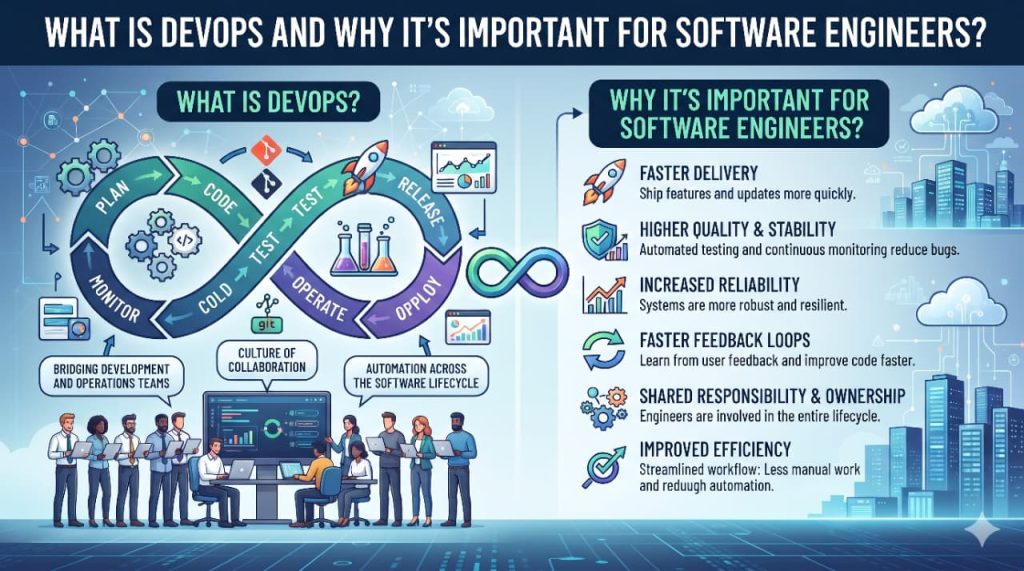
A DevOps engineer helps development and operations teams work together throughout the software delivery lifecycle. Their responsibilities include automating infrastructure, managing cloud environments, building CI/CD pipelines, deploying applications, monitoring system performance, and maintaining security and reliability. Modern DevOps engineers are expected to understand both development and infrastructure technologies while also having strong problem-solving and communication skills.
Companies increasingly look for practical knowledge of Linux, Git, Docker, Kubernetes, cloud platforms, Terraform, scripting, CI/CD, and monitoring tools. Security awareness, infrastructure automation, and the ability to troubleshoot production environments are also important. As organizations adopt platform engineering and AI-based infrastructure solutions, the skill requirements continue to expand.
This article explains the most important DevOps engineer skills required by modern IT companies, the tools professionals should learn, and how beginners can develop the knowledge needed to build a successful DevOps career.
1. Linux and Operating System Fundamentals
Linux is one of the most important technical skills for DevOps engineers. Many application servers, cloud environments, containers, and enterprise infrastructure systems run on Linux-based operating systems. DevOps engineers frequently use Linux to configure servers, manage applications, troubleshoot errors, automate tasks, and monitor system resources.
A strong understanding of Linux helps engineers identify problems that may affect application availability or performance. They should know how to work with the command line, manage files and directories, configure permissions, monitor processes, and investigate system logs.
Important Linux concepts include:
- Linux commands: Understand commands such as
ls,cd,cp,mv,grep,find,awk,sed, andtailfor daily administration. - File permissions: Learn how to manage users, groups, ownership, and permissions using commands such as
chmodandchown. - Process management: Understand how to inspect, start, stop, and troubleshoot running processes.
- Package management: Learn how to install and update software using package managers such as APT and YUM or DNF.
- System monitoring: Use commands such as
top,free,df,du, andpsto examine system resources. - Log management: Understand how to inspect application and system logs using tools such as
journalctl. - Networking: Learn basic Linux networking commands and troubleshoot connectivity problems.
Modern IT companies expect DevOps engineers to be comfortable working in Linux environments because many infrastructure and deployment tasks depend on operating system knowledge.
2. Programming and Scripting Skills
Programming and scripting are essential for automating repetitive tasks and building reliable DevOps workflows. DevOps engineers do not always need to develop complete applications, but they should understand programming fundamentals and be able to write scripts that simplify infrastructure and operational activities.
Scripting helps engineers automate server configuration, application deployment, log analysis, backups, health checks, and routine maintenance. It also reduces manual errors and saves time.
Some important programming and scripting languages include:
Python: Python is widely used for automation, API integration, cloud management, infrastructure operations, and monitoring scripts. Its simple syntax and extensive libraries make it useful for both beginners and experienced engineers.
Bash: Bash scripting is important for Linux administration and command-line automation. Engineers use shell scripts to execute system commands, manage files, configure services, and automate deployment tasks.
Go: Go is increasingly useful in cloud-native infrastructure, container ecosystems, networking tools, and distributed systems. Several popular infrastructure technologies are developed using Go.
PowerShell: PowerShell is particularly useful in Windows-based environments, Microsoft Azure administration, and enterprise automation.
A DevOps engineer should understand variables, loops, conditional statements, functions, error handling, and APIs. Practical scripting experience is more valuable than simply knowing programming language names.
3. Git and Version Control Systems
Version control is an essential part of modern software development. It allows developers and operations teams to track changes, collaborate on code, maintain project history, and manage different versions of applications and configuration files.
Git is one of the most widely used version control systems. DevOps engineers use Git to manage source code, infrastructure definitions, automation scripts, configuration files, and deployment pipelines.
Important Git skills include:
- Creating and managing repositories.
- Understanding commits, branches, merges, and tags.
- Working with remote repositories.
- Resolving merge conflicts.
- Using pull requests and code reviews.
- Managing release branches and version history.
- Understanding branching strategies such as Git Flow and trunk-based development.
Popular Git-based platforms include GitHub, GitLab, and Bitbucket. These platforms provide collaboration features and integrations with CI/CD tools.
For example, when a developer pushes updated application code to a GitHub repository, an automated pipeline can begin testing and building the application. This demonstrates how version control becomes the starting point for an automated DevOps workflow.
4. CI/CD Pipeline Automation
Continuous Integration and Continuous Delivery or Deployment are among the most important DevOps practices. CI/CD pipelines automate the process of building, testing, packaging, and delivering software.
Without automation, teams may need to perform many deployment activities manually. This can increase delivery time and introduce human errors. CI/CD pipelines help organizations release software more consistently and efficiently.
A DevOps engineer should understand how to design, configure, maintain, and troubleshoot automated pipelines.
Important CI/CD concepts include:
- Continuous Integration: Automatically integrate code changes and run tests to identify problems early.
- Continuous Delivery: Keep software in a deployable state so that releases can be delivered through a controlled process.
- Continuous Deployment: Automatically release changes to production when the required checks and approval conditions are satisfied.
- Build automation: Convert source code into deployable artifacts.
- Automated testing: Run unit, integration, and other relevant tests.
- Deployment automation: Deploy applications to development, testing, staging, and production environments.
- Rollback strategies: Restore a previous working version when a deployment causes problems.
Popular CI/CD tools include Jenkins, GitHub Actions, GitLab CI/CD, Azure DevOps, and CircleCI.
Modern companies value engineers who can build reliable pipelines, manage credentials securely, integrate automated tests, and reduce deployment failures.
5. Docker and Containerization
Containerization has become an important part of modern application development and deployment. Docker allows developers to package an application with its dependencies, libraries, and configuration into a portable container image.
Containers help applications run consistently across different environments. This reduces the common problem of software working on a developer’s machine but failing on a testing or production server.
DevOps engineers should understand how to create, build, run, manage, and troubleshoot containers.
Important Docker skills include:
- Understanding images and containers.
- Writing and managing Dockerfiles.
- Building and tagging container images.
- Managing container networks and volumes.
- Working with Docker Compose.
- Using container registries.
- Reducing image size through efficient builds.
- Understanding container security and image scanning.
For example, a company may develop a web application that requires a particular runtime, framework, and set of libraries. Instead of configuring each server manually, the team can package the application into a Docker image and run it consistently across development, testing, and production environments.
Docker knowledge is especially useful for organizations working with microservices and cloud-native applications.
6. Kubernetes and Container Orchestration
Docker helps package applications into containers, while Kubernetes helps manage containerized workloads at scale. It is widely used to deploy, scale, and manage applications across clusters of machines.
Modern IT companies use Kubernetes to operate microservices, manage application availability, and automate container workloads. DevOps engineers working with Kubernetes should understand its architecture and core components.
Important Kubernetes concepts include:
- Pods: The smallest deployable units in Kubernetes.
- Deployments: Manage application replicas and rolling updates.
- Services: Provide stable network access to applications.
- ConfigMaps and Secrets: Manage application configuration and sensitive information.
- Namespaces: Organize resources within a cluster.
- Ingress: Manage external access to services.
- Persistent Volumes: Provide storage for workloads.
- Helm: Package and manage Kubernetes applications through charts.
Engineers should also understand how to troubleshoot pod failures, investigate cluster events, manage resource requests and limits, and perform application rollbacks.
Managed Kubernetes services such as Amazon EKS, Azure Kubernetes Service, and Google Kubernetes Engine are commonly used by organizations.
Kubernetes is a valuable skill, but beginners should first understand Linux, networking, Docker, and basic container concepts before moving into advanced cluster administration.
7. Cloud Computing Skills
Cloud computing is a major part of modern IT infrastructure. Organizations use cloud platforms to host applications, store data, manage networks, provision computing resources, and scale services according to business requirements.
A DevOps engineer should understand at least one major cloud platform in sufficient depth to deploy and manage real applications.
The three leading cloud platforms include:
Amazon Web Services (AWS): AWS provides services for computing, storage, networking, databases, security, and application deployment. Important services include EC2, S3, IAM, VPC, RDS, Lambda, and EKS.
Microsoft Azure: Azure is widely used by enterprises that depend on Microsoft’s technology ecosystem. Important services include Azure Virtual Machines, Azure Storage, Azure Networking, Azure Kubernetes Service, and Azure DevOps.
Google Cloud Platform (GCP): GCP provides cloud infrastructure, data services, networking, and container management. Important services include Compute Engine, Cloud Storage, Google Kubernetes Engine, Cloud Run, and BigQuery.
Cloud skills should include:
- Creating and managing virtual machines.
- Configuring cloud networks and firewalls.
- Managing identity and access permissions.
- Working with storage and databases.
- Deploying applications to cloud infrastructure.
- Understanding load balancing and autoscaling.
- Monitoring cloud resources.
- Managing cloud costs and resource usage.
Rather than learning every cloud platform at once, beginners should select one platform and develop practical experience with its core services.
8. Infrastructure as Code (IaC)
Infrastructure as Code is a practice that allows engineers to define and manage infrastructure through configuration files instead of creating resources manually.
IaC makes infrastructure provisioning repeatable, consistent, and easier to review. It also allows teams to store infrastructure definitions in version control, reuse configurations, and automate environment creation.
Terraform is one of the popular tools used for Infrastructure as Code. Other options include AWS CloudFormation, Azure Bicep, and Pulumi.
Important IaC skills include:
- Understanding declarative and imperative infrastructure management.
- Writing reusable infrastructure configurations.
- Managing variables, outputs, and modules.
- Understanding state files and state management.
- Using remote state storage and locking where supported.
- Managing development, staging, and production environments.
- Reviewing and testing infrastructure changes.
- Detecting configuration drift.
For example, instead of manually creating multiple cloud virtual machines, a DevOps engineer can write a Terraform configuration that defines the required resources. The same configuration can then be reviewed, maintained, and used to provision consistent environments.
Companies value IaC because it improves infrastructure management and supports scalable cloud operations.
9. Configuration Management and Automation Tools
Configuration management tools help engineers maintain consistent system configurations across multiple servers and environments. They automate tasks such as installing packages, creating users, configuring services, managing files, and applying system settings.
Ansible is a popular automation tool because it uses readable YAML-based playbooks and can manage systems without requiring a traditional agent on every managed host.
Other configuration management tools include Chef, Puppet, and Salt.
A DevOps engineer should understand:
- How to automate server configuration.
- How to write and organize Ansible playbooks.
- How to manage inventories and variables.
- How to reuse roles and templates.
- How to manage configuration across multiple environments.
- How to maintain consistency between infrastructure systems.
For example, when a company needs to install the same monitoring agent on hundreds of servers, configuration management can automate the process instead of requiring manual installation on every machine.
10. Monitoring, Logging, and Observability
Deploying an application is only one part of the DevOps lifecycle. Organizations must also ensure that applications and infrastructure remain available, secure, and responsive.
Monitoring and observability help teams understand system health, identify failures, investigate performance problems, and respond to incidents.
Monitoring typically tracks predefined metrics and alerts, while observability combines metrics, logs, and traces to provide deeper insight into system behavior.
Important tools include:
- Prometheus: Collects and stores time-series metrics.
- Grafana: Creates dashboards and visualizes monitoring data.
- ELK Stack: Elasticsearch, Logstash, and Kibana can be used for log collection, processing, and analysis.
- Loki: Provides log aggregation and querying.
- OpenTelemetry: Helps collect and export telemetry data, including metrics, logs, and traces.
- Datadog: Provides monitoring and observability capabilities across applications and infrastructure.
DevOps engineers should understand how to create dashboards, configure alerts, analyze logs, monitor resource usage, and investigate application failures.
For example, if an application suddenly becomes slow, an engineer may examine CPU and memory metrics, review application logs, and inspect distributed traces to identify the source of the problem.
11. DevSecOps and Security Skills
Security is no longer a separate activity performed only after software development. Modern organizations increasingly integrate security checks into development, infrastructure, and deployment workflows.
This approach is commonly known as DevSecOps. It encourages development, operations, and security teams to share responsibility for protecting applications and infrastructure.
Important DevSecOps skills include:
- Understanding identity and access management.
- Managing passwords, API keys, and secrets securely.
- Scanning container images for vulnerabilities.
- Checking infrastructure configurations for security risks.
- Integrating security testing into CI/CD pipelines.
- Applying least-privilege access policies.
- Understanding network security and encryption.
- Monitoring security events and responding to incidents.
Tools such as Trivy, SonarQube, Snyk, Checkov, and HashiCorp Vault can support different security activities.
For example, a CI/CD pipeline can automatically scan a Docker image for known vulnerabilities before allowing it to move into a production deployment stage.
Security knowledge helps DevOps engineers build safer and more reliable software delivery systems.
12. Networking and Infrastructure Fundamentals
Networking knowledge is essential because applications, servers, containers, and cloud services communicate through networks. Many production problems are caused by connectivity issues, DNS configuration, firewall rules, routing problems, or incorrect network settings.
DevOps engineers should understand how network communication works and how to troubleshoot common issues.
Important networking topics include:
- TCP/IP and network protocols.
- IP addresses and subnetting.
- DNS and domain name resolution.
- HTTP and HTTPS.
- SSL/TLS certificates.
- Firewalls and security groups.
- Load balancing.
- Reverse proxies.
- Routing and network troubleshooting.
Tools such as ping, curl, traceroute, nslookup, dig, and ss are useful for investigating connectivity problems.
For example, when an application cannot connect to a database, the engineer may need to check DNS resolution, network routes, firewall rules, service ports, and database availability.
A strong understanding of networking helps engineers solve problems that cannot be diagnosed through application logs alone.
13. Database and Storage Knowledge
DevOps engineers do not always need to work as database administrators, but they should understand the basics of database systems and storage technologies.
Applications depend on databases to store user information, transactions, business records, and application data. Engineers may be responsible for configuring database services, managing backups, monitoring performance, and supporting reliable deployments.
Important database concepts include:
- SQL fundamentals.
- Relational databases such as MySQL and PostgreSQL.
- NoSQL databases such as MongoDB.
- Database backups and recovery.
- Database connectivity and access control.
- Storage performance and capacity.
- Database monitoring and availability.
They should also understand how application deployments can affect database schemas and why database changes require careful planning.
14. GitOps and Modern Deployment Practices
GitOps is an operational approach in which Git repositories act as the source of truth for infrastructure and application deployment configurations.
Instead of manually applying every deployment change, teams store the desired system state in Git. Automated controllers compare the actual environment with the declared configuration and work to keep them aligned.
Tools such as Argo CD and Flux are commonly used for Kubernetes-based GitOps workflows.
Important GitOps concepts include:
- Keeping deployment configuration in Git.
- Using pull requests to review changes.
- Managing environment-specific configurations.
- Automating deployment synchronization.
- Detecting and correcting configuration drift.
- Maintaining deployment history and rollback options.
GitOps can improve deployment consistency, traceability, and collaboration, especially in organizations managing multiple Kubernetes environments.
15. AI and Automation Awareness
Artificial intelligence is becoming increasingly relevant to software development and IT operations. Modern engineering teams are exploring AI-assisted coding, infrastructure troubleshooting, log analysis, incident response, and operational automation.
DevOps engineers do not necessarily need to become machine learning specialists. However, understanding how AI tools can support engineering workflows is becoming a useful additional skill.
Areas worth exploring include:
- AI-assisted coding and scripting.
- Automated log analysis and error investigation.
- AI-supported incident response.
- Infrastructure automation using intelligent tools.
- MLOps fundamentals for managing machine learning workloads.
- Security and governance considerations when using AI systems.
Engineers should use AI-generated recommendations carefully, validate scripts before execution, and avoid exposing confidential information to unauthorized tools.
AI can help improve productivity, but it does not replace the need for strong Linux, cloud, networking, security, and troubleshooting fundamentals.
16. Soft Skills Required for DevOps Engineers
Technical knowledge is important, but successful DevOps engineers also need strong communication and collaboration skills. DevOps involves working with developers, testers, security professionals, system administrators, project managers, and business teams.
The ability to explain technical problems clearly and work effectively with different teams can make a significant difference in professional performance.
Important soft skills include:
Communication: Engineers should explain technical issues, deployment risks, and operational requirements clearly.
Problem-solving: Production environments can fail unexpectedly. Engineers must investigate problems logically and identify practical solutions.
Team collaboration: DevOps requires shared responsibility between development and operations teams.
Adaptability: Tools and technologies change frequently, so engineers must be willing to learn and update their knowledge.
Time management: Engineers often manage deployment activities, incidents, automation tasks, and project deadlines.
Documentation: Clear documentation helps teams understand infrastructure, deployment procedures, troubleshooting steps, and recovery processes.
Ownership: DevOps engineers should take responsibility for the reliability and quality of the systems they manage.
17. Important DevOps Tools Modern IT Companies Use
Modern DevOps environments often combine several tools to manage the software delivery lifecycle. Engineers should understand the purpose of each tool and how it connects with other technologies.
| Category | Popular Tools | Main Purpose |
|---|---|---|
| Operating Systems | Linux, Ubuntu, Red Hat | Server administration |
| Version Control | Git, GitHub, GitLab, Bitbucket | Source code management |
| Scripting | Python, Bash, PowerShell | Task automation |
| CI/CD | Jenkins, GitHub Actions, GitLab CI | Build and deployment automation |
| Containers | Docker, Podman | Application containerization |
| Orchestration | Kubernetes, OpenShift | Container management |
| Cloud Platforms | AWS, Azure, GCP | Cloud infrastructure |
| Infrastructure as Code | Terraform, Pulumi, CloudFormation | Infrastructure provisioning |
| Configuration Management | Ansible, Chef, Puppet | System configuration automation |
| Monitoring | Prometheus, Grafana, Datadog | System and application monitoring |
| Logging | ELK Stack, Loki | Log collection and analysis |
| Security | Trivy, Snyk, SonarQube | Security and code analysis |
| GitOps | Argo CD, Flux | Declarative application delivery |
The exact toolset varies between organizations. A company may use Jenkins and AWS, while another may use GitLab CI and Azure. The important thing is to understand the underlying concepts and gain practical experience with tools used in real environments.
18. Practical Projects to Develop DevOps Skills
Learning tools through theory alone is not enough to become a job-ready DevOps engineer. Practical projects help learners understand how technologies work together and provide evidence of their skills.
Here are some useful projects for beginners and intermediate learners:
Project 1: Build a CI/CD Pipeline Using Jenkins
Create a sample application repository and configure Jenkins to automatically build and test the application whenever new code is committed. Add deployment automation to a test environment.
Project 2: Containerize an Application Using Docker
Select a simple web application, create a Dockerfile, build an image, and run it as a container. Learn how to manage environment variables, ports, and persistent storage.
Project 3: Deploy an Application on Kubernetes
Create a Kubernetes deployment for a containerized application. Configure services, replicas, ConfigMaps, and resource limits. Practice troubleshooting failed pods.
Project 4: Provision Cloud Infrastructure Using Terraform
Use Terraform to create cloud resources such as virtual machines, networks, and storage. Store the configuration in Git and practice reviewing infrastructure changes.
Project 5: Automate Server Configuration Using Ansible
Create Ansible playbooks to install packages, configure services, create users, and maintain consistent server settings.
Project 6: Create a Monitoring Dashboard
Use Prometheus and Grafana to monitor system metrics. Build dashboards for CPU, memory, disk usage, and application availability.
Project 7: Implement GitOps with Argo CD
Store Kubernetes manifests in a Git repository and configure Argo CD to synchronize the desired application state with a Kubernetes cluster.
Project 8: Add Security Scanning to a CI/CD Pipeline
Integrate a tool such as Trivy or SonarQube into a pipeline. Configure checks to identify vulnerabilities or code-quality issues before deployment.
When completing these projects, document the architecture, tools, configuration steps, challenges, and solutions. Uploading clean project documentation and code to a Git repository can help demonstrate practical ability during interviews.
19. How Beginners Can Develop the Skills Required for a DevOps Career
A beginner should avoid trying to learn every DevOps tool at the same time. A structured learning path makes it easier to understand the relationship between different technologies.
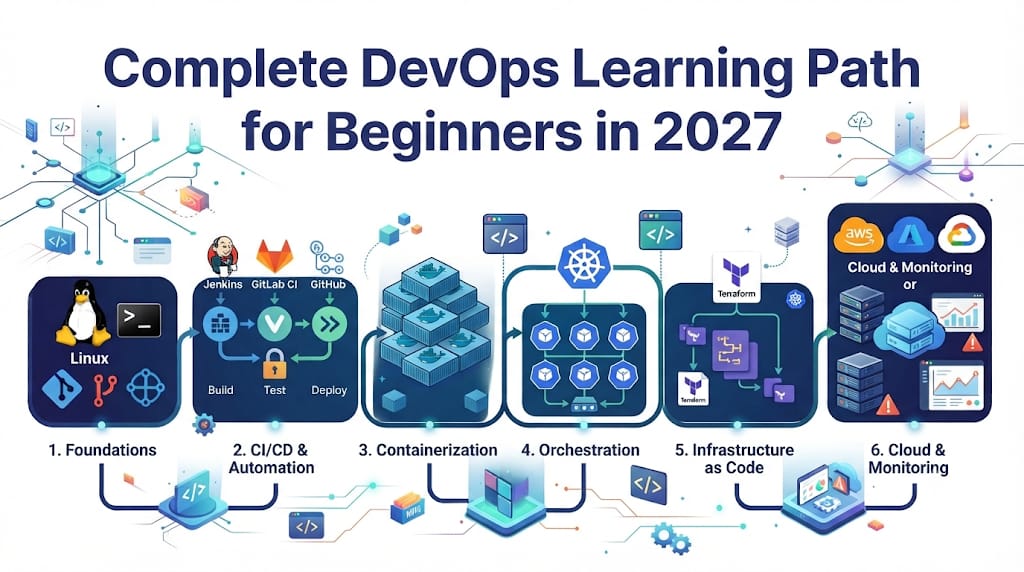
A practical learning sequence can look like this:
Step 1: Learn Linux Fundamentals
Start with Linux commands, file permissions, process management, package installation, services, and system logs.
Step 2: Understand Networking Basics
Study IP addresses, DNS, ports, HTTP, HTTPS, firewalls, and basic connectivity troubleshooting.
Step 3: Learn Git and GitHub
Practice creating repositories, committing changes, managing branches, and collaborating through pull requests.
Step 4: Learn Python or Bash
Write simple scripts to automate file management, system checks, and repetitive administrative tasks.
Step 5: Understand CI/CD
Build simple pipelines using Jenkins, GitHub Actions, or GitLab CI/CD.
Step 6: Learn Docker
Practice creating images, running containers, managing networks, and working with volumes.
Step 7: Select a Cloud Platform
Learn the fundamentals of AWS, Azure, or GCP and deploy a small application.
Step 8: Study Terraform and Ansible
Automate infrastructure provisioning and system configuration.
Step 9: Learn Kubernetes
Understand container orchestration, deployments, services, storage, and troubleshooting.
Step 10: Add Monitoring and Security
Explore Prometheus, Grafana, logging systems, vulnerability scanning, and secure secrets management.
Step 11: Build End-to-End Projects
Combine multiple tools into practical projects that demonstrate a complete software delivery workflow.
This sequence provides a foundation for beginners while allowing experienced IT professionals to strengthen specific areas based on their existing knowledge.
20. What Do Modern IT Companies Expect from a DevOps Engineer?
Modern companies generally look beyond a candidate’s ability to list tools on a resume. They want professionals who understand how to apply technology to real business and engineering problems.
Common expectations include:
- Automation experience: Ability to reduce repetitive manual work through scripts and automated workflows.
- Cloud infrastructure knowledge: Ability to deploy, configure, and manage cloud resources.
- CI/CD experience: Ability to design and troubleshoot build, testing, and deployment pipelines.
- Container skills: Understanding of Docker and Kubernetes-based application environments.
- Infrastructure as Code: Ability to create repeatable infrastructure using tools such as Terraform.
- Security awareness: Ability to follow secure access practices and integrate security checks into workflows.
- Monitoring and troubleshooting: Ability to investigate incidents and improve application reliability.
- Collaboration: Ability to work with developers, testers, security teams, and other stakeholders.
- Continuous learning: Willingness to adapt to new technologies and engineering practices.
The relative importance of these skills depends on the job role, company size, technology stack, and level of experience. A junior DevOps engineer may focus on Linux, Git, scripting, and basic CI/CD, while a senior engineer may be expected to design scalable infrastructure and establish engineering standards.
21. Future Trends That Will Influence DevOps Skills
DevOps continues to evolve as organizations adopt new technologies and modern infrastructure practices. Engineers who understand emerging trends can prepare for changing responsibilities.
Platform Engineering: Organizations are building internal developer platforms to provide reusable tools, services, and workflows. DevOps engineers may work on self-service infrastructure and standardized deployment environments.
GitOps Adoption: Git-based infrastructure and application management continues to influence Kubernetes deployment practices. Knowledge of tools such as Argo CD and Flux can be useful.
DevSecOps: Security is becoming more closely integrated with software delivery. Engineers are expected to understand automated security checks, identity management, and secure infrastructure practices.
AI-Assisted Operations: AI tools are being explored for log analysis, operational assistance, incident investigation, and infrastructure automation.
Cloud-Native Architecture: Containers, microservices, serverless platforms, and managed cloud services continue to shape application infrastructure.
Observability Engineering: Organizations need deeper visibility into distributed systems through metrics, logs, and traces.
FinOps and Cloud Cost Optimization: Companies increasingly expect engineers to understand resource usage, cost monitoring, and efficient cloud architecture.
These trends do not make foundational skills less important. Linux, networking, scripting, cloud computing, automation, and security remain essential building blocks for understanding more advanced technologies.
Frequently Asked Questions (FAQs)
1. What are the most important skills required for a DevOps engineer?
The most important skills include Linux administration, Git, Python or Bash scripting, CI/CD, Docker, Kubernetes, cloud computing, Terraform, monitoring, and basic security practices. These skills help engineers automate software delivery and manage modern infrastructure.
2. Is coding necessary for a DevOps engineer?
Yes, basic programming and scripting knowledge is important. DevOps engineers commonly use Python, Bash, or PowerShell to automate repetitive tasks, manage infrastructure, integrate APIs, and troubleshoot operational problems. Advanced application development is not required for every DevOps role, but coding fundamentals are valuable.
3. Which programming language is best for DevOps?
Python is a useful choice for general automation because it is readable and has many libraries. Bash is important for Linux administration, while PowerShell is useful in Microsoft environments. Go is also valuable in cloud-native infrastructure development.
4. Do DevOps engineers need to learn Linux?
Yes. Linux is widely used in servers, cloud infrastructure, containers, and deployment environments. DevOps engineers should understand command-line operations, permissions, processes, services, networking, and system logs.
5. Is Kubernetes mandatory for DevOps engineers?
Kubernetes is an important skill in many organizations that use containerized and cloud-native applications. However, not every DevOps role requires advanced Kubernetes knowledge. Beginners should first learn Docker and container fundamentals before studying Kubernetes.
6. Which cloud platform should a beginner learn for DevOps?
Beginners can choose AWS, Microsoft Azure, or Google Cloud Platform. The best choice depends on their career goals and the requirements of the companies they want to join. Learning one platform deeply is generally more useful initially than learning several platforms superficially.
7. What is the importance of Terraform in DevOps?
Terraform is an Infrastructure as Code tool that helps engineers provision and manage infrastructure through configuration files. It makes infrastructure changes repeatable, version-controlled, and easier to automate across different environments.
8. Which DevOps tools are commonly used by IT companies?
Common tools include Git, GitHub, Jenkins, GitLab CI/CD, Docker, Kubernetes, Terraform, Ansible, AWS, Azure, Prometheus, Grafana, and Argo CD. Organizations select tools according to their infrastructure, applications, security requirements, and engineering workflows.
9. How can a fresher become a DevOps engineer?
A fresher should begin with Linux, networking, Git, and scripting. After learning these fundamentals, they can study CI/CD, Docker, cloud computing, Terraform, Kubernetes, and monitoring. Building practical projects and documenting them in a Git repository can help demonstrate job-ready skills.
10. Are DevOps skills in demand in modern IT companies?
DevOps skills remain relevant as organizations continue to invest in cloud infrastructure, automation, continuous delivery, container platforms, and reliable software operations. Specific requirements vary by employer, but practical knowledge of cloud, CI/CD, scripting, infrastructure automation, and troubleshooting is valuable across many engineering teams.
Conclusion
DevOps engineering has become an important discipline in modern IT organizations because it helps businesses deliver software faster, improve collaboration, automate infrastructure, and maintain reliable applications. Companies expect DevOps engineers to combine technical knowledge with practical problem-solving and communication skills.
The most important skills include Linux administration, programming and scripting, Git, CI/CD, Docker, Kubernetes, cloud computing, Infrastructure as Code, configuration management, monitoring, networking, and DevSecOps. Familiarity with modern practices such as GitOps, platform engineering, and AI-assisted operations can provide additional value.
For beginners, the best approach is to learn the fundamentals first, practice with industry-relevant tools, and build projects that demonstrate real-world understanding. Rather than collecting tool names, focus on understanding how the complete software delivery lifecycle works.
With consistent learning, hands-on experience, and a strong foundation in automation and cloud technologies, aspiring professionals can prepare themselves for DevOps opportunities in modern IT companies. DevOpsSchool can also be explored as a learning resource for structured DevOps and cloud technology training.

Find Trusted Cardiac Hospitals
Compare heart hospitals by city and services — all in one place.
Explore Hospitals