
Introduction
In the fast-paced landscape of 2026, DevOps has matured into the essential backbone of modern software delivery, where the ability to synthesize development, operations, and cloud architecture is highly sought after by organizations worldwide. Building a successful career in this field is far more than mastering a specific set of tools; it requires a strategic mindset focused on continuous learning, automation, and the delivery of tangible business value. For those navigating this journey—whether you are a student, developer, or system administrator—structured guidance is the difference between aimless tool-chasing and professional mastery. At DevOpsSchool, we help learners bridge the gap between theoretical concepts and real-world application through a proven, comprehensive ecosystem designed to build lasting expertise. By following a structured roadmap and prioritizing hands-on experience, you can position yourself as an indispensable asset in the evolving IT sector, and this guide will serve as your blueprint for identifying the right roles, cultivating essential skills, and navigating the path to a long-term, rewarding DevOps career.
What Is a DevOps Career?
A DevOps career is defined by the intersection of software engineering, infrastructure management, and process optimization. Unlike traditional silos where developers write code and administrators manage servers, a DevOps professional integrates these functions.
At its core, a DevOps career involves:
- Cross-functional Collaboration: Breaking down walls between teams to ensure a shared responsibility for the software lifecycle.
- Automation: Eliminating manual tasks that hinder speed and consistency.
- Infrastructure as Code (IaC): Managing infrastructure using configuration files rather than manual hardware configuration.
- Continuous Improvement: Using feedback loops and monitoring to make systems more resilient and efficient.
Professionals in this field focus on business impact—ensuring that software can be deployed rapidly, securely, and reliably to satisfy customer needs.
Why Choose a Career in DevOps?
The demand for DevOps professionals shows no signs of slowing down. As cloud-native technologies and AI-assisted workflows become standard, companies need experts who can manage these complex environments.
Key reasons to pursue this path include:
- Diverse Career Options: You are not limited to one title. You can evolve into an SRE, a Platform Engineer, an Architect, or a Consultant.
- Continuous Learning: The landscape changes, ensuring that your work remains intellectually stimulating.
- High Value: Organizations prioritize professionals who can reduce downtime and speed up time-to-market.
- Remote and Global Opportunities: Because most work is cloud-based, the location barrier for DevOps professionals is effectively removed.
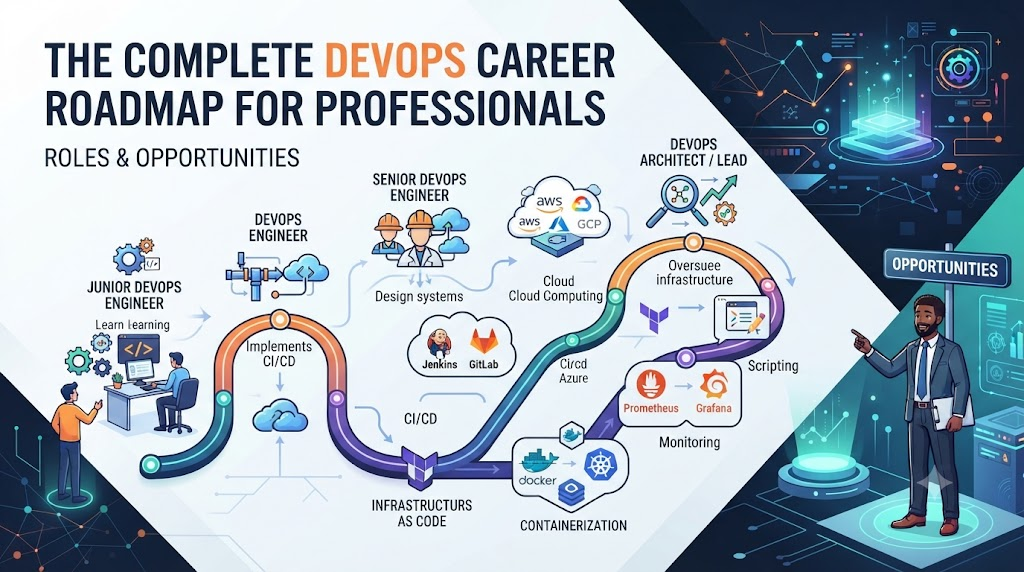
DevOps Career Roadmap
The roadmap below is designed as a sequential guide. While you do not need to master everything at once, each level builds the foundation for the next.
- Student / Beginner: Focus on conceptual understanding. Learn what SDLC (Software Development Life Cycle) is and why DevOps exists.
- Linux Fundamentals: The operating system of the cloud. You cannot bypass this. Learn the command line, permissions, and file systems.
- Git & Version Control: Learn how to manage code. Git is the industry standard.
- Networking Basics: Understand how data moves. HTTP, DNS, TCP/IP, and load balancing are non-negotiable.
- Scripting (Bash/Python): Automation begins with scripting. Automate the repetitive tasks you find in Linux.
- Docker: Learn containerization. It is the packaging standard for applications today.
- CI/CD: Learn to build pipelines. This is the heart of DevOps.
- Cloud Platforms (AWS/Azure/GCP): Move your infrastructure to the cloud. Start with one provider and learn its core services.
- Terraform & Infrastructure as Code (IaC): Stop provisioning servers manually. Code your infrastructure.
- Kubernetes: The orchestration engine. This is for large-scale application management.
- Monitoring & Observability: Learn to track the health of your systems.
- DevSecOps: Integrate security into the pipeline.
- Platform Engineering / SRE: Shift from managing tools to building internal platforms.
- Senior DevOps Engineer: Mentorship, architectural design, and complex problem solving.
- DevOps Architect / Engineering Manager: Strategic decision-making and team leadership.
DevOps Career Roles and Responsibilities
The following table outlines the progression and the expectation at each stage.
| Role | Primary Responsibilities | Required Skills | Typical Career Stage |
| DevOps Intern | Shadowing, basic scripting, documentation | Linux, Basic Git | Early Entry |
| Junior DevOps Engineer | CI/CD maintenance, environment setup | Linux, Docker, Git | 0-2 Years |
| DevOps Engineer | Pipeline optimization, Cloud mgmt | Terraform, K8s, Cloud | 2-5 Years |
| Senior DevOps Engineer | System design, scaling, mentoring | Deep K8s, Security, IaC | 5+ Years |
| Cloud Engineer | Cloud infra architecture, cost optimization | AWS/Azure/GCP, Networking | Mid-Senior |
| Platform Engineer | Building internal developer portals | Go/Python, K8s, APIs | Mid-Senior |
| Site Reliability Engineer | System uptime, incident response | Python, Monitoring, Observability | Mid-Senior |
| DevSecOps Engineer | Security automation, vulnerability scanning | Security tools, Pipeline integration | Mid-Senior |
| DevOps Architect | Enterprise-level strategy, high-level design | System Architecture, Leadership | Expert |
| Engineering Manager | Team management, career growth, strategy | Leadership, Budgeting, Mentoring | Executive/Lead |
Technical Skills Required
To succeed, you must move beyond the “surface level” of tools.
| Skill | Why It Matters | Practical Application |
| Linux | It powers almost all cloud infrastructure. | Managing servers, troubleshooting kernel issues. |
| Git | The foundation of collaborative work. | Managing branching, merging, and pull requests. |
| Networking | Understanding how traffic reaches the app. | Configuring firewalls, subnets, and load balancers. |
| Scripting | Necessary for glue-code automation. | Writing cron jobs, backup scripts, and API wrappers. |
| Docker | Decouples app from the operating system. | Building, tagging, and running container images. |
| Kubernetes | Handles massive scale deployment. | Managing clusters, pods, and service discovery. |
| Cloud Computing | The platform where apps live. | Utilizing managed services like RDS, S3, or EC2. |
| CI/CD | Enables rapid release cycles. | Creating pipeline stages (Build, Test, Deploy). |
| IaC | Reproducible infrastructure. | Writing Terraform modules to provision environments. |
| Monitoring | Prevents blind spots in production. | Alerting based on CPU, RAM, and application logs. |
| Security | Protects the supply chain. | Scanning containers for vulnerabilities. |
Essential Soft Skills
Technical ability gets you the interview; soft skills get you the promotion.
- Communication: You must be able to explain complex technical concepts to non-technical stakeholders.
- Problem-solving: Troubleshooting is 70% of the job. You need a calm, systematic approach to incident management.
- Collaboration: DevOps is a team sport. If you cannot work with developers, your pipelines will fail.
- Adaptability: The toolset changes every few years. You must unlearn and relearn constantly.
- Documentation: If you didn’t write it down, it didn’t happen. Good documentation is the hallmark of a senior engineer.
- Leadership: Even without a manager title, you should lead by mentoring peers.
Certifications and Learning Paths
While projects matter most, certifications act as a signal of competence to recruiters.
| Certification | Best For | Skill Level | Focus Area |
| LFCS / RHCSA | Linux Administration | Foundational | OS/Kernel |
| CKA / CKAD | Kubernetes Proficiency | Advanced | Orchestration |
| AWS/Azure/GCP Solutions Architect | Cloud Knowledge | Intermediate/Expert | Cloud Services |
| Terraform Associate | IaC Competency | Intermediate | Infrastructure |
| DevOps Professional (Various) | General DevOps Logic | Intermediate | Methodology |
Career Opportunities Beyond Full-Time Employment
A DevOps career offers significant flexibility if you wish to step outside the traditional 9-to-5 model.
- Freelancing: Many companies require short-term help to set up CI/CD pipelines or migrate to the cloud.
- Consulting: Once you reach the Architect level, you can sell your expertise to optimize operational costs for multiple companies.
- Contracting: Large enterprises often hire DevOps contractors for specific long-term project migrations.
- Technical Training: There is a constant demand for experienced professionals who can teach others to navigate the DevOps ecosystem.
Factors That Influence Career Growth
| Factor | Career Impact |
| Practical Projects | Proves you can do the work, not just answer trivia. |
| Hands-on Labs | Muscle memory for commands and troubleshooting. |
| Certifications | Validates your baseline knowledge for HR. |
| Communication Skills | Determines your ability to move into management. |
| Open-source Contributions | Demonstrates passion and collaborative capability. |
| Industry Networking | Opens doors to unadvertised senior roles. |
| Continuous Learning | Prevents skill obsolescence. |
Measuring Career Progress
How do you know if you are growing?
| Metric | Why It Matters | Career Benefit |
| Projects Completed | Tangible portfolio assets. | Evidence of capability. |
| Certifications Earned | Industry-recognized milestones. | Increased hireability. |
| GitHub Contributions | Proof of coding consistency. | Demonstrates activity level. |
| Interview Readiness | Confidence in explaining trade-offs. | Higher success rate in hiring. |
| Client Satisfaction | Validates your impact. | Leads to referrals and promotions. |
| Leadership Experience | Shows ability to drive teams. | Path to management roles. |
Common Career Challenges
| Challenge | Impact | Recommended Solution |
| Tool Overload | Burnout from trying to learn everything. | Focus on one tool in each category first (e.g., Jenkins before GitLab CI). |
| Lack of Experience | Hard to land the first job. | Build a home lab and document your projects on a blog. |
| Weak Linux Knowledge | Bottlenecks in troubleshooting. | Dedicate 1 month to deep-diving into Linux fundamentals. |
| Poor Communication | Stalled promotion. | Practice writing technical summaries for management. |
| Career Uncertainty | Lack of focus. | Set clear 6-month goals with a mentor. |
Best Practices for Building a Successful DevOps Career
- Master the Fundamentals: Do not jump to Kubernetes without understanding containers, and do not jump to containers without understanding Linux.
- Build Real-World Projects: Deploy a web app, add a CI/CD pipeline, monitor it, and secure it. This is more valuable than ten certificates.
- Learn Cloud Platforms: Pick one major provider and become highly proficient in its ecosystem.
- Practice Automation: If you do a task more than twice, script it.
- Join Technical Communities: Engage with others to share knowledge and stay updated on trends.
- Keep Learning Consistently: Dedicate at least 30 minutes a day to reading or practicing.
Real-World Career Journey: Case Study
Beginner Starting Point: A manual tester looking to move into engineering.
- Learning Roadmap: They started with Linux fundamentals. They spent three months purely on the terminal and Bash scripting.
- Home Lab Projects: They set up a local VirtualBox server. They hosted a website, then added Nginx. They learned Git by pushing their configuration files to a repository.
- Certification Milestones: They earned an AWS Cloud Practitioner certification to understand the cloud landscape.
- First Job: Landed a Junior DevOps role in a small firm where they maintained Jenkins pipelines.
- Career Progression: Over three years, they focused on Kubernetes (CKA) and Terraform. They transitioned to a Senior role.
- Lessons Learned: The biggest lesson was that troubleshooting is the most valuable skill. They focused on “why it broke” rather than “how to fix it,” which made them an indispensable engineer.
Common Beginner Mistakes
- Learning Tools Without Understanding Concepts: Knowing how to click buttons in a CI/CD tool is not the same as understanding the theory of continuous delivery.
- Ignoring Networking: You cannot debug a microservice if you do not understand how HTTP headers or DNS work.
- Avoiding Troubleshooting: Some beginners search for the answer immediately. Senior engineers know how to read logs and trace errors through the stack.
- Skipping Documentation: It is not just about writing code; it is about writing clear guides so your team can maintain what you built.
- Chasing Certifications Only: You can pass an exam without being able to fix a broken production server. Balance theory with hands-on practice.
Future Opportunities in DevOps
The future of DevOps is shifting toward higher levels of abstraction:
- AI-assisted DevOps: Tools that analyze logs and automatically suggest fixes are becoming common.
- Platform Engineering: Focusing on providing self-service tools for developers rather than managing every ticket manually.
- GitOps: Managing infrastructure and applications entirely through Git repositories.
- Cloud-native Technologies: Everything is becoming containerized and managed via APIs.
- Intelligent Automation: moving from “automating tasks” to “automating processes.”
Practical DevOps Career Checklist
- Learn Linux: Navigate the file system, manage permissions, and edit files in the terminal.
- Build Git Projects: Maintain a professional repository where you store your scripts and configurations.
- Practice Docker: Create a Dockerfile for a simple application and run it as a container.
- Deploy Kubernetes: Set up a mini-cluster (e.g., using Minikube or Kind) to understand pods and services.
- Create CI/CD Pipelines: Build a pipeline that automates testing and deployment.
- Learn Cloud Services: Deploy a web server on a public cloud provider.
- Monitor Applications: Use a tool like Prometheus to track the health of your application.
- Strengthen Security Knowledge: Understand how to scan your code for secrets and vulnerabilities.
FAQs
- Is DevOps a good career choice?Yes. It offers high job security, excellent growth potential, and the ability to work across various industries.
- Can beginners learn DevOps?Absolutely, provided you have patience. Start with Linux and basic networking.
- Which programming language should I learn first?Python is the most versatile for DevOps due to its readability and powerful libraries. Bash is also mandatory.
- Is Kubernetes mandatory?Not for entry-level roles, but it is essential for long-term career growth in the modern market.
- How important are cloud certifications?They are very helpful for getting past HR screens, but they should be backed by hands-on projects.
- Can I become a DevOps freelancer?Yes, once you have established expertise in specific toolsets like Terraform or Kubernetes migrations.
- How long does it take to become job-ready?Typically 6 to 12 months of consistent, focused study and project work.
- Which role should I target first?Target a “Junior DevOps Engineer” or “Associate Cloud Engineer” role.
- Do I need to be a developer first?No, but understanding basic coding logic is a significant advantage.
- Is DevOps just about tools?No. It is about culture, process, and business efficiency. Tools are just the means to an end.
- How do I handle “tool fatigue”?Pick one tool per category and master it before moving on. Don’t try to learn every competing technology.
- Is Linux really that important?Yes. It is the language of the internet and cloud infrastructure.
- How do I gain experience without a job?Build a home lab, contribute to open source, and document your projects on a personal blog or GitHub.
- What is the difference between DevOps and SRE?DevOps is the culture/philosophy, while SRE is a specific way of implementing that philosophy focused on system reliability.
- Are soft skills really required for engineers?Yes. You will spend more time communicating, documenting, and negotiating than writing code.
Final Thoughts
Building a career in DevOps is a marathon, not a sprint. The industry rewards those who focus on fundamentals, understand the “why” behind the tools, and maintain a commitment to solving real-world business problems. Do not get distracted by the noise of every new tool release. Instead, focus on building a deep, resilient skill set that allows you to adapt to any technology stack. Stay curious, practice consistently, and remember that your value lies in y

Find Trusted Cardiac Hospitals
Compare heart hospitals by city and services — all in one place.
Explore Hospitals