
Introduction
AI Citation & Reference Extraction Tools use artificial intelligence to identify, collect, organize, and analyze citations, references, bibliographic information, and research sources from academic papers, documents, and digital content. These tools help researchers, students, analysts, and organizations reduce the manual effort required to manage large volumes of references.
Traditional citation management often requires manually extracting author names, publication details, journal information, references, and source relationships from documents. AI-powered extraction tools improve this process by automatically identifying citation patterns, extracting metadata, organizing references, and supporting research workflows.
As research output continues to grow across scientific, academic, healthcare, engineering, and business domains, efficient reference management has become increasingly important. AI citation tools help researchers improve accuracy, speed up literature workflows, discover related sources, and maintain organized knowledge repositories.
Common use cases include:
- Academic paper reference extraction
- Research bibliography creation
- Citation management automation
- Scientific document analysis
- Literature review preparation
- Knowledge base development
When evaluating AI Citation & Reference Extraction Tools, organizations should consider extraction accuracy, citation format support, document compatibility, metadata quality, integration with reference managers, AI summarization capabilities, privacy controls, workflow automation, collaboration features, and scalability.
Best for: Researchers, universities, publishers, scientific organizations, healthcare research teams, students, legal analysts, and businesses managing large document collections.
Not ideal for: Users managing only a small number of references manually, teams requiring complete research automation without human review, or workflows where citation accuracy is not important.
What’s Changed in AI Citation & Reference Extraction in 2026+
AI-powered citation and reference management is evolving as organizations handle increasing amounts of research content and require more intelligent knowledge workflows.
Key trends include:
- AI-powered metadata extraction: Modern tools are improving their ability to identify authors, journals, publication dates, references, and research relationships automatically.
- Semantic citation understanding: AI systems are moving beyond extracting citation details and starting to understand why a paper is cited and how sources relate to each other.
- Automated research organization: Citation tools are increasingly helping users organize papers, create collections, and generate structured research libraries.
- Multimodal document processing: Advanced systems are improving support for PDFs, tables, figures, scanned documents, and complex academic formats.
- Citation quality analysis: Researchers increasingly need tools that identify citation relevance, reliability, and supporting evidence.
- AI-assisted literature workflows: Citation extraction is becoming part of broader research workflows involving discovery, summarization, and knowledge management.
- Private research data handling: Organizations are demanding stronger controls for confidential documents, unpublished research, and internal knowledge.
- Integration with AI research assistants: Citation extraction capabilities are increasingly connected with AI writing, analysis, and literature review workflows.
- Enterprise knowledge management: Companies are using citation extraction to organize internal documents, technical reports, and research archives.
- Improved evaluation workflows: Teams are focusing on extraction accuracy, duplicate detection, metadata validation, and source verification.
Quick Buyer Checklist (Scan-Friendly)
Before selecting an AI Citation & Reference Extraction Tool, evaluate:
- Citation extraction accuracy
- Reference metadata quality
- Support for academic PDFs
- Support for scanned documents
- Author and publication identification
- DOI and identifier extraction
- Citation format support
- Bibliography generation
- Duplicate reference detection
- Reference management integration
- AI summarization support
- Semantic citation analysis
- Document organization features
- Collaboration capabilities
- Data privacy and retention controls
- Enterprise administration features
- API availability
- Export formats
- Cloud or self-hosted options
- Workflow automation capabilities
- AI evaluation and verification features
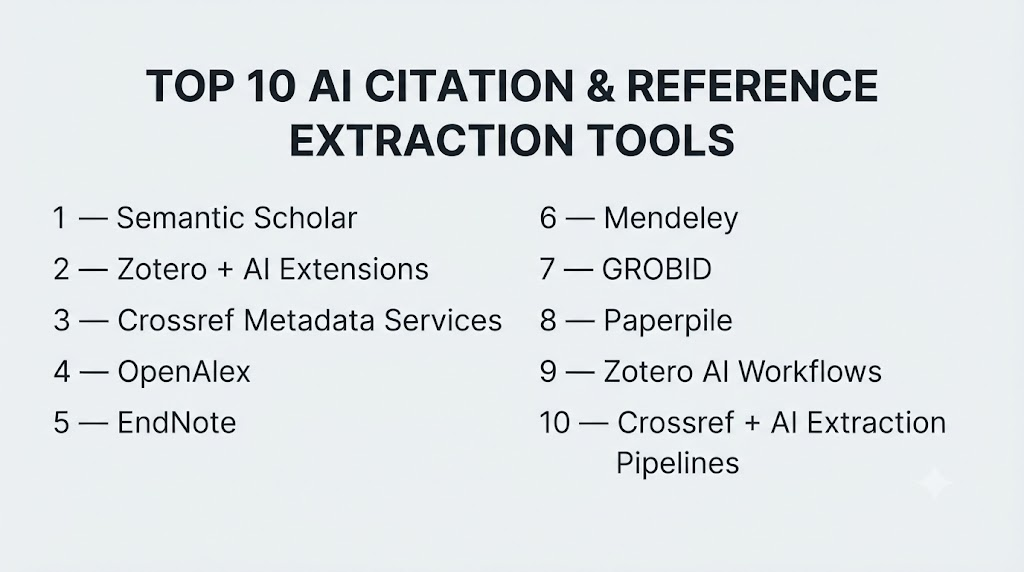
Top 10 AI Citation & Reference Extraction Tools
#1 — Semantic Scholar
One-line verdict: Best for AI-powered academic citation discovery and research reference analysis.
Short description (2–3 lines):
Semantic Scholar is an AI-enhanced academic research platform designed to help users discover scientific papers, analyze citation relationships, and explore research connections.
It supports researchers by improving access to academic information and helping identify relevant publications.
Standout Capabilities
- AI-powered research discovery
- Citation relationship analysis
- Academic paper indexing
- Research recommendation workflows
- Related paper identification
- Author and topic exploration
- Scientific knowledge discovery
AI-Specific Depth (Must Include)
- Model support: Uses AI models for research discovery and analysis. Specific model details vary.
- RAG / knowledge integration: Uses academic literature databases and research relationships.
- Evaluation: Citation relevance and research connections should be verified by users.
- Guardrails: Research-focused outputs require expert review before important decisions.
- Observability: Internal AI processing details are not publicly stated.
Pros
- Strong academic research ecosystem.
- Useful citation discovery capabilities.
- Helps researchers find related publications.
Cons
- Not a dedicated citation extraction workflow for every document type.
- Requires additional tools for advanced reference management.
- AI-generated insights need verification.
Security & Compliance
Not publicly stated.
Deployment & Platforms
- Platforms: Web-based.
- Deployment: Cloud-based.
Integrations & Ecosystem
Supports:
- Academic research workflows
- Citation discovery
- Research databases
- Literature exploration
- Knowledge discovery processes
Pricing Model
Not publicly stated.
Best-Fit Scenarios
- Academic research
- Citation exploration
- Literature discovery
#2 — Zotero + AI Extensions
One-line verdict: Best for researchers needing flexible reference management with AI-assisted workflows.
Short description (2–3 lines):
Zotero is a reference management platform used to collect, organize, and manage research sources. AI extensions and connected workflows can enhance citation extraction and document analysis.
It is widely used by students, researchers, and academic teams.
Standout Capabilities
- Reference organization
- Citation library management
- Metadata extraction
- Document attachment management
- Bibliography generation
- Research collection organization
- Plugin ecosystem
AI-Specific Depth (Must Include)
- Model support: AI capabilities depend on connected extensions and integrations.
- RAG / knowledge integration: Can support document-based workflows through integrations.
- Evaluation: Requires user verification of extracted references.
- Guardrails: Depends on connected AI tools.
- Observability: Depends on selected extensions and workflows.
Pros
- Flexible reference management.
- Strong academic adoption.
- Large extension ecosystem.
Cons
- AI features are not always built directly into the platform.
- Requires configuration for advanced workflows.
- Users may need multiple tools.
Security & Compliance
Not publicly stated.
Deployment & Platforms
- Platforms: Windows, macOS, Linux, and supported environments.
- Deployment: Desktop and cloud synchronization options.
Integrations & Ecosystem
Supports:
- Academic databases
- Research documents
- Citation plugins
- Writing workflows
- Export formats
Pricing Model
Open-source with optional services varying.
Best-Fit Scenarios
- Academic researchers
- Students
- Reference-heavy workflows
#3 — Crossref Metadata Services
One-line verdict: Best for organizations needing structured scholarly metadata and citation information.
Short description (2–3 lines):
Crossref provides access to scholarly publication metadata that helps organizations identify, organize, and manage research references.
It is commonly used in publishing, research platforms, and academic workflows.
Standout Capabilities
- Scholarly metadata access
- DOI information
- Publication identification
- Research record organization
- Reference linking
- Academic publishing support
- Structured metadata workflows
AI-Specific Depth (Must Include)
- Model support: AI capabilities depend on connected applications.
- RAG / knowledge integration: Provides structured research metadata for connected systems.
- Evaluation: Metadata quality depends on available records and validation workflows.
- Guardrails: Depends on implementation.
- Observability: Depends on connected systems.
Pros
- Strong scholarly metadata foundation.
- Useful for large-scale research systems.
- Supports structured citation workflows.
Cons
- Not a complete AI citation assistant.
- Requires development integration.
- Requires additional AI processing tools.
Security & Compliance
Not publicly stated.
Deployment & Platforms
- Platforms: API-based services.
- Deployment: Cloud-based.
Integrations & Ecosystem
Supports:
- Research platforms
- Publishing workflows
- Academic databases
- Metadata systems
- AI research applications
Pricing Model
Varies.
Best-Fit Scenarios
- Research platforms
- Publishing systems
- Large-scale citation processing
#4 — OpenAlex
One-line verdict: Best for organizations building large-scale AI-powered academic citation and research discovery systems.
Short description (2–3 lines):
OpenAlex is an open scholarly metadata platform that provides structured information about research works, authors, institutions, and citation relationships.
It is commonly used by developers, researchers, and organizations building research intelligence applications.
Standout Capabilities
- Large-scale scholarly metadata
- Citation relationship data
- Author and institution information
- Research topic discovery
- Open research graph
- API-based access
- Academic knowledge organization
AI-Specific Depth (Must Include)
- Model support: AI capabilities depend on applications built on top of the data.
- RAG / knowledge integration: Provides research metadata that can support retrieval-based AI workflows.
- Evaluation: Data quality depends on metadata completeness and connected validation processes.
- Guardrails: Depends on implementation.
- Observability: Depends on connected applications and monitoring systems.
Pros
- Large research metadata ecosystem.
- Useful for building custom AI research applications.
- Supports structured citation analysis.
Cons
- Requires technical integration.
- Not a complete end-user citation management tool.
- AI capabilities depend on external applications.
Security & Compliance
Not publicly stated.
Deployment & Platforms
- Platforms: API-based access.
- Deployment: Cloud-based.
Integrations & Ecosystem
Supports:
- Research platforms
- Academic applications
- AI knowledge systems
- Citation analysis workflows
- Data pipelines
Pricing Model
Not publicly stated.
Best-Fit Scenarios
- Research technology platforms
- Academic analytics
- AI-powered knowledge systems
#5 — EndNote
One-line verdict: Best for professional researchers managing large reference libraries and academic citations.
Short description (2–3 lines):
EndNote is a reference management platform designed for organizing research papers, managing citations, and creating bibliographies.
It is widely used in academic and professional research environments.
Standout Capabilities
- Reference organization
- Citation formatting
- Bibliography generation
- Research library management
- Document attachment support
- Academic writing workflows
- Collaboration features
AI-Specific Depth (Must Include)
- Model support: AI capabilities vary depending on connected workflows.
- RAG / knowledge integration: Depends on document and research integrations.
- Evaluation: Reference accuracy depends on imported metadata quality.
- Guardrails: Depends on connected AI features.
- Observability: Not publicly stated.
Pros
- Mature reference management workflow.
- Supports complex citation requirements.
- Useful for academic publishing.
Cons
- AI automation capabilities may require additional tools.
- Less focused on advanced AI analysis.
- Can require learning for new users.
Security & Compliance
Not publicly stated.
Deployment & Platforms
- Platforms: Desktop environments and supported applications.
- Deployment: Desktop and cloud synchronization options.
Integrations & Ecosystem
Supports:
- Academic writing tools
- Research documents
- Citation styles
- Reference databases
- Collaboration workflows
Pricing Model
Not publicly stated.
Best-Fit Scenarios
- Academic publishing
- Large research projects
- Professional researchers
#6 — Mendeley
One-line verdict: Best for researchers organizing papers, references, and collaborative research libraries.
Short description (2–3 lines):
Mendeley is a reference management platform that helps researchers collect papers, organize citations, and collaborate on academic research collections.
It combines document organization with research workflow features.
Standout Capabilities
- Reference management
- PDF organization
- Citation creation
- Research library synchronization
- Collaboration workflows
- Document annotation
- Academic discovery
AI-Specific Depth (Must Include)
- Model support: AI capabilities depend on available platform features and integrations.
- RAG / knowledge integration: Depends on connected document workflows.
- Evaluation: Users should verify extracted citation information.
- Guardrails: Depends on implementation.
- Observability: Not publicly stated.
Pros
- Easy research library management.
- Useful for organizing academic documents.
- Supports collaboration.
Cons
- Advanced AI extraction may require additional solutions.
- Not designed as a complete AI research assistant.
- Some workflows need manual management.
Security & Compliance
Not publicly stated.
Deployment & Platforms
- Platforms: Desktop and web environments.
- Deployment: Cloud synchronization.
Integrations & Ecosystem
Supports:
- Research papers
- Citation workflows
- Academic writing tools
- Document libraries
- Collaboration environments
Pricing Model
Not publicly stated.
Best-Fit Scenarios
- Student research
- Academic teams
- Paper organization
#7 — GROBID
One-line verdict: Best for developers extracting structured citations and metadata from scientific documents.
Short description (2–3 lines):
GROBID is an open-source system designed to extract structured information from scholarly documents, especially academic PDFs.
It is commonly used in research infrastructure and document processing pipelines.
Standout Capabilities
- Scientific PDF processing
- Bibliographic metadata extraction
- Reference extraction
- Document structure analysis
- Machine learning-based parsing
- Research document processing
- Automated metadata generation
AI-Specific Depth (Must Include)
- Model support: Uses machine learning approaches for document processing.
- RAG / knowledge integration: Extracted metadata can support retrieval-based workflows.
- Evaluation: Extraction accuracy requires validation against source documents.
- Guardrails: Depends on document processing workflows.
- Observability: Requires integration with monitoring systems.
Pros
- Strong scientific document extraction capabilities.
- Useful for custom research systems.
- Open-source flexibility.
Cons
- Requires technical implementation.
- Not designed for end-user researchers.
- Requires infrastructure management.
Security & Compliance
Not publicly stated.
Deployment & Platforms
- Platforms: Server-based environments.
- Deployment: Self-hosted.
Integrations & Ecosystem
Supports:
- Research databases
- Document processing pipelines
- AI applications
- Academic platforms
- Metadata workflows
Pricing Model
Open-source.
Best-Fit Scenarios
- Research infrastructure
- Academic platforms
- Large document processing systems
#8 — Paperpile
One-line verdict: Best for researchers wanting simple cloud-based reference management with streamlined workflows.
Short description (2–3 lines):
Paperpile is a reference management tool designed to help researchers collect papers, organize citations, and manage academic libraries.
It focuses on simplifying research organization and writing workflows.
Standout Capabilities
- Reference organization
- Citation management
- Paper collection
- Research library management
- Writing workflow support
- Cloud-based access
- Document organization
AI-Specific Depth (Must Include)
- Model support: AI capabilities depend on connected features.
- RAG / knowledge integration: Depends on integrations.
- Evaluation: Citation accuracy requires user verification.
- Guardrails: Depends on implementation.
- Observability: Not publicly stated.
Pros
- Simple user experience.
- Good for managing research libraries.
- Useful writing workflow support.
Cons
- Limited advanced AI analysis.
- Not focused on large-scale citation extraction.
- Requires additional AI tools for automation.
Security & Compliance
Not publicly stated.
Deployment & Platforms
- Platforms: Web and supported desktop environments.
- Deployment: Cloud-based.
Integrations & Ecosystem
Supports:
- Writing workflows
- Citation libraries
- Academic documents
- Research organization
Pricing Model
Not publicly stated.
Best-Fit Scenarios
- Individual researchers
- Academic writing
- Reference organization
#9 — Zotero AI Workflows
One-line verdict: Best for researchers combining open reference management with AI-powered automation.
Short description (2–3 lines):
Zotero AI workflows combine reference management capabilities with AI integrations for extracting information, organizing papers, and improving research productivity.
It is commonly used by researchers who want customization and flexibility.
Standout Capabilities
- Reference collection
- Metadata organization
- AI-assisted workflows
- Document management
- Citation organization
- Plugin ecosystem
- Research customization
AI-Specific Depth (Must Include)
- Model support: Depends on connected AI extensions and tools.
- RAG / knowledge integration: Possible through document-based workflows.
- Evaluation: Requires human review of AI-generated extraction.
- Guardrails: Depends on selected AI tools.
- Observability: Depends on integrations.
Pros
- Flexible and customizable.
- Strong research community.
- Supports advanced workflows.
Cons
- AI capabilities require configuration.
- Users need technical setup for advanced automation.
- Multiple components may be required.
Security & Compliance
Not publicly stated.
Deployment & Platforms
- Platforms: Windows, macOS, Linux, and supported environments.
- Deployment: Desktop-based with synchronization options.
Integrations & Ecosystem
Supports:
- Research plugins
- Academic documents
- Citation systems
- AI tools
- Writing platforms
Pricing Model
Open-source with optional services.
Best-Fit Scenarios
- Researchers wanting customization
- Academic teams
- AI-assisted reference workflows
#10 — Crossref + AI Extraction Pipelines
One-line verdict: Best for organizations creating custom citation extraction and scholarly data systems.
Short description (2–3 lines):
Crossref combined with AI extraction workflows enables organizations to build customized systems for identifying references, enriching metadata, and analyzing scholarly information.
It is commonly used by research platforms and publishing technology teams.
Standout Capabilities
- Metadata enrichment
- Citation processing
- Custom AI workflows
- Research data pipelines
- Scholarly information processing
- Automated extraction systems
- Large-scale document analysis
AI-Specific Depth (Must Include)
- Model support: Depends on selected AI extraction models.
- RAG / knowledge integration: Supports research retrieval workflows through metadata integration.
- Evaluation: Requires custom validation systems.
- Guardrails: Must be implemented within the application.
- Observability: Requires custom monitoring.
Pros
- Highly customizable.
- Suitable for large-scale research systems.
- Supports advanced data workflows.
Cons
- Requires engineering resources.
- Not a ready-to-use researcher application.
- Maintenance responsibility remains internal.
Security & Compliance
Not publicly stated.
Deployment & Platforms
- Platforms: API and custom application environments.
- Deployment: Cloud or self-managed.
Integrations & Ecosystem
Supports:
- Research platforms
- Publishing systems
- AI applications
- Data pipelines
- Knowledge management systems
Pricing Model
Varies.
Best-Fit Scenarios
- Research platforms
- Publishing organizations
- Custom AI citation systems
Comparison Table
| Tool Name | Best For | Deployment (Cloud/Self-hosted/Hybrid) | Model Flexibility (Hosted / BYO / Multi-model / Open-source) | Strength | Watch-Out | Public Rating |
|---|---|---|---|---|---|---|
| Semantic Scholar | Academic citation discovery | Cloud | Hosted AI workflow | Research discovery and citation analysis | Requires verification | N/A |
| Zotero + AI Extensions | Flexible reference management | Desktop/Cloud | Open-source + BYO AI integrations | Customizable workflows | AI features depend on extensions | N/A |
| Crossref Metadata Services | Scholarly metadata systems | Cloud/API | Metadata-driven workflows | Structured citation data | Requires development integration | N/A |
| OpenAlex | Research intelligence platforms | Cloud/API | Open-source data ecosystem | Large scholarly graph | Technical implementation required | N/A |
| EndNote | Professional reference management | Desktop/Cloud | Reference management workflows | Academic citation organization | Limited AI automation | N/A |
| Mendeley | Research libraries and collaboration | Cloud/Desktop | Reference workflows | Document organization | Requires additional AI tools | N/A |
| GROBID | Scientific document extraction | Self-hosted | Open-source/custom models | PDF citation extraction | Requires technical setup | N/A |
| Paperpile | Simple research organization | Cloud | Hosted workflow | Easy reference management | Limited advanced AI capabilities | N/A |
| Zotero AI Workflows | AI-enhanced research management | Desktop/Cloud | Open-source/BYO AI | Flexible automation | Requires configuration | N/A |
| Crossref + AI Extraction Pipelines | Custom citation systems | Cloud/Self-hosted | BYO models/custom AI | Enterprise customization | Engineering effort required | N/A |
Scoring & Evaluation (Transparent Rubric)
The following scoring compares AI Citation & Reference Extraction Tools based on citation accuracy, AI reliability, workflow integration, usability, security, performance, and ecosystem maturity.
The evaluation is comparative rather than absolute. Different organizations may prioritize different capabilities depending on whether they need academic research support, publishing workflows, enterprise knowledge management, or custom AI systems.
| Tool | Core | Reliability/Eval | Guardrails | Integrations | Ease | Perf/Cost | Security/Admin | Support | Weighted Total |
|---|---|---|---|---|---|---|---|---|---|
| Semantic Scholar | 9 | 8 | 8 | 9 | 9 | 9 | 8 | 9 | 8.7 |
| Zotero + AI Extensions | 8 | 8 | 8 | 9 | 8 | 9 | 8 | 9 | 8.4 |
| Crossref Metadata Services | 9 | 9 | 8 | 10 | 6 | 9 | 8 | 9 | 8.6 |
| OpenAlex | 9 | 8 | 8 | 10 | 7 | 9 | 8 | 8 | 8.5 |
| EndNote | 8 | 8 | 8 | 8 | 8 | 8 | 8 | 9 | 8.1 |
| Mendeley | 8 | 8 | 7 | 8 | 9 | 8 | 7 | 8 | 8.0 |
| GROBID | 9 | 9 | 8 | 9 | 6 | 9 | 8 | 8 | 8.3 |
| Paperpile | 7 | 7 | 7 | 8 | 9 | 8 | 7 | 8 | 7.7 |
| Zotero AI Workflows | 8 | 8 | 8 | 9 | 7 | 9 | 8 | 9 | 8.3 |
| Crossref + AI Extraction Pipelines | 9 | 9 | 8 | 10 | 6 | 9 | 8 | 8 | 8.5 |
Top 3 for Enterprise
1. Crossref + AI Extraction Pipelines
Best suited for organizations building custom research intelligence platforms, publishing systems, and large-scale citation workflows.
2. Semantic Scholar
A strong choice for organizations requiring academic discovery and citation relationship analysis.
3. OpenAlex
Useful for organizations building knowledge graphs, research analytics, and AI-powered academic systems.
Top 3 for SMB
1. Zotero + AI Extensions
Best for teams requiring flexible reference management with customization options.
2. Semantic Scholar
Useful for research discovery and academic information exploration.
3. Mendeley
Suitable for teams managing research documents and collaborative libraries.
Top 3 for Developers
1. GROBID
Best for developers building custom scientific document extraction pipelines.
2. OpenAlex
Useful for creating research intelligence applications.
3. Crossref + AI Extraction Pipelines
Ideal for teams building custom AI-powered citation systems.
Which AI Citation & Reference Extraction Tool Is Right for You?
Solo / Freelancer
Individual researchers, students, and independent analysts should prioritize:
- Easy setup
- Simple citation management
- Accurate reference organization
- Low operational complexity
Recommended options:
- Zotero + AI Extensions
- Semantic Scholar
- Paperpile
Important considerations:
- Citation accuracy
- Export options
- Research workflow compatibility
- Ease of learning
Solo users usually benefit from ready-to-use tools rather than building custom extraction systems.
SMB
Small and medium research teams should focus on improving productivity while maintaining manageable workflows.
Recommended options:
- Zotero + AI Extensions
- Semantic Scholar
- Mendeley
SMBs should evaluate:
- Collaboration features
- Document organization
- AI assistance quality
- Integration capabilities
- Cost management
A practical tool should reduce manual citation work without adding unnecessary complexity.
Mid-Market
Growing organizations need stronger automation and research organization capabilities.
Recommended options:
- OpenAlex
- Semantic Scholar
- Crossref Metadata Services
Important requirements:
- Large-scale reference processing
- Research data integration
- Workflow automation
- Team collaboration
- Metadata accuracy
Mid-market organizations should consider how citation systems connect with their broader knowledge management strategy.
Enterprise
Large organizations such as universities, publishers, pharmaceutical companies, and research departments require scalable systems.
Recommended options:
- Crossref + AI Extraction Pipelines
- OpenAlex
- Semantic Scholar
Enterprise buyers should prioritize:
- Large document processing capabilities
- Data governance
- Research workflow integration
- Access controls
- Custom AI capabilities
- Auditability
For enterprise environments, citation extraction should become part of a broader research intelligence strategy.
Regulated Industries (Finance / Healthcare / Public Sector)
Organizations working with sensitive research data should focus on:
- Data privacy
- Secure document processing
- Access management
- Research validation
- Audit requirements
Recommended approach:
- Verify extracted references before important decisions.
- Maintain original source records.
- Establish human review workflows.
- Control access to confidential documents.
Budget vs Premium
Budget Approach
Suitable for:
- Students
- Individual researchers
- Small teams
Consider:
- Open-source reference tools
- Basic citation management platforms
- Community-supported solutions
Advantages:
- Lower cost
- Flexible customization
- Easy adoption
Challenges:
- More manual workflows
- Limited enterprise controls
- Additional configuration requirements
Premium Enterprise Approach
Suitable for:
- Research organizations
- Publishers
- Large enterprises
Advantages:
- Better scalability
- Advanced integrations
- Stronger administration
- Custom workflows
Challenges:
- Higher implementation effort
- Greater platform management requirements
Build vs Buy (When to DIY)
Build a custom AI citation extraction system when:
- You process very large document collections.
- You need specialized extraction rules.
- You require integration with internal knowledge systems.
- You have AI engineering resources.
Choose existing platforms when:
- Standard citation workflows are enough.
- Faster adoption is important.
- Maintenance resources are limited.
A hybrid approach often works best by combining reference management tools with custom AI extraction pipelines.
Implementation Playbook (30 / 60 / 90 Days)
First 30 Days: Pilot + Success Metrics
The first phase should focus on identifying research requirements and testing extraction workflows.
Key activities:
- Identify document sources.
- Select citation extraction tools.
- Test reference accuracy.
- Evaluate metadata quality.
- Define workflow requirements.
AI-specific tasks:
- Compare extracted citations.
- Test document formats.
- Evaluate duplicate detection.
- Measure extraction accuracy.
Success metrics:
- Citation extraction accuracy
- Time saved
- Metadata completeness
- Researcher productivity
- Workflow improvement
First 60 Days: Security + Evaluation
The second phase focuses on improving reliability and responsible AI adoption.
Key activities:
- Define document handling policies.
- Establish validation processes.
- Improve collaboration workflows.
- Configure access controls.
AI-specific tasks:
- Review extraction quality.
- Validate AI-generated metadata.
- Monitor incorrect references.
- Improve processing workflows.
Security improvements:
- Document access control
- Privacy policies
- Secure storage practices
- User permissions
First 90 Days: Optimization + Governance
The final phase focuses on scaling research operations.
Key activities:
- Integrate citation workflows.
- Automate repetitive tasks.
- Improve knowledge management.
- Standardize research processes.
AI-specific improvements:
- Automated reference validation
- Research workflow automation
- Citation quality monitoring
- AI extraction optimization
- Knowledge repository improvement
Organizations should create a structured process where AI improves citation management while maintaining research accuracy and expert review.
Common Mistakes & How to Avoid Them
AI Citation & Reference Extraction Tools can significantly improve research efficiency, but incorrect adoption can create citation errors, workflow issues, and data management challenges.
Below are common mistakes organizations should avoid:
- Trusting extracted citations without verification AI extraction systems can improve speed, but researchers should verify important references, metadata, and publication details against original sources.
- Ignoring document quality issues Poor-quality PDFs, scanned documents, and incomplete files can reduce extraction accuracy. Organizations should prepare documents properly before processing.
- Using AI extraction without human review Citation extraction should support researchers, not replace academic judgment. Important references should always be reviewed before publication or decision-making.
- Not checking duplicate references Large research libraries often contain duplicate papers or slightly different versions of the same publication. Duplicate detection should be part of the workflow.
- Ignoring citation formatting requirements Different academic fields require different citation styles. Organizations should ensure extracted references match required formatting standards.
- Failing to maintain original sources Extracted metadata should always remain connected to original documents for verification and future reference.
- Overlooking privacy requirements Research documents may contain confidential information, unpublished findings, or proprietary knowledge. Organizations should review data handling policies carefully.
- Choosing tools only based on AI features AI capability is only one factor. Users should also evaluate usability, integrations, export options, and workflow compatibility.
- Ignoring metadata accuracy Incorrect author names, publication details, or identifiers can create problems in academic writing and research databases.
- Not defining research workflows Organizations should establish clear processes for collecting, reviewing, approving, and managing extracted references.
- Lack of integration planning Citation extraction works best when connected with research platforms, document systems, and knowledge management tools.
- Ignoring scalability requirements A tool that works for a small research library may not handle thousands or millions of documents efficiently.
- No AI evaluation process Organizations should measure extraction accuracy, duplicate detection quality, and metadata completeness.
- Creating unnecessary custom solutions Building a custom AI extraction pipeline may create maintenance challenges if existing tools already meet requirements.
FAQs
What is an AI Citation & Reference Extraction Tool?
An AI Citation & Reference Extraction Tool uses artificial intelligence to identify, extract, organize, and analyze citation information from academic papers, documents, and research materials.
These tools help automate manual reference management tasks.
How do AI citation extraction tools work?
These tools analyze documents using machine learning, natural language processing, and document processing techniques to identify authors, titles, publication details, references, and citation relationships.
Why are AI citation extraction tools useful for researchers?
They reduce the time required to manually collect and organize references.
Researchers can quickly build bibliographies, analyze sources, and manage large research collections.
Can AI citation extraction tools process PDF documents?
Many AI citation tools support PDF processing, including academic papers and research documents.
However, extraction quality depends on document structure, formatting, and file quality.
Can AI tools automatically create bibliographies?
Many citation management platforms can organize extracted references and generate bibliographies in different citation formats.
Available formats depend on the specific tool.
Are AI-generated citations always accurate?
No. AI extraction improves efficiency but does not guarantee perfect accuracy.
Researchers should verify important references before using them in publications or reports.
Can AI citation tools detect duplicate references?
Some tools provide duplicate detection or reference organization features.
Capabilities vary between platforms.
Do AI citation extraction tools support academic research?
Yes. These tools are commonly used by researchers, universities, publishers, and scientific organizations to manage literature and references.
Can organizations use AI citation tools for internal documents?
Yes. Organizations can use citation extraction workflows for technical documents, reports, knowledge repositories, and research archives.
Data handling policies should be reviewed before processing confidential documents.
Are AI citation extraction tools secure?
Security depends on the platform, deployment method, and organizational configuration.
Users should evaluate privacy controls, document handling, and access management.
Can AI citation tools integrate with reference managers?
Many tools support integration with reference management systems, academic databases, export formats, and research workflows.
Integration capabilities vary by platform.
What is the difference between citation extraction and citation management?
Citation extraction focuses on identifying reference information from documents.
Citation management focuses on storing, organizing, formatting, and managing references throughout the research lifecycle.
Can AI citation tools support literature reviews?
Yes. Citation extraction tools can support literature reviews by organizing sources, identifying relationships, and improving research preparation.
They should be combined with expert analysis.
Are AI citation extraction tools useful for publishers?
Yes. Publishers can use these tools for metadata processing, reference validation, and improving research content workflows.
Should enterprises build custom AI citation extraction systems?
A custom system may be useful for organizations with large document collections, specialized requirements, or internal research platforms.
For many teams, existing solutions provide faster adoption.
How should organizations choose an AI citation extraction tool?
Organizations should evaluate:
- Extraction accuracy
- Document compatibility
- Research workflow support
- Integration options
- Privacy controls
- Scalability
- AI verification capabilities
Conclusion
AI Citation & Reference Extraction Tools are becoming an important part of modern research workflows by helping organizations manage growing volumes of academic and technical information. These tools reduce manual effort by extracting references, organizing metadata, and improving research productivity.The best solution depends on the organization’s requirements, including document volume, research complexity, workflow needs, and integration goals. Individual researchers may prefer simple reference management tools, while enterprises may require scalable systems with custom AI pipelines.AI-powered citation extraction should be treated as an enhancement to research processes rather than a replacement for expert validation. Accurate references, reliable metadata, and proper source verification remain essential for high-quality research.Organizations should focus on selecting tools that provide the right balance of automation, accuracy, security, usability, and long-term flexibility.

Find Trusted Cardiac Hospitals
Compare heart hospitals by city and services — all in one place.
Explore Hospitals