
Customer incentive software delivers an approved incentive after a customer action such as a purchase, referral, survey completion, or milestone. Loyalty platforms instead maintain points, tiers, and balances over time. The useful comparison isn’t which catalog is biggest, but which platform best matches a company’s desired program. A customer incentive platform should fit around the system that verifies the action, the recipient geography, and the level of technical control required. For DevOps teams, that means asking where eligibility is decided, how duplicates are prevented, and what happens when delivery fails.
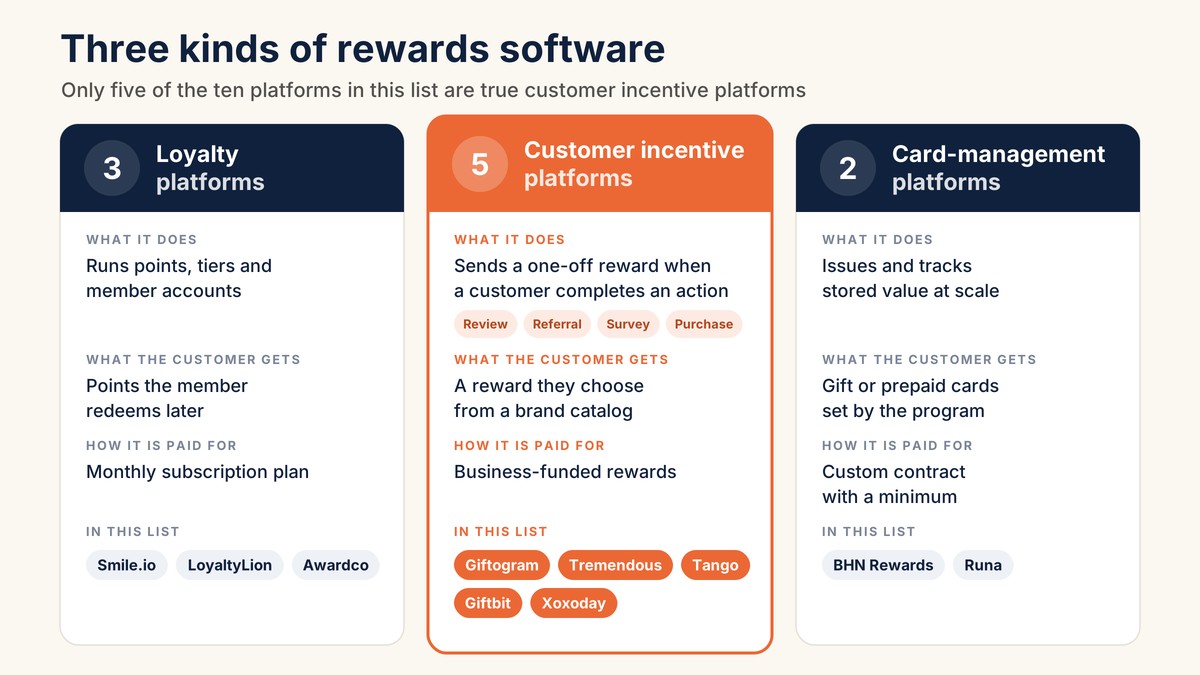
Comparison of top customer incentive software
The strongest shortlist separates incentive delivery from loyalty mechanics, then compares automation, recipient choice, and implementation burden.
| Platform | Category | Strength | Tradeoff |
| Giftogram | Incentive delivery | Bulk enterprise sends, Zapier, API, recipient choice, 140,000+ options | Suited to externally verified triggers |
| Tremendous | Incentive delivery | Bulk, integrations, API, 2,500+ options | Some methods carry fees |
| Tango | Incentive delivery | Portal, API, bulk delivery, choice links | More infrastructure than simple campaigns need |
| Giftbit | Incentive delivery | Dashboard, API | 2.9% credit-card funding fee |
| Xoxoday Plum | Incentive infrastructure | Dashboard, APIs, webhooks | Pricing varies by model |
| Runa | Incentive infrastructure | API-led international digital value | Better for embedded workflows |
| Prezzee | Incentive delivery | Bulk CSV, API, Smart eGift Card | Regional API setup matters |
| Hoppier | Incentive delivery | CSV, integrations, API-driven sends | API remains in beta |
| Smile.io | Loyalty | Points, VIP tiers, referrals | Not standalone incentive delivery |
| LoyaltyLion | Loyalty | Points, tiers, e-commerce rules | Requires an ongoing member program |
The Incentive Research Foundation’s 2026 Industry Outlook found 62% of North American organizations expect program technology budgets to rise, while nearly 70% expect gift-card use to increase. This suggests that as more value moves through digital incentive programs, automation, controls, and reconciliation will become increasingly important. It additionally points to greater program maturity, where incentives are being managed as repeatable systems.
What is the best customer incentive platform for action-triggered rewards?
Action-triggered programs work best when the source system verifies the behavior and the incentive layer handles delivery and status tracking. A referral should not fire when someone merely submits a form. The CRM or commerce system should first confirm the required outcome, then pass the approved event downstream; this separation of tasks avoids fraud, duplicate sends, and rewards firing too early. Giftogram runs this model with bulk gift cards, scheduled sends, 100+ built-in integrations, Zapier, and a public API. Recipients choose from 140,000+ national and local brands across 230+ countries, while standard digital rewards carry no platform fee. Tremendous, Tango, and other delivery platforms follow the same broad principle: qualification happens upstream, delivery downstream.
How should a business choose a customer incentive platform?
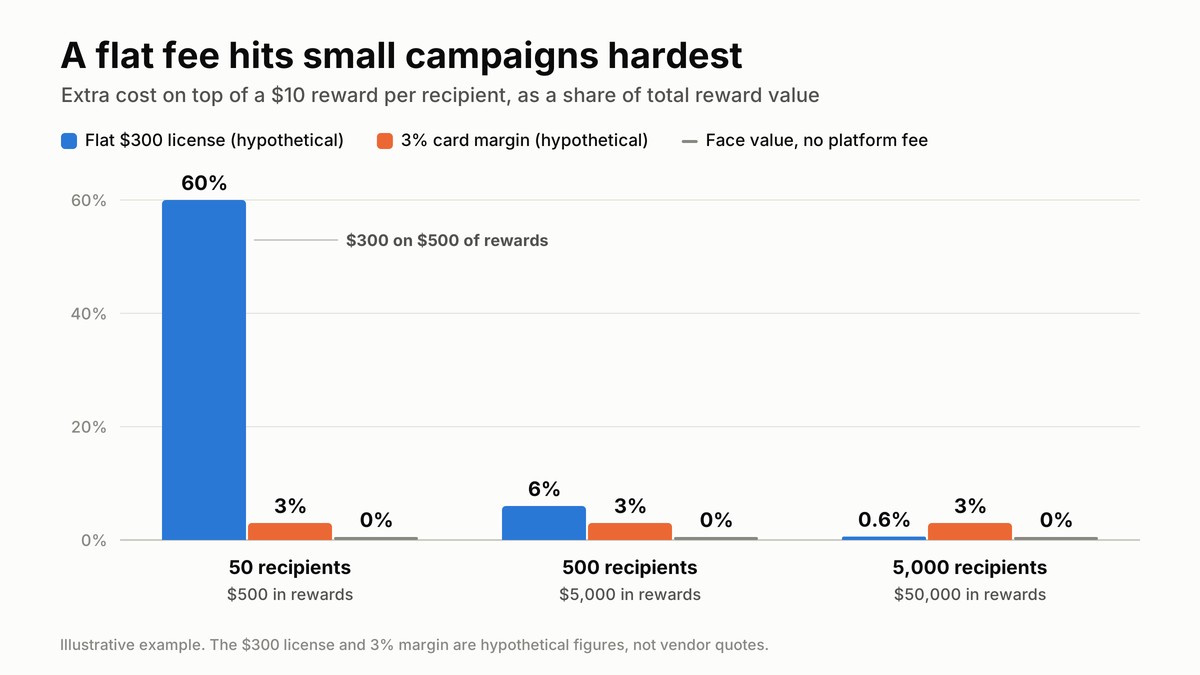
Choose around the qualifying event, integration path, geography, and total operating cost before comparing extra features. If a CRM verifies a referral, the incentive platform should receive only the approved trigger. If an e-commerce store runs points continuously, a loyalty platform is the better solution. Then compare what a customer incentive program costs, including platform charges, funding fees, integration costs, and staff time. For example, a $300 software fee adds 60% to a campaign sending fifty $10 incentives, but only 0.6% to 5,000. Fixed fees therefore need enough volume, automation, or control value to justify them.
Deloitte’s 2026 research on value-seeking consumers found that four in ten Americans show deal-driven, cost-conscious, or trade-down behavior, while consumers ranked overall value above an immediate sign-up incentive when considering a loyalty program. The implication is that customer incentives need to create a visible exchange of value. Gift cards and discount codes also solve different jobs. Gift cards deliver value after a verified action, while coupons reduce the price of a future purchase. DevOpsSchool’s comparison of digital coupon management tools covers that distinction.
What are the best practices for integrating incentive software with a CRM?
The CRM should decide when a customer qualifies, while the incentive platform handles the approved delivery and reports what happened. For a purchase milestone, the CRM or commerce system should first confirm that the required action occurred, then send one approved event to the incentive platform. Give each event a unique reference so a retry cannot accidentally issue the same incentive twice. AWS Well-Architected guidance recommends this kind of duplicate protection because repeated requests are normal in distributed systems. The business payoff is straightforward: a temporary connection problem should not turn one $100 incentive into two. A strong integration therefore keeps qualification in the CRM, prevents duplicate sends, and gives marketing or finance a clear record when delivery fails.
What are the best customer incentive platforms for small businesses?
Small teams benefit from low fixed costs and manual-to-automated upgrade paths rather than enterprise complexity on day one. Giftogram, Tremendous, Giftbit, and Prezzee support self-service or bulk digital sending, while Smile.io and LoyaltyLion make more sense when repeat-purchase points are the program. Pilot one real trigger, measure qualifying actions, staff time and delivery exceptions, then automate when repetition justifies it. At higher volume, the question becomes: can the system prove why it sent, retry safely, and reconcile the result? That is where API design, permissions, and reporting start to come into their own.
Frequently Asked Questions
Does a business need a loyalty platform to run customer rewards programs?
Only for ongoing points and tiers. Customer rewards programs built around single actions, such as referrals or survey completions, can run on customer incentive software that sends the reward once the action is verified.
How much does customer incentive software cost?
Costs combine platform fees, funding charges, integration fees, and staff time. Giftogram charges no platform fee on standard digital rewards, so a $100 reward costs $100, making budgeting straightforward.
Which customer actions should a business reward?
Actions that create measurable value and that a system can verify, such as a referral that converts or a repeat purchase.

Find Trusted Cardiac Hospitals
Compare heart hospitals by city and services — all in one place.
Explore Hospitals