
Introduction
Probation & Parole Case Management software plays a critical role in modern criminal justice systems by helping agencies supervise individuals in the community while ensuring public safety, legal compliance, and rehabilitation outcomes. These systems centralize offender records, supervision plans, risk assessments, court conditions, reporting schedules, and communication between officers, courts, and service providers.
As probation and parole caseloads continue to grow, manual processes and fragmented tools are no longer sufficient. Digital case management platforms improve efficiency, reduce administrative burden, enhance accountability, and support data-driven decision-making. From tracking compliance and violations to managing electronic monitoring and treatment referrals, these tools support the full lifecycle of community supervision.
When choosing a Probation & Parole Case Management solution, organizations should evaluate case tracking depth, usability for officers, automation capabilities, integration with justice partners, security standards, reporting strength, and scalability. The right platform not only streamlines daily operations but also improves outcomes for both agencies and supervised individuals.
Best for:
Probation departments, parole boards, community corrections agencies, state and county justice systems, and integrated public safety organizations managing medium to large supervision caseloads.
Not ideal for:
Very small agencies with minimal caseloads, organizations needing only basic record-keeping, or environments where non-justice-specific CRM tools are already deeply embedded.
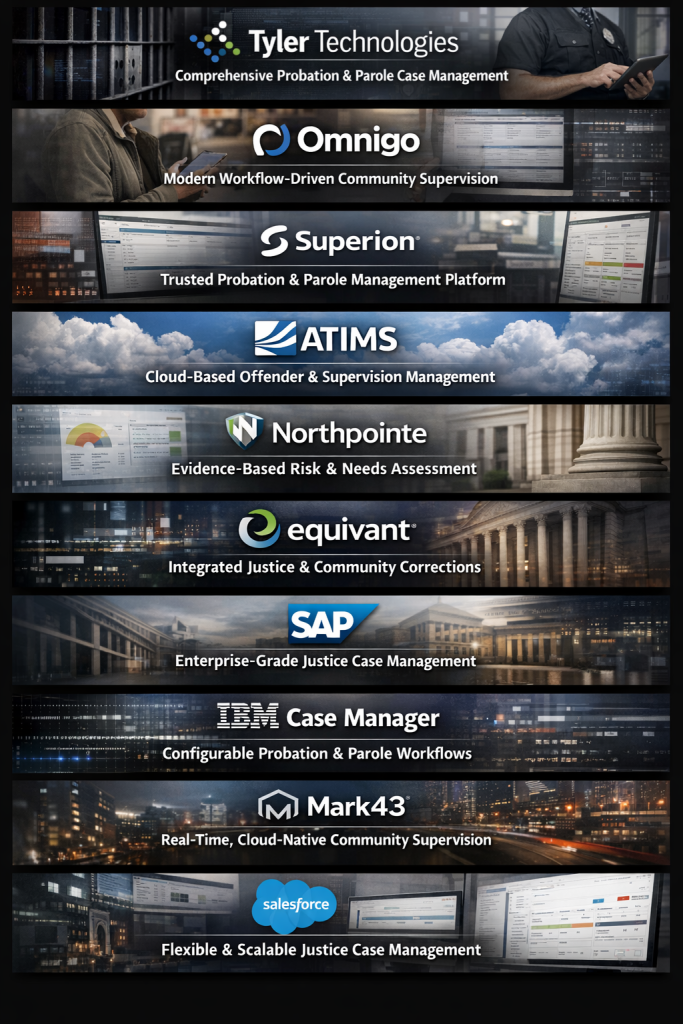
Top 10 Probation & Parole Case Management Tools
1 — Tyler Technologies (Corrections & Community Supervision)
Short description:
A comprehensive justice platform supporting probation, parole, and community corrections within an integrated court and corrections ecosystem.
Key features:
- End-to-end offender lifecycle management
- Supervision plans and condition tracking
- Integrated court and corrections data
- Risk and needs assessments
- Automated alerts and reminders
- Advanced reporting and analytics
Pros:
- Deep integration with court systems
- Highly configurable for state and county use
- Proven large-scale deployments
Cons:
- Higher cost compared to niche tools
- Longer implementation cycles
Security & compliance: SOC 2-aligned controls, encryption, audit logs
Support & community: Enterprise-grade support, structured onboarding, extensive documentation
2 — Omnigo
Short description:
A modern public safety platform offering flexible probation and parole case management with strong workflow automation.
Key features:
- Centralized supervision records
- Officer task and workload management
- Configurable workflows
- Mobile-friendly access
- Real-time reporting dashboards
Pros:
- Intuitive user interface
- Strong mobile usability
- Faster deployment than legacy systems
Cons:
- Limited advanced analytics out-of-box
- Customization may require vendor support
Security & compliance: Encryption, role-based access, audit trails
Support & community: Responsive support team, guided onboarding
3 — Superion
Short description:
A long-established justice software provider delivering community supervision tools for probation and parole agencies.
Key features:
- Case and offender management
- Condition compliance tracking
- Officer scheduling
- Integrated reporting
- Court data exchange
Pros:
- Trusted by many US agencies
- Stable, mature platform
- Strong compliance features
Cons:
- User interface feels dated
- Less flexible customization
Security & compliance: CJIS-aligned practices, audit logs
Support & community: Enterprise support, legacy user community
4 — ATIMS
Short description:
A cloud-based offender management system designed for corrections, probation, and parole supervision.
Key features:
- Cloud-native architecture
- Risk assessment tools
- Automated compliance tracking
- Case notes and documentation
- Analytics and reporting
Pros:
- Scalable cloud deployment
- Strong reporting capabilities
- Suitable for modern IT strategies
Cons:
- Fewer third-party integrations
- Smaller ecosystem than larger vendors
Security & compliance: Encryption, secure cloud hosting
Support & community: Direct vendor support, structured training
5 — Northpointe (now Equivant-related tools)
Short description:
Known for risk assessment expertise integrated into probation and parole case management workflows.
Key features:
- Validated risk and needs assessments
- Supervision planning tools
- Data-driven decision support
- Reporting and analytics
- Court collaboration features
Pros:
- Strong evidence-based approach
- Trusted assessment methodologies
- Improves supervision outcomes
Cons:
- Focused heavily on assessments
- Broader case management may need add-ons
Security & compliance: Varies by deployment
Support & community: Training-focused support, practitioner resources
6 — Equivant (Community Corrections)
Short description:
A comprehensive justice case management suite covering probation, parole, and pretrial services.
Key features:
- Unified justice data model
- Case, offender, and supervision tracking
- Court and law enforcement integrations
- Reporting and analytics
- Configurable workflows
Pros:
- Broad justice system coverage
- Strong integration capabilities
- Scales well for large agencies
Cons:
- Complex configuration
- Requires formal training
Security & compliance: CJIS-aligned, encryption, audit logs
Support & community: Enterprise support, established user base
7 — SAP (Justice & Public Sector Solutions)
Short description:
Enterprise-grade case management frameworks adapted for probation and parole in large government environments.
Key features:
- Highly configurable case management
- Advanced analytics and dashboards
- Integration with ERP and finance systems
- Workflow automation
- Enterprise scalability
Pros:
- Extremely powerful analytics
- Strong security and compliance
- Ideal for large government deployments
Cons:
- High cost
- Requires significant IT expertise
Security & compliance: ISO standards, enterprise security controls
Support & community: Global enterprise support ecosystem
8 — IBM (Case Manager for Justice)
Short description:
A configurable case management platform supporting complex probation and parole workflows.
Key features:
- Flexible case modeling
- Business rules and automation
- Integration with legacy systems
- Advanced reporting
- AI-assisted insights
Pros:
- Highly customizable
- Strong integration capabilities
- Enterprise reliability
Cons:
- Long implementation timelines
- Higher total cost of ownership
Security & compliance: Enterprise-grade security, audit logging
Support & community: Professional services-driven support
9 — Mark43
Short description:
A modern cloud platform extending into community supervision with real-time data and analytics.
Key features:
- Cloud-native architecture
- Real-time data access
- Mobile-first design
- Analytics dashboards
- API-driven integrations
Pros:
- Modern user experience
- Fast performance
- Strong interoperability
Cons:
- Less specialized probation features
- Best as part of a broader ecosystem
Security & compliance: CJIS-aligned cloud security
Support & community: Strong onboarding, modern documentation
10 — Salesforce (Justice-configured solutions)
Short description:
A highly flexible platform adapted for probation and parole through custom justice data models.
Key features:
- Configurable case workflows
- Automation and notifications
- Robust reporting
- Large integration marketplace
- Mobile access
Pros:
- Extremely flexible
- Strong ecosystem
- Familiar UI for many users
Cons:
- Requires customization for justice use
- Licensing costs can add up
Security & compliance: SOC 2, encryption, role-based access
Support & community: Massive global community, enterprise support
Comparison Table
| Tool Name | Best For | Platform(s) Supported | Standout Feature | Rating |
|---|---|---|---|---|
| Tyler Technologies | Large justice agencies | Web | End-to-end justice integration | N/A |
| Omnigo | Mid-size agencies | Web, Mobile | Officer-friendly workflows | N/A |
| Superion | Traditional departments | Web | Mature compliance tracking | N/A |
| ATIMS | Cloud-first agencies | Web | Cloud scalability | N/A |
| Northpointe | Evidence-based supervision | Web | Risk assessment expertise | N/A |
| Equivant | Integrated justice systems | Web | Unified data model | N/A |
| SAP | Large governments | Web | Enterprise analytics | N/A |
| IBM | Complex workflows | Web | Custom case modeling | N/A |
| Mark43 | Modern agencies | Web, Mobile | Real-time data | N/A |
| Salesforce | Custom implementations | Web, Mobile | Extreme flexibility | N/A |
Evaluation & Scoring of Probation & Parole Case Management
| Criteria | Weight | Key Considerations |
|---|---|---|
| Core features | 25% | Case tracking, supervision, compliance |
| Ease of use | 15% | Officer productivity, UI clarity |
| Integrations & ecosystem | 15% | Courts, law enforcement, monitoring |
| Security & compliance | 10% | CJIS, encryption, audit logs |
| Performance & reliability | 10% | Uptime, scalability |
| Support & community | 10% | Training, vendor support |
| Price / value | 15% | ROI, long-term cost |
Which Probation & Parole Case Management Tool Is Right for You?
- Solo users / small agencies: Cloud-based, easy-to-use platforms with minimal configuration
- SMB to mid-market: Tools like Omnigo or ATIMS offering balance of features and usability
- Enterprise / statewide systems: Tyler Technologies, Equivant, SAP, or IBM
- Budget-conscious: Modular platforms with phased rollouts
- Compliance-heavy environments: Vendors with CJIS-aligned and audit-ready architectures
- Highly customized workflows: Salesforce or IBM-based solutions
Frequently Asked Questions (FAQs)
- What is probation & parole case management software?
It is a digital system that manages supervision, compliance, and reporting for individuals under community supervision. - Is cloud deployment safe for justice data?
Yes, when platforms follow CJIS-aligned security, encryption, and access controls. - Can these tools integrate with courts?
Most leading platforms support court and justice partner integrations. - Do officers need extensive training?
Modern systems reduce training needs, though enterprise tools require onboarding. - Are risk assessments included?
Some tools include built-in assessments; others integrate third-party models. - How long does implementation take?
Ranges from weeks (cloud tools) to months (enterprise systems). - Are mobile apps available?
Many platforms offer mobile-friendly or native mobile access. - Do these systems support electronic monitoring?
Yes, often via integrations with monitoring providers. - What are common mistakes when choosing a tool?
Underestimating integration needs and over-customizing early. - Is there a single “best” solution?
No—success depends on agency size, workflows, and compliance needs.
Conclusion
Probation & Parole Case Management software is essential for modern community supervision, enabling agencies to manage caseloads efficiently, ensure compliance, and support rehabilitation goals. While some platforms excel in enterprise-scale integration and analytics, others focus on usability and rapid deployment.
The most important takeaway is that the “best” tool depends on your agency’s size, complexity, budget, and long-term strategy. By carefully evaluating features, security, integrations, and support, organizations can select a solution that strengthens supervision outcomes and public trust—without unnecessary complexity or cost.

Find Trusted Cardiac Hospitals
Compare heart hospitals by city and services — all in one place.
Explore Hospitals
Really helpful article — thanks for breaking down the pros and cons of each probation and parole case management system! Having a clear comparison like this makes it much easier to understand which tools fit different agency needs and workflows. Case management plays such an important role in supervision and rehabilitation, so seeing practical trade‑offs and features side by side is valuable. I’m curious how others handle reporting and data sharing between agencies with these tools.