
DataOps
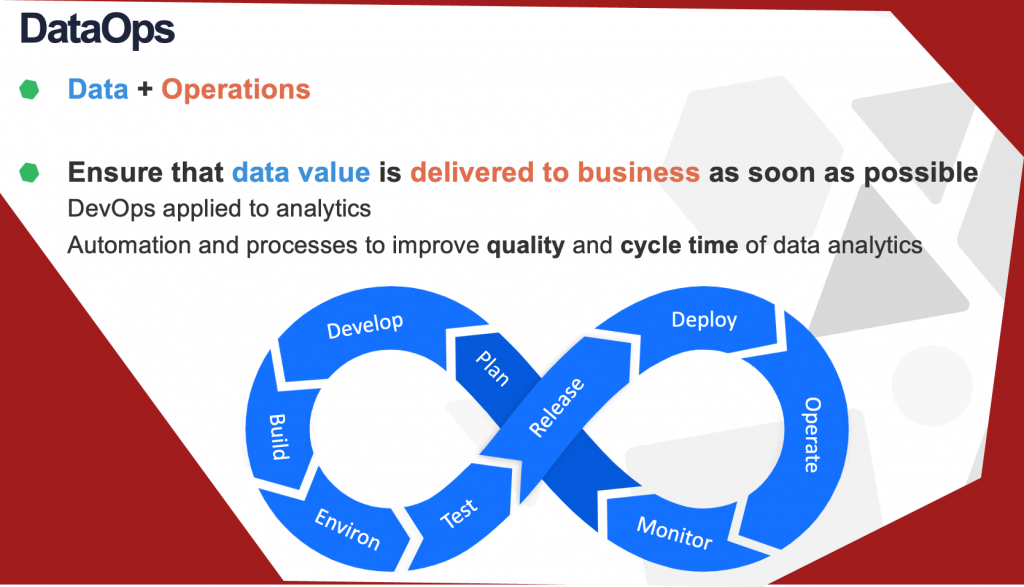
DataOps is a collection of technical practices, workflows, cultural norms, and architectural patterns that allows:
- Rapid innovation and experimentation delivering new intuition to customers with increasing velocity
- Very high data quality and low error rates
- Collaboration over complex arrays of people, technology, and environments
- Clear measurement, monitoring, and transparency of results
DataOps was introduced by Lenny Liebman.
DataOps incorporates the Agile methodology to shorten the cycle time of analytics development in alignment with business goals.
Problems solved by DataOps

1. Limited collaboration –
Implementing DataOps workflows improve collaboration between data-focused teams and Development-focused teams. At it’s best, in fact, DataOps focuses to remove the distinction between these two business functions.
Critical to realizing this, though, is an underlying process of goal-setting. Both development staff and the data team need to collectively develop an overview of the data acquisition journey by your organization, so that both can see where the work of the other can be used to improve their own work.
2. Bug fixing –
While DataOps has generally been thought of as a way of improving the efficiency and agility of development processes, it also has great utility when it comes to incident management. Fixing bugs and defects in your products is possibly to include input from both data and development specialists, and is a time-critical business function as well.
With greater levels of communication and collaboration between these two staff groups, the timescale to respond to bugs and defects can be dramatically minimize.
3. Slow responses –
Perhaps one of the biggest challenges facing organizations today is responding to development requests. Both from users and higher management. Historically, requests to include new features involved the same request being sent backward and forward between data scientists and the development team.
Because DataOps teams include both of these functions, staff can work together on new requests. This permits the development team to see what effect new features have on the data flow through the organization, and can also help data teams to better focus their processing on the actual goals of the enterprise.
4. Goal setting –
When implemented correctly, DataOps can provide both development teams and management with real-time data on the performance of their data systems. These data are not useful only for monitoring success against business goals, these data also allow management to adjust and update performance goals in real time, if sufficiently adaptable business processes are in place.
5. Efficiency –
All of the issues above reduce the efficiency of organizations. In the old DevOps model, each team would compile reports on their work, and these would be passed between multiple, hierarchical, vertically-organized structures.
With DataOps, data staff and development staff work alongside each other, and so the information flow is horizontal. Instead of comparing notes at monthly meetings, the exchange of information happens on an everyday basis. This greatly improves the efficiency of an organization.

Best Insitute for learning DataOps
In my consdiration, Its DevOpsSchool. Why? Because this institute providing training in a best way, with all the topics that needs to be covered in DataOps training as well as they offers so many other benefits like online live and interactive classes, Pdfs, slides, class recordings, and so many.
This institute has well experienced and skilled trainers that gives the opportunity to participants to levarage their ideas and skills to be on the path of success.
Reference
- What is DevOps?
- DataOps Certifications
- DataOps Consultants
- DataOps Consulting Company
- Best DataOps Courses
- Best DataOps Tools
- Best DataOps Trainer
- Best DataOps Training

I’m Rajesh Kumar, a DevOps, SRE, DevSecOps, Cloud, and Platform Engineering expert passionate about sharing practical knowledge, real-world experiences, and industry best practices. I have worked at Cotocus and regularly write about technology, travel, investing, health, product reviews, and digital marketing through my various platforms.
I publish technical articles at DevOps School, travel stories at Holiday Landmark, stock market insights at Stocks Mantra, health and fitness guidance at My Medic Plus, product reviews at TrueReviewNow, and SEO and digital marketing strategies at Wizbrand.
Find Trusted Cardiac Hospitals
Compare heart hospitals by city and services — all in one place.
Explore Hospitals





