
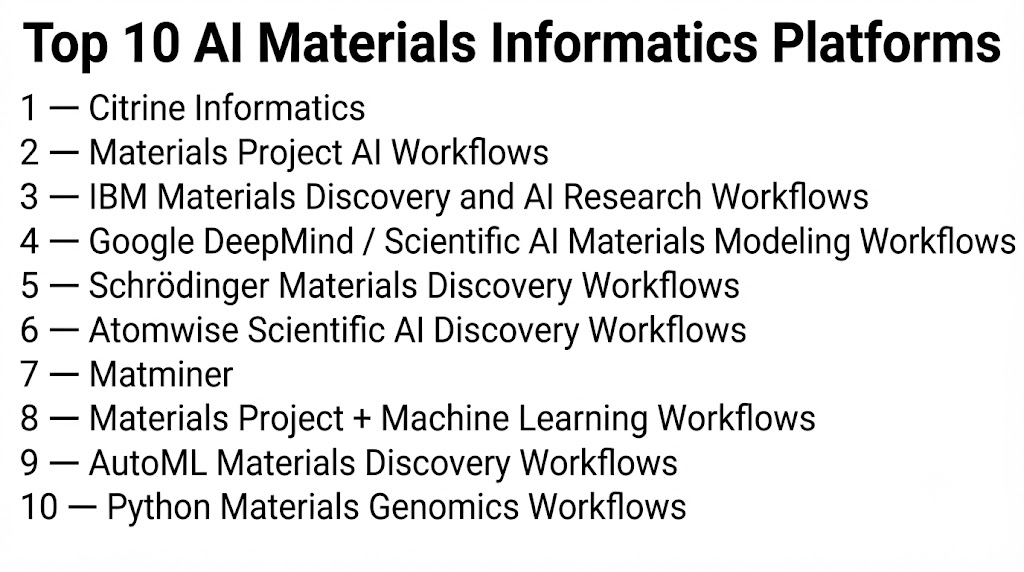
Introduction
AI Materials Informatics Platforms combine artificial intelligence, machine learning, data analytics, and materials science to accelerate the discovery, development, and optimization of new materials. These platforms analyze large amounts of experimental data, simulation results, scientific literature, and material properties to help researchers predict performance and identify promising materials faster.
Traditional materials development can require years of laboratory experiments, testing cycles, and expensive research processes. AI-powered materials informatics helps scientists reduce experimentation time by using machine learning models to predict material behavior, optimize formulations, and guide research decisions.
As industries focus on advanced manufacturing, clean energy, semiconductor innovation, pharmaceuticals, aerospace materials, and sustainable technologies, AI materials platforms are becoming important tools for research organizations and industrial R&D teams.
Common use cases include:
- Battery material discovery and optimization
- Semiconductor material research
- Advanced manufacturing materials
- Polymer and chemical formulation development
- Aerospace material engineering
- Energy storage research
When evaluating AI Materials Informatics Platforms, organizations should consider AI modeling capabilities, materials database support, simulation integration, experiment tracking, machine learning flexibility, scientific workflow compatibility, data management, explainability, deployment options, security controls, and collaboration features.
Best for: Materials scientists, chemical companies, battery manufacturers, semiconductor organizations, aerospace companies, universities, pharmaceutical research teams, manufacturing companies, and R&D departments working on advanced materials.
Not ideal for: Organizations without scientific datasets, teams requiring only basic data analytics, or businesses that do not perform materials research or experimentation.
What’s Changed in AI Materials Informatics Platforms in 2026+
AI materials informatics is evolving as organizations look for faster discovery cycles, better prediction accuracy, and more efficient research workflows.
Key trends include:
- AI-driven materials discovery: Organizations are increasingly using machine learning to identify promising materials and reduce manual experimentation.
- Foundation models for materials science: Emerging AI approaches are exploring larger models trained on scientific data to understand complex material relationships.
- Machine learning-based property prediction: AI models are improving predictions of material characteristics such as performance, stability, and behavior.
- Automated experiment design: AI systems are helping researchers select experiments that provide the most valuable information.
- Self-driving laboratories: Materials research is moving toward automated systems where AI helps control experiments, analyze results, and suggest next steps.
- Digital twins for materials development: Virtual representations of materials and processes are helping researchers simulate behavior before physical testing.
- Multimodal scientific data integration: Modern platforms increasingly combine experimental data, simulations, images, text, and structured material information.
- Physics-informed AI materials modeling: AI models are being combined with scientific principles to improve reliability and interpretability.
- High-throughput virtual screening: Researchers are using AI to evaluate large numbers of possible materials before laboratory testing.
- Explainable and reproducible scientific AI: Research teams are placing greater importance on understanding AI predictions and maintaining transparent workflows.
Quick Buyer Checklist (Scan-Friendly)
Before selecting an AI Materials Informatics Platform, evaluate:
- Materials science database support
- Machine learning model capabilities
- Material property prediction
- Chemical and molecular data support
- Simulation integration
- Experimental data management
- Literature and knowledge integration
- AI model evaluation methods
- Explainable AI capabilities
- Physics-informed modeling support
- Automated experiment planning
- High-throughput screening support
- Data visualization capabilities
- Collaboration features
- API availability
- Cloud deployment options
- Self-hosted deployment options
- Research workflow compatibility
- Data privacy controls
- Security management
- Model version tracking
- Reproducibility support
- Integration with laboratory systems
- Scalability for large research projects
Top 10 AI Materials Informatics Platforms
#1 — Citrine Informatics
One-line verdict: Best for organizations using AI to accelerate materials discovery and formulation optimization.
Short description (2–3 lines):
Citrine Informatics is an AI-powered materials informatics platform designed to help organizations analyze materials data and accelerate research workflows.
It supports materials discovery, property prediction, and optimization processes across scientific and industrial applications.
Standout Capabilities
- Materials data management
- AI-driven materials discovery
- Property prediction
- Experimental data analysis
- Materials optimization
- Machine learning workflows
- Research collaboration
AI-Specific Depth (Must Include)
- Model support: Supports machine learning approaches for materials informatics workflows.
- RAG / knowledge integration: Depends on connected scientific knowledge sources and workflows.
- Evaluation: Requires validation against experimental results and materials data.
- Guardrails: Scientific validation processes help improve reliability.
- Observability: Depends on platform monitoring and research workflow configuration.
Pros
- Designed specifically for materials science.
- Supports AI-assisted discovery workflows.
- Helps organize complex materials data.
Cons
- Primarily focused on materials research use cases.
- Requires quality materials datasets.
- Implementation may require scientific expertise.
Security & Compliance
Not publicly stated.
Deployment & Platforms
- Platforms: Scientific research environments.
- Deployment: Cloud and enterprise options vary.
Integrations & Ecosystem
Supports:
- Materials databases
- Scientific workflows
- Research data systems
- Machine learning applications
- Industrial R&D environments
Pricing Model
Not publicly stated.
Best-Fit Scenarios
- Materials discovery
- Chemical research
- Industrial R&D
#2 — Materials Project AI Workflows
One-line verdict: Best for researchers using computational materials data and AI-driven discovery workflows.
Short description (2–3 lines):
Materials Project provides computational materials data and scientific resources that researchers use for materials analysis and discovery.
AI workflows can use these datasets to predict properties and explore new material possibilities.
Standout Capabilities
- Computational materials data
- Materials property information
- Scientific research workflows
- Computational screening
- Materials comparison
- Research collaboration
- Data-driven discovery
AI-Specific Depth (Must Include)
- Model support: AI capabilities depend on connected machine learning workflows.
- RAG / knowledge integration: Scientific data integration is a core workflow.
- Evaluation: Requires validation against computational or experimental results.
- Guardrails: Scientific validation is required for AI predictions.
- Observability: Depends on connected research workflows.
Pros
- Valuable scientific data foundation.
- Useful for computational materials research.
- Supports AI-based discovery workflows.
Cons
- Requires scientific expertise.
- Not a complete enterprise AI platform.
- Additional AI development may be required.
Security & Compliance
Not publicly stated.
Deployment & Platforms
- Platforms: Research computing environments.
- Deployment: Varies.
Integrations & Ecosystem
Supports:
- Computational materials research
- Scientific databases
- Machine learning workflows
- Academic projects
- Materials analysis
Pricing Model
Not publicly stated.
Best-Fit Scenarios
- Materials research
- Computational discovery
- Academic projects
#3 — IBM Materials Discovery and AI Research Workflows
One-line verdict: Best for organizations combining AI research with enterprise scientific workflows.
Short description (2–3 lines):
IBM provides AI and scientific computing capabilities that can support materials discovery and research optimization workflows.
Organizations can combine machine learning approaches with scientific data analysis for advanced materials research.
Standout Capabilities
- AI-assisted scientific research
- Data analytics
- Machine learning workflows
- Research optimization
- Enterprise AI infrastructure
- Scientific computing support
- Data management
AI-Specific Depth (Must Include)
- Model support: Supports AI and machine learning workflows depending on implementation.
- RAG / knowledge integration: Depends on connected scientific knowledge systems.
- Evaluation: Requires validation using research data and experiments.
- Guardrails: Depends on AI governance implementation.
- Observability: Depends on monitoring and workflow tools.
Pros
- Enterprise AI capabilities.
- Supports complex research environments.
- Suitable for large organizations.
Cons
- May require significant implementation effort.
- Not exclusively focused on materials informatics.
- Requires technical expertise.
Security & Compliance
Not publicly stated.
Deployment & Platforms
- Platforms: Enterprise AI environments.
- Deployment: Cloud, hybrid, and enterprise options vary.
Integrations & Ecosystem
Supports:
- AI platforms
- Scientific computing
- Enterprise data systems
- Research applications
- Machine learning workflows
Pricing Model
Not publicly stated.
Best-Fit Scenarios
- Enterprise materials research
- Scientific AI projects
- Large R&D organizations
#4 — Google DeepMind / Scientific AI Materials Modeling Workflows
One-line verdict: Best for advanced research teams exploring AI-driven scientific material prediction and discovery.
Short description (2–3 lines):
Scientific AI materials modeling workflows use advanced machine learning techniques to understand relationships between structures, properties, and behaviors of materials.
These approaches support research organizations working on computational materials discovery and prediction.
Standout Capabilities
- AI-based scientific modeling
- Materials property prediction
- Large-scale scientific datasets
- Machine learning experimentation
- Computational discovery workflows
- Pattern recognition across materials data
- Research acceleration
AI-Specific Depth (Must Include)
- Model support: Uses specialized scientific AI models depending on research workflows.
- RAG / knowledge integration: Depends on connected scientific databases and knowledge systems.
- Evaluation: Requires validation against experimental or computational materials results.
- Guardrails: Scientific validation and expert review are required.
- Observability: Depends on research infrastructure and experiment tracking.
Pros
- Supports advanced scientific AI research.
- Useful for complex materials prediction problems.
- Helps accelerate computational discovery.
Cons
- Not a standard enterprise materials management platform.
- Requires advanced research expertise.
- Production deployment depends on implementation.
Security & Compliance
Not publicly stated.
Deployment & Platforms
- Platforms: Research computing environments.
- Deployment: Varies.
Integrations & Ecosystem
Supports:
- Scientific datasets
- AI research workflows
- Computational modeling
- Materials research projects
- Machine learning environments
Pricing Model
Not publicly stated.
Best-Fit Scenarios
- Advanced materials research
- Scientific AI experimentation
- Computational discovery
#5 — Schrödinger Materials Discovery Workflows
One-line verdict: Best for organizations combining computational chemistry with AI-assisted materials research.
Short description (2–3 lines):
Schrödinger provides computational modeling and simulation solutions used in scientific discovery workflows.
AI and machine learning techniques can support materials research, molecular modeling, and predictive analysis.
Standout Capabilities
- Molecular modeling
- Computational simulation
- Scientific discovery workflows
- Property prediction
- Chemical analysis
- Research optimization
- Simulation-based exploration
AI-Specific Depth (Must Include)
- Model support: AI capabilities depend on selected scientific workflows.
- RAG / knowledge integration: Depends on connected scientific databases.
- Evaluation: Requires validation against experimental and computational results.
- Guardrails: Scientific modeling validation provides reliability checks.
- Observability: Depends on research workflow monitoring.
Pros
- Strong scientific modeling capabilities.
- Useful for computational research.
- Supports advanced discovery workflows.
Cons
- Requires scientific expertise.
- Primarily focused on specialized research areas.
- Implementation complexity varies.
Security & Compliance
Not publicly stated.
Deployment & Platforms
- Platforms: Scientific computing environments.
- Deployment: Enterprise and research options vary.
Integrations & Ecosystem
Supports:
- Molecular modeling workflows
- Scientific computing
- Research databases
- Simulation systems
- AI research tools
Pricing Model
Not publicly stated.
Best-Fit Scenarios
- Materials research
- Chemical discovery
- Computational modeling
#6 — Atomwise Scientific AI Discovery Workflows
One-line verdict: Best for AI-driven scientific discovery approaches using predictive modeling.
Short description (2–3 lines):
Atomwise is known for AI-based scientific discovery workflows that use machine learning to analyze complex scientific problems.
Similar AI approaches can support materials and molecular research applications.
Standout Capabilities
- AI-based prediction workflows
- Scientific data analysis
- Machine learning modeling
- Discovery optimization
- Large-scale data analysis
- Research acceleration
- Computational screening
AI-Specific Depth (Must Include)
- Model support: Uses machine learning models depending on research application.
- RAG / knowledge integration: Depends on connected scientific data sources.
- Evaluation: Requires scientific validation.
- Guardrails: Expert review and scientific validation are required.
- Observability: Depends on research workflow configuration.
Pros
- Strong AI research capabilities.
- Supports predictive scientific workflows.
- Useful for discovery-focused projects.
Cons
- Not specifically a complete materials informatics platform.
- Requires specialized research knowledge.
- Workflow capabilities vary.
Security & Compliance
Not publicly stated.
Deployment & Platforms
- Platforms: Research and enterprise environments.
- Deployment: Varies.
Integrations & Ecosystem
Supports:
- Scientific datasets
- Machine learning workflows
- Research applications
- Computational analysis
- Discovery pipelines
Pricing Model
Not publicly stated.
Best-Fit Scenarios
- Scientific discovery
- AI research
- Predictive modeling
#7 — Matminer
One-line verdict: Best for researchers building machine learning workflows using materials science datasets.
Short description (2–3 lines):
Matminer is an open-source materials data mining library designed to help researchers analyze materials datasets and create machine learning workflows.
It is commonly used in computational materials research.
Standout Capabilities
- Materials data processing
- Feature generation
- Machine learning preparation
- Materials dataset analysis
- Scientific computing
- Research experimentation
- Open-source workflows
AI-Specific Depth (Must Include)
- Model support: Supports integration with machine learning frameworks.
- RAG / knowledge integration: Not typically applicable.
- Evaluation: Requires custom machine learning evaluation workflows.
- Guardrails: Scientific validation depends on researcher implementation.
- Observability: Requires external experiment tracking tools.
Pros
- Open-source flexibility.
- Useful for materials research.
- Supports machine learning experimentation.
Cons
- Requires programming expertise.
- Not a complete AI platform.
- Requires custom workflow development.
Security & Compliance
Not publicly stated.
Deployment & Platforms
- Platforms: Python scientific environments.
- Deployment: Self-managed and cloud environments.
Integrations & Ecosystem
Supports:
- Materials datasets
- Python scientific libraries
- Machine learning frameworks
- Research workflows
- Computational materials tools
Pricing Model
Open-source.
Best-Fit Scenarios
- Academic research
- Materials data analysis
- ML experimentation
#8 — Materials Project + Machine Learning Workflows
One-line verdict: Best for researchers combining materials databases with AI prediction techniques.
Short description (2–3 lines):
Materials Project provides access to computational materials information used by researchers for materials analysis and discovery.
Machine learning workflows can use these datasets for property prediction and screening.
Standout Capabilities
- Materials databases
- Computational property analysis
- Scientific data exploration
- Materials comparison
- Research workflows
- AI model development
- Discovery support
AI-Specific Depth (Must Include)
- Model support: Depends on connected machine learning workflows.
- RAG / knowledge integration: Scientific database integration is a core capability.
- Evaluation: Requires validation against known materials results.
- Guardrails: Scientific verification is required.
- Observability: Depends on research tooling.
Pros
- Strong scientific data foundation.
- Useful for materials researchers.
- Supports AI experimentation.
Cons
- Requires additional AI development.
- Not a full enterprise platform.
- Requires domain expertise.
Security & Compliance
Not publicly stated.
Deployment & Platforms
- Platforms: Research environments.
- Deployment: Varies.
Integrations & Ecosystem
Supports:
- Scientific databases
- Computational workflows
- Machine learning pipelines
- Research projects
- Materials analysis
Pricing Model
Not publicly stated.
Best-Fit Scenarios
- Materials discovery research
- Computational screening
- Academic projects
#9 — AutoML Materials Discovery Workflows
One-line verdict: Best for teams applying automated machine learning to materials prediction problems.
Short description (2–3 lines):
AutoML-based materials workflows use automated machine learning techniques to build predictive models from materials datasets.
They help researchers experiment with different models and identify useful prediction approaches.
Standout Capabilities
- Automated model selection
- Feature engineering
- Prediction workflows
- Data analysis
- Machine learning experimentation
- Model comparison
- Research acceleration
AI-Specific Depth (Must Include)
- Model support: Supports automated machine learning approaches.
- RAG / knowledge integration: Depends on connected scientific databases.
- Evaluation: Supports model comparison and validation workflows.
- Guardrails: Depends on scientific review processes.
- Observability: Depends on selected AutoML platform.
Pros
- Reduces manual model development.
- Useful for experimentation.
- Supports faster ML workflows.
Cons
- Requires quality datasets.
- May need customization for complex materials problems.
- Scientific interpretation remains necessary.
Security & Compliance
Not publicly stated.
Deployment & Platforms
- Platforms: Cloud or self-managed ML environments.
- Deployment: Varies.
Integrations & Ecosystem
Supports:
- Machine learning platforms
- Materials datasets
- Research workflows
- Data processing tools
- AI experimentation systems
Pricing Model
Varies depending on selected platform.
Best-Fit Scenarios
- Materials prediction
- Research experimentation
- ML-based discovery
#10 — Python Materials Genomics Workflows
One-line verdict: Best for developers creating custom AI materials informatics applications.
Short description (2–3 lines):
Python-based materials informatics workflows combine scientific libraries, machine learning frameworks, and materials datasets to build customized discovery solutions.
They are widely used for research and experimental development.
Standout Capabilities
- Custom AI workflows
- Materials data processing
- Machine learning development
- Scientific computing
- Feature engineering
- Model experimentation
- Research automation
AI-Specific Depth (Must Include)
- Model support: Supports custom machine learning models.
- RAG / knowledge integration: Requires external implementation.
- Evaluation: Depends on implemented validation workflows.
- Guardrails: Scientific validation must be designed into workflows.
- Observability: Requires external monitoring and experiment tracking.
Pros
- Highly customizable.
- Large Python ecosystem.
- Suitable for research teams.
Cons
- Requires programming skills.
- Requires workflow development.
- No single integrated platform.
Security & Compliance
Not publicly stated.
Deployment & Platforms
- Platforms: Python development environments.
- Deployment: Cloud, edge, and self-managed options vary.
Integrations & Ecosystem
Supports:
- Scientific Python libraries
- Machine learning frameworks
- Materials databases
- Research systems
- Custom applications
Pricing Model
Open-source components with infrastructure costs varying.
Best-Fit Scenarios
- Custom materials AI development
- Research workflows
- Experimental applications
Comparison Table
| Tool Name | Best For | Deployment (Cloud/Self-hosted/Hybrid) | Model Flexibility (Hosted / BYO / Multi-model / Open-source) | Strength | Watch-Out | Public Rating |
|---|---|---|---|---|---|---|
| Citrine Informatics | Enterprise materials discovery | Cloud/Enterprise | Hosted AI workflows | Materials-specific AI platform | Requires quality materials data | N/A |
| Materials Project AI Workflows | Computational materials research | Research environments | Open-source data + BYO models | Scientific materials datasets | Requires AI implementation | N/A |
| IBM Materials AI Workflows | Enterprise scientific AI | Cloud/Hybrid/Enterprise | Multi-model AI workflows | Enterprise AI ecosystem | Requires technical setup | N/A |
| Scientific AI Materials Modeling Workflows | Advanced research | Research environments | Specialized AI models | Scientific prediction | Research-focused | N/A |
| Schrödinger Materials Workflows | Computational chemistry and materials research | Desktop/Enterprise | Scientific modeling workflows | Simulation-based discovery | Specialized expertise needed | N/A |
| Atomwise Scientific AI Workflows | AI discovery research | Cloud/Enterprise | AI-based scientific models | Predictive discovery | Not dedicated only to materials | N/A |
| Matminer | Materials ML research | Self-managed/Cloud | Open-source/BYO models | Materials data processing | Requires coding | N/A |
| Materials Project + ML Workflows | Materials screening | Research environments | Open-source/BYO models | Computational materials data | Requires customization | N/A |
| AutoML Materials Workflows | Automated ML experimentation | Cloud/Self-managed | Multi-model ML workflows | Faster model development | Scientific interpretation required | N/A |
| Python Materials Informatics Workflows | Custom development | Cloud/Self-managed | Open-source/BYO models | Maximum flexibility | Requires engineering effort | N/A |
Scoring & Evaluation (Transparent Rubric)
The following evaluation compares AI Materials Informatics Platforms based on materials science capabilities, AI reliability, evaluation methods, integration options, usability, performance, security, and ecosystem maturity.
The scoring is comparative rather than absolute. Different organizations may prioritize discovery speed, scientific accuracy, customization, enterprise integration, or research flexibility.
| Tool | Core | Reliability/Eval | Guardrails | Integrations | Ease | Perf/Cost | Security/Admin | Support | Weighted Total |
|---|---|---|---|---|---|---|---|---|---|
| Citrine Informatics | 10 | 9 | 9 | 9 | 8 | 8 | 8 | 9 | 8.9 |
| Materials Project AI Workflows | 9 | 9 | 8 | 9 | 7 | 9 | 7 | 9 | 8.5 |
| IBM Materials AI Workflows | 9 | 9 | 9 | 10 | 7 | 8 | 9 | 9 | 8.9 |
| Scientific AI Materials Modeling | 9 | 9 | 8 | 8 | 6 | 9 | 7 | 8 | 8.1 |
| Schrödinger Materials Workflows | 10 | 9 | 9 | 9 | 8 | 8 | 8 | 9 | 8.9 |
| Atomwise Scientific AI Workflows | 8 | 8 | 8 | 8 | 8 | 8 | 8 | 8 | 8.0 |
| Matminer | 8 | 9 | 8 | 9 | 6 | 9 | 7 | 9 | 8.0 |
| Materials Project + ML Workflows | 9 | 9 | 8 | 9 | 7 | 9 | 7 | 9 | 8.5 |
| AutoML Materials Workflows | 8 | 8 | 8 | 9 | 8 | 8 | 8 | 8 | 8.1 |
| Python Materials Informatics Workflows | 9 | 9 | 8 | 10 | 6 | 10 | 8 | 10 | 8.9 |
Top 3 for Enterprise
1. Citrine Informatics
Best suited for organizations focused on AI-driven materials discovery, formulation optimization, and industrial R&D.
2. IBM Materials AI Workflows
A strong option for enterprises that need AI infrastructure, data management, and scientific workflow integration.
3. Schrödinger Materials Workflows
Useful for organizations combining computational modeling with materials and chemical research.
Top 3 for SMB
1. Materials Project AI Workflows
Suitable for smaller research teams using computational materials data.
2. Matminer
A strong option for teams wanting open-source materials machine learning workflows.
3. AutoML Materials Workflows
Useful for organizations exploring machine learning-based materials prediction.
Top 3 for Developers
1. Python Materials Informatics Workflows
Best for developers creating customized materials AI applications.
2. Matminer
Useful for building materials data processing and machine learning pipelines.
3. Materials Project + ML Workflows
Suitable for developers working with scientific datasets and predictive models.
Which AI Materials Informatics Platform Is Right for You?
Solo / Freelancer
Individual researchers, students, and developers should prioritize:
- Open-source availability
- Flexible experimentation
- Scientific datasets
- Low infrastructure requirements
Recommended options:
- Matminer
- Materials Project AI Workflows
- Python Materials Informatics Workflows
Solo users should focus on learning and experimentation rather than enterprise-scale deployment.
Important considerations:
- Materials science knowledge
- Machine learning skills
- Programming experience
- Available computing resources
SMB
Small and medium organizations should focus on:
- Faster research workflows
- Lower operational complexity
- Accessible AI capabilities
- Flexible deployment
Recommended options:
- Citrine Informatics
- Matminer
- Materials Project AI Workflows
SMBs should evaluate:
- Existing research processes
- Data availability
- Required automation level
- Team expertise
The best solution should improve research productivity without creating unnecessary complexity.
Mid-Market
Growing organizations require stronger collaboration and scalability.
Recommended options:
- Citrine Informatics
- Schrödinger Materials Workflows
- IBM Materials AI Workflows
Important requirements:
- Research data management
- Model validation
- Collaboration features
- Workflow automation
- Integration capabilities
Mid-market organizations should create standardized materials AI workflows before expanding adoption.
Enterprise
Large organizations require reliable AI-driven research systems with strong governance.
Recommended options:
- Citrine Informatics
- IBM Materials AI Workflows
- Schrödinger Materials Workflows
Enterprise buyers should prioritize:
- Materials database management
- AI model governance
- Research collaboration
- Security controls
- Integration with laboratory systems
For enterprise environments, AI should support scientists by accelerating discovery while maintaining scientific validation.
Regulated Industries (Finance / Healthcare / Public Sector)
Organizations working with sensitive research or scientific data should focus on:
- Data governance
- Access controls
- Model transparency
- Reproducibility
- Auditability
Recommended approach:
- Maintain experiment records.
- Document AI-generated predictions.
- Validate materials decisions.
- Track model changes.
Scientific AI workflows should support responsible research practices.
Budget vs Premium
Budget Approach
Suitable for:
- Universities
- Researchers
- Small R&D teams
Consider:
- Open-source libraries
- Scientific datasets
- Custom machine learning workflows
Advantages:
- Lower software costs
- High flexibility
- Research customization
Challenges:
- Requires technical expertise
- More development work
- Limited enterprise support
Premium Enterprise Approach
Suitable for:
- Chemical companies
- Semiconductor organizations
- Aerospace companies
- Industrial R&D teams
Advantages:
- Integrated workflows
- Better collaboration
- Enterprise support
- Scalable research processes
Challenges:
- Higher investment
- Complex implementation
Build vs Buy (When to DIY)
Build a custom AI materials informatics solution when:
- The research problem is highly specialized.
- Existing platforms cannot meet requirements.
- Internal AI and materials science expertise exists.
- Full control over models and workflows is required.
Choose existing platforms when:
- Faster adoption is important.
- Standard materials workflows are sufficient.
- Research teams need integrated capabilities.
A hybrid approach is often effective by combining commercial platforms with custom AI models and scientific workflows.
Implementation Playbook (30 / 60 / 90 Days)
First 30 Days: Pilot + Success Metrics
The first phase should focus on identifying valuable materials research opportunities.
Key activities:
- Select a materials discovery challenge.
- Collect historical materials data.
- Define prediction goals.
- Build initial AI models.
- Establish evaluation criteria.
AI-specific tasks:
- Compare AI predictions with experimental results.
- Evaluate model accuracy.
- Identify important material properties.
- Test different modeling approaches.
Success metrics:
- Faster discovery cycles
- Prediction accuracy
- Reduced experimentation effort
- Improved research efficiency
First 60 Days: Security + Evaluation
The second phase focuses on improving reliability and research governance.
Key activities:
- Validate AI predictions.
- Improve model performance.
- Document workflows.
- Train research teams.
AI-specific tasks:
- Evaluate model uncertainty.
- Compare different algorithms.
- Review prediction errors.
- Maintain experiment records.
Security improvements:
- Research data protection
- Access management
- Model version tracking
- Documentation standards
First 90 Days: Optimization + Governance
The final phase focuses on scaling AI materials workflows.
Key activities:
- Integrate AI into research processes.
- Automate repetitive analysis.
- Improve collaboration.
- Establish governance practices.
AI-specific improvements:
- Continuous model evaluation
- Automated retraining workflows
- Research workflow monitoring
- Cost optimization
- Model lifecycle management
Organizations should create structured AI materials informatics workflows where artificial intelligence accelerates discovery while maintaining scientific accuracy and research confidence.
Common Mistakes & How to Avoid Them
AI Materials Informatics Platforms can significantly accelerate materials discovery, prediction, and research workflows. However, poor implementation can lead to inaccurate predictions, wasted experiments, and unreliable scientific conclusions.
Below are common mistakes organizations should avoid:
- Using AI without enough quality materials data AI models require reliable experimental data, simulation results, and material property information. Poor-quality data can reduce prediction accuracy.
- Ignoring domain expertise Materials science problems require scientific understanding. AI models work best when combined with researcher knowledge and validation.
- Expecting AI to discover perfect materials automatically AI helps prioritize candidates and accelerate research, but laboratory testing and expert analysis remain important.
- Skipping experimental validation AI predictions should be verified through experiments or trusted computational methods before large-scale adoption.
- Using incomplete or inconsistent datasets Missing values, inconsistent measurements, and poor data organization can negatively affect machine learning performance.
- Ignoring explainability Researchers often need to understand why AI recommends specific materials or predicts certain properties.
- Not tracking model versions Scientific workflows require reproducibility. Teams should maintain records of datasets, models, and experiments.
- Overlooking data governance Research organizations should manage access, ownership, and usage of valuable scientific data.
- Choosing tools without considering research goals Different materials problems require different approaches, including property prediction, simulation, screening, and optimization.
- Ignoring integration with laboratory workflows AI platforms provide more value when connected with experiments, simulations, and research systems.
- Not evaluating uncertainty AI predictions should include confidence evaluation, especially when guiding expensive experiments.
- Building complex AI systems unnecessarily Custom development may increase maintenance requirements when existing platforms already support the needed workflow.
- Ignoring computational requirements Large-scale materials AI models may require significant computing resources.
- Using AI predictions without scientist review Human expertise remains essential for interpreting AI-generated insights and making research decisions.
FAQs
What are AI Materials Informatics Platforms?
AI Materials Informatics Platforms are software systems that use artificial intelligence and machine learning to analyze materials data and accelerate discovery.
They help researchers predict material properties, optimize formulations, and identify promising candidates.
Why is materials informatics important?
Traditional materials discovery often requires long experimental cycles.
AI materials informatics helps researchers analyze large datasets and reduce the time required to identify useful materials.
How does AI help discover new materials?
AI models analyze relationships between material structures, properties, and performance.
They can suggest promising candidates, predict behavior, and prioritize experiments.
What industries use AI Materials Informatics Platforms?
Common industries include:
- Battery technology
- Semiconductor manufacturing
- Aerospace
- Chemical industries
- Pharmaceuticals
- Energy
- Advanced manufacturing
- Research institutions
Are AI materials platforms replacing laboratory experiments?
No. AI platforms help researchers make better decisions and reduce unnecessary experiments.
Laboratory testing remains important for confirming material performance.
What data is needed for materials AI?
Common data sources include:
- Material compositions
- Experimental results
- Simulation outputs
- Chemical structures
- Physical properties
- Research datasets
The quality of data directly affects AI performance.
Can AI predict material properties?
Yes. Machine learning models can predict different material characteristics depending on available data and the selected modeling approach.
Accuracy depends on training data quality and validation methods.
What is materials discovery using AI?
AI-based materials discovery uses machine learning models to identify, rank, and optimize potential materials before physical testing.
It helps researchers explore larger design spaces more efficiently.
Are AI Materials Informatics Platforms suitable for small companies?
Yes. Small companies can use open-source workflows or specialized platforms depending on their research needs and available resources.
Do AI materials platforms support simulations?
Many materials AI workflows can integrate with computational simulations and scientific modeling systems.
The level of integration depends on the selected platform.
What are self-driving laboratories in materials science?
Self-driving laboratories combine automation, robotics, experiments, and AI decision-making to improve research efficiency.
AI helps select experiments and analyze results.
Can developers build custom materials AI solutions?
Yes. Developers can create custom workflows using machine learning frameworks, scientific libraries, and materials datasets.
This approach provides flexibility but requires technical expertise.
Are open-source materials informatics tools available?
Yes. Several open-source libraries and scientific datasets support materials research and machine learning experimentation.
How accurate are AI materials predictions?
Accuracy depends on:
- Dataset quality
- Model selection
- Scientific validation
- Feature engineering
- Complexity of the materials problem
Predictions should always be validated before practical use.
Are AI Materials Informatics Platforms secure?
Security depends on the platform, deployment environment, and organizational controls.
Organizations should evaluate data protection, access management, and governance practices.
How much do AI Materials Informatics Platforms cost?
Pricing varies depending on the platform, deployment model, computing requirements, and enterprise features.
Exact pricing details are not publicly stated for many platforms.
Should organizations build or buy a materials AI platform?
Organizations should build custom solutions when they have unique research requirements and strong internal AI expertise.
Buying existing platforms is often better when faster adoption, support, and integrated workflows are priorities.
Conclusion
AI Materials Informatics Platforms are transforming how organizations approach materials discovery, optimization, and scientific research. By combining artificial intelligence with materials science knowledge, these platforms help researchers analyze complex datasets, predict material behavior, and accelerate innovation.The best materials informatics platform depends on research objectives, available data, technical expertise, industry requirements, and workflow complexity. Research teams may prefer flexible open-source tools, while enterprises may require integrated platforms with collaboration, governance, and scalability features.AI should be considered a research accelerator rather than a replacement for scientists or laboratory validation. The strongest materials AI workflows combine machine learning predictions with experimental testing, scientific expertise, and responsible data management.Organizations adopting AI materials informatics should focus on data quality, model evaluation, explainability, integration capabilities, and long-term scalability.

Find Trusted Cardiac Hospitals
Compare heart hospitals by city and services — all in one place.
Explore Hospitals