
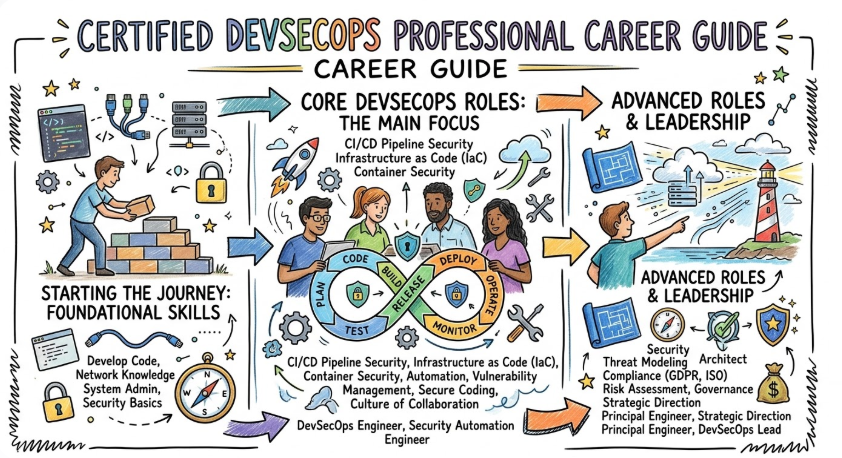
The global technology landscape is currently undergoing a massive transformation where security is no longer a peripheral concern but a core architectural requirement. For engineers and managers across India and the international tech hubs, the traditional separation between “building” and “protecting” has vanished. Today, the most valuable technical assets are those who can integrate security into the very DNA of the software delivery lifecycle.
This guide explores the strategic importance of the Certified DevSecOps Professional (CDP) and how it serves as a foundational pillar for any career aiming for technical mastery in the modern cloud-native ecosystem.
The Strategic Shift to DevSecOps
In the past, security was often a bottleneck—a final check before production that delayed releases. In a world of high-velocity CI/CD, that model is obsolete. Modern engineering requires “Shift-Left” security, where vulnerabilities are identified and mitigated at the moment of creation.
For the working professional, moving into DevSecOps isn’t just about learning a new tool; it’s about adopting a mindset where security is treated as code. This transition is essential for Software Engineers, DevOps specialists, and Engineering Managers who want to remain relevant in a market that rewards resilience as much as speed.
Deep Dive: Certified DevSecOps Professional
The Certified DevSecOps Professional (CDP) is the industry standard for those seeking to bridge the gap between rapid development and robust security automation.
What it is
The Certified DevSecOps Professional (CDP) is a rigorous, hands-on certification program designed to validate your expertise in automating security within the DevOps pipeline. It moves beyond theoretical concepts to focus on the practical implementation of “Security as Code.” By mastering this program, you demonstrate the ability to build automated defense systems that scale with modern cloud infrastructures.
Who should take it
- Software Engineers: Developers who want to take ownership of their code’s security posture and build inherently secure applications.
- DevOps & SRE Professionals: Engineers looking to expand their automation capabilities into the security domain to drive higher system reliability.
- Security Engineers: Professionals transitioning from manual audits to automated, pipeline-integrated security testing.
- Engineering Managers: Leaders responsible for implementing secure development standards across global engineering teams.
Skills you’ll gain
This program equips you with a comprehensive toolkit to manage security at every stage of the lifecycle. You will transition from being an operator to an architect of secure systems.
- Integrated Pipeline Defense: You will learn to embed security gates into major CI/CD platforms like Jenkins, GitLab, and GitHub Actions, ensuring no vulnerable code reaches production.
- Automated Security Analysis: Mastery over Static Application Security Testing (SAST) and Dynamic Application Security Testing (DAST) allows you to catch flaws in both source code and running services.
- Supply Chain Security: Skills in Software Composition Analysis (SCA) will enable you to identify and neutralize risks in third-party libraries and open-source components.
- Cloud-Native & Container Security: You will gain the ability to harden Docker images and implement runtime security policies within Kubernetes clusters.
- Automated Compliance: Learn how to translate complex regulatory requirements into automated scripts that continuously audit your infrastructure.
- Infrastructure as Code (IaC) Scanning: Develop the expertise to scan Terraform and Ansible scripts for misconfigurations before they are ever deployed to the cloud.
Real-world projects you should be able to do after it
Completing the CDP means you are ready to solve complex, high-stakes engineering challenges. Your portfolio will include:
- Self-Healing Security Pipelines: Architecting a CI/CD flow that automatically blocks deployments, alerts developers, and suggests fixes when a critical vulnerability is detected.
- Enterprise-Scale Secret Management: Implementing centralized vault systems (like HashiCorp Vault) to eliminate hardcoded credentials across thousands of repositories.
- Continuous Compliance Dashboards: Building real-time monitoring systems that track your organization’s adherence to global standards like SOC2 or ISO 27001.
- Automated Container Patching: Designing a system that detects CVEs in production containers and automatically triggers a secure rebuild and redeploy process.
Preparation plan
Your path to certification should be structured according to your existing professional workload.
- 14-Day Accelerated Path (For Active Practitioners): Focus strictly on the integration of specific security tools within the pipeline and perfecting your speed in the hands-on lab environments.
- 30-Day Professional Path (For Standard Working Engineers): Dedicate the first two weeks to mastering SAST, DAST, and SCA. Spend the final two weeks on container security and end-to-end pipeline automation.
- 60-Day Foundation Path (For Career Transferees): Use the first month to solidify your DevOps and Cloud basics. Use the second month to dive deep into the security-specific modules of the CDP curriculum.
Common mistakes
Even highly skilled engineers can struggle if they approach DevSecOps with an outdated perspective.
- Over-reliance on Manual Gates: The goal of DevSecOps is automation. If your security process still requires manual approval for every small change, you haven’t fully implemented the philosophy.
- Treating Security as an Isolated Task: Security must be integrated into the developer’s workflow. If your security tools are too difficult for developers to use, the system will fail.
- Neglecting the Labs: The CDP is a performance-based validation. Reading the theory is not enough; you must spend significant time writing code and fixing broken environments in the labs.
Global Landscape: Master Certification Table
Navigating the various tracks of modern engineering requires a clear roadmap. we have mapped the top certifications for the global market.
| Track | Level | Who it’s for | Prerequisites | Skills Covered | Recommended Order |
| DevSecOps | Professional | Engineers/Managers | DevOps/Linux | SAST, DAST, SCA, CI/CD | 1st (The Defense) |
| Observability | Master | Senior Engineers | 2+ Years Exp. | Metrics, Tracing, SLOs | 2nd (The Vision) |
| SRE | Professional | SREs/Ops | Cloud Basics | Error Budgets, Reliability | 1st (The Foundation) |
| AIOps | Professional | Data/Ops | Python/Stats | Anomaly Detection, ML | 3rd (The Future) |
| FinOps | Associate | Managers/Architects | Cloud Awareness | Cost Optimization | 2nd (The Business) |
Choose Your Path: 6 Architectural Learning Journeys
- The DevOps Path: Focus on creating high-velocity, automated delivery systems.
- The DevSecOps Path: Focus on building secure-by-default pipelines and automated defense.
- The SRE Path: Focus on system reliability, scalability, and incident management.
- The AIOps/MLOps Path: Focus on applying AI/ML to manage and optimize infrastructure.
- The DataOps Path: Focus on the automated and secure flow of high-volume data.
- The FinOps Path: Focus on the financial efficiency and cost-governance of cloud operations.
Role → Recommended Certifications Mapping
Align your learning with your current or aspirational role to maximize career impact.
- DevOps Engineer: DevOps Professional → Certified DevSecOps Professional.
- SRE: SRE Professional → Master in Observability Engineering.
- Platform Engineer: Kubernetes Specialist → Certified DevSecOps Professional.
- Cloud Engineer: Cloud Architect → Certified DevSecOps Professional.
- Security Engineer: Ethical Hacking → Certified DevSecOps Professional.
- Data Engineer: DataOps Professional → Master in Observability Engineering.
- FinOps Practitioner: FinOps Associate → Master in Observability Engineering.
- Engineering Manager: DevSecOps Manager → Master in Observability Engineering.
Leading Training Institutions for DevSecOps Mastery
Selecting the right training partner is critical for mastering the practical aspects of DevSecOps. These institutions are recognized for their commitment to engineering excellence.
DevOpsSchool
DevOpsSchool is a global leader in providing deep-dive, instructor-led training. Their programs are designed to replicate real-world enterprise environments, providing students with the hands-on experience needed to lead digital transformation projects in top-tier organizations.
Cotocus
Cotocus focuses on the intersection of cloud-native technology and corporate readiness. Their training methodology emphasizes the “Day 1” skills required to manage production-grade infrastructure, making them a preferred partner for engineers aiming for high-growth tech roles.
Scmgalaxy
Scmgalaxy serves as a massive knowledge repository and community for SCM and DevOps professionals. They provide specialized training that covers the entire software configuration management lifecycle, with a strong focus on automation and security.
BestDevOps
BestDevOps offers focused, high-impact training modules designed for the modern working professional. Their approach is results-oriented, helping engineers quickly acquire the specific skills needed to advance their careers in a competitive market.
This institution is dedicated exclusively to the security side of the DevOps lifecycle. Their curriculum is highly specialized, ensuring that graduates are experts in the niche but critical field of automated security and compliance.
sreschool
SRESchool provides the definitive training for those looking to master Site Reliability Engineering. They teach the frameworks and mindsets necessary to maintain massive, distributed systems with the highest levels of uptime and performance.
aiopsschool
AIOpsSchool is at the forefront of the next wave of operations. They provide the training necessary to integrate artificial intelligence into the DevOps lifecycle, focusing on predictive maintenance and automated problem resolution.
dataopsschool
DataOpsSchool addresses the unique security and reliability needs of data-driven organizations. Their programs teach how to apply the principles of DevOps to data engineering, ensuring that data is both high-quality and highly secure.
finopsschool
FinOpsSchool focuses on the financial governance of the cloud. They provide engineers and managers with the tools to balance technical performance with financial accountability, a skill that is increasingly in demand as cloud budgets grow.
Next Step Certification Options:
- Same Track: Certified DevSecOps Expert – for those wanting to reach the pinnacle of technical defense.
- Cross-Track: Master in Observability Engineering – to gain total transparency into production systems.
- Leadership Track: Engineering Management Masterclass – to move into high-level strategic leadership roles.
FAQs – Career & Market Outcomes
- Why is DevSecOps more valuable than traditional DevOps? Because it addresses the single biggest risk to modern business: security breaches.
- How does this certification help in the Indian market? India is a global hub for SaaS and IT services; these firms are desperately seeking certified security-automation experts.
- Is the Master in Observability difficult for beginners? It is an advanced track; we recommend having a solid understanding of Linux and networking first.
- Can I balance these certifications with a full-time job? Yes, the 30-day preparation plans are designed specifically for working professionals.
- What is the ROI of these programs? Most professionals report a significant increase in both salary offers and the quality of roles they are considered for.
- Are these skills applicable to all cloud providers? Yes, the concepts of SAST, DAST, and O11y are universal across AWS, Azure, and Google Cloud.
- Do I need a computer science degree? No, practical skills and certifications are often prioritized over formal degrees in the current tech market.
- Which path is better: SRE or DevSecOps? Both are excellent. Choose SRE if you love system performance; choose DevSecOps if you love system security.
- How do these certifications help managers? They provide the technical literacy needed to lead complex teams and make informed budget decisions.
- Is there a community for these students? Yes, platforms like Scmgalaxy offer massive communities for networking and peer support.
- Do I need to be a coding expert? You should be comfortable with basic scripting and YAML, but you don’t need to be a full-stack developer.
- How often should I recertify? Every 2-3 years is standard to ensure your skills remain aligned with the latest technology shifts.
FAQs – Certified DevSecOps Professional Specifics
- What is the exam format? It is a practical, lab-based exam where you must implement security tools in a live environment.
- Does it cover Kubernetes? Yes, container and orchestration security are central to the curriculum.
- What tools will I learn? You will work with industry leaders like Snyk, SonarQube, Vault, and various open-source security scanners.
- Is the certification recognized globally? Yes, it is a standard credential for DevSecOps roles worldwide.
- Does it cover “Security as Code”? This is the core focus—writing scripts and policies that automate security tasks.
- Can I take the exam online? Yes, proctored online exams are available through authorized providers.
- What if I fail the exam? Most providers offer a retake policy and additional lab time to help you succeed on your next attempt.
- Is there a focus on API security? Yes, securing the communication between services is a key part of the DAST and pipeline security modules.
Conclusion
Mastering the Certified DevSecOps Professional domain is an investment in your technical future that yields immediate professional dividends. In an era where data breaches and system failures can cost millions, the ability to build and observe secure, resilient pipelines is the ultimate competitive advantage. By moving through these certification tracks—from DevSecOps to the Master in Observability Engineering—you are doing more than just earning badges; you are evolving into a high-level technical architect capable of leading the most complex engineering challenges of the next decade. The path to mastery is built on continuous learning, hands-on practice, and the strategic foresight to stay ahead of the technology curve.

Find Trusted Cardiac Hospitals
Compare heart hospitals by city and services — all in one place.
Explore Hospitals