
Introduction
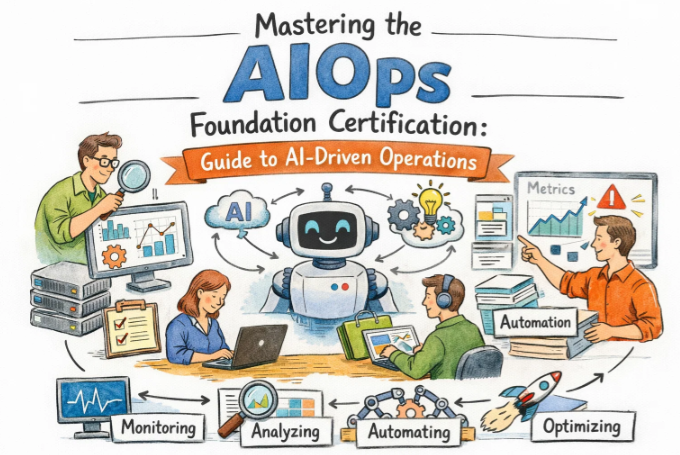
The modern operational landscape is shifting from manual intervention toward automated, intelligent systems. The AIOps Foundation Certification is designed to bridge the gap between traditional infrastructure management and the data-driven future of systems engineering. This guide is crafted for professionals who recognize that standard DevOps and SRE practices are no longer sufficient to handle the scale and complexity of cloud-native environments. By pursuing this path at AIOps School, engineers and managers can gain a structured understanding of how machine learning and big data integrate with daily operations. This document provides a transparent look at the certification to help you determine if it aligns with your specific career trajectory and organizational goals.
What is the AIOps Foundation Certification?
The AIOps Foundation Certification represents a specialized validation of an engineer’s ability to apply artificial intelligence and machine learning to IT operations. It exists because the sheer volume of telemetry data—logs, metrics, and traces—generated by modern microservices has surpassed human cognitive limits. Rather than focusing on abstract theory, this certification emphasizes the practical application of algorithmic analysis to reduce “noise” in monitoring systems. It aligns with modern engineering workflows by teaching professionals how to move from reactive troubleshooting to proactive, automated incident remediation within enterprise-grade environments.
Who Should Pursue AIOps Foundation Certification?
This certification is highly beneficial for DevOps engineers, Site Reliability Engineers (SREs), and Cloud Architects who are responsible for maintaining high availability in complex systems. Security and data professionals will also find value here, as the principles of pattern recognition and anomaly detection are universal across these domains. For beginners, it provides a roadmap for entering a high-growth field, while experienced engineers can use it to formalize their knowledge of automated operations. In both the Indian market and the global tech landscape, these skills are becoming a prerequisite for senior-level platform engineering roles.
Why AIOps Foundation Certification is Valuable and Beyond
As enterprises continue their digital transformation, the demand for “intelligent” operations is skyrocketing, ensuring long-term career longevity for those who master these tools. This certification helps professionals stay relevant even as specific vendors or cloud providers change, because it focuses on the underlying logic of data-driven operations. Organizations are rapidly adopting AIOps to reduce Mean Time to Repair (MTTR) and improve developer productivity, making certified individuals high-value assets. Ultimately, the return on time investment is significant, as it positions you at the intersection of Data Science and Infrastructure.
AIOps Foundation Certification Overview
The program is delivered via the official course portal and is hosted on AIOps School. It is structured as a comprehensive introduction to the core pillars of AI-driven operations, including data ingestion, pattern discovery, and automated response. The assessment approach focuses on validating a candidate’s grasp of how AI can be integrated into existing CI/CD pipelines and monitoring stacks. Unlike generic IT certificates, this program is owned and curated by industry practitioners who prioritize the actual utility of the skills in a production-ready environment.
AIOps Foundation Certification Tracks & Levels
The certification path is divided into Foundation, Professional, and Advanced levels to accommodate various stages of professional growth. The Foundation level establishes the core vocabulary and concepts, while Professional and Advanced tracks dive deep into specialized implementations for SRE, FinOps, or DevSecOps. These tracks are designed to align with career progression, allowing an engineer to start with the basics and eventually move into architecting global-scale AIOps platforms. This tiered structure ensures that learning is continuous and maps directly to increasing levels of organizational responsibility.
Complete AIOps Foundation Certification Table
| Track | Level | Who it’s for | Prerequisites | Skills Covered | Recommended Order |
| Core Operations | Foundation | Junior Engineers / Managers | Basic IT Knowledge | AIOps Pillars, Data Basics | 1 |
| Engineering | Professional | SREs / DevOps Leads | 2+ Years Experience | ML Models, Anomaly Detection | 2 |
| Architecture | Advanced | Principal Engineers | Professional Cert | System Design, Automation | 3 |
| Specialized | FinOps | Cloud Economists | Foundation Cert | Cost Optimization via AI | Optional |
| Specialized | DevSecOps | Security Engineers | Foundation Cert | Threat Detection via AI | Optional |
Detailed Guide for Each AIOps Foundation Certification
AIOps Foundation Certification – Foundation Level
What it is
This certification validates a foundational understanding of how artificial intelligence transforms traditional IT operations. It confirms that the holder understands the primary terminology, the data lifecycle, and the business value of AIOps.
Who should take it
It is suitable for IT generalists, system administrators, and technical project managers who need to speak the language of modern operations. It is also the ideal starting point for experienced DevOps engineers transitioning into AI-driven roles.
Skills you’ll gain
- Understanding the five dimensions of AIOps.
- Ability to differentiate between Big Data and Machine Learning in IT.
- Knowledge of noise reduction and event correlation techniques.
- Familiarity with the AIOps implementation roadmap.
Real-world projects you should be able to do
- Create a business case for adopting AIOps in a legacy environment.
- Map out a data ingestion pipeline for centralized logging.
- Identify key performance indicators (KPIs) for automated systems.
Preparation plan
- 7–14 days: Intense review of official course materials and core terminology.
- 30 days: Inclusion of practical labs and study of industry whitepapers on AI operations.
- 60 days: Deep dive into case studies and practice exams to ensure conceptual mastery.
Common mistakes
- Overcomplicating the math behind ML instead of focusing on operational utility.
- Neglecting the importance of high-quality data ingestion.
- Treating AIOps as a “silver bullet” that solves all cultural problems instantly.
Best next certification after this
- Same-track option: AIOps Professional Certification.
- Cross-track option: SRE Foundation Certification.
- Leadership option: Digital Transformation Officer Track.
Choose Your Learning Path
DevOps Path
In this path, the focus is on integrating AI into the continuous delivery pipeline to predict deployment failures before they occur. Engineers learn to use AIOps tools to analyze commit patterns and test results, ensuring that only high-quality code reaches production. The goal is to move from automated testing to “intelligent” testing that adapts to code changes dynamically. This path is essential for organizations looking to scale their deployment frequency without compromising system stability.
DevSecOps Path
The DevSecOps path emphasizes the use of AI for real-time threat detection and automated security responses within the infrastructure. Professionals learn how to train models to recognize abnormal user behavior or unauthorized access attempts that traditional rule-based systems might miss. By applying AI to security logs, engineers can reduce the time it takes to identify and mitigate vulnerabilities. This specialization is critical for maintaining compliance and protecting sensitive data in distributed cloud environments.
SRE Path
For SREs, AIOps is a force multiplier that helps manage error budgets and service level objectives (SLOs) with greater precision. This path teaches how to use predictive analytics to forecast potential outages and automate the remediation of recurring issues. Engineers focus on “self-healing” infrastructure, where the system can adjust resources or restart services based on AI-driven insights. It is the gold standard for those aiming to manage massive, high-concurrency platforms with minimal manual toil.
AIOps Path
The dedicated AIOps path is for those who wish to become specialists in building and maintaining the AI platforms that power modern operations. This involves deep knowledge of data science platforms, streaming data architectures, and the orchestration of machine learning models. Professionals in this path act as the bridge between data scientists and infrastructure engineers, ensuring models are performant in production. It is a highly technical route focused on the architecture of intelligence itself.
MLOps Path
The MLOps path is specifically designed for managing the lifecycle of machine learning models used across the enterprise. It addresses the challenges of model versioning, data drift, and automated retraining pipelines to ensure that AI remains accurate over time. Engineers learn how to treat ML models with the same rigor as software code, applying CI/CD principles to the data science workflow. This path is vital for companies that rely on AI for their core product offerings and business logic.
DataOps Path
DataOps focuses on the automated, policy-based management of data flows to ensure that AIOps engines have access to clean, reliable information. This path covers data quality, governance, and the orchestration of complex data pipelines across hybrid cloud environments. Professionals learn how to reduce the cycle time of data analytics, making it easier for the organization to derive insights. It is an essential foundation for any successful AI initiative, as the quality of AI output is entirely dependent on the data input.
FinOps Path
The FinOps path utilizes AI to manage and optimize cloud spending in real-time, preventing “cloud sprawl” and unexpected billing spikes. Engineers learn how to use machine learning to predict future usage patterns and recommend the most cost-effective reserved instances or spot-market purchases. This path bridges the gap between engineering and finance, providing clear visibility into the ROI of cloud investments. It is increasingly popular as enterprises look to tighten budgets without sacrificing technical performance.
Role → Recommended AIOps Foundation Certifications
| Role | Recommended Certifications |
| DevOps Engineer | AIOps Foundation + DevOps Professional |
| SRE | AIOps Foundation + SRE Advanced |
| Platform Engineer | AIOps Foundation + Cloud Architecture |
| Cloud Engineer | AIOps Foundation + FinOps Track |
| Security Engineer | AIOps Foundation + DevSecOps Expert |
| Data Engineer | AIOps Foundation + DataOps Specialist |
| FinOps Practitioner | AIOps Foundation + FinOps Certified |
| Engineering Manager | AIOps Foundation + Leadership Track |
Next Certifications to Take After AIOps Foundation Certification
Same Track Progression
After completing the Foundation level, the most logical step is to move toward the Professional and Master levels within the AIOps domain. This allows for a deeper dive into the specific algorithms and architectural patterns required to build a custom AIOps platform. Deep specialization ensures you are recognized as a subject matter expert who can lead large-scale digital transformation projects. It also prepares you for roles like Chief Data Officer or Head of Infrastructure.
Cross-Track Expansion
Broadening your skills by pursuing certifications in SRE or DevSecOps can make you a more versatile engineer. Understanding how AI interacts with security protocols or reliability engineering frameworks allows you to solve cross-functional problems. This “T-shaped” skill set is highly valued in modern flat organizations where engineers are expected to handle multiple aspects of the lifecycle. It ensures you remain an asset regardless of which specific technology stack the company uses.
Leadership & Management Track
For those looking to move away from hands-on keyboard work, the leadership track focuses on the strategy and economics of AIOps. This involves learning how to manage teams of AI engineers, setting long-term technical roadmaps, and communicating the value of AI to non-technical stakeholders. This transition is ideal for senior engineers who want to influence the direction of the entire organization. It requires a balance of technical understanding and business acumen.
Training & Certification Support Providers for AIOps Foundation Certification
DevOpsSchool provides a comprehensive curriculum that covers the entire lifecycle of software development, focusing on the integration of AI into existing pipelines. Their instructors are industry veterans who bring real-world scenarios into the classroom, ensuring students learn practical skills. The school offers both self-paced and instructor-led training options to suit different learning styles.
Cotocus is known for its hands-on approach to technical training, offering immersive bootcamps that focus on the architectural aspects of AIOps. They provide extensive lab environments where students can practice deploying and managing AI models in real-time. Their certification support is highly regarded for its focus on production-grade engineering.
Scmgalaxy offers a wealth of resources for version control and configuration management, which are essential precursors to a successful AIOps implementation. Their community-driven approach provides students with access to a vast network of professionals and open-source tools. They are a go-to resource for engineers looking to master the “Ops” part of AIOps.
BestDevOps focuses on the elite practices of high-performing technology organizations, helping students understand how to achieve global-scale reliability. Their training modules are designed to be concise and high-impact, perfect for busy professionals. They emphasize the cultural shifts required to successfully adopt AI-driven operations.
devsecopsschool.com is the premier destination for learning how to secure the modern software supply chain using AI. Their courses cover everything from automated vulnerability scanning to AI-driven threat intelligence. They ensure that security is not an afterthought but a core component of the operational lifecycle.
sreschool.com specializes in the principles of Site Reliability Engineering, teaching students how to use AI to maintain system uptime and performance. Their curriculum is heavily influenced by the practices of major tech giants, providing a blueprint for scalable operations. They focus on the elimination of toil through intelligent automation.
aiopsschool.com is the primary host for the AIOps Foundation Certification, providing the most direct and authoritative path to mastery. Their platform is designed specifically for AI operations, offering tailored content that isn’t found in more generalist schools. They are the leaders in defining the standards for the AIOps profession.
dataopsschool.com addresses the critical need for high-quality data in the AI lifecycle, teaching engineers how to build robust data pipelines. Their training focuses on the intersection of data engineering and operations, ensuring a smooth flow of information. They are essential for anyone looking to specialize in the data-heavy aspects of AIOps.
finopsschool.com teaches the art of cloud financial management, using AI to provide deep insights into infrastructure costs. Their courses are designed for both engineers and finance professionals, fostering a collaborative approach to cloud spending. They help organizations maximize the value of every dollar spent in the cloud.
Frequently Asked Questions (General)
- How difficult is the AIOps Foundation exam?
The exam is designed to be accessible to those with a solid background in IT operations, focusing more on conceptual understanding than complex mathematical formulas. - How much time is required to prepare?
Most professionals find that 30 days of consistent study is sufficient to master the core concepts and pass the certification exam comfortably. - Are there any prerequisites for the foundation level?
There are no formal prerequisites, but a basic understanding of Linux, cloud computing, and the software development lifecycle is highly recommended. - What is the ROI of this certification?
Certified professionals often see an increase in salary and job opportunities, as AIOps is one of the highest-paying and fastest-growing specializations in tech. - Can I take the exam online?
Yes, the certification is designed to be accessible globally through an online proctored environment, allowing you to learn and test from anywhere. - Is this certification recognized globally?
AIOps School certifications are recognized by major enterprises and consultancy firms worldwide as a standard for AI operational excellence. - Does this certification expire?
The certification is typically valid for two to three years, after which a refresher or a higher-level certification is recommended to stay current. - Is there a focus on specific tools like Splunk or Datadog?
The foundation level is vendor-neutral, focusing on the underlying principles that apply to all major AIOps tools and platforms. - How does this differ from a Data Science certification?
This certification focuses on the application of AI specifically for IT operations, rather than the general development of machine learning models. - Is there a community for certified professionals?
Yes, holders gain access to an exclusive network of practitioners where they can share best practices and find career opportunities. - What kind of study materials are provided?
Students receive comprehensive study guides, access to video lectures, and practice exams that closely mimic the actual testing environment. - Can managers benefit from this certification?
Absolutely, as it provides the technical literacy needed to lead AIOps initiatives and make informed decisions about tool procurement and team structure.
FAQs on AIOps Foundation Certification
- What are the core pillars of the AIOps Foundation curriculum?
The curriculum focuses on data selection, pattern discovery, inference, communication, and automation as the fundamental steps of the AIOps process. - How does this certification help with career progression?
It validates your transition from a traditional administrator to a modern platform engineer, making you eligible for high-level architect and lead roles. - Is there a practical lab component in the training?
Most supported providers include hands-on labs where you can interact with simulated data sets to see AIOps principles in action. - Does the exam cover MLOps and DataOps?
The Foundation level introduces these concepts as part of the broader ecosystem, while higher levels provide deeper specialization in each area. - How is the certification delivered?
It is delivered digitally through AIOps School, ensuring that all materials and exams are updated frequently to reflect the latest industry trends. - Are there group discounts for corporate teams?
Many training providers offer bulk pricing for organizations looking to certify their entire DevOps or SRE departments simultaneously. - What is the passing score for the exam?
The passing score is typically set at 70 percent, ensuring that candidates have a firm grasp of the essential concepts before being certified. - Can I jump straight to the Professional level?
It is generally recommended to complete the Foundation level first to ensure a common vocabulary and understanding of the core framework.
Final Thoughts: Is AIOps Foundation Certification Worth It?
In my experience, the transition to AI-driven operations is not a matter of “if” but “when.” The AIOps Foundation Certification provides a clear, structured path for engineers who want to stay ahead of the curve and avoid being left behind by the rapid pace of automation. It isn’t just about adding a badge to your resume; it’s about fundamentally changing how you approach system reliability and scalability. If you are looking to move into a senior or lead role within a modern tech organization, this certification is a highly practical and worthwhile investment in your future. Focus on the principles, master the data lifecycle, and you will find yourself at the forefront of the next generation of IT operations.

Find Trusted Cardiac Hospitals
Compare heart hospitals by city and services — all in one place.
Explore Hospitals