
Introduction
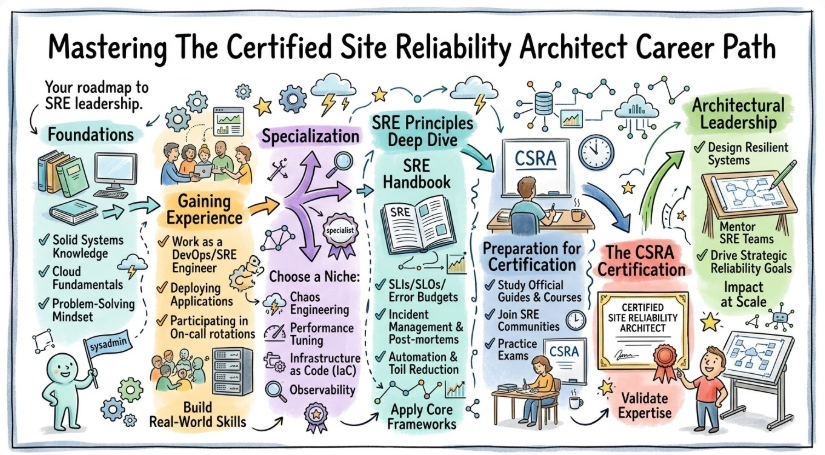
The Certified Site Reliability Architect is a comprehensive professional program designed to bridge the gap between traditional software engineering and modern operational excellence. This guide is tailored for engineers and technical managers who recognize that reliability is not just a feature but a foundational requirement for any cloud-native enterprise. By exploring the depths of this architectural framework, professionals can navigate the evolving landscape of DevOps, platform engineering, and distributed systems with confidence. We have structured this analysis to provide a clear roadmap for career growth through the specialized resources available at sreschool.
What is the Certified Site Reliability Architect?
The Certified Site Reliability Architect represents a high-level mastery of the principles that govern stable, scalable, and efficient production environments. It exists to formalize the advanced skill set required to design systems that are inherently resilient to failure while maintaining a high velocity of feature delivery. Unlike theoretical certifications, this program emphasizes real-world application, focusing on how architectural decisions impact long-term maintenance and operational overhead. It aligns perfectly with modern engineering workflows by integrating observability, automation, and incident response into the very core of the system design process.
Who Should Pursue Certified Site Reliability Architect?
This certification is ideal for senior software engineers, system architects, and DevOps leads who are responsible for the uptime and performance of large-scale applications. Cloud professionals and security engineers will find the curriculum valuable for understanding how infrastructure-as-code and security-by-design intersect with reliability goals. Even data professionals and engineering managers can benefit from the architectural insights to better lead teams through complex digital transformations. In the competitive job markets of India and the global tech hubs, holding this credential signals a deep commitment to engineering quality and operational maturity.
Why Certified Site Reliability Architect is Valuable and Beyond
The demand for reliable systems continues to grow as enterprises migrate mission-critical workloads to multi-cloud and hybrid environments. This certification provides longevity to a professional career because it focuses on enduring architectural principles rather than the fleeting syntax of specific tools. As organizations face increasing pressure to reduce downtime and improve user experience, the ability to architect for reliability becomes a high-value skill set with significant ROI. By investing time in this certification, you ensure your relevance in a market that is shifting from simple automation to sophisticated, self-healing system architecture.
Certified Site Reliability Architect Certification Overview
The program is delivered via the specialized curriculum and assessment framework provided by the official training portal. It is hosted on the primary platform for SRE education, ensuring that all content is curated by industry practitioners with decades of experience. The certification structure is designed to be practical, utilizing scenario-based assessments that mirror the challenges faced in production-grade environments. Ownership of the certification rests with a body dedicated to advancing SRE standards, providing a clear path from foundational knowledge to advanced architectural mastery.
Certified Site Reliability Architect Certification Tracks & Levels
The certification is organized into three primary tiers: foundation, professional, and advanced, allowing for a structured progression of skills. The foundation level introduces the core vocabulary and concepts, while the professional level dives deep into the implementation of SRE patterns and practices. Advanced levels are reserved for those designing organization-wide reliability strategies and leading large-scale platform engineering initiatives. These tracks are further specialized into areas like FinOps, AI-driven operations, and security, ensuring that your learning path aligns with your specific career trajectory and organizational needs.
Complete Certified Site Reliability Architect Certification Table
| Track | Level | Who it’s for | Prerequisites | Skills Covered | Recommended Order |
| Core SRE | Foundation | Junior Engineers | Basic Linux/Cloud | SLIs/SLOs, Error Budgets | 1 |
| SRE Architecture | Professional | Senior Engineers | Foundation Level | Microservices Design, IaC | 2 |
| Platform Ops | Professional | Platform Engineers | 3+ Years Exp | Kubernetes, Observability | 2 |
| Reliability Lead | Advanced | Architects/Leads | Professional Level | Capacity Planning, Post-mortems | 3 |
| Specialized SRE | Advanced | Domain Specialists | Professional Level | AIOps, Chaos Engineering | 3 |
Detailed Guide for Each Certified Site Reliability Architect Certification
What it is
This certification validates a professional’s understanding of the core Site Reliability Engineering principles as defined by industry leaders. It confirms that the candidate can speak the language of reliability and understands the fundamental relationship between development and operations.
Who should take it
It is suitable for software developers, system administrators, and recent graduates who want to enter the SRE field. It is also highly recommended for project managers who need to understand the technical constraints of the systems their teams build.
Skills you’ll gain
- Defining and calculating SLIs, SLOs, and SLAs.
- Understanding and managing Error Budgets.
- Implementing basic monitoring and alerting strategies.
- Applying the concept of Toil reduction through automation.
- Participating effectively in incident response and blameless post-mortems.
Real-world projects you should be able to do
- Set up a monitoring dashboard for a web application using standard metrics.
- Draft a basic Service Level Objective document for a production service.
- Identify and automate a repetitive manual task using scripting.
Preparation plan
- 7–14 days: Intensive review of the SRE handbook and core definitions while taking practice quizzes.
- 30 days: Deep dive into case studies and basic hands-on labs involving monitoring tools and automation scripts.
- 60 days: Comprehensive study including advanced scenario analysis and contributing to a small-scale reliability project at work.
Common mistakes
- Focusing too much on specific tool syntax rather than the underlying SRE principles.
- Underestimating the importance of the cultural and psychological aspects of blamelessness.
- Confusing SLAs with SLOs during the assessment process.
Best next certification after this
- Same-track option: Certified Site Reliability Architect – Professional.
- Cross-track option: Certified DevSecOps Professional.
- Leadership option: Engineering Management Certification.
Choose Your Learning Path
DevOps Path
The DevOps path focuses on the seamless integration of development and operations through continuous delivery and cultural alignment. This path is ideal for those who want to master the entire software delivery lifecycle, from code commit to production deployment. You will learn to build robust CI/CD pipelines and foster a culture of shared responsibility. This journey emphasizes speed and quality, ensuring that software is delivered frequently and reliably to end-users.
DevSecOps Path
The DevSecOps path integrates security into every stage of the development and operations cycle, treating security as code. It is designed for professionals who want to ensure that reliability does not come at the cost of vulnerability. You will gain skills in automated security testing, compliance-as-code, and identity management within cloud-native environments. This path is crucial for organizations operating in highly regulated industries or those facing significant cybersecurity threats.
SRE Path
The SRE path is the most direct route to mastering the Certified Site Reliability Architect principles by focusing on system stability. You will delve into the nuances of observability, incident management, and performance tuning at scale. This path teaches you how to balance the need for new features with the requirement for a stable production environment. It is the gold standard for engineers who want to manage complex, distributed systems that serve millions of users.
AIOps Path
The AIOps path explores the application of artificial intelligence and machine learning to IT operations. You will learn how to use data-driven insights to predict outages, automate root cause analysis, and optimize resource allocation. This path is perfect for those who want to stay at the cutting edge of operational technology and manage high-volume telemetry data. It prepares you to build proactive rather than reactive systems, significantly reducing the mean time to detect issues.
MLOps Path
The MLOps path focuses on the operational challenges specific to deploying and maintaining machine learning models in production. It addresses the unique requirements of model versioning, data drift monitoring, and hardware acceleration in a reliable manner. Professionals on this path ensure that AI initiatives are scalable and sustainable within the broader corporate infrastructure. It bridges the gap between data science and traditional software engineering, providing a framework for reliable AI delivery.
DataOps Path
The DataOps path applies the principles of SRE and DevOps to data engineering and analytics pipelines. You will learn how to ensure data quality, reliability, and accessibility across the entire organization by treating data as a product. This path involves building automated pipelines for data ingestion, transformation, and storage with high uptime requirements. It is essential for organizations that rely on real-time data for decision-making and operational intelligence.
FinOps Path
The FinOps path centers on the financial management and optimization of cloud resources through architectural efficiency. You will gain the skills to align cloud spending with business value while maintaining the performance and reliability of your systems. This path teaches you how to implement cost-allocation strategies, rightsizing, and architectural changes that reduce waste. It is a critical path for senior architects who need to prove the economic viability of their technical designs.
Role → Recommended Certified Site Reliability Architect Certifications
| Role | Recommended Certifications |
| DevOps Engineer | SRE Foundation, Professional DevOps Track |
| SRE | SRE Foundation, Architect Professional, AIOps |
| Platform Engineer | SRE Professional, Kubernetes Specialization |
| Cloud Engineer | SRE Foundation, Multi-cloud Architecture |
| Security Engineer | SRE Foundation, DevSecOps Specialist |
| Data Engineer | SRE Foundation, DataOps Certification |
| FinOps Practitioner | SRE Foundation, FinOps Optimization Track |
| Engineering Manager | SRE Foundation, Leadership and SRE Strategy |
Next Certifications to Take After Certified Site Reliability Architect
Same Track Progression
Deep specialization within the SRE track involves moving toward the Advanced Architect or Principal SRE designations. These certifications focus on organizational strategy, cross-team reliability initiatives, and the design of global-scale systems. You will learn to manage massive complexity and drive cultural shifts toward reliability across entire enterprises. This progression is suited for those who wish to remain technical leaders while influencing broad architectural standards.
Cross-Track Expansion
Broadening your skills into areas like DevSecOps or MLOps allows you to become a more versatile architect who can handle diverse workloads. By understanding how reliability interacts with security and data science, you become a bridge between different engineering departments. This expansion makes you an invaluable asset during complex digital transformations where multiple technologies must converge. It also provides a safety net against market shifts in any single technology domain.
Leadership & Management Track
For those looking to transition away from day-to-day coding, the leadership track focuses on engineering management and SRE advocacy. This involves learning how to manage budgets, lead diverse teams, and communicate technical risk to non-technical stakeholders. You will focus on building high-performing teams that embrace SRE principles as a core part of their identity. This path is ideal for senior engineers who want to scale their impact through people and organizational design.
Training & Certification Support Providers for Certified Site Reliability Architect
DevOpsSchool
DevOpsSchool provides a robust ecosystem for professionals looking to master SRE and DevOps methodologies through hands-on training and mentorship. Their curriculum is deeply rooted in industry requirements, offering a blend of theoretical knowledge and practical lab exercises that prepare students for real-world challenges. With a strong focus on community learning, they provide extensive resources and post-training support to ensure career success. They are widely recognized for their comprehensive approach to technical education in the Indian and global markets.
Cotocus
Cotocus stands out as a specialized provider that delivers high-quality training focused on the practical implementation of cloud and reliability technologies. Their instructors are veteran practitioners who bring years of field experience into the classroom, ensuring that the training is relevant to current industry trends. They offer flexible learning options that cater to working professionals, making it easier to balance career growth with existing responsibilities. Their commitment to excellence has made them a preferred partner for many corporate training initiatives.
Scmgalaxy
Scmgalaxy is a premier destination for engineers seeking in-depth knowledge of configuration management, SRE, and continuous integration. They host a vast repository of tutorials, blogs, and community forums that serve as a continuous learning platform for professionals at all levels. Their certification programs are designed to be rigorous and thorough, testing the actual technical capabilities of the candidates. By fostering a culture of knowledge sharing, they have built one of the largest communities of DevOps and SRE experts.
BestDevOps
BestDevOps focuses on providing streamlined and efficient learning paths for those who want to achieve certification quickly without sacrificing depth. Their training modules are highly structured and targeted toward the specific competencies required by major certification bodies. They utilize modern pedagogical techniques to ensure high retention and successful application of learned skills. This provider is particularly noted for its clear communication and student-centric approach to complex technical topics.
devsecopsschool.com
This platform is dedicated entirely to the intersection of security and operations, providing the most specialized training in the DevSecOps domain. They recognize that in the modern era, reliability is impossible without security, and their courses reflect this critical dependency. Their curriculum covers everything from automated threat modeling to secure container orchestration. For an SRE looking to broaden their impact, this provider offers the necessary tools to integrate security into the heart of their architectural designs.
sreschool.com
As the primary host for the Certified Site Reliability Architect program, this site provides the most direct and authoritative learning path available. The content is curated specifically to align with the certification’s rigorous standards, offering a seamless experience from enrollment to examination. Their resources include detailed case studies, interactive labs, and direct access to SRE experts who have managed production at scale. It is the essential starting point for anyone serious about pursuing a career as a reliability architect.
aiopsschool.com
This provider leads the way in educating the next generation of engineers on the power of AI-driven operations. Their courses break down the complexities of machine learning and data science into actionable insights for IT professionals. They focus on how to build intelligent systems that can self-heal and predict issues before they impact the end-user. As the industry moves toward autonomous operations, this school provides the foundational knowledge required to stay ahead of the curve.
dataopsschool.com
Focusing on the burgeoning field of DataOps, this school teaches how to apply the agility of DevOps to the world of data management. They address the unique challenges of data latency, quality, and governance within high-pressure production environments. Their training is essential for SREs who are increasingly finding themselves responsible for the reliability of data-heavy applications. By mastering these skills, engineers can ensure that their organization’s data assets are as reliable as their software services.
finopsschool.com
FinOps School provides the specialized training needed to master the financial aspects of cloud architecture. They bridge the gap between engineering, finance, and business units, teaching a collaborative approach to cloud cost management. Their courses empower architects to make data-driven decisions that optimize spending while maintaining high levels of service reliability. In an era where cloud costs can spiral out of control, the skills taught here are vital for any senior engineering leader.
Frequently Asked Questions (General)
- How difficult is it to get an SRE certification?
The difficulty depends on your prior experience with Linux, networking, and software development, but it is generally considered moderate to high due to the requirement for practical application. - How long does it take to prepare for the foundation exam?
Most professionals find that 30 to 60 days of consistent study is sufficient to master the core concepts and pass the exam. - What are the prerequisites for the architect level?
Typically, you need a foundation-level certification and at least three to five years of experience in an engineering or operations role. - Is an SRE certification worth the investment?
Yes, as it is one of the highest-paying roles in the technology sector and provides a clear path for long-term career growth. - Should I learn DevOps or SRE first?
While they overlap, starting with DevOps provides a broad overview of delivery, while starting with SRE focuses immediately on production excellence and reliability. - Do these certifications require hands-on coding?
Yes, the professional and architect levels often involve practical labs where you must write automation scripts or configure monitoring tools. - Are these certifications recognized globally?
Yes, the principles of SRE are universal, and these credentials are valued by major tech companies and enterprises worldwide. - Can I skip the foundation level if I have experience?
While some programs allow it, taking the foundation exam ensures you have no gaps in your core knowledge and are familiar with the specific terminology used. - How often do I need to renew my certification?
Most SRE certifications require renewal or continuing education credits every two to three years to ensure your skills remain current. - Does this help in moving into management?
Absolutely, as it demonstrates an understanding of risk management, resource allocation, and organizational reliability strategy. - What is the passing score for most of these exams?
While it varies, most exams require a score of 70% or higher to demonstrate professional competency. - Are there any community groups for study?
Yes, platforms like Scmgalaxy and various LinkedIn groups provide vibrant communities for peer support and knowledge exchange.
FAQs on Certified Site Reliability Architect
- What is the core focus of the Certified Site Reliability Architect program?
It focuses on the architectural principles of building and maintaining highly reliable, scalable distributed systems using SRE methodologies. - Does this certification cover multi-cloud environments?
Yes, the architectural patterns taught are designed to be cloud-agnostic and applicable to AWS, Azure, and GCP. - How does this certification differ from a standard DevOps course?
It focuses specifically on the “Run” and “Operate” phases of the lifecycle, emphasizing uptime, performance, and reliability over just deployment speed. - Is there a focus on automation in this program?
Automation is a primary pillar, specifically focusing on toil reduction and the creation of self-healing infrastructure. - Are incident management and post-mortems included?
Yes, the program covers the technical and cultural aspects of managing incidents and learning from failures. - What role does observability play in the curriculum?
Observability is central, teaching you how to move beyond simple monitoring to deep system insights using metrics, logs, and traces. - Is the exam based on multiple-choice questions or labs?
It usually features a mix of scenario-based questions and practical demonstrations of skill. - How does this certification impact my salary potential?
Architect-level certifications in the SRE domain often lead to significant salary increases and access to senior leadership roles.
Final Thoughts: Is Certified Site Reliability Architect Worth It?
From the perspective of a senior mentor who has seen many trends come and go, I can confidently say that the Certified Site Reliability Architect is a worthy investment for any serious professional. It focuses on the fundamental problems of computing: how to keep complex systems running in an unpredictable world. This is not about learning a specific tool that might be obsolete in three years; it is about learning the mindset and the architectural patterns that define a world-class engineer. If you are looking to move beyond the daily grind of manual fixes and want to start designing systems that can take care of themselves, this certification is your roadmap. It provides the structure, the credibility, and the community support needed to elevate your career from a competent engineer to a visionary architect.

Find Trusted Cardiac Hospitals
Compare heart hospitals by city and services — all in one place.
Explore Hospitals