
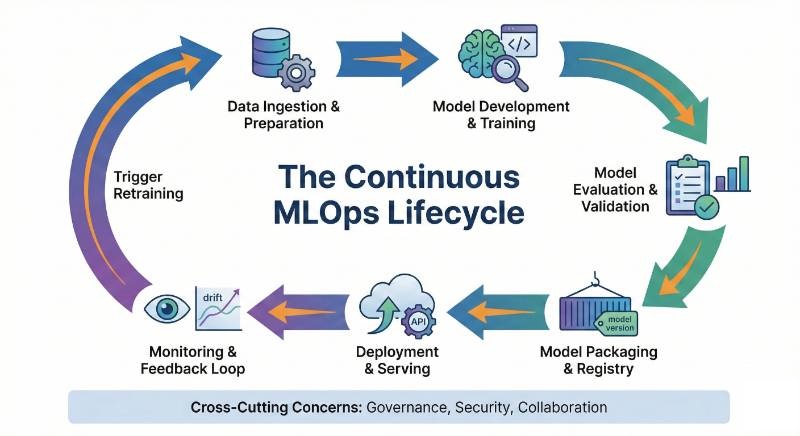
In the modern world of software, building a Machine Learning (ML) model is only half the battle. The real challenge lies in putting that model into production, keeping it healthy, and ensuring it delivers value every single day. This is where MLOps (Machine Learning Operations) comes in.
If you are a software engineer or a manager looking to stay ahead, you have likely heard the buzz. But how do you actually master this field? The answer lies in the MLOps Certified Professional (MLOCP) program. This guide will walk you through everything you need to know to become a certified expert and lead AI transformations in your company.
What is MLOps Certified Professional (MLOCP)?
The MLOps Certified Professional (MLOCP) is a specialized certification designed to bridge the gap between data science and traditional DevOps. While data scientists focus on building models, MLOps professionals focus on the “plumbing”—the automated pipelines, monitoring, and infrastructure that keep those models running at scale.
This certification proves that you don’t just know how to write a Python script; you know how to build a production-grade system that handles data versioning, model tracking, and automated deployment. It is the gold standard for anyone wanting to move into the high-paying world of AI infrastructure.
Complete MLOps & Ops Certification Table
To help you see the big picture, here is a list of key certifications across different tracks that help you become a well-rounded expert.
| Track | Level | Who it’s for | Prerequisites | Skills Covered | Recommended Order |
| MLOps | Foundation | Beginners, Managers | Basic Python | ML Lifecycle, CI/CD Basics | 1st |
| MLOps | Professional | Engineers (1-3 yrs) | Foundation Level | MLflow, DVC, Kubernetes | 2nd |
| MLOps | Master | Senior Engineers | Professional Level | Scaling LLMs, Drift Detection | 3rd |
| DevOps | Professional | Software Engineers | Coding knowledge | CI/CD, Docker, Jenkins | Parallel |
| DevSecOps | Professional | Security/DevOps Eng | DevOps knowledge | Security as Code, SAST/DAST | Post-MLOps |
MLOps Certified Professional (MLOCP)
What it is
The MLOCP is a comprehensive program that covers the entire “Model-to-Market” journey. It focuses on using tools like Jenkins, Docker, and Kubernetes specifically for Machine Learning workloads, ensuring that models are reproducible, auditable, and scalable.
Who should take it
- Software Engineers who want to work on AI/ML projects without becoming pure data scientists.
- DevOps Engineers looking to specialize in the fastest-growing niche in tech.
- Data Scientists who are tired of their models “dying” in a Jupyter Notebook and want to learn how to deploy them.
- Engineering Managers who need to oversee MLOps teams and understand the technical bottlenecks.
Skills you’ll gain
- Automated Pipelines: Building CI/CD for both code and data.
- Model Versioning: Tracking different versions of models and experiments using MLflow.
- Data Management: Mastering Data Version Control (DVC) to ensure reproducibility.
- Orchestration: Deploying ML containers on Kubernetes using KServe or Kubeflow.
- Monitoring: Tracking “model drift” and data quality in real-time.
Real-world projects you should be able to do
- Automated Retraining Loop: A system that detects when model accuracy drops and automatically starts a new training job.
- Scalable Prediction API: Deploying a deep learning model behind a FastAPI gateway that scales up as traffic increases.
- Feature Store Implementation: Setting up a central place (like Feast) where all your data features are stored for easy reuse.
Preparation Plan
| Timeline | Goal | Focus |
| 7–14 Days | Quick Sprint | Focus on MLOps theory, the lifecycle, and basic tool syntax. |
| 30 Days | Balanced Path | Spend 2 weeks on theory and 2 weeks on building 2 small projects. |
| 60 Days | Expert Mastery | Deep dive into Kubernetes, Advanced MLflow, and enterprise security. |
Common Mistakes
- Ignoring Data Quality: Thinking MLOps is just about the code. If your data is “trash,” your model will be “trash.”
- Manual Everything: Trying to deploy models manually instead of using automated pipelines.
- Over-Engineering: Setting up a complex Kubernetes cluster for a small project that could run on a single VM.
- Lack of Monitoring: Deploying a model and forgetting about it until a customer complains about wrong predictions.
Best next certification after this
After finishing MLOCP, the best next step is usually the AiOps Certified Professional (AIOCP) to learn how to use AI to manage infrastructure itself.
Choose Your Path: 6 Specialized Learning Paths
If you want to grow your career beyond MLOps, here are the six most powerful paths you can follow today:
- DevOps Path: Focus on the speed of delivery. Learn to automate everything from code commit to production.
- DevSecOps Path: The “Security-First” path. Learn to bake security into every stage of the automated pipeline.
- SRE Path: Focus on reliability. Learn how to keep massive systems running with 99.9% uptime.
- AIOps/MLOps Path: The “Intelligence” path. Use AI to improve operations, and use Ops to improve AI.
- DataOps Path: Focus on the data flow. Ensure that data is clean, fast, and available for analytics teams.
- FinOps Path: The “Money” path. Learn how to track and optimize cloud costs so your company doesn’t go broke on AWS bills.
Role → Recommended Certifications Mapping
Not sure where to start? Match your current role to the recommended certification path:
- DevOps Engineer: MLOps Certified Professional + DevSecOps Certified Professional.
- SRE: MLOps Certified Professional + Site Reliability Engineering Certified Professional.
- Platform Engineer: MLOps Certified Professional + Master in DevOps Engineering.
- Cloud Engineer: MLOps Certified Professional + Azure/AWS/GCP Professional DevOps.
- Security Engineer: MLOps Certified Professional + DevSecOps Certified Professional.
- Data Engineer: MLOps Certified Professional + DataOps Certified Professional.
- FinOps Practitioner: MLOps Certified Professional + FinOps Certified Professional.
- Engineering Manager: MLOps Certified Professional + Certified DevOps Manager.
Next Certifications to Take
To stay at the top of the engineering game, you should always be looking at your next move. Based on industry trends, here are your best options after completing your MLOps certification:
- Same Track (Deeper Expertise): AiOps Certified Professional (AIOCP). Move from managing ML models to using AI to run your entire data center.
- Cross-Track (Broadened Skills): DataOps Certified Professional (DOCP). Since MLOps relies heavily on data, becoming an expert in DataOps makes you irreplaceable.
- Leadership (Career Growth): Certified DevOps Manager (CDM). Perfect for those who want to stop writing code and start leading teams and strategy.
Top Institutions for MLOps Training & Certification
Finding the right place to learn is critical. Here are the top institutions that help you get certified in MLOCP:
- DevOpsSchool: One of the most recognized names globally. They provide deep, hands-on labs and instructor-led training that focuses on real-world scenarios rather than just theory.
- Cotocus: Known for their boutique training style. They offer specialized sessions for MLOps that are highly practical and tailored for working professionals.
- Scmgalaxy: A massive community-driven platform. They provide extensive resources, blogs, and technical guides that support your journey toward MLOCP.
- BestDevOps: This institution focuses purely on the “best practices” of the industry. Their MLOps curriculum is updated frequently to include the latest tools like LLMOps.
- DevSecOpsSchool: If you want to add a security twist to your MLOps journey, this is the place. They specialize in the intersection of security and automation.
- SRESchool: Perfect for engineers who want to ensure their ML models are highly reliable. They focus on the “SRE for ML” mindset.
- AIOpsSchool: Focuses on the future of operations. They help you transition from traditional MLOps to the world of Artificial Intelligence for Operations.
- DataOpsSchool: Since MLOps is nothing without good data, this school provides the foundational data engineering skills needed to succeed.
- FinOpsSchool: Helps you manage the high costs associated with training ML models in the cloud. A must-visit for managers and senior engineers.
FAQs: MLOps Certified Professional (MLOCP)
1. How difficult is the MLOCP exam?
The exam is moderately difficult. It requires a solid understanding of both Machine Learning concepts and DevOps tools like Docker and Git.
2. How much time does it take to prepare?
Most working professionals can prepare in 30 to 60 days by dedicating 5-10 hours a week to study and labs.
3. Are there any prerequisites for MLOCP?
While not mandatory, having a basic knowledge of Python and a high-level understanding of what Machine Learning is will help you significantly.
4. In what sequence should I take these certifications?
Start with MLOps Foundation, move to MLOCP (Professional), and then consider a cross-track certification like DevSecOps or DataOps.
5. What is the value of this certification in the job market?
MLOps is one of the highest-paying roles in tech right now. This certification acts as a “trust signal” to employers that you can handle production environments.
6. Can a manager benefit from MLOCP?
Yes. Managers need to understand the ML lifecycle to set realistic deadlines and hire the right talent for their engineering teams.
7. Does the certification cover Cloud providers like AWS or Azure?
Yes, the MLOCP program is designed to be cloud-agnostic but often uses AWS or Azure for the hands-on lab portions.
8. What are the career outcomes after getting certified?
You can aim for roles like MLOps Engineer, Machine Learning Engineer, Platform Engineer (AI), or Senior DevOps Architect.
9. Is the exam practical or multiple-choice?
It usually involves a mix of conceptual questions and practical, scenario-based tasks to test your real-world skills.
10. How long is the certification valid?
Like most technical certifications, it is generally valid for 2-3 years, after which you can renew it to show you are up-to-date with new tools.
11. Is MLOps better than DevOps?
It’s not “better,” but it is more “specialized.” MLOps is essentially DevOps applied to the unique challenges of Machine Learning.
12. Will this help me with Generative AI and LLMs?
Absolutely. The principles of MLOps are the foundation for “LLMOps,” which is the practice of deploying and managing Large Language Models.
Additional FAQs on MLOps Career
13. Do I need to be a math expert for MLOps?
No. You need to understand how models behave, but you don’t need a PhD in math. You are the “engineer” who builds the factory, not the “scientist” who invents the formula.
14. What is the most important tool in MLOps?
While there are many, MLflow and Kubernetes are currently the industry favorites for tracking and deployment.
15. Can I transition from a manual QA role to MLOps?
Yes, but you will need to learn Python and the basics of automation first. The MLOCP Foundation is a great starting point.
16. Is MLOps just “DevOps with a different name”?
No. ML models have “state” (data) and “drift” (accuracy loss), which traditional software does not have. MLOps handles these unique issues.
17. What is the average salary hike after MLOCP?
While it varies by region, many professionals see a 20-40% increase in their total compensation after specializing in MLOps.
18. Does MLOps involve a lot of coding?
It involves a fair amount of Python for scripting and YAML for infrastructure configuration. It is more about “glue code” and automation scripts.
19. How is MLOps different from Data Engineering?
Data Engineering is about getting the data ready. MLOps is about getting the model ready and keeping it running in production.
20. Is the MLOCP certification recognized in India?
Yes, it is highly recognized in major tech hubs like Bangalore, Hyderabad, and Pune, where AI/ML adoption is at an all-time high.
Conclusion
The world of engineering is moving toward a future where every application will have a touch of AI. Standing still is not an option. By pursuing the MLOps Certified Professional (MLOCP) certification, you are not just adding a line to your resume; you are future-proofing your career. Whether you are a seasoned engineer or a manager leading a team, understanding how to operationalize Machine Learning is the most valuable skill you can acquire this year. Take the first step, choose your path, and start your journey toward becoming a Master in MLOps. The tech world is waiting for experts like you.

Find Trusted Cardiac Hospitals
Compare heart hospitals by city and services — all in one place.
Explore Hospitals