
Introduction
AI CSAT prediction tools help businesses estimate customer satisfaction before, during, or after support interactions by analyzing conversations, tickets, surveys, call transcripts, sentiment, behavior signals, and service history. Instead of waiting only for customers to submit a survey, these tools use AI to predict whether a customer is likely satisfied, neutral, frustrated, or at risk of escalation or churn.
Why it matters: many customers never respond to CSAT surveys, which means support leaders often make decisions using incomplete feedback. AI CSAT prediction helps teams understand hidden dissatisfaction, detect risky interactions earlier, prioritize follow-ups, improve coaching, and identify service quality issues that may not appear in survey results. It gives support, CX, and operations teams a broader view of customer experience across every conversation, not only the small percentage of customers who leave ratings.
Real-world use cases include predicting satisfaction from support tickets, identifying frustrated customers before escalation, prioritizing callbacks, coaching agents, detecting poor handoffs, monitoring contact center quality, finding churn risk signals, analyzing survey-free interactions, routing sensitive cases to senior agents, and measuring service quality across email, chat, voice, and messaging.
Evaluation criteria for buyers should include prediction accuracy, sentiment depth, conversation analytics, ticket context, model explainability, survey integration, CRM integration, contact center compatibility, real-time alerts, coaching workflows, data privacy, role-based access, audit logs, customization, multilingual support, reporting quality, and ability to validate predictions against real CSAT outcomes.
Best for: customer experience teams, support leaders, contact centers, SaaS companies, ecommerce brands, BPOs, financial service teams, healthcare support teams, telecom providers, and enterprises that want to detect customer dissatisfaction earlier. Not ideal for: very small support teams with limited interaction volume, businesses without reliable historical customer feedback, or organizations that do not have clear processes for acting on predicted dissatisfaction.
What’s Changed in AI CSAT Prediction Tools
- AI CSAT prediction is moving beyond post-interaction surveys into real-time and near-real-time customer experience forecasting.
- Modern tools can analyze calls, chats, emails, tickets, reviews, surveys, and digital interactions together.
- Prediction models increasingly use multiple signals such as sentiment, issue type, response time, escalation history, agent behavior, customer tier, and resolution status.
- Contact centers now use predicted CSAT to identify interactions that need supervisor review.
- Support teams are using predicted satisfaction to coach agents even when customers do not submit surveys.
- AI can now highlight likely drivers of poor satisfaction, such as long wait time, repeated contacts, negative tone, unresolved issue, or weak empathy.
- Real-time alerts are becoming valuable for saving at-risk customers before they churn or complain publicly.
- Explainability is becoming important because leaders need to know why the AI predicted a poor experience.
- Multilingual and regional analysis matters more for global customer service operations.
- AI CSAT models are increasingly connected to QA scorecards, customer sentiment, ticket routing, and escalation workflows.
- Governance is becoming more important because predicted satisfaction may influence agent coaching and performance reviews.
- Buyers now evaluate whether predictions improve business outcomes, not only whether dashboards look impressive.
Quick Buyer Checklist
Use this checklist to shortlist AI CSAT prediction tools quickly:
- Check whether the tool predicts CSAT from tickets, calls, chats, emails, surveys, and messaging channels.
- Test prediction accuracy using historical interactions with known CSAT scores.
- Confirm whether the platform explains why a customer is predicted to be dissatisfied.
- Review whether predictions update in real time or only after the interaction ends.
- Check if the tool detects sentiment, intent, urgency, effort, escalation risk, and churn signals.
- Confirm integration with CRM, help desk, contact center, survey, QA, and BI systems.
- Review whether supervisors can receive alerts for low predicted CSAT.
- Check if AI predictions can trigger workflows such as callbacks, escalation, coaching, or case review.
- Confirm multilingual and regional support if your customers are global.
- Review role-based access, audit logs, retention rules, encryption, and admin controls.
- Validate whether human reviewers can correct or calibrate predictions.
- Check dashboard segmentation by agent, team, channel, product, region, issue type, and customer tier.
- Evaluate pricing by seats, conversations, minutes, feedback volume, AI analysis, and enterprise features.
- Confirm export options for analytics and model validation.
- Make sure predicted CSAT is used for coaching and improvement, not unfair agent scoring.
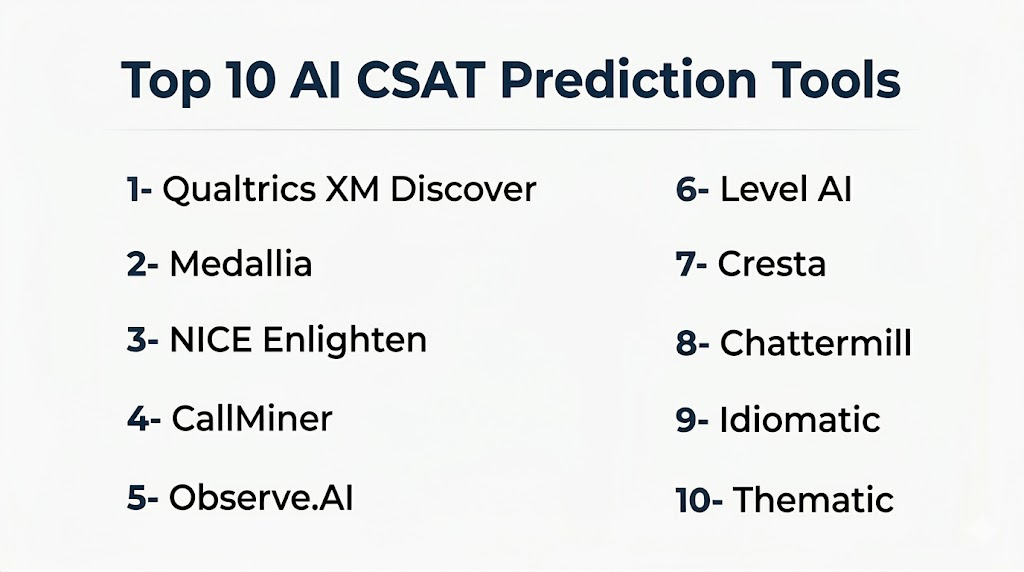
Top 10 AI CSAT Prediction Tools
1- Qualtrics XM Discover
One-line verdict: Best for enterprises predicting satisfaction from surveys, feedback, and customer experience signals.
Short description:
Qualtrics XM Discover helps organizations analyze structured and unstructured feedback to understand customer satisfaction, sentiment, topics, and experience drivers. It is strong for companies that want predicted CSAT insights connected to broader voice of customer and experience management programs.
Standout Capabilities
- AI-powered analysis of customer feedback and open-text responses
- Sentiment and topic detection across feedback sources
- Customer experience dashboards for satisfaction trends
- Survey and non-survey feedback analysis
- Root cause identification for poor satisfaction
- Segmentation by product, region, customer group, and journey stage
- Alerts and workflows for experience improvement
- Strong fit for enterprise CX programs
AI-Specific Depth
- Model support: Hosted AI and analytics model approach
- RAG / knowledge integration: Varies / N/A
- Evaluation: Feedback analysis, prediction validation, dashboard monitoring, and human review workflows
- Guardrails: Admin permissions, data access controls, workflow rules, and governance settings
- Observability: Dashboards for CSAT trends, sentiment, topics, survey outcomes, and customer experience metrics
Pros
- Strong enterprise customer experience analytics
- Useful for connecting CSAT with root cause themes
- Good fit for survey and feedback-heavy organizations
Cons
- May require implementation and CX program maturity
- Can be more advanced than small teams need
- Pricing is typically enterprise-oriented
Security & Compliance
Qualtrics provides enterprise security and admin controls depending on product configuration and contract. Buyers should verify SSO, RBAC, audit logs, encryption, retention controls, data residency, and compliance requirements directly. Unknown details should be treated as Not publicly stated.
Deployment & Platforms
- Web-based platform
- Cloud deployment
- Customer experience analytics environment
- Self-hosted deployment: Varies / N/A
Integrations & Ecosystem
Qualtrics XM Discover works best when predicted CSAT needs to connect with surveys, experience programs, and enterprise reporting.
- Survey systems
- CRM platforms
- Contact center data
- Customer feedback channels
- BI tools
- Data warehouse workflows
- APIs and exports
Pricing Model
Enterprise SaaS pricing is typically custom and depends on modules, users, feedback volume, analytics requirements, and service scope.
Best-Fit Scenarios
- Enterprise CSAT prediction programs
- Voice of customer analytics
- Root cause analysis for poor satisfaction
2- Medallia
One-line verdict: Best for large organizations predicting satisfaction across customer journeys and service touchpoints.
Short description:
Medallia helps organizations collect, analyze, and act on customer feedback across multiple channels. Its AI and analytics capabilities help teams understand satisfaction drivers, detect negative experiences, and prioritize recovery workflows.
Standout Capabilities
- Customer experience and satisfaction analytics
- AI-powered text and feedback analysis
- Journey-level customer insights
- Sentiment and theme detection
- Alerts for service recovery
- Dashboards for CX leaders and frontline teams
- Multi-channel feedback analysis
- Workflow support for closing the loop
AI-Specific Depth
- Model support: Hosted AI and analytics model approach
- RAG / knowledge integration: Varies / N/A
- Evaluation: Feedback review, predicted satisfaction analysis, and journey reporting
- Guardrails: Role controls, workflow governance, and admin permissions
- Observability: Dashboards for satisfaction, customer journeys, feedback trends, alerts, and experience metrics
Pros
- Strong fit for enterprise customer experience teams
- Useful for journey-level satisfaction insights
- Good for closing the loop on negative feedback
Cons
- Enterprise implementation can be complex
- Smaller teams may find it too broad
- Advanced capabilities depend on modules and configuration
Security & Compliance
Medallia provides enterprise security and governance controls depending on product edition and contract. Buyers should verify SSO, RBAC, audit logs, encryption, retention, residency, and compliance requirements directly.
Deployment & Platforms
- Web-based platform
- Cloud deployment
- CX and feedback analytics environment
- Self-hosted deployment: Varies / N/A
Integrations & Ecosystem
Medallia is useful when CSAT prediction must connect with experience management, customer journeys, service recovery, and operational workflows.
- Survey channels
- CRM systems
- Contact center data
- Digital feedback tools
- BI platforms
- Workflow systems
- APIs and exports
Pricing Model
Enterprise pricing is typically custom and depends on feedback channels, modules, users, analytics depth, and deployment scope.
Best-Fit Scenarios
- Customer journey satisfaction prediction
- Enterprise feedback programs
- Service recovery and customer experience improvement
3- NICE Enlighten
One-line verdict: Best for large contact centers predicting CSAT from calls, agent behavior, and interaction quality.
Short description:
NICE Enlighten provides AI-powered intelligence for contact center operations, helping teams understand customer sentiment, agent behaviors, interaction outcomes, and service quality. It is useful for predicting satisfaction in high-volume customer service environments.
Standout Capabilities
- AI analytics for contact center conversations
- Customer sentiment and interaction quality insights
- Agent behavior and performance signals
- Quality management and coaching support
- Compliance and risk monitoring
- Operational dashboards for service leaders
- Predictive signals for customer experience outcomes
- Strong fit within large contact center ecosystems
AI-Specific Depth
- Model support: Hosted AI within NICE ecosystem
- RAG / knowledge integration: Varies / N/A
- Evaluation: QA analytics, interaction review, sentiment tracking, and satisfaction trend analysis
- Guardrails: Supervisor review, compliance workflows, policy controls, and admin settings
- Observability: Dashboards for CSAT signals, sentiment, QA trends, agent performance, and operational metrics
Pros
- Strong enterprise contact center analytics
- Useful for linking agent behavior to satisfaction outcomes
- Good fit for large-scale service operations
Cons
- Best value often appears inside NICE environments
- Implementation can be complex
- May be excessive for smaller support teams
Security & Compliance
NICE provides enterprise security and governance capabilities depending on product configuration. Buyers should verify SSO, RBAC, encryption, audit logs, retention, and compliance requirements directly.
Deployment & Platforms
- Web-based enterprise platform
- Cloud deployment
- Contact center ecosystem deployment
- Self-hosted deployment: Varies / N/A
Integrations & Ecosystem
NICE Enlighten is strongest when predicted CSAT needs to connect with contact center analytics, QA, workforce workflows, and service operations.
- NICE CXone ecosystem
- Contact center platforms
- Workforce management
- CRM integrations
- Quality management workflows
- Analytics dashboards
- APIs and data workflows
Pricing Model
Enterprise pricing is usually custom and depends on contact center size, modules, analytics depth, and deployment requirements.
Best-Fit Scenarios
- Contact center CSAT prediction
- Agent coaching based on satisfaction drivers
- Enterprise service quality monitoring
4- CallMiner
One-line verdict: Best for speech-heavy contact centers predicting satisfaction from customer conversations and sentiment.
Short description:
CallMiner is a conversation intelligence and speech analytics platform that helps contact centers analyze calls, chats, and customer interactions. It can help identify satisfaction signals, frustration, compliance risks, and agent coaching opportunities from conversation data.
Standout Capabilities
- Speech and text analytics for customer interactions
- Sentiment and emotion analysis
- Conversation scoring and quality insights
- Compliance monitoring support
- Customer experience trend analysis
- Root cause detection for dissatisfaction
- Agent performance insights
- Dashboards for QA and operations teams
AI-Specific Depth
- Model support: Hosted AI and analytics model approach
- RAG / knowledge integration: Varies / N/A
- Evaluation: Conversation analytics, sentiment review, QA scoring, and satisfaction trend validation
- Guardrails: Compliance rules, supervisor review, and policy workflows
- Observability: Dashboards for CSAT signals, sentiment, topics, call quality, and agent performance
Pros
- Strong speech analytics depth
- Useful for contact centers with large call volume
- Good for root cause analysis from conversations
Cons
- Can require specialist configuration
- Small teams may find it too advanced
- Accuracy depends on call quality and transcription performance
Security & Compliance
CallMiner offers enterprise security and data protection capabilities depending on plan and contract. Buyers should verify SSO, RBAC, audit logs, encryption, retention controls, residency, and compliance requirements directly.
Deployment & Platforms
- Web-based analytics platform
- Cloud deployment
- Voice and text conversation analytics
- Self-hosted deployment: Varies / N/A
Integrations & Ecosystem
CallMiner works well as an analytics layer across recorded calls, transcripts, contact center systems, and quality workflows.
- Contact center platforms
- Call recording systems
- CRM systems
- Workforce management tools
- QA platforms
- BI tools
- APIs and exports
Pricing Model
Enterprise pricing usually varies by interaction volume, channels, analytics modules, and deployment needs.
Best-Fit Scenarios
- Predicting CSAT from call conversations
- Contact center QA and coaching
- Speech analytics for satisfaction drivers
5- Observe.AI
One-line verdict: Best for contact centers predicting CSAT through QA automation, sentiment, and agent coaching insights.
Short description:
Observe.AI is a contact center intelligence platform that analyzes customer conversations to support QA, coaching, performance management, and customer experience improvement. It helps teams identify signals that may predict customer satisfaction or dissatisfaction.
Standout Capabilities
- AI-powered call and conversation analysis
- Sentiment and intent detection
- Automated QA scorecards
- Agent coaching workflows
- Conversation summaries and trends
- Performance dashboards for supervisors
- Compliance monitoring support
- Customer experience insights from interactions
AI-Specific Depth
- Model support: Hosted AI model approach
- RAG / knowledge integration: Varies / N/A
- Evaluation: QA scoring, conversation review, sentiment analysis, and satisfaction trend validation
- Guardrails: QA rules, compliance checks, supervisor review, and workflow controls
- Observability: Dashboards for CSAT signals, agent performance, sentiment, call quality, and coaching trends
Pros
- Strong fit for QA and coaching programs
- Helps analyze high interaction volume
- Useful for linking sentiment with agent behavior
Cons
- Best suited for teams with defined QA workflows
- Requires thoughtful scorecard design
- Pricing is usually custom
Security & Compliance
Observe.AI provides enterprise security controls depending on plan and agreement. Buyers should verify SSO, RBAC, audit logs, encryption, retention, residency, and compliance requirements directly.
Deployment & Platforms
- Web-based platform
- Cloud deployment
- Contact center analytics workflows
- Self-hosted deployment: Varies / N/A
Integrations & Ecosystem
Observe.AI is useful when predicted CSAT needs to connect with QA, coaching, and contact center performance workflows.
- Contact center platforms
- CRM systems
- Help desk tools
- Call recording systems
- Workforce management tools
- APIs and exports
- Coaching workflows
Pricing Model
Enterprise SaaS pricing usually depends on users, interaction volume, analytics scope, and implementation requirements.
Best-Fit Scenarios
- Predicting low satisfaction from support calls
- Agent coaching based on customer sentiment
- Contact center QA and experience improvement
6- Level AI
One-line verdict: Best for AI-native contact centers connecting CSAT prediction with QA, coaching, and performance analytics.
Short description:
Level AI provides AI-powered contact center intelligence for conversation analysis, quality assurance, coaching, and customer insights. It helps support leaders identify interaction patterns that affect satisfaction and agent performance.
Standout Capabilities
- Automated QA and conversation review
- Sentiment and intent analysis
- Customer experience trend detection
- Agent coaching recommendations
- Call and ticket summarization
- Compliance and script monitoring
- Supervisor dashboards
- Root cause insights from conversations
AI-Specific Depth
- Model support: Hosted AI model approach
- RAG / knowledge integration: Varies / N/A
- Evaluation: Automated QA scoring, conversation analysis, and satisfaction signal tracking
- Guardrails: Scorecard rules, compliance checks, review workflows, and escalation controls
- Observability: Dashboards for QA, sentiment, predicted satisfaction signals, coaching, and support trends
Pros
- Strong AI-native QA automation focus
- Useful for coaching and service quality improvement
- Helps uncover drivers of poor customer experience
Cons
- Requires clear QA and coaching processes
- Advanced integrations may require setup support
- Pricing details are generally custom
Security & Compliance
Level AI offers enterprise security controls depending on plan and agreement. Buyers should verify SSO, RBAC, audit logs, encryption, retention settings, residency, and compliance requirements directly.
Deployment & Platforms
- Web-based platform
- Cloud deployment
- Contact center and conversation analytics workflows
- Self-hosted deployment: Varies / N/A
Integrations & Ecosystem
Level AI works well when CSAT prediction is part of broader quality and conversation intelligence workflows.
- Contact center platforms
- CRM tools
- Help desk systems
- Call recording tools
- APIs
- QA workflows
- Coaching systems
Pricing Model
Enterprise SaaS pricing usually depends on interaction volume, users, analytics needs, and implementation scope.
Best-Fit Scenarios
- CSAT prediction from contact center conversations
- Automated QA and coaching
- Customer experience trend discovery
7- Cresta
One-line verdict: Best for teams improving predicted CSAT through real-time agent coaching and conversation intelligence.
Short description:
Cresta provides AI-powered contact center tools focused on real-time agent assistance, coaching, and conversation intelligence. It helps teams improve service quality during live conversations and identify behaviors that influence satisfaction.
Standout Capabilities
- Real-time agent guidance
- Conversation intelligence for support and sales teams
- Agent coaching and performance insights
- Playbook adherence tracking
- Call summarization and analysis
- Supervisor dashboards
- Sentiment and customer signal detection
- Workflow recommendations for service improvement
AI-Specific Depth
- Model support: Hosted AI model approach
- RAG / knowledge integration: Knowledge and playbook integration varies by setup
- Evaluation: Conversation analysis, coaching insights, and performance review
- Guardrails: Playbook adherence, policy prompts, supervisor workflows, and admin controls
- Observability: Dashboards for agent behavior, customer signals, satisfaction trends, and coaching analytics
Pros
- Strong real-time coaching capabilities
- Useful for improving live customer interactions
- Helps connect agent behavior with customer outcomes
Cons
- Requires structured playbooks for best results
- Enterprise pricing may not fit smaller teams
- CSAT prediction depth should be validated with real workflows
Security & Compliance
Cresta provides enterprise controls depending on plan and deployment. Buyers should verify SSO, RBAC, encryption, retention, audit logs, and compliance requirements directly before regulated use.
Deployment & Platforms
- Web-based platform
- Cloud deployment
- Contact center and agent workflow integrations
- Self-hosted deployment: Varies / N/A
Integrations & Ecosystem
Cresta works best when predicted CSAT insights need to support live agent guidance, supervisor coaching, and contact center workflows.
- Contact center systems
- CRM platforms
- Agent desktop workflows
- Knowledge systems
- Call recording tools
- APIs
- Reporting tools
Pricing Model
Enterprise SaaS pricing is typically custom and depends on users, interaction volume, AI features, and deployment scope.
Best-Fit Scenarios
- Improving satisfaction during live calls
- Agent coaching based on customer signals
- Sales and service conversation quality improvement
8- Chattermill
One-line verdict: Best for CX teams predicting customer satisfaction from feedback, reviews, surveys, and support data.
Short description:
Chattermill is a customer feedback analytics platform that uses AI to unify and analyze customer comments, reviews, surveys, support tickets, and experience data. It helps teams understand satisfaction drivers, dissatisfaction themes, and customer journey issues.
Standout Capabilities
- AI-powered customer feedback analysis
- Sentiment and theme detection
- Feedback unification across multiple sources
- Customer journey and experience insights
- Root cause analysis for poor satisfaction
- Dashboards for CX and product teams
- Trend detection across customer comments
- Segmentation by product, region, and customer group
AI-Specific Depth
- Model support: Hosted AI and analytics model approach
- RAG / knowledge integration: Varies / N/A
- Evaluation: Feedback analytics, sentiment review, and satisfaction trend validation
- Guardrails: Workspace permissions, review workflows, and admin controls
- Observability: Dashboards for CSAT signals, sentiment trends, themes, feedback volume, and customer experience metrics
Pros
- Strong for feedback-driven CX analytics
- Useful for identifying satisfaction drivers
- Good fit for product and customer experience teams
Cons
- Less contact-center-specific than speech analytics tools
- Requires enough feedback volume for best insights
- Advanced workflow automation should be validated
Security & Compliance
Chattermill provides business and enterprise controls depending on plan and agreement. Buyers should verify SSO, RBAC, audit logs, encryption, retention, and compliance requirements directly.
Deployment & Platforms
- Web-based platform
- Cloud deployment
- Customer feedback analytics environment
- Self-hosted deployment: Varies / N/A
Integrations & Ecosystem
Chattermill works well when predicted CSAT needs to connect with surveys, reviews, tickets, support feedback, and product insights.
- Survey platforms
- Review channels
- Help desk tools
- CRM systems
- Product analytics workflows
- BI tools
- APIs and exports
Pricing Model
Pricing is typically custom and may depend on feedback volume, data sources, users, and analytics scope.
Best-Fit Scenarios
- Predicting satisfaction from customer feedback
- Product and CX root cause analysis
- Multi-source feedback intelligence
9- Idiomatic
One-line verdict: Best for CX and support teams finding themes that explain CSAT movement and customer dissatisfaction.
Short description:
Idiomatic analyzes customer feedback, support tickets, survey comments, reviews, and other text data to identify themes, sentiment, and drivers of customer experience. It is useful for teams that want to understand why CSAT is rising or falling.
Standout Capabilities
- AI-powered customer feedback categorization
- Sentiment and theme analysis
- CSAT driver discovery
- Support ticket and survey feedback analysis
- Trend tracking across customer issues
- Dashboards for CX and support teams
- Root cause discovery from unstructured comments
- Prioritization of customer pain points
AI-Specific Depth
- Model support: Hosted AI and analytics model approach
- RAG / knowledge integration: Varies / N/A
- Evaluation: Feedback review, theme validation, and satisfaction driver analysis
- Guardrails: User permissions, review workflows, and admin settings
- Observability: Dashboards for feedback themes, sentiment, CSAT drivers, and customer issue trends
Pros
- Strong for explaining customer feedback trends
- Useful for CSAT root cause analysis
- Good fit for support and product teams
Cons
- Less focused on real-time contact center alerts
- Requires good feedback data sources
- Enterprise governance should be verified by plan
Security & Compliance
Idiomatic provides security and admin controls depending on plan and contract. Buyers should verify SSO, RBAC, audit logs, encryption, retention, and compliance requirements directly.
Deployment & Platforms
- Web-based platform
- Cloud deployment
- Customer feedback analytics environment
- Self-hosted deployment: Varies / N/A
Integrations & Ecosystem
Idiomatic is useful when CSAT prediction and explanation depend on analyzing large volumes of customer comments and tickets.
- Help desk systems
- Survey tools
- Review channels
- CRM systems
- Product feedback systems
- BI tools
- APIs and exports
Pricing Model
Pricing is generally custom and may depend on feedback volume, users, data sources, and analytics needs.
Best-Fit Scenarios
- CSAT driver analysis
- Support ticket theme detection
- Customer feedback prioritization
10- Thematic
One-line verdict: Best for teams analyzing open-ended feedback to predict satisfaction drivers and customer pain points.
Short description:
Thematic helps organizations analyze open-ended customer feedback from surveys, reviews, tickets, and other sources. It identifies sentiment, recurring themes, and customer experience drivers that can explain CSAT changes and dissatisfaction patterns.
Standout Capabilities
- AI-powered text analytics for customer feedback
- Theme detection across open-ended responses
- Sentiment analysis by topic
- Customer satisfaction driver discovery
- Feedback trend dashboards
- Survey and review analysis
- Reporting for CX, product, and support teams
- Root cause insights from unstructured comments
AI-Specific Depth
- Model support: Hosted AI and analytics model approach
- RAG / knowledge integration: Varies / N/A
- Evaluation: Human review, theme validation, sentiment review, and feedback analytics
- Guardrails: Workspace permissions, review controls, and admin settings
- Observability: Dashboards for CSAT themes, sentiment trends, topic performance, and feedback volume
Pros
- Strong for open-ended feedback analysis
- Useful for understanding why CSAT changes
- Good for CX and product insight workflows
Cons
- Not a full contact center QA platform
- Less focused on real-time prediction alerts
- Requires quality feedback data to produce useful insights
Security & Compliance
Thematic provides business security and admin controls depending on plan and agreement. Buyers should verify SSO, RBAC, audit logs, encryption, retention, and compliance requirements directly.
Deployment & Platforms
- Web-based platform
- Cloud deployment
- Customer feedback analytics environment
- Self-hosted deployment: Varies / N/A
Integrations & Ecosystem
Thematic works well when teams need to connect CSAT, survey comments, product feedback, and support insights.
- Survey tools
- Review platforms
- Help desk systems
- CRM systems
- Data exports
- BI workflows
- Feedback management systems
Pricing Model
Pricing is typically custom and depends on feedback volume, users, data sources, and analytics requirements.
Best-Fit Scenarios
- CSAT root cause analysis
- Survey comment analytics
- Customer feedback theme discovery
Comparison Table
| Tool Name | Best For | Deployment | Model Flexibility | Strength | Watch-Out | Public Rating |
|---|---|---|---|---|---|---|
| Qualtrics XM Discover | Enterprise CX programs | Cloud | Hosted | Feedback and CSAT analytics depth | Enterprise setup effort | N/A |
| Medallia | Journey-level satisfaction programs | Cloud | Hosted | Service recovery workflows | Complex implementation | N/A |
| NICE Enlighten | Contact center CSAT prediction | Cloud | Hosted | Agent behavior and call analytics | Best inside NICE ecosystem | N/A |
| CallMiner | Speech-based satisfaction prediction | Cloud | Hosted | Deep conversation analytics | Specialist setup needed | N/A |
| Observe.AI | QA and coaching insights | Cloud | Hosted | Agent performance and sentiment | Needs QA maturity | N/A |
| Level AI | AI-native contact center QA | Cloud | Hosted | Automated conversation review | Custom setup may be needed | N/A |
| Cresta | Real-time coaching and satisfaction signals | Cloud | Hosted | Live agent guidance | Needs strong playbooks | N/A |
| Chattermill | Feedback-driven CSAT insights | Cloud | Hosted | Multi-source feedback analysis | Less real-time call focused | N/A |
| Idiomatic | CSAT driver discovery | Cloud | Hosted | Theme and root cause analysis | Needs strong feedback data | N/A |
| Thematic | Open-ended feedback analysis | Cloud | Hosted | Survey and comment themes | Not a full QA platform | N/A |
Scoring & Evaluation
This scoring is comparative, not absolute. It reflects CSAT prediction fit, AI reliability, satisfaction driver analysis, integration ecosystem, usability, governance, security readiness, and practical buyer value. Scores should be used for shortlisting only. Buyers should test each platform using real historical interactions, actual CSAT results, survey comments, tickets, call transcripts, support channels, multilingual samples, and known dissatisfied customer cases before making a final decision.
| Tool | Core | Reliability and Eval | Guardrails | Integrations | Ease | Perf and Cost | Security and Admin | Support | Weighted Total |
|---|---|---|---|---|---|---|---|---|---|
| Qualtrics XM Discover | 10 | 9 | 8 | 9 | 7 | 7 | 9 | 9 | 8.7 |
| Medallia | 10 | 9 | 8 | 9 | 7 | 7 | 9 | 9 | 8.7 |
| NICE Enlighten | 10 | 9 | 9 | 9 | 7 | 7 | 9 | 9 | 8.8 |
| CallMiner | 9 | 9 | 9 | 8 | 7 | 7 | 9 | 8 | 8.4 |
| Observe.AI | 9 | 8 | 8 | 8 | 8 | 7 | 8 | 8 | 8.0 |
| Level AI | 8 | 8 | 8 | 8 | 8 | 8 | 8 | 7 | 8.0 |
| Cresta | 8 | 8 | 8 | 8 | 8 | 7 | 8 | 8 | 8.0 |
| Chattermill | 8 | 8 | 7 | 8 | 8 | 8 | 8 | 7 | 7.9 |
| Idiomatic | 8 | 8 | 7 | 8 | 8 | 8 | 8 | 7 | 7.9 |
| Thematic | 8 | 8 | 7 | 8 | 8 | 8 | 8 | 7 | 7.9 |
Top 3 for Enterprise
- NICE Enlighten
- Qualtrics XM Discover
- Medallia
Top 3 for SMB
- Thematic
- Idiomatic
- Chattermill
Top 3 for Developers
- CallMiner
- Level AI
- Observe.AI
Which AI CSAT Prediction Tool Is Right for You
Solo / Freelancer
Solo users usually do not need a dedicated AI CSAT prediction platform unless they manage a large number of support conversations, client feedback, or service interactions. A simple survey tool, review tracker, or lightweight feedback analytics workflow may be enough. If open-ended feedback becomes difficult to analyze manually, Thematic, Idiomatic, or Chattermill can be considered, depending on budget and data volume.
SMB
Small and growing businesses should prioritize simplicity, feedback source coverage, dashboard clarity, and actionable insights. Thematic, Idiomatic, and Chattermill are strong options when the main goal is to understand why customers are satisfied or dissatisfied. For support-heavy SMBs, Observe.AI or Level AI may be useful if call or chat volume is high enough to justify conversation intelligence.
Mid-Market
Mid-market companies usually need better segmentation, integrations, feedback analytics, support conversation review, and predictive alerts. Observe.AI, Level AI, Cresta, Chattermill, Idiomatic, and Thematic are good candidates depending on whether the main data source is support conversations, surveys, tickets, or product feedback. These teams should validate predictions against real historical CSAT results.
Enterprise
Enterprises should prioritize multi-channel data coverage, governance, security, auditability, workflow automation, dashboard depth, and integration with CRM, contact center, survey, and BI systems. NICE Enlighten is strong for contact center-driven CSAT prediction. Qualtrics XM Discover and Medallia are strong for enterprise CX programs. CallMiner is strong for speech analytics and conversation-based prediction.
Regulated industries
Finance, healthcare, insurance, telecom, and public sector teams should focus on encryption, role permissions, audit logs, data retention, redaction, and approval workflows. NICE Enlighten, CallMiner, Qualtrics XM Discover, Medallia, and Observe.AI are stronger candidates for regulated evaluations. Buyers should verify every security and compliance requirement directly before using customer interaction data for AI prediction.
Budget vs premium
Budget-focused teams should start with feedback analytics tools that match their primary data source, such as survey comments, support tickets, or reviews. Premium buyers should evaluate Qualtrics XM Discover, Medallia, NICE Enlighten, CallMiner, and Observe.AI when they need enterprise reporting, contact center analytics, governance, and broad integration depth. The right spend depends on whether predicted CSAT will directly influence retention, support quality, service recovery, or revenue.
Build vs buy
Building an internal CSAT prediction model can make sense if your organization has strong data science resources, large historical CSAT datasets, clean interaction data, and strict data control requirements. Most teams should buy because production-ready CSAT prediction also requires dashboards, integrations, alerts, governance, model monitoring, security, and workflow automation. A hybrid approach can work when teams buy a platform for operational workflows and export data for internal modeling.
Implementation Playbook 30 / 60 / 90 Days
First 30 Days
- Define the main prediction goal such as identifying dissatisfied customers, improving agent coaching, reducing churn, or finding service quality gaps.
- Collect historical CSAT results, survey comments, tickets, call transcripts, chat logs, and customer metadata.
- Identify which channels should be included first.
- Clean inconsistent tags, duplicate records, and low-quality feedback data.
- Define key labels such as satisfied, neutral, dissatisfied, escalation risk, repeat contact, and churn signal.
- Test tool predictions against known CSAT outcomes.
- Review false positives and false negatives with support leaders and QA reviewers.
- Define baseline metrics such as CSAT score, response time, resolution time, escalation rate, repeat contact rate, and churn rate.
- Configure access controls and data retention settings.
- Start with a controlled pilot team or support queue.
Days 31 to 60
- Connect the platform with CRM, help desk, contact center, survey, and BI systems.
- Configure alerts for predicted low CSAT, repeat frustration, VIP dissatisfaction, and escalation risk.
- Segment predicted CSAT by product, issue type, agent, team, channel, region, and customer tier.
- Calibrate AI predictions against human review and actual survey results.
- Build dashboards for supervisors, CX leaders, and executives.
- Create coaching workflows based on satisfaction drivers.
- Add review processes for sensitive or regulated interactions.
- Train managers on responsible use of predicted CSAT.
- Create workflows for customer callbacks or service recovery.
- Review model drift and prediction reliability over time.
Days 61 to 90
- Expand prediction coverage to more teams, channels, products, and regions.
- Link predicted CSAT with quality assurance, agent coaching, and knowledge base improvements.
- Use root cause themes to improve product, support scripts, self-service content, and routing rules.
- Monitor cost by feedback volume, call minutes, seats, and AI analysis usage.
- Build executive reporting around predicted dissatisfaction, service recovery, customer retention, and operational improvement.
- Add governance for how predicted CSAT can and cannot be used in agent performance reviews.
- Review export options and vendor lock-in risks.
- Create a recurring model calibration process.
- Compare predicted CSAT improvements with actual survey changes.
- Build a continuous improvement loop across CX, support, product, operations, and leadership teams.
Common Mistakes and How to Avoid Them
- Treating predicted CSAT as perfect truth without validation.
- Using predicted CSAT for agent performance decisions without human review.
- Ignoring customers who do not respond to surveys.
- Training predictions on messy or biased historical CSAT data.
- Focusing only on sentiment while ignoring resolution status, wait time, repeat contact, and escalation history.
- Not explaining why a customer is predicted to be dissatisfied.
- Building dashboards without creating workflows for follow-up action.
- Ignoring multilingual accuracy and cultural differences.
- Not segmenting by product, region, customer tier, channel, or issue type.
- Overreacting to individual predictions instead of looking at trends and patterns.
- Uploading sensitive customer interactions without privacy review.
- Not comparing AI predictions with actual CSAT outcomes over time.
- Choosing a tool based only on demo data instead of historical interactions.
- Failing to connect prediction insights with coaching, QA, and customer recovery workflows.
FAQs
1. What is an AI CSAT prediction tool?
An AI CSAT prediction tool estimates how satisfied a customer is likely to be based on signals from conversations, tickets, surveys, sentiment, behavior, and service history. It helps teams detect poor experiences even when customers do not complete surveys.
2. How is CSAT prediction different from CSAT surveys?
CSAT surveys rely on customers submitting ratings after an interaction. CSAT prediction uses AI to estimate satisfaction from interaction data, which helps cover conversations where no survey response is available.
3. Can AI accurately predict customer satisfaction?
AI can provide useful predictions when trained or validated against quality data. Accuracy depends on historical CSAT quality, conversation data, model tuning, language, channel type, and whether the tool is tested with real business examples.
4. What data is needed for CSAT prediction?
Useful data includes tickets, call transcripts, chat logs, survey responses, agent notes, resolution status, response times, customer history, escalation records, sentiment signals, and repeat contact information.
5. Can CSAT prediction work without survey responses?
Yes, some tools can infer likely satisfaction from conversation and operational signals. However, historical survey data helps validate and calibrate prediction quality.
6. Is predicted CSAT useful for agent coaching?
Yes, predicted CSAT can highlight interactions that need review and help managers coach agents on empathy, accuracy, resolution quality, and process adherence. It should be used carefully with human calibration.
7. Can predicted CSAT help reduce churn?
Yes, predicted low satisfaction can help teams identify customers who may be at risk and trigger follow-up actions. It works best when connected to customer success, support recovery, and account management workflows.
8. Are CSAT prediction tools secure?
Security varies by vendor and configuration. Buyers should verify encryption, SSO, RBAC, audit logs, data retention, redaction, data residency, and compliance requirements before uploading customer interaction data.
9. Can these tools work across multiple languages?
Many platforms support multiple languages, but performance varies by language, region, slang, and business terminology. Buyers should test multilingual interactions before broad deployment.
10. What is the biggest risk of AI CSAT prediction?
The biggest risk is treating predictions as objective truth without validation. Poor predictions can lead to wrong coaching, missed escalations, or unfair performance decisions.
11. How should teams validate CSAT predictions?
Teams should compare predictions against historical CSAT survey results, human QA reviews, escalation outcomes, repeat contacts, churn signals, and customer follow-up results.
12. Should companies build or buy CSAT prediction tools?
Most teams should buy because production-ready prediction requires analytics, dashboards, integrations, workflows, security, and ongoing calibration. Building may make sense for companies with strong data science teams and large clean datasets.
Conclusion
AI CSAT prediction tools help organizations understand customer satisfaction beyond survey responses, detect dissatisfaction earlier, and connect customer experience insights with support, QA, coaching, and service recovery workflows. The best platform depends on your main data sources, whether you focus on surveys, calls, chats, tickets, contact center quality, or broad customer experience programs. NICE Enlighten, CallMiner, Observe.AI, Level AI, and Cresta are strong for contact center-driven CSAT prediction, while Qualtrics XM Discover, Medallia, Chattermill, Idiomatic, and Thematic are strong for feedback and experience analytics. The smartest path is to shortlist tools based on your real customer interaction data, pilot with historical CSAT outcomes, verify privacy and prediction accuracy, then scale with human review, clear governance, and workflows that turn predicted dissatisfaction into measurable customer experience improvement.

Find Trusted Cardiac Hospitals
Compare heart hospitals by city and services — all in one place.
Explore Hospitals
The article is useful for comparing CSAT prediction tools, but in real-world support operations the main challenge isn’t predicting satisfaction—it’s closing the loop between predicted CSAT and actual service improvements. Many systems can estimate sentiment or satisfaction scores, but teams often fail to act on them in time due to disconnected workflows between support, product, and QA teams. A more practical approach is to tie CSAT predictions directly to agent coaching, escalation triggers, and root-cause analysis so the insights lead to real operational fixes instead of just reporting metrics.