
Introduction
AI personalization engines for CX are platforms that help businesses deliver tailored customer experiences across websites, mobile apps, email, messaging, product interfaces, support channels, ecommerce stores, and digital journeys. These tools use customer data, behavioral signals, AI models, segmentation, experimentation, recommendation logic, and journey orchestration to decide what content, product, offer, message, next action, or support experience each customer should receive.
Why it matters: customers now expect brands to understand their needs without forcing them to repeat context across channels. Generic campaigns, static websites, and one-size-fits-all journeys often lead to lower engagement, abandoned carts, poor onboarding, weak retention, and missed revenue opportunities. AI personalization engines help companies use real-time behavior, customer profiles, product usage, purchase history, support signals, and intent data to create more relevant experiences.
Real-world use cases include ecommerce product recommendations, personalized homepage content, next-best-offer decisions, account-based web personalization, abandoned cart recovery, in-app onboarding, lifecycle messaging, support content recommendations, loyalty offers, dynamic email content, customer journey orchestration, and retention-focused engagement.
Evaluation criteria for buyers should include real-time decisioning, data source flexibility, segmentation, recommendation quality, experimentation, omnichannel activation, privacy controls, consent management, identity resolution, analytics, model transparency, integration depth, ease of use, performance impact, governance, and ability to connect personalization with measurable business outcomes.
Best for: ecommerce brands, SaaS companies, digital product teams, financial services, telecom providers, travel companies, media platforms, B2B marketing teams, customer experience leaders, and enterprises that need relevant experiences across multiple channels. Not ideal for: very small businesses with low traffic, teams without enough customer data, organizations without clear personalization goals, or companies that cannot maintain content, offers, segments, and governance over time.
What’s Changed in AI Personalization Engines for CX
- Personalization is moving from static rules and broad segments to real-time AI decisioning based on behavior, intent, context, and customer history.
- AI is increasingly used to decide the next best action, product, message, offer, article, or journey step.
- Customer data platforms and personalization engines are becoming more tightly connected because personalization depends on unified customer profiles.
- Privacy-safe personalization is becoming more important as buyers reduce reliance on third-party cookies and focus more on first-party data.
- Personalization now spans websites, apps, email, SMS, push notifications, call centers, support portals, and sales workflows.
- Experimentation is becoming essential because teams need to prove whether personalized experiences improve conversion, retention, or satisfaction.
- Generative AI is helping marketers create content variations faster, but governance is needed before publishing personalized experiences.
- AI recommendations now go beyond ecommerce products and include content, support articles, onboarding steps, financial offers, service actions, and retention plays.
- Enterprises are demanding better auditability, consent controls, role permissions, and data retention policies.
- Real-time analytics are becoming more important because personalization must respond to customer behavior quickly.
- Agentic workflows are emerging where AI not only recommends experiences but also helps create, test, and optimize them.
- Buyers increasingly evaluate personalization platforms based on measurable lift, not just AI claims or dashboard features.
Quick Buyer Checklist
Use this checklist to shortlist AI personalization engines for CX quickly:
- Confirm whether the platform supports your main channels such as web, mobile app, email, SMS, push, chat, support, and call center.
- Check whether it can use first-party customer data, behavioral events, CRM data, product usage, purchase history, and support signals.
- Test whether the platform supports real-time decisioning and next-best-action logic.
- Review recommendation quality for products, content, offers, support articles, and journeys.
- Confirm whether marketers can build segments and experiences without heavy engineering work.
- Check whether developers have APIs, SDKs, event tracking, and integration controls.
- Review experimentation features such as A/B testing, multivariate testing, holdouts, and lift measurement.
- Confirm whether the platform supports identity resolution across devices, sessions, users, and accounts.
- Review privacy, consent, retention, audit logs, encryption, and role-based access.
- Check whether personalization decisions are explainable enough for business and compliance teams.
- Confirm integrations with CRM, CDP, CMS, ecommerce, data warehouse, marketing automation, analytics, and support systems.
- Test performance impact on website speed and customer experience.
- Review whether AI-generated content or offers require approval workflows.
- Evaluate pricing by profiles, events, decisions, channels, seats, traffic, and enterprise features.
- Confirm export options and portability to reduce vendor lock-in.
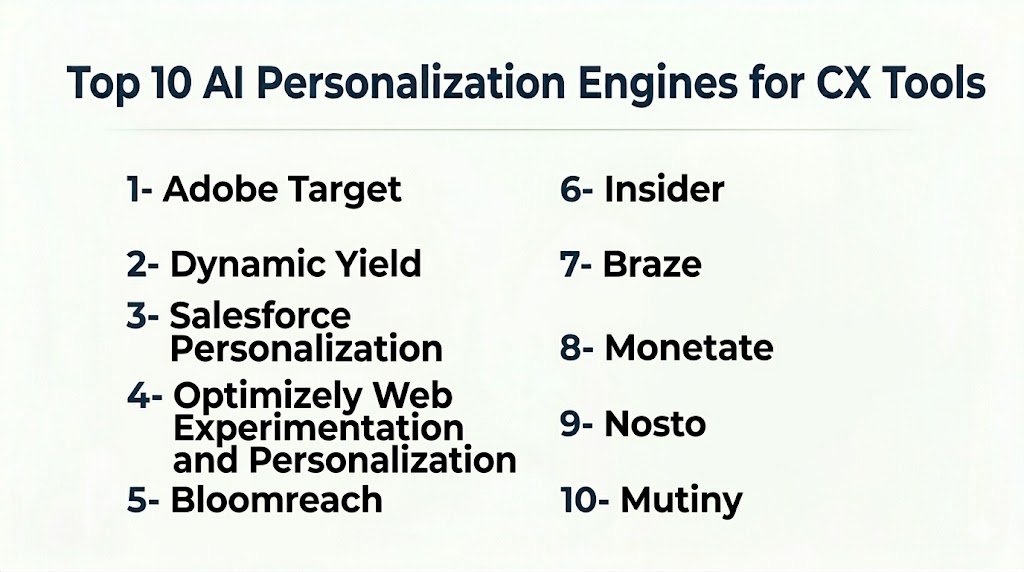
Top 10 AI Personalization Engines for CX Tools
1- Adobe Target
One-line verdict: Best for enterprises needing advanced testing, targeting, and personalization across digital experiences.
Short description:
Adobe Target is a personalization and experimentation platform used to deliver targeted content, recommendations, and optimized digital experiences. It is especially strong for enterprises already using Adobe Experience Cloud and needing sophisticated testing and personalization programs.
Standout Capabilities
- A/B testing and multivariate testing
- AI-powered personalization and automated targeting
- Experience targeting by audience and behavior
- Product and content recommendations
- Integration with Adobe Experience Cloud
- Real-time digital experience optimization
- Enterprise-grade experimentation workflows
- Strong analytics alignment with Adobe tools
AI-Specific Depth
- Model support: Hosted AI and Adobe ecosystem models
- RAG / knowledge integration: Varies / N/A
- Evaluation: Experimentation, holdouts, lift measurement, and performance reporting
- Guardrails: Role permissions, workspace controls, approval workflows, and governance settings
- Observability: Dashboards for experiments, audiences, conversion, recommendations, and experience performance
Pros
- Strong enterprise experimentation depth
- Good fit for complex digital experience programs
- Powerful integration with Adobe ecosystem
Cons
- Requires expertise to configure and optimize
- May be too complex for small teams
- Best value appears in Adobe-centered environments
Security & Compliance
Adobe provides enterprise security and governance controls depending on product configuration and contract. Buyers should verify SSO, RBAC, audit logs, encryption, retention, data residency, consent management, and compliance requirements directly. Unknown details should be treated as Not publicly stated.
Deployment & Platforms
- Web-based platform
- Cloud deployment
- Web and mobile personalization
- Enterprise digital experience environment
- Self-hosted deployment: Varies / N/A
Integrations & Ecosystem
Adobe Target is strongest when personalization is part of a broader digital experience, analytics, and marketing stack.
- Adobe Experience Cloud
- Adobe Analytics
- Adobe Experience Platform
- CMS tools
- Ecommerce systems
- Data platforms
- APIs and integrations
Pricing Model
Enterprise pricing is typically custom and may depend on traffic, modules, users, personalization scope, and analytics requirements.
Best-Fit Scenarios
- Enterprise website personalization
- Testing and optimization programs
- Adobe ecosystem personalization
2- Dynamic Yield
One-line verdict: Best for ecommerce and retail teams needing real-time recommendations and digital personalization.
Short description:
Dynamic Yield is a personalization platform focused on delivering tailored product recommendations, content, offers, and digital experiences. It is widely used by ecommerce, retail, travel, and digital commerce teams that need customer-specific experiences across web, app, and email.
Standout Capabilities
- Product recommendation engine
- Real-time behavioral personalization
- Audience segmentation and targeting
- A/B testing and experience optimization
- Personalized search and merchandising support
- Omnichannel activation across digital touchpoints
- Ecommerce-focused personalization workflows
- Campaign and experience performance reporting
AI-Specific Depth
- Model support: Hosted AI recommendation and decisioning models
- RAG / knowledge integration: Product catalog and customer behavior integration
- Evaluation: Experimentation, recommendation performance, and lift reporting
- Guardrails: Admin controls, campaign rules, audience restrictions, and approval workflows
- Observability: Dashboards for recommendations, conversions, revenue impact, audiences, and experience performance
Pros
- Strong ecommerce personalization depth
- Useful real-time recommendation capabilities
- Good fit for digital commerce optimization
Cons
- Best suited for teams with meaningful traffic and product data
- Setup requires merchandising and analytics alignment
- Pricing is typically enterprise-oriented
Security & Compliance
Dynamic Yield provides business and enterprise security controls depending on plan and agreement. Buyers should verify SSO, RBAC, audit logs, encryption, retention, consent controls, and compliance requirements directly.
Deployment & Platforms
- Web-based platform
- Cloud deployment
- Web, mobile, email, and digital commerce channels
- Self-hosted deployment: Varies / N/A
Integrations & Ecosystem
Dynamic Yield is useful when personalization must connect with product catalogs, ecommerce behavior, customer segments, and digital commerce systems.
- Ecommerce platforms
- Product catalogs
- CRM systems
- Customer data platforms
- Email tools
- Analytics platforms
- APIs and SDKs
Pricing Model
Enterprise SaaS pricing is usually custom and may depend on traffic, profiles, recommendation volume, modules, and channels.
Best-Fit Scenarios
- Ecommerce product recommendations
- Personalized shopping experiences
- Retail and travel digital optimization
3- Salesforce Personalization
One-line verdict: Best for CRM-centric enterprises needing real-time personalization across customer lifecycle touchpoints.
Short description:
Salesforce Personalization helps organizations deliver real-time tailored experiences using customer data, behavioral signals, and Salesforce ecosystem context. It is strongest for companies that want personalization connected to CRM, marketing, commerce, service, and customer data workflows.
Standout Capabilities
- Real-time personalization across digital and service touchpoints
- Customer profile and behavioral decisioning
- Next-best-action and recommendation capabilities
- Integration with Salesforce Data Cloud
- Web, email, mobile, and service personalization
- Rule-based and AI-assisted decisioning
- Experimentation and attribution support
- Strong CRM and service context
AI-Specific Depth
- Model support: Hosted AI and Salesforce ecosystem models
- RAG / knowledge integration: Salesforce customer data, CRM records, behavior, and profile context
- Evaluation: Personalization performance, attribution, testing, and engagement reporting
- Guardrails: Permission controls, workflow policies, governance settings, and admin rules
- Observability: Dashboards for profiles, engagement, personalization, conversion, and customer journey performance
Pros
- Strong CRM and customer data alignment
- Good for lifecycle-wide personalization
- Works well with Salesforce marketing and service workflows
Cons
- Requires Salesforce ecosystem expertise
- Can be complex for smaller teams
- Best value depends on Salesforce adoption
Security & Compliance
Salesforce provides enterprise security capabilities such as SSO, RBAC, encryption, audit logging, permissions, and governance controls depending on configuration. Buyers should verify compliance, retention, consent, and data residency requirements directly.
Deployment & Platforms
- Web-based platform
- Cloud deployment
- Web, email, mobile, service, and commerce touchpoints
- Salesforce ecosystem environment
- Self-hosted deployment: N/A
Integrations & Ecosystem
Salesforce Personalization is strongest when personalized experiences need CRM, marketing, sales, commerce, and service context.
- Salesforce CRM
- Salesforce Data Cloud
- Marketing Cloud
- Service Cloud
- Commerce Cloud
- MuleSoft
- APIs and marketplace apps
Pricing Model
Enterprise subscription pricing varies by modules, data usage, profiles, AI features, and platform configuration.
Best-Fit Scenarios
- CRM-driven personalization
- Real-time next-best-action
- Enterprise lifecycle personalization
4- Optimizely Web Experimentation and Personalization
One-line verdict: Best for digital teams combining experimentation, feature testing, and personalized experiences.
Short description:
Optimizely helps teams test, optimize, and personalize digital experiences across websites, apps, and product interfaces. It is a strong fit for teams that want experimentation and personalization to work together under a disciplined optimization program.
Standout Capabilities
- A/B and multivariate testing
- Feature experimentation support
- Audience targeting and segmentation
- Web personalization workflows
- Digital experience optimization
- Experiment governance and reporting
- CMS and commerce ecosystem alignment
- Analytics for conversion and engagement
AI-Specific Depth
- Model support: Hosted AI and optimization capabilities
- RAG / knowledge integration: Varies / N/A
- Evaluation: Experimentation, holdouts, conversion analysis, and experience performance review
- Guardrails: Experiment permissions, approval workflows, role controls, and governance settings
- Observability: Dashboards for experiments, audience segments, conversion, personalization, and feature performance
Pros
- Strong experimentation-first approach
- Useful for disciplined growth and optimization teams
- Good balance of testing and personalization
Cons
- Personalization value depends on traffic and testing maturity
- Advanced workflows may require technical setup
- Not a full customer data platform by itself
Security & Compliance
Optimizely provides business and enterprise security controls depending on plan and configuration. Buyers should verify SSO, RBAC, audit logs, encryption, retention, and compliance needs directly.
Deployment & Platforms
- Web-based platform
- Cloud deployment
- Web, app, and feature experimentation workflows
- Self-hosted deployment: Varies / N/A
Integrations & Ecosystem
Optimizely is useful when personalization must be tested, measured, and governed through an experimentation culture.
- CMS tools
- Ecommerce systems
- Analytics platforms
- Customer data platforms
- Feature flag systems
- APIs and SDKs
- Data warehouse workflows
Pricing Model
Enterprise SaaS pricing varies by traffic, products, users, experiments, features, and business requirements.
Best-Fit Scenarios
- Website experimentation and personalization
- Conversion rate optimization
- Feature testing and experience optimization
5- Bloomreach
One-line verdict: Best for commerce teams needing AI search, recommendations, merchandising, and customer engagement.
Short description:
Bloomreach is a commerce experience platform that combines product discovery, search, merchandising, personalization, customer engagement, and marketing automation. It is especially useful for ecommerce teams that want personalization tied to product discovery and commerce journeys.
Standout Capabilities
- AI-powered product discovery
- Personalized search and recommendations
- Ecommerce merchandising workflows
- Customer segmentation and engagement
- Email, SMS, and campaign personalization
- Product catalog and behavior-based recommendations
- Commerce journey optimization
- Customer data and marketing activation capabilities
AI-Specific Depth
- Model support: Hosted AI search, recommendation, and personalization models
- RAG / knowledge integration: Product catalog, customer behavior, commerce data, and content integration
- Evaluation: Recommendation performance, search analytics, campaign reporting, and conversion tracking
- Guardrails: Merchandising rules, permissions, audience controls, and admin governance
- Observability: Dashboards for search, recommendations, revenue, segments, campaigns, and customer engagement
Pros
- Strong commerce personalization capabilities
- Combines search, recommendations, and marketing engagement
- Useful for ecommerce teams with product catalogs
Cons
- May be more than non-commerce teams need
- Setup requires product data quality
- Advanced capabilities may need dedicated operations
Security & Compliance
Bloomreach provides business and enterprise security controls depending on plan and agreement. Buyers should verify SSO, RBAC, audit logs, encryption, retention, consent, and compliance requirements directly.
Deployment & Platforms
- Web-based platform
- Cloud deployment
- Commerce, web, email, SMS, and digital channels
- Self-hosted deployment: Varies / N/A
Integrations & Ecosystem
Bloomreach fits ecommerce organizations that want to connect discovery, engagement, and personalization.
- Ecommerce platforms
- Product catalogs
- Customer data systems
- Email and SMS channels
- Web analytics
- APIs and SDKs
- Marketing automation workflows
Pricing Model
Enterprise pricing is typically custom and may depend on modules, traffic, product catalog size, customer profiles, and message volume.
Best-Fit Scenarios
- Ecommerce personalization
- Product search and recommendation optimization
- Commerce customer engagement
6- Insider
One-line verdict: Best for omnichannel growth teams needing personalization across web, app, messaging, and lifecycle journeys.
Short description:
Insider is a customer engagement and personalization platform that helps brands personalize web, mobile, email, SMS, push, WhatsApp, and app experiences. It is useful for growth, marketing, and ecommerce teams that need cross-channel lifecycle personalization.
Standout Capabilities
- Omnichannel customer engagement
- Web and mobile personalization
- AI-powered recommendations
- Journey orchestration across messaging channels
- Behavioral segmentation and targeting
- Predictive customer intent signals
- Personalization for ecommerce and digital growth
- Campaign analytics and performance dashboards
AI-Specific Depth
- Model support: Hosted AI decisioning and recommendation models
- RAG / knowledge integration: Customer behavior, campaign data, product catalog, and engagement data
- Evaluation: Journey analytics, campaign testing, conversion reporting, and segment performance review
- Guardrails: Audience controls, permissions, campaign approval workflows, and admin settings
- Observability: Dashboards for engagement, conversion, journeys, recommendations, and channel performance
Pros
- Strong omnichannel personalization
- Useful for marketing and growth teams
- Good fit for ecommerce and lifecycle engagement
Cons
- Requires strong campaign strategy and governance
- May be too broad for simple website personalization
- Data quality and channel setup affect results
Security & Compliance
Insider provides business and enterprise security controls depending on agreement and configuration. Buyers should verify SSO, RBAC, audit logs, encryption, retention, consent controls, and compliance requirements directly.
Deployment & Platforms
- Web-based platform
- Cloud deployment
- Web, mobile, email, SMS, push, WhatsApp, and digital channels
- Self-hosted deployment: Varies / N/A
Integrations & Ecosystem
Insider works well when teams need to personalize across multiple marketing and customer engagement channels.
- Ecommerce platforms
- CRM systems
- Customer data platforms
- Mobile apps
- Messaging channels
- APIs and SDKs
- Analytics tools
Pricing Model
Pricing is generally custom and may depend on channels, contacts, usage, modules, and engagement volume.
Best-Fit Scenarios
- Omnichannel customer personalization
- Ecommerce lifecycle journeys
- Growth marketing automation
7- Braze
One-line verdict: Best for lifecycle teams personalizing customer engagement across messaging and digital channels.
Short description:
Braze is a customer engagement platform that helps brands personalize messaging across email, push, in-app, SMS, web, and other lifecycle channels. It is especially strong for consumer apps, subscription businesses, media, ecommerce, and digital-first brands.
Standout Capabilities
- Cross-channel lifecycle personalization
- Behavioral segmentation and journey orchestration
- Email, push, SMS, web, and in-app messaging
- Real-time customer engagement triggers
- Personalization using event and profile data
- Campaign testing and performance analytics
- Content personalization and recommendations through integrations
- Strong mobile and app engagement workflows
AI-Specific Depth
- Model support: Hosted AI and personalization capabilities with integrations
- RAG / knowledge integration: Customer profile, event data, campaign data, and connected content systems
- Evaluation: Campaign analytics, testing, journey reporting, and engagement review
- Guardrails: Audience permissions, campaign approvals, workspace controls, and governance settings
- Observability: Dashboards for campaigns, journeys, segments, engagement, conversion, and retention
Pros
- Strong lifecycle messaging personalization
- Good for mobile and digital-first brands
- Real-time engagement workflows are powerful
Cons
- Not a pure web personalization platform
- Requires good event tracking and campaign strategy
- Product recommendation depth may depend on integrations
Security & Compliance
Braze provides business and enterprise security controls depending on plan and agreement. Buyers should verify SSO, RBAC, audit logs, encryption, retention, consent, and compliance requirements directly.
Deployment & Platforms
- Web-based platform
- Cloud deployment
- Email, SMS, push, in-app, web, and lifecycle channels
- SDK-based app integration
- Self-hosted deployment: Varies / N/A
Integrations & Ecosystem
Braze is strongest when personalization is focused on lifecycle engagement, messaging, retention, and customer activation.
- Customer data platforms
- Data warehouses
- Mobile SDKs
- Email and messaging channels
- Analytics tools
- APIs
- Content and recommendation systems
Pricing Model
Enterprise SaaS pricing is typically custom and may depend on users, contacts, messages, channels, events, and modules.
Best-Fit Scenarios
- Lifecycle engagement personalization
- Mobile app messaging
- Retention and reactivation campaigns
8- Monetate
One-line verdict: Best for commerce and digital teams needing targeted experiences, recommendations, and personalization testing.
Short description:
Monetate is a personalization platform focused on delivering targeted experiences, recommendations, testing, and digital optimization. It is useful for commerce, retail, travel, and digital teams that want personalized web experiences and measurable conversion improvement.
Standout Capabilities
- Web personalization and targeting
- Product recommendations
- A/B testing and optimization
- Audience segmentation
- Commerce-focused experience delivery
- Behavioral personalization
- Campaign performance reporting
- Rules and AI-based experience selection
AI-Specific Depth
- Model support: Hosted AI and recommendation capabilities
- RAG / knowledge integration: Product catalog, customer behavior, and web experience data
- Evaluation: Testing, lift measurement, recommendation reporting, and conversion analysis
- Guardrails: Campaign controls, user permissions, audience rules, and approval workflows
- Observability: Dashboards for campaigns, recommendations, segments, conversion, and revenue performance
Pros
- Strong for commerce personalization
- Useful testing and targeting workflows
- Good for teams focused on conversion improvement
Cons
- May require traffic volume for reliable testing
- Best suited for digital commerce environments
- Needs merchandising and analytics ownership
Security & Compliance
Monetate provides business and enterprise controls depending on plan and agreement. Buyers should verify SSO, RBAC, audit logs, encryption, retention, consent controls, and compliance requirements directly.
Deployment & Platforms
- Web-based platform
- Cloud deployment
- Web and commerce personalization
- Self-hosted deployment: Varies / N/A
Integrations & Ecosystem
Monetate works well when digital teams need to personalize experiences using product, audience, and behavioral data.
- Ecommerce platforms
- Product catalogs
- CRM tools
- Customer data platforms
- Analytics platforms
- APIs
- Testing workflows
Pricing Model
Enterprise pricing is typically custom and may depend on traffic, modules, campaigns, users, and recommendation volume.
Best-Fit Scenarios
- Commerce experience personalization
- Website conversion optimization
- Product recommendation testing
9- Nosto
One-line verdict: Best for ecommerce teams needing practical product recommendations and onsite personalization.
Short description:
Nosto is a commerce experience platform focused on ecommerce personalization, product recommendations, merchandising, search, and user-generated content. It is particularly useful for online retailers that need product discovery and shopping experience personalization.
Standout Capabilities
- Ecommerce product recommendations
- Personalized onsite experiences
- Merchandising and product discovery
- Search and category personalization
- Behavioral segmentation
- User-generated content support
- A/B testing and campaign analytics
- Designed for online retail teams
AI-Specific Depth
- Model support: Hosted AI recommendation and commerce personalization models
- RAG / knowledge integration: Product catalog, ecommerce behavior, and customer interaction data
- Evaluation: Recommendation analytics, campaign performance, conversion tracking, and testing
- Guardrails: Merchandising rules, permissions, audience controls, and admin settings
- Observability: Dashboards for recommendations, product discovery, revenue, conversions, and shopper behavior
Pros
- Strong ecommerce focus
- Practical product recommendation workflows
- Good fit for online retail teams
Cons
- Less suited for non-commerce personalization
- Requires good product catalog data
- Advanced enterprise needs should be validated
Security & Compliance
Nosto provides business and enterprise controls depending on plan and contract. Buyers should verify SSO, RBAC, audit logs, encryption, retention, consent, and compliance needs directly.
Deployment & Platforms
- Web-based platform
- Cloud deployment
- Ecommerce website and product discovery workflows
- Self-hosted deployment: Varies / N/A
Integrations & Ecosystem
Nosto works best when personalization is tied to online retail, product discovery, and shopping journeys.
- Ecommerce platforms
- Product catalogs
- Search and merchandising tools
- Analytics systems
- Email and marketing tools
- APIs
- Retail workflows
Pricing Model
Pricing is generally SaaS-based or custom depending on traffic, modules, product catalog size, recommendations, and business needs.
Best-Fit Scenarios
- Ecommerce product recommendations
- Online store personalization
- Retail merchandising optimization
10- Mutiny
One-line verdict: Best for B2B marketing teams personalizing website experiences for accounts, segments, and campaigns.
Short description:
Mutiny is a website personalization platform focused on B2B growth teams. It helps marketers create personalized landing pages, account-based experiences, segment-specific content, and conversion-focused website variations without requiring heavy engineering support.
Standout Capabilities
- B2B website personalization
- Account-based marketing experiences
- Segment-based landing page personalization
- No-code personalization workflows
- Campaign-specific page variants
- Visitor firmographic and behavioral targeting
- Conversion analytics
- Growth team experimentation support
AI-Specific Depth
- Model support: Hosted AI-assisted personalization capabilities
- RAG / knowledge integration: Website content, campaign data, audience signals, and CRM context depending on setup
- Evaluation: Experimentation, conversion reporting, segment performance, and campaign review
- Guardrails: Workspace permissions, campaign approvals, brand controls, and audience rules
- Observability: Dashboards for website conversions, segments, experiences, campaigns, and personalization impact
Pros
- Strong for B2B web personalization
- Easier for marketers than heavily technical platforms
- Useful for ABM and growth campaigns
Cons
- Less suited for ecommerce product recommendations
- Best value depends on website traffic and segmentation quality
- Enterprise omnichannel depth is more limited than larger suites
Security & Compliance
Mutiny provides business security and admin controls depending on plan and agreement. Buyers should verify SSO, RBAC, audit logs, encryption, retention, data handling, and compliance requirements directly.
Deployment & Platforms
- Web-based platform
- Cloud deployment
- Website personalization workflows
- No-code marketer experience
- Self-hosted deployment: Varies / N/A
Integrations & Ecosystem
Mutiny is useful when B2B teams want website personalization connected to CRM, campaigns, and account-based marketing efforts.
- CRM systems
- Marketing automation tools
- Website CMS tools
- Data enrichment tools
- Analytics platforms
- Campaign tools
- APIs and integrations
Pricing Model
SaaS pricing is typically custom or tiered based on traffic, users, personalization scope, and business requirements.
Best-Fit Scenarios
- B2B website personalization
- Account-based marketing campaigns
- Landing page conversion optimization
Comparison Table
| Tool Name | Best For | Deployment | Model Flexibility | Strength | Watch-Out | Public Rating |
|---|---|---|---|---|---|---|
| Adobe Target | Enterprise testing and personalization | Cloud | Hosted | Advanced experimentation | Requires expertise | N/A |
| Dynamic Yield | Ecommerce recommendations | Cloud | Hosted | Real-time commerce personalization | Needs traffic and product data | N/A |
| Salesforce Personalization | CRM-centric CX | Cloud | Hosted and configurable | Lifecycle customer context | Salesforce complexity | N/A |
| Optimizely | Experimentation-led personalization | Cloud | Hosted | Testing and optimization | Needs experimentation maturity | N/A |
| Bloomreach | Commerce search and engagement | Cloud | Hosted | Product discovery and campaigns | Commerce-focused scope | N/A |
| Insider | Omnichannel growth personalization | Cloud | Hosted | Cross-channel journeys | Requires campaign governance | N/A |
| Braze | Lifecycle messaging | Cloud | Hosted | Real-time engagement | Not pure web personalization | N/A |
| Monetate | Digital commerce targeting | Cloud | Hosted | Web and recommendation testing | Needs analytics ownership | N/A |
| Nosto | Ecommerce product discovery | Cloud | Hosted | Retail recommendations | Less suited outside commerce | N/A |
| Mutiny | B2B website personalization | Cloud | Hosted | ABM web experiences | Limited ecommerce depth | N/A |
Scoring & Evaluation
This scoring is comparative, not absolute. It reflects personalization depth, AI decisioning, experimentation quality, integration ecosystem, ease of use, governance, performance controls, and practical buyer value. Scores should be used for shortlisting only. Buyers should test each platform with real customer data, actual traffic, product catalogs, content variations, customer segments, consent requirements, and measurable business goals before making a final decision.
| Tool | Core | Reliability and Eval | Guardrails | Integrations | Ease | Perf and Cost | Security and Admin | Support | Weighted Total |
|---|---|---|---|---|---|---|---|---|---|
| Adobe Target | 10 | 9 | 9 | 10 | 6 | 7 | 10 | 9 | 8.8 |
| Dynamic Yield | 9 | 9 | 8 | 9 | 7 | 7 | 8 | 8 | 8.3 |
| Salesforce Personalization | 10 | 9 | 9 | 10 | 6 | 7 | 10 | 9 | 8.8 |
| Optimizely | 9 | 9 | 8 | 9 | 8 | 7 | 9 | 9 | 8.5 |
| Bloomreach | 9 | 8 | 8 | 9 | 7 | 7 | 8 | 8 | 8.1 |
| Insider | 8 | 8 | 8 | 9 | 8 | 7 | 8 | 8 | 8.0 |
| Braze | 8 | 8 | 8 | 9 | 8 | 7 | 9 | 9 | 8.2 |
| Monetate | 8 | 8 | 8 | 8 | 8 | 7 | 8 | 8 | 7.9 |
| Nosto | 8 | 8 | 7 | 8 | 8 | 8 | 7 | 8 | 7.8 |
| Mutiny | 8 | 8 | 7 | 8 | 9 | 8 | 7 | 8 | 7.9 |
Top 3 for Enterprise
- Adobe Target
- Salesforce Personalization
- Optimizely
Top 3 for SMB
- Nosto
- Mutiny
- Insider
Top 3 for Developers
- Optimizely
- Adobe Target
- Braze
Which AI Personalization Engine for CX Is Right for You
Solo / Freelancer
Solo users usually do not need a full personalization engine unless they manage a high-traffic website, ecommerce store, or digital product. Basic website segmentation, email automation, and simple recommendations may be enough. If ecommerce personalization is important, Nosto can be a practical option. If B2B website conversion is the goal, Mutiny may be worth evaluating once traffic and audience segments are meaningful.
SMB
Small businesses should prioritize ease of use, clear revenue impact, quick implementation, and low operational complexity. Nosto is useful for ecommerce product recommendations, Mutiny is useful for B2B website personalization, and Insider may be useful for omnichannel engagement if the business has multiple customer communication channels. SMBs should avoid enterprise tools until they have enough data, traffic, and content resources.
Mid-Market
Mid-market companies usually need stronger experimentation, segmentation, customer data integration, and cross-channel personalization. Dynamic Yield, Optimizely, Bloomreach, Insider, Braze, and Monetate are good candidates depending on whether the focus is ecommerce, web testing, lifecycle messaging, or omnichannel growth. These teams should test measurable lift through controlled experiments before scaling personalization.
Enterprise
Enterprises should prioritize governance, identity resolution, privacy controls, experimentation depth, workflow approvals, integrations, and cross-channel decisioning. Adobe Target is strong for enterprise experimentation and digital experience personalization. Salesforce Personalization is strong for CRM and lifecycle-driven personalization. Optimizely is strong for teams with mature testing and optimization programs. Bloomreach, Braze, and Insider can support commerce and engagement use cases at scale.
Regulated industries
Finance, healthcare, insurance, telecom, and public sector teams should focus on consent, audit logs, role-based access, data minimization, explainability, and approval workflows. Salesforce Personalization, Adobe Target, Optimizely, and Braze are strong candidates for regulated evaluations, depending on the channel and governance needs. Buyers should verify every security, privacy, and compliance requirement directly before using sensitive customer data for personalization.
Budget vs premium
Budget-focused teams should start with targeted use cases such as product recommendations, landing page personalization, or lifecycle messaging rather than trying to personalize every channel at once. Nosto, Mutiny, and selected ecommerce or messaging tools may be practical starting points. Premium buyers should evaluate Adobe Target, Salesforce Personalization, Optimizely, Dynamic Yield, Bloomreach, Insider, or Braze when they need enterprise scale, advanced experimentation, and cross-channel orchestration.
Build vs buy
Building a personalization engine may make sense if your company has strong engineering, data science, real-time infrastructure, experimentation systems, consent management, and custom decisioning requirements. Most teams should buy because real-time targeting, recommendations, experimentation, analytics, privacy controls, and integrations are difficult to build well. A hybrid approach can work when teams use a vendor for decisioning and activation while maintaining customer data and models inside an internal data platform.
Implementation Playbook 30 / 60 / 90 Days
First 30 Days
- Define the main personalization goal such as conversion lift, retention, onboarding, cart recovery, support deflection, product discovery, or lifecycle engagement.
- Identify your highest-value customer journeys and touchpoints.
- Audit available customer data such as browsing behavior, purchases, product usage, CRM fields, support interactions, and campaign engagement.
- Select one narrow pilot use case instead of personalizing everything at once.
- Create audience segments such as new visitors, returning customers, high-value accounts, inactive users, trial users, or abandoned cart users.
- Define success metrics such as conversion rate, revenue per visitor, activation, retention, engagement, click-through rate, or support deflection.
- Review consent, privacy, retention, and data access requirements.
- Prepare content, product recommendations, offers, or messages for testing.
- Set up holdout groups to measure true lift.
- Start with human-approved personalization rules before increasing automation.
Days 31 to 60
- Connect the personalization platform to CRM, CDP, analytics, ecommerce, CMS, marketing automation, and data warehouse systems.
- Expand from rules-based personalization to AI-assisted recommendations where appropriate.
- Run A/B tests or multivariate tests to measure impact.
- Create dashboards for marketers, product teams, ecommerce managers, and executives.
- Add governance for content approvals, audience restrictions, and sensitive customer segments.
- Test personalization impact across devices, channels, and customer groups.
- Monitor website performance, page speed, and customer experience quality.
- Review recommendation accuracy and avoid irrelevant or repetitive suggestions.
- Add real-time triggers for key behaviors such as cart abandonment, low engagement, renewal risk, or onboarding friction.
- Train teams on how to interpret results and avoid over-personalization.
Days 61 to 90
- Scale successful personalization use cases to more channels and audiences.
- Add lifecycle personalization across email, mobile, app, support, and sales touchpoints.
- Use AI insights to identify new segments, customer intents, and next-best-action opportunities.
- Connect personalization with experimentation, customer journey analytics, and retention workflows.
- Monitor incremental lift, not just engagement metrics.
- Create executive reporting around revenue impact, conversion improvement, retention, satisfaction, and customer lifetime value.
- Review data costs, profile volume, decision volume, and campaign performance.
- Establish a recurring governance review for models, segments, campaigns, content, and privacy rules.
- Document learnings from winning and losing experiments.
- Build a continuous improvement loop across marketing, product, ecommerce, CX, support, and data teams.
Common Mistakes and How to Avoid Them
- Starting with too many personalization ideas instead of one measurable use case.
- Personalizing without enough traffic, data, or content variations.
- Treating AI recommendations as automatically better than rules-based experiences.
- Ignoring privacy, consent, and customer trust.
- Not using holdout groups to measure true lift.
- Optimizing clicks while ignoring revenue, retention, or satisfaction.
- Creating segments that are too narrow to produce reliable results.
- Letting personalization slow down website or app performance.
- Using poor product data or incomplete customer profiles.
- Showing customers irrelevant offers because data is outdated.
- Over-personalizing experiences in ways that feel intrusive.
- Not involving legal, security, data, and brand teams early.
- Running experiments without clear ownership or decision rules.
- Failing to retire underperforming personalized experiences.
FAQs
1. What is an AI personalization engine for CX?
An AI personalization engine for CX is a platform that uses customer data and AI decisioning to deliver tailored experiences across digital and service channels. It can personalize content, products, offers, messages, journeys, and next-best-actions.
2. How is AI personalization different from basic segmentation?
Basic segmentation shows experiences to predefined groups. AI personalization can use real-time behavior, customer context, predictions, and recommendation models to decide what each customer should see or receive.
3. What data is needed for personalization?
Useful data includes web behavior, app events, purchases, product usage, CRM fields, email engagement, support history, customer preferences, consent status, location, device, and lifecycle stage.
4. Can AI personalization improve customer experience?
Yes, when implemented carefully. It can help customers find relevant products, content, support answers, onboarding steps, offers, or actions faster. Poor personalization, however, can feel intrusive or irrelevant.
5. Is AI personalization only for ecommerce?
No. Ecommerce is a common use case, but personalization also helps SaaS onboarding, financial services, media recommendations, B2B account-based marketing, support portals, retention campaigns, and lifecycle engagement.
6. What is next-best-action personalization?
Next-best-action personalization uses customer data and business rules or AI models to recommend the most relevant action, offer, message, or support step for a customer at a specific moment.
7. How should teams measure personalization success?
Teams should measure incremental lift using tests and holdouts. Useful metrics include conversion rate, revenue per visitor, retention, activation, engagement, average order value, churn reduction, and customer satisfaction.
8. Are personalization engines secure?
Security depends on vendor and configuration. Buyers should verify encryption, SSO, RBAC, audit logs, consent controls, data retention, data residency, and compliance requirements before using customer data.
9. Can personalization work without third-party cookies?
Yes, many teams are shifting to first-party data, logged-in user behavior, consented customer profiles, server-side events, and contextual signals. Data strategy matters more than third-party cookie dependence.
10. What is the risk of over-personalization?
Over-personalization can feel invasive, especially when customers do not understand how their data is being used. Teams should use consent, transparency, frequency controls, and respectful experience design.
11. Should small businesses use AI personalization engines?
Small businesses should start with simple segmentation and clear use cases before buying advanced platforms. AI personalization works best when there is enough traffic, data, and content to test.
12. Should companies build or buy a personalization engine?
Most teams should buy because real-time decisioning, recommendations, experimentation, analytics, integrations, and privacy controls are complex to build. Building may make sense for companies with strong engineering and custom requirements.
Conclusion
AI personalization engines for CX help businesses move from generic customer experiences to relevant, timely, and data-driven interactions across digital, marketing, commerce, product, and support channels. The best platform depends on your business model, data maturity, channel mix, traffic volume, privacy requirements, and whether your priority is ecommerce recommendations, lifecycle messaging, web experimentation, CRM-driven next-best-action, or omnichannel engagement. Adobe Target and Salesforce Personalization are strong for enterprises, Dynamic Yield, Bloomreach, Monetate, and Nosto are strong for commerce, Optimizely is excellent for experimentation-led teams, Braze and Insider are strong for lifecycle engagement, and Mutiny is useful for B2B website personalization. The smartest path is to shortlist tools based on your highest-value customer journeys, pilot with real customer data and controlled experiments, verify privacy and governance controls, then scale gradually with measurable lift, content ownership, and continuous optimization.

Find Trusted Cardiac Hospitals
Compare heart hospitals by city and services — all in one place.
Explore Hospitals
The article is useful for comparing personalization engines, but in real-world CX systems the main challenge is not generating recommendations—it’s keeping personalization accurate and consistent across fast-changing customer behavior and fragmented data sources. Many tools struggle when identity resolution is weak or when real-time and historical data don’t align, leading to irrelevant or repetitive experiences. A more practical approach is to focus on strong first-party data pipelines, real-time event tracking, and continuous A/B validation so personalization actually improves engagement instead of just being algorithmically “smart.”