
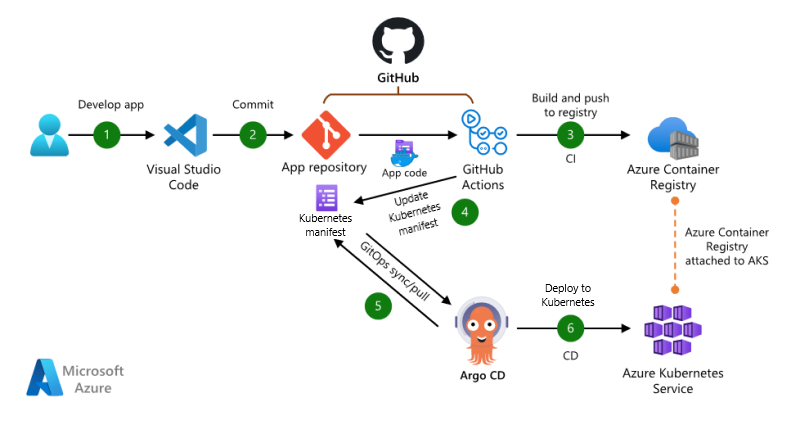
Are you looking for a more efficient and secure way to manage your software deployments? Look no further than GitOps deployment! In this article, we’ll dive into what GitOps deployment is, how it works, and the benefits it can bring to your software development process.
What is GitOps Deployment?
GitOps deployment is a method of continuous delivery for software applications. It involves using Git repositories as the source of truth for configuration and infrastructure management. This means that every change to the application’s configuration or infrastructure is managed through Git version control.
GitOps deployment is built on the foundational principles of DevOps. It emphasizes the collaboration and communication between development and operations teams to ensure that software deployments are efficient, reliable, and secure.
How Does GitOps Deployment Work?
GitOps deployment works by using Git repositories to store and manage the configuration and infrastructure of an application. When a change is made to the configuration or infrastructure, it is committed and pushed to the Git repository.
A continuous integration and delivery (CI/CD) pipeline is then triggered to deploy the changes to the application. The pipeline pulls the latest changes from the Git repository, builds the application, and deploys it to the target environment.
GitOps deployment also includes a reconciliation loop that ensures the target environment matches the desired state defined in the Git repository. This means that any changes made outside of the Git repository are automatically reconciled with the desired state.
Benefits of GitOps Deployment
GitOps deployment offers several benefits to software development teams, including:
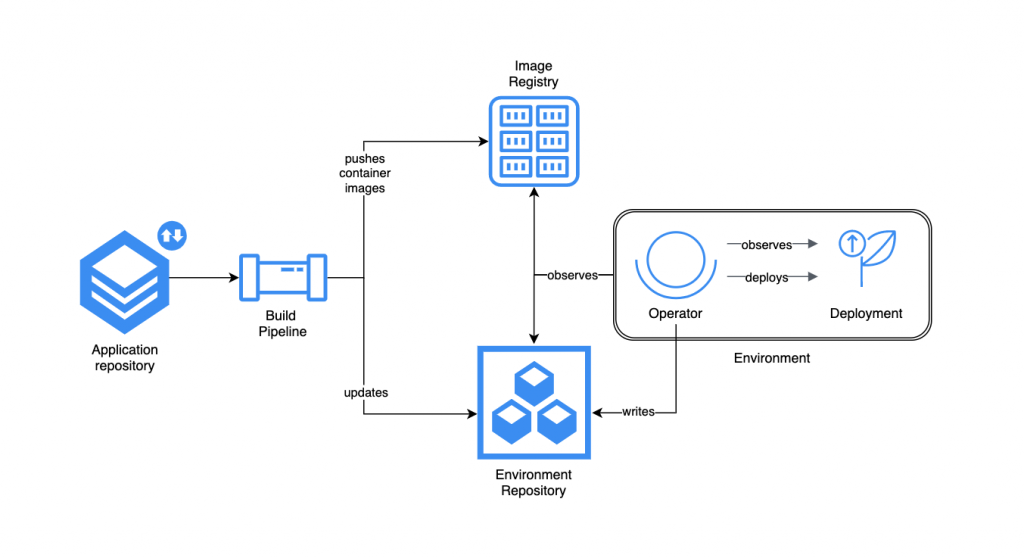
- Improved collaboration: GitOps deployment promotes collaboration between development and operations teams, ensuring that everyone is working towards the same goal.
- Increased efficiency: By using Git as the source of truth for configuration and infrastructure management, GitOps deployment streamlines the deployment process, reducing the time and effort required to deploy changes.
- Enhanced security: GitOps deployment provides a more secure way to manage application deployments. By using Git repositories to manage configuration and infrastructure, teams can ensure that only authorized personnel have access to make changes.
- Greater reliability: GitOps deployment ensures that every change is tracked and audited through Git version control, providing greater reliability and transparency in the deployment process.
Getting Started with GitOps Deployment
To get started with GitOps deployment, you’ll need to follow these basic steps:
- Set up a Git repository to store your application’s configuration and infrastructure.
- Define the desired state of your application in the Git repository.
- Configure your CI/CD pipeline to pull the latest changes from the Git repository and deploy them to the target environment.
- Implement a reconciliation loop to ensure that the target environment matches the desired state defined in the Git repository.
Conclusion
GitOps deployment is a powerful method of continuous delivery that offers several benefits to software development teams. By using Git as the source of truth for configuration and infrastructure management, teams can streamline the deployment process, increase efficiency, enhance security, and improve reliability. Getting started with GitOps deployment is easy, and the benefits are well worth the effort. Give it a try today!

👤 About the Author
Ashwani is passionate about DevOps, DevSecOps, SRE, MLOps, and AiOps, with a strong drive to simplify and scale modern IT operations. Through continuous learning and sharing, Ashwani helps organizations and engineers adopt best practices for automation, security, reliability, and AI-driven operations.
🌐 Connect & Follow:
Website: WizBrand.com
Facebook: facebook.com/DevOpsSchool
X (Twitter): x.com/DevOpsSchools
LinkedIn: linkedin.com/company/devopsschool
YouTube: youtube.com/@TheDevOpsSchool
Instagram: instagram.com/devopsschool
Quora: devopsschool.quora.com
Email– contact@devopsschool.com
Find Trusted Cardiac Hospitals
Compare heart hospitals by city and services — all in one place.
Explore Hospitals
A key nuance that is often missed in GitOps deployment discussions is that deployment is no longer a one-time push action, but an ongoing reconciliation process where the real complexity lies in controlling how changes move safely across environments. In real Kubernetes environments, it quickly becomes clear that applying manifests from Git is only part of the story—the bigger challenge is managing promotion strategies between dev, staging, and production, handling rollbacks when multiple changes have already been reconciled, and avoiding unintended side effects from shared base configurations. Another important consideration is the boundary between CI and CD, where CI should ideally handle build and validation while GitOps controllers manage runtime state, but in practice this separation often becomes blurred and complicates troubleshooting during incidents. At scale, deployment reliability also depends on additional practices such as progressive delivery, automated health-based rollback, and secure secrets handling, which are critical but not always emphasized. Without strong observability into reconciliation status, drift, and runtime health, teams may assume deployments are successful simply because Git is updated, even when the cluster is not fully stable. Overall, GitOps deployment is less about pushing changes and more about building a controlled, observable, and resilient system for managing continuous state convergence across environments.