
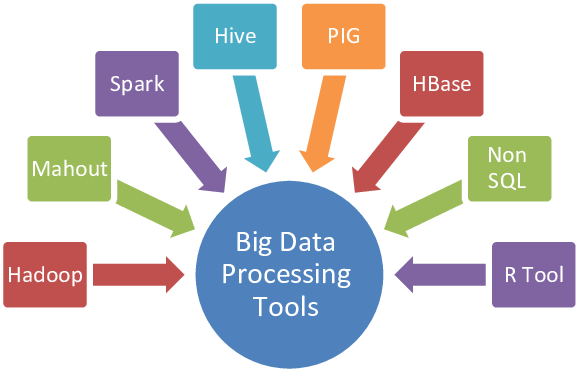
Big data is a game-changer in today’s digital world. In fact, the amount of data created and stored is growing exponentially each year. To deal with this massive amount of data, businesses require powerful tools that can process, analyze, and extract insights from diverse data sets. In this article, we will explore some of the most popular big data processing tools used by businesses today.
Hadoop
Hadoop is a popular open-source big data processing framework that allows distributed processing of large data sets across clusters of computers. It is designed to handle large data sets in a fault-tolerant manner. Hadoop has two main components: HDFS, which is a distributed file system for storing data, and MapReduce, which is a programming model for processing and analyzing data.
Spark

Apache Spark is another popular open-source big data processing tool that provides a fast and general-purpose engine for large-scale data processing. It can process data in real-time and supports various programming languages like Java, Python, and Scala. Spark is known for its speed, scalability, and ease of use.
Cassandra
Cassandra is a distributed NoSQL database that is designed to handle large amounts of data across multiple commodity servers. It can handle high write and read throughput and provides automatic data partitioning and replication. Cassandra is used by companies like Twitter, Netflix, and eBay for storing and managing large data sets.
MongoDB
MongoDB is another popular NoSQL database that is designed for handling unstructured and semi-structured data. It is known for its scalability, flexibility, and ease of use. MongoDB can be used to store and manage large data sets, and it can also be used for real-time analytics.
Elasticsearch

Elasticsearch is a distributed search and analytics engine that is built on top of Apache Lucene. It is designed to handle and analyze large amounts of data in real-time. Elasticsearch can be used for full-text search, log analysis, and analytics.
Flink
Apache Flink is a distributed processing engine for big data that is designed to handle both batch and stream processing. It can handle both real-time and offline data processing and supports various programming languages like Java, Scala, and Python. Flink is known for its speed, scalability, and fault-tolerance.
Pig
Apache Pig is a high-level platform for creating MapReduce programs used for large-scale data processing. It provides a simple and easy-to-use language for expressing data analysis programs. Pig can be used to process both structured and unstructured data and is commonly used in the Hadoop ecosystem.
Hive
Apache Hive is a data warehouse system for querying and analyzing large data sets stored in Hadoop. It provides a SQL-like interface for querying data and supports various data formats like CSV, AVRO, and Parquet. Hive can be used to generate reports, perform ad-hoc analysis, and extract insights from large data sets.
Impala

Impala is an open-source SQL engine designed for querying and analyzing large data sets stored in Hadoop. It provides a fast and interactive SQL interface for querying data in real-time. Impala can be used for ad-hoc analysis, data exploration, and reporting.
Conclusion
In conclusion, big data processing tools play a vital role in managing and analyzing large data sets. Whether you are dealing with structured or unstructured data, there are various tools available to help you extract insights and gain a competitive edge in today’s digital world. From Hadoop to Spark, Cassandra to MongoDB, Elasticsearch to Flink, Pig to Hive, and Impala, each tool has its unique features and advantages. Choose the tool that fits your business needs and start processing big data today!

👤 About the Author
Ashwani is passionate about DevOps, DevSecOps, SRE, MLOps, and AiOps, with a strong drive to simplify and scale modern IT operations. Through continuous learning and sharing, Ashwani helps organizations and engineers adopt best practices for automation, security, reliability, and AI-driven operations.
🌐 Connect & Follow:
Website: WizBrand.com
Facebook: facebook.com/DevOpsSchool
X (Twitter): x.com/DevOpsSchools
LinkedIn: linkedin.com/company/devopsschool
YouTube: youtube.com/@TheDevOpsSchool
Instagram: instagram.com/devopsschool
Quora: devopsschool.quora.com
Email– contact@devopsschool.com
Find Trusted Cardiac Hospitals
Compare heart hospitals by city and services — all in one place.
Explore Hospitals




