
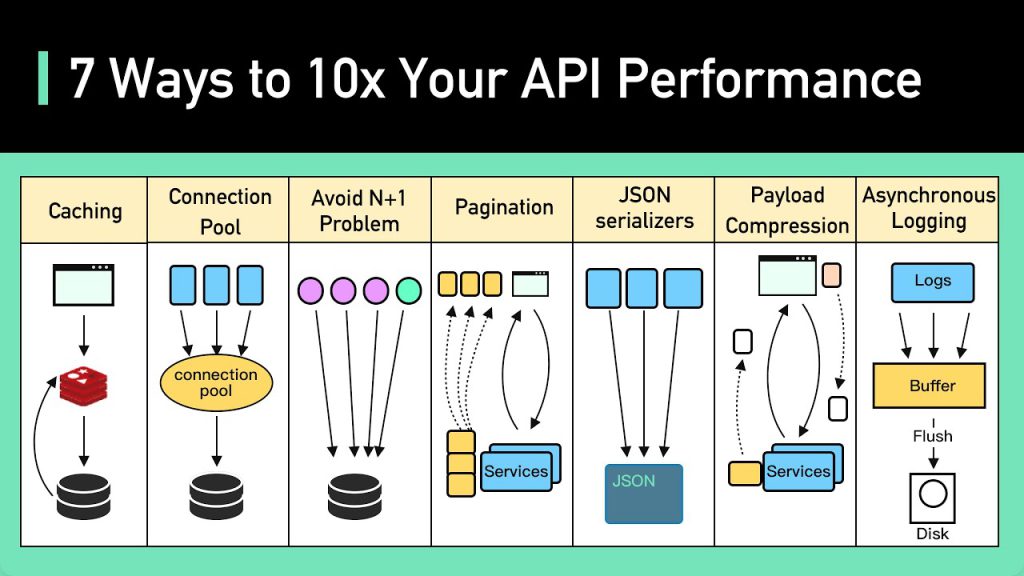
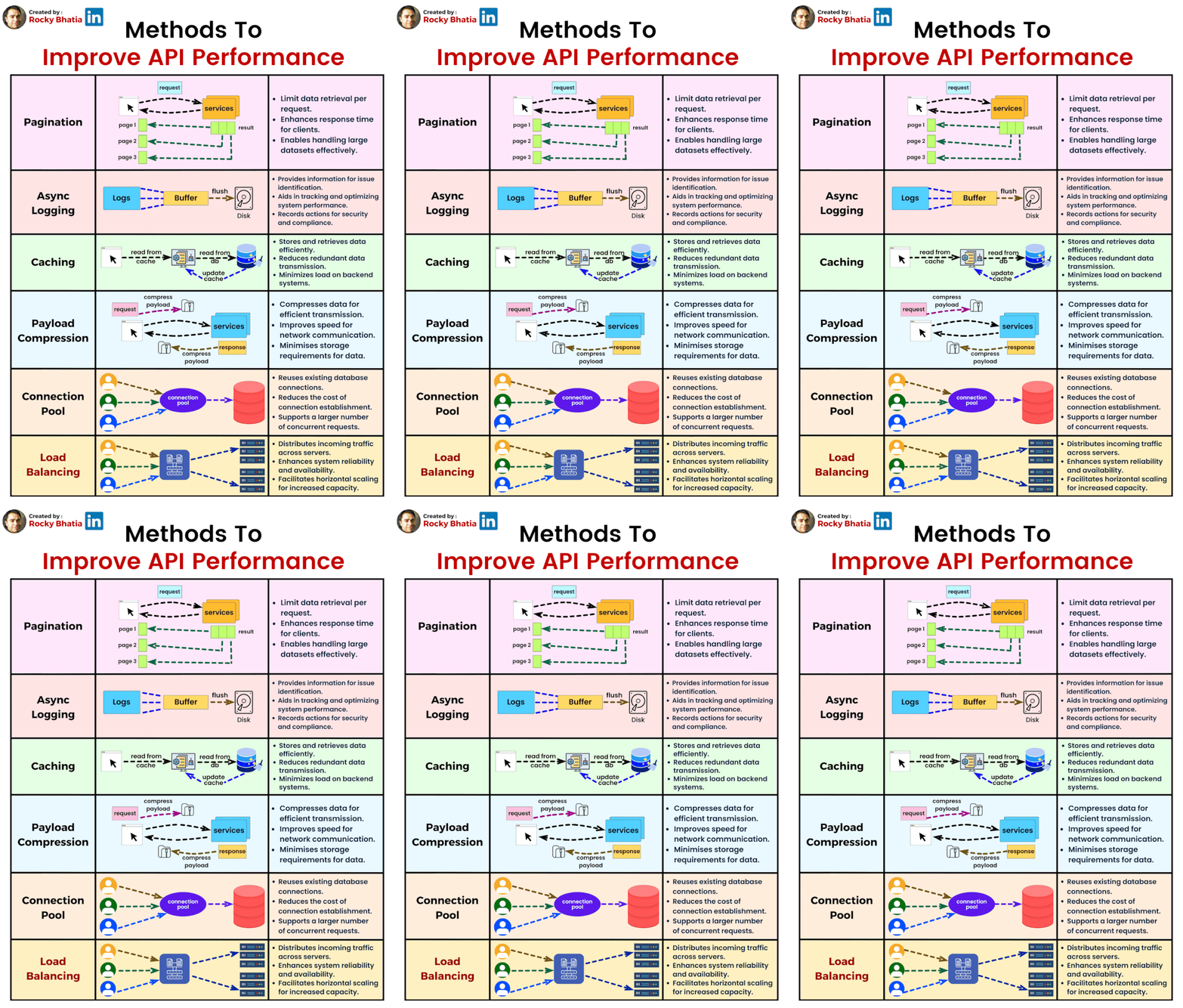
Improving API performance is critical for reducing latency, enhancing user experience, and optimizing resource consumption. Below is a detailed guide on all the methods you can use to improve REST, GraphQL, gRPC, and WebSocket APIs.
🔹 List of Methods to Improve API Performance
| Category | Optimization Techniques |
|---|---|
| 1️⃣ API Request Optimization | Reduce payload size, Compression, HTTP/2, Connection Pooling |
| 2️⃣ API Response Optimization | Caching, Gzip Compression, Minimize Headers |
| 3️⃣ Network & Protocol Optimization | HTTP/2, WebSockets, gRPC, TLS Termination |
| 4️⃣ Load Balancing & Scalability | API Gateway, CDNs, Auto-scaling |
| 5️⃣ Database Optimization | Indexing, Query Optimization, Read Replicas, Connection Pooling |
| 6️⃣ Security & Authentication Efficiency | Token Expiry, OAuth Optimization, Lightweight Encryption |
| 7️⃣ Logging, Monitoring & Debugging | API Observability, Distributed Tracing, Rate Limits |
| 8️⃣ Code & Infrastructure Optimization | Asynchronous Processing, Edge Computing, Serverless APIs |
1️⃣ API Request Optimization
Optimizing API requests reduces network overhead and improves response times.
✅ 1.1 Reduce Payload Size
📌 Why?
- Large request payloads slow down APIs due to higher network transfer time.
- JSON/XML-based APIs suffer from unnecessary fields & large objects.
📌 How to Optimize? ✔ Use Protobuf (for gRPC) instead of JSON for better efficiency.
✔ Use GraphQL for selective field fetching instead of REST over-fetching.
✔ Minimize unnecessary headers & avoid long query parameters.
📌 Example: Large vs. Optimized JSON Payload ❌ Bad (Unoptimized Payload)
{
  "id": 12345,
  "first_name": "John",
  "last_name": "Doe",
  "address": {
    "street": "123 Main St",
    "city": "New York",
    "zipcode": "10001"
  },
  "extra_data": {
    "unused_field_1": "...",
    "unused_field_2": "..."
  }
}
Code language: JSON / JSON with Comments (json)
✅ Good (Optimized Payload)
{
  "id": 12345,
  "name": "John Doe",
  "city": "New York"
}
Code language: JSON / JSON with Comments (json)
✅ 1.2 Use Request Compression (Gzip, Brotli)
📌 Why?
✔ Compressing API requests reduces the payload size by 60-80%.
✔ Gzip and Brotli are widely supported compression methods.
📌 How to Enable Compression in APIs? ✔ Set Content-Encoding: gzip in HTTP headers.
✔ Enable gzip compression at API Gateway / Load Balancer level.
Example (Node.js Express API with Compression):
const compression = require('compression');
const express = require('express');
const app = express();
app.use(compression());
app.get('/data', (req, res) => {
  res.json({ message: "Compressed response!" });
});
Code language: PHP (php)
2️⃣ API Response Optimization
✅ 2.1 Implement Response Caching (Redis, CDN, API Gateway)
📌 Why?
✔ Caching avoids repeated database queries, reducing response time.
✔ Popular cache solutions: Redis, Memcached, API Gateway Cache, Cloudflare CDN.
📌 How to Implement? ✔ Use HTTP Caching Headers (Cache-Control, ETag).
✔ Use API Gateway Caching (AWS API Gateway, Fastly, Akamai).
Example (Cache-Control Header for API Responses):
Cache-Control: max-age=600, public
Code language: PHP (php)
✅ 2.2 Use Response Compression
📌 Why?
✔ Reduces bandwidth usage and improves performance.
✔ Works for REST, GraphQL, gRPC APIs.
📌 How to Enable? ✔ Use Gzip (faster compression) or Brotli (better compression).
✔ Configure Nginx / Apache / API Gateway to auto-compress responses.
Example (Enable Gzip Compression in Nginx for API responses):
gzip on;
gzip_types application/json text/javascript;
3️⃣ Network & Protocol Optimization
✅ 3.1 Use HTTP/2 Instead of HTTP/1.1
📌 Why?
✔ Multiplexing (multiple requests in a single TCP connection).
✔ Reduces round-trip latency.
📌 How to Enable?
✔ Enable HTTP/2 on Load Balancer (AWS ALB, Nginx, Traefik).
✔ Use TLS encryption (HTTP/2 requires HTTPS).
✅ 3.2 Use WebSockets or gRPC Instead of REST
📌 Why?
✔ WebSockets are faster for real-time applications (e.g., chat, stock data).
✔ gRPC is faster than REST for microservices communication.
📌 How to Implement? ✔ Use gRPC APIs instead of REST for microservices.
✔ Use WebSockets instead of polling APIs.
Example (Node.js WebSockets API):
const WebSocket = require('ws');
const wss = new WebSocket.Server({ port: 8080 });
wss.on('connection', ws => {
  ws.send('Hello Client!');
});
Code language: PHP (php)
4️⃣ Load Balancing & Scalability
✅ 4.1 Use API Gateway & Load Balancers
📌 Why?
✔ Distributes API traffic across multiple backend servers.
✔ Prevents overloading a single API instance.
📌 Best API Gateways:
- AWS API Gateway (fully managed)
- Kong / Nginx API Gateway (self-hosted)
- Traefik (lightweight)
Example (Nginx Load Balancing for API Servers):
upstream api_servers {
    server api1.example.com;
    server api2.example.com;
}
server {
    location /api {
        proxy_pass http://api_servers;
    }
}
Code language: JavaScript (javascript)
5️⃣ Database Optimization
✅ 5.1 Optimize Database Queries (Indexes, Read Replicas)
📌 Why?
✔ Reduces query execution time from seconds to milliseconds.
✔ Prevents slow API responses.
📌 How to Optimize? ✔ Use Indexing (CREATE INDEX on frequently searched fields).
✔ Use Read Replicas for high-volume read operations.
Example (Create Index in MySQL):
CREATE INDEX idx_user_email ON users(email);
6️⃣ Security & Authentication Efficiency
✅ 6.1 Optimize Token Authentication (JWT Expiry & Caching)
📌 Why?
✔ Reduces repeated authentication calls.
✔ Prevents unnecessary API load.
📌 How to Optimize? ✔ Use short-lived JWT tokens with refresh tokens.
✔ Cache authentication tokens in Redis to reduce DB lookups.
Example (Short-Lived JWT Token):
const token = jwt.sign({ user: "John" }, secret, { expiresIn: "10m" });
Code language: JavaScript (javascript)
7️⃣ Monitoring & Debugging
✅ 7.1 Use API Observability Tools
📌 Why?
✔ Helps identify slow APIs, bottlenecks, errors.
✔ Tracks latency, API usage, and failures.
📌 Best Monitoring Tools: ✔ Prometheus + Grafana (self-hosted monitoring).
✔ AWS CloudWatch (for AWS APIs).
✔ Jaeger / OpenTelemetry (for distributed tracing).
🚀 Final Checklist for Improving API Performance
✔ ✅ Reduce API request & response payloads
✔ ✅ Enable caching (Redis, API Gateway, CDN)
✔ ✅ Use HTTP/2, gRPC, or WebSockets for real-time APIs
✔ ✅ Load balance APIs (Nginx, AWS ALB, API Gateway)
✔ ✅ Optimize database queries & indexing
✔ ✅ Use API observability tools (Prometheus, Grafana, Jaeger)

I’m Rajesh Kumar, a DevOps, SRE, DevSecOps, Cloud, and Platform Engineering expert passionate about sharing practical knowledge, real-world experiences, and industry best practices. I have worked at Cotocus and regularly write about technology, travel, investing, health, product reviews, and digital marketing through my various platforms.
I publish technical articles at DevOps School, travel stories at Holiday Landmark, stock market insights at Stocks Mantra, health and fitness guidance at My Medic Plus, product reviews at TrueReviewNow, and SEO and digital marketing strategies at Wizbrand.
Find Trusted Cardiac Hospitals
Compare heart hospitals by city and services — all in one place.
Explore Hospitals





