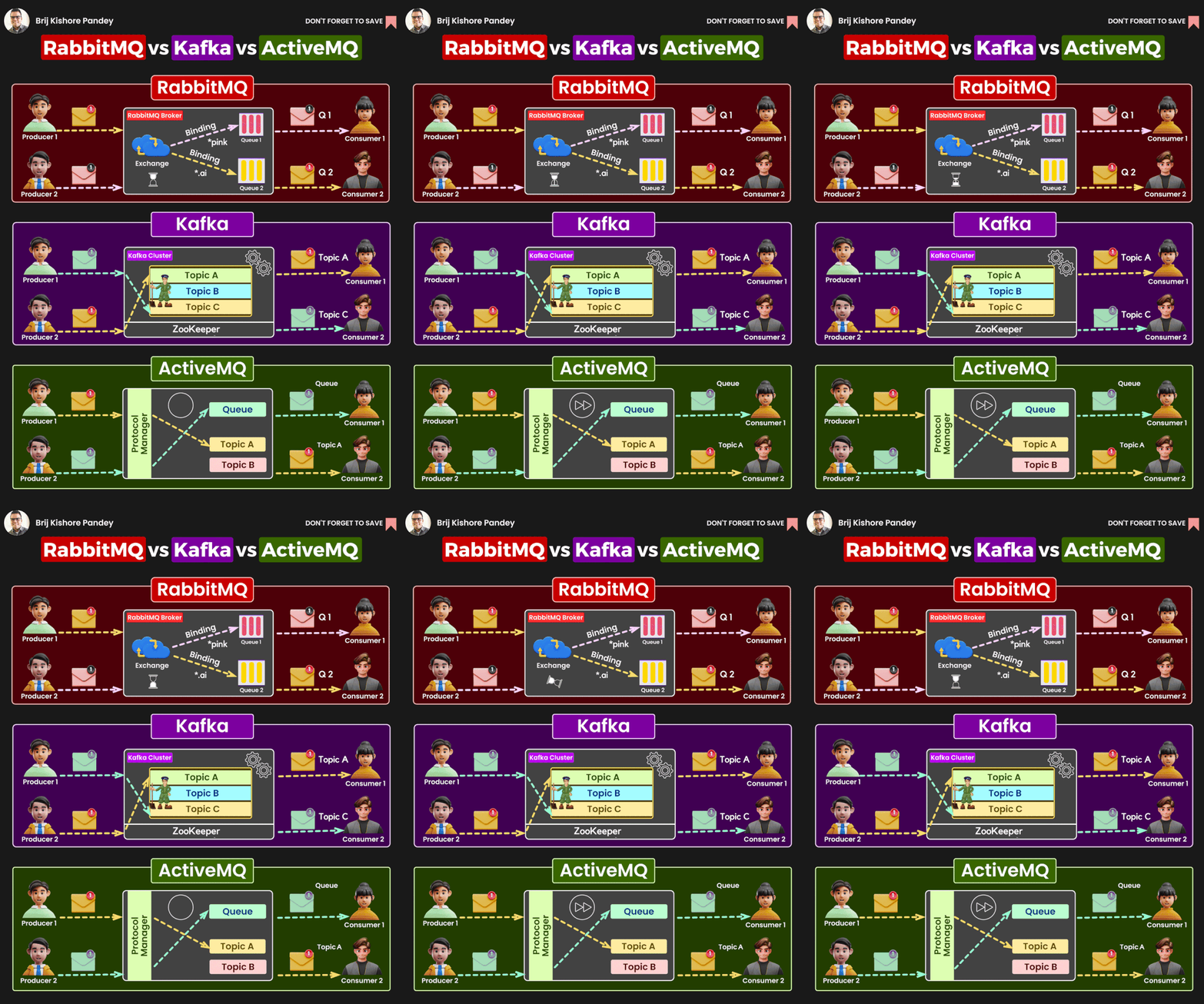
RabbitMQ, Kafka, and ActiveMQ are three popular message brokers, each designed for different use cases. Here’s a detailed comparison of RabbitMQ vs Kafka vs ActiveMQ based on various parameters:
1. Overview
Feature
RabbitMQ
Kafka
ActiveMQ
Type
Message Broker (AMQP)
Event Streaming Platform
Message Broker (JMS)
Best For
Traditional message queuing with complex routing
High-throughput event streaming and real-time processing
Enterprise-grade message queuing and transactions
Architecture
Push-based
Pull-based
Push-based
2. Performance & Scalability
Feature
RabbitMQ
Kafka
ActiveMQ
Latency
Low (milliseconds)
High (microseconds)
Moderate (milliseconds)
Throughput
Low to Medium
Very High
Medium
Scalability
Moderate
Highly Scalable (distributed)
Moderate
Kafka provides the highest throughput because it is log-based and optimized for event-driven architectures.
RabbitMQ has low latency, making it ideal for real-time messaging.
ActiveMQ supports broker clustering, but it’s not as scalable as Kafka.
3. Message Durability & Persistence
Feature
RabbitMQ
Kafka
ActiveMQ
Message Retention
Queues persist until consumed
Messages are retained for a configurable period
Queues persist until consumed
Replication
Yes, with clustering and HA
Yes, with partitions and replication factor
Yes, using Master-Slave clusters
Guaranteed Delivery
Yes (acknowledgments)
Yes (commit log)
Yes (acknowledgments)
Kafka retains messages for a set period even after consumption.
RabbitMQ and ActiveMQ delete messages once they are acknowledged by consumers.
4. Message Ordering & Routing
Feature
RabbitMQ
Kafka
ActiveMQ
Message Ordering
FIFO within queues
Ordered within partitions
FIFO within queues
Complex Routing
Supports Exchanges (Direct, Topic, Fanout)
Supports Topics & Partitions
Supports Virtual Topics & Selectors
Guaranteed Ordering
Partial
Yes (Partition level)
Partial
Kafka ensures ordering within partitions, making it the best for event-driven systems.
RabbitMQ & ActiveMQ support FIFO, but ordering is not always guaranteed due to parallel processing.
5. Protocols & API Support
Feature
RabbitMQ
Kafka
ActiveMQ
Protocols
AMQP, STOMP, MQTT
Custom TCP Protocol
JMS, AMQP, STOMP, MQTT
Client Libraries
Many (Java, Python, Go, C#)
Java, Python, Go, C#
Java, C++, Python, C#
Language Support
Wide
Wide
Wide
RabbitMQ supports more messaging protocols than Kafka and ActiveMQ.
Kafka has a proprietary protocol, but client libraries exist for many languages.
ActiveMQ is JMS-compliant, making it suitable for Java-based enterprise systems.
6. Use Cases
Use Case
RabbitMQ
Kafka
ActiveMQ
Real-time Messaging
✅ Best
❌ No
✅ Good
Event-Driven Systems
❌ No
✅ Best
❌ No
Streaming Data Processing
❌ No
✅ Best
❌ No
Request-Response (RPC)
✅ Yes
❌ No
✅ Yes
IoT & Microservices
✅ Yes
✅ Yes
✅ Yes
Transactional Messaging
✅ Yes
❌ No
✅ Yes
Big Data Pipelines
❌ No
✅ Best
❌ No
RabbitMQ is best for request-response patterns and real-time messaging.
Kafka is ideal for event-driven architectures and big data pipelines.
ActiveMQ is good for transactional messaging in Java-based enterprise apps.
7. Pros & Cons
Feature
RabbitMQ
Kafka
ActiveMQ
Pros
Easy to use, flexible, supports multiple protocols
High throughput, persistent storage, built for scalability
Java-native, supports transactions, integrates well with JMS
Cons
Not suitable for event streaming, requires more resources
Complex setup, not ideal for traditional queuing
Slower than RabbitMQ, not as scalable as Kafka
Final Verdict: Which One to Choose?
Use RabbitMQ if you need low-latency, real-time messaging and complex routing.
Use Kafka if you need high-throughput, event-driven messaging, and data streaming.
Use ActiveMQ if you need enterprise-grade transactional messaging with JMS support.
Conclusion
Each message broker excels in different areas. Kafka is best for event-driven architectures, RabbitMQ is best for real-time messaging, and ActiveMQ is best for Java enterprise systems. Choose the right one based on your needs!
I’m Rajesh Kumar, a DevOps, SRE, DevSecOps, Cloud, and Platform Engineering expert passionate about sharing practical knowledge, real-world experiences, and industry best practices. I have worked at Cotocus and regularly write about technology, travel, investing, health, product reviews, and digital marketing through my various platforms.
I publish technical articles at DevOps School, travel stories at Holiday Landmark, stock market insights at Stocks Mantra, health and fitness guidance at My Medic Plus, product reviews at TrueReviewNow, and SEO and digital marketing strategies at Wizbrand.
Find Trusted Cardiac Hospitals
Compare heart hospitals by city and services — all in one place.
I'm Rajesh Kumar, a DevOps, SRE, DevSecOps, Cloud, and Platform Engineering expert passionate about sharing practical knowledge, real-world experiences, and industry best practices. I have worked at Cotocus and regularly write about technology, travel, investing, health, product reviews, and digital marketing through my various platforms.
I publish technical articles at DevOps School, travel stories at Holiday Landmark, stock market insights at Stocks Mantra, health and fitness guidance at My Medic Plus, product reviews at TrueReviewNow, and SEO and digital marketing strategies at Wizbrand.
Install Team Foundation Server 2015 using the original Microsoft download paths, with clear guidance for online, offline, and ISO-based setup. This revised guide also includes an installation workflow, command example, and practical pitfalls to avoid.
Need a shell inside a running container that is already in detached mode? This updated guide shows the correct workflow, compares docker exec and docker attach, and explains when SSH does and does not make sense.
Learn how to host a private NuGet feed using three practical approaches: a local folder source, NuGet.Server, and NuGetGallery. This revised guide includes setup steps, command examples, and a workflow diagram to help you choose the right model.
Learn how to publish a NuGet package to NuGet.org using either nuget.exe or the dotnet CLI. This revised guide includes a workflow diagram, command comparison, and a CI-friendly example.
Learn three practical ways to build NuGet packages using nuget.exe: from an existing assembly, from a convention-based folder layout, or directly from a Visual Studio project. This guide includes commands, folder conventions, token behavior, and common pitfalls.
This guide explains how VM-based workflows, containers, and cloud platforms complement each other in DevOps. It includes a practical workflow, trade-off table, and command examples for day-to-day use.