
Introduction
A Data Warehouse Platform is a centralized system designed to collect, store, process, and analyze large volumes of structured and semi-structured data from multiple sources. Unlike operational databases that handle daily transactions, data warehouses are optimized for analytics, reporting, and business intelligence. They enable organizations to make data-driven decisions by providing a single, trusted source of truth.
In today’s data-driven world, businesses generate data from applications, websites, IoT devices, CRMs, ERPs, and marketing tools. Without a proper data warehouse, this data remains fragmented, inconsistent, and underutilized. A modern data warehouse platform helps unify this data, apply transformations, ensure data quality, and deliver fast query performance for analysts and decision-makers.
Key real-world use cases include:
- Business intelligence and reporting
- Financial and regulatory reporting
- Customer behavior and personalization analytics
- Supply chain and operations optimization
- Machine learning and advanced analytics
When choosing a data warehouse platform, users should evaluate:
- Scalability and performance
- Ease of use and learning curve
- Integration with existing tools
- Security and compliance
- Cost structure and long-term value
Best for:
Data warehouse platforms are ideal for data analysts, data engineers, BI teams, product managers, finance teams, and executives. They are widely used across SMBs, mid-market companies, and enterprises in industries such as finance, healthcare, retail, e-commerce, SaaS, manufacturing, and telecom.
Not ideal for:
They may be unnecessary for very small teams with minimal data, simple applications relying only on transactional databases, or organizations that only need lightweight reporting without historical analysis. In such cases, simpler analytics tools or embedded databases may be more suitable.
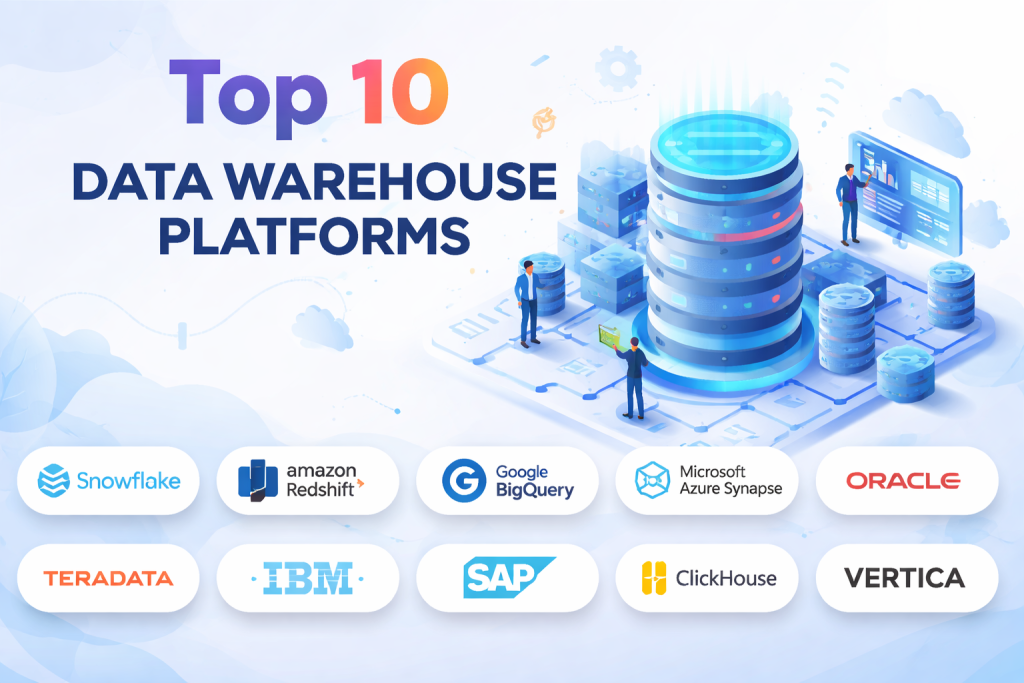
Top 10 Data Warehouse Platforms Tools
1 — Snowflake
Short description:
Snowflake is a cloud-native data warehouse designed for scalability, performance, and simplicity. It separates storage and compute, making it popular among data-driven organizations of all sizes.
Key features:
- Independent scaling of compute and storage
- Near-zero maintenance and automatic optimization
- Support for structured and semi-structured data
- Secure data sharing across organizations
- Multi-cloud deployment options
- Time travel and data cloning
- High-performance SQL analytics
Pros:
- Extremely fast performance at scale
- Flexible pay-as-you-go pricing model
- Minimal operational overhead
Cons:
- Costs can increase with heavy usage
- Limited support for on-prem environments
Security & compliance:
SSO, encryption at rest and in transit, audit logs, SOC 2, ISO, GDPR, HIPAA support.
Support & community:
Strong documentation, enterprise-grade support, active user community, extensive partner ecosystem.
2 — Amazon Redshift
Short description:
Amazon Redshift is a fully managed cloud data warehouse optimized for analytics within the AWS ecosystem.
Key features:
- Columnar storage for fast queries
- Tight integration with AWS services
- Managed scaling and workload management
- Support for SQL-based analytics
- Data sharing across clusters
- Redshift Spectrum for querying external data
Pros:
- Ideal for AWS-centric organizations
- Strong performance for large datasets
- Mature and stable platform
Cons:
- Complex tuning for optimal performance
- Less flexible outside AWS
Security & compliance:
IAM-based access control, encryption, VPC isolation, SOC 2, GDPR, HIPAA.
Support & community:
Extensive AWS documentation, large community, enterprise support plans.
3 — Google BigQuery
Short description:
Google BigQuery is a serverless, highly scalable data warehouse designed for real-time analytics and massive datasets.
Key features:
- Serverless architecture with no infrastructure management
- Built-in machine learning capabilities
- Real-time streaming ingestion
- ANSI SQL support
- Automatic scaling and optimization
- Integration with Google Cloud services
Pros:
- Very easy to get started
- Excellent performance on large datasets
- Strong analytics and ML integration
Cons:
- Query-based pricing can be unpredictable
- Best suited for Google Cloud users
Security & compliance:
Encryption by default, IAM controls, audit logs, SOC 2, ISO, GDPR, HIPAA.
Support & community:
Strong documentation, growing community, enterprise-grade Google Cloud support.
4 — Microsoft Azure Synapse Analytics
Short description:
Azure Synapse Analytics combines data warehousing and big data analytics into a single integrated platform.
Key features:
- Unified analytics for SQL and Spark
- Deep integration with Microsoft ecosystem
- Massively parallel processing (MPP)
- Advanced security and monitoring
- Support for real-time analytics
- Integrated data pipelines
Pros:
- Excellent for Microsoft-centric organizations
- Unified analytics experience
- Strong enterprise security
Cons:
- Steeper learning curve
- Performance tuning required
Security & compliance:
Azure Active Directory, encryption, audit logs, SOC 2, ISO, GDPR, HIPAA.
Support & community:
Comprehensive documentation, strong enterprise support, large Microsoft user base.
5 — Oracle Autonomous Data Warehouse
Short description:
Oracle Autonomous Data Warehouse is a self-driving data warehouse with automated tuning, scaling, and security.
Key features:
- Fully autonomous management
- High-performance analytics
- Advanced SQL and analytics features
- Built-in machine learning
- Automatic patching and backups
- Strong support for enterprise workloads
Pros:
- Minimal manual administration
- High reliability and performance
- Strong enterprise feature set
Cons:
- Higher cost compared to some competitors
- Best suited for Oracle ecosystem
Security & compliance:
Encryption, access controls, audit logging, SOC 2, ISO, GDPR, HIPAA.
Support & community:
Enterprise-grade Oracle support, extensive documentation, established user base.
6 — Teradata Vantage
Short description:
Teradata Vantage is a high-performance analytics platform designed for large-scale enterprise data workloads.
Key features:
- Advanced parallel processing
- Hybrid cloud and on-prem support
- Integrated analytics and ML
- Strong workload management
- High concurrency support
- Enterprise-grade reliability
Pros:
- Excellent for very large datasets
- Proven enterprise performance
- Flexible deployment options
Cons:
- High cost
- Complex setup and management
Security & compliance:
Encryption, role-based access, audit logs, SOC 2, ISO, GDPR.
Support & community:
Strong enterprise support, professional services, smaller community compared to cloud-native tools.
7 — IBM Db2 Warehouse
Short description:
IBM Db2 Warehouse is an analytics-focused data warehouse offering strong performance and hybrid deployment options.
Key features:
- In-memory processing
- Advanced compression
- AI-assisted query optimization
- Hybrid and on-prem deployment
- High availability and disaster recovery
Pros:
- Strong performance for analytics
- Flexible deployment models
- Reliable enterprise-grade solution
Cons:
- Less modern UI
- Smaller ecosystem
Security & compliance:
Encryption, role-based access, audit trails, SOC 2, ISO, GDPR.
Support & community:
Enterprise IBM support, solid documentation, moderate community presence.
8 — SAP Data Warehouse Cloud
Short description:
SAP Data Warehouse Cloud is a business-centric data warehouse optimized for SAP and enterprise analytics.
Key features:
- Tight integration with SAP ecosystem
- Business semantic modeling
- Cloud-native architecture
- Real-time analytics
- Self-service data access
Pros:
- Ideal for SAP customers
- Strong business modeling capabilities
- Integrated analytics
Cons:
- Limited appeal outside SAP
- Premium pricing
Security & compliance:
SSO, encryption, audit logs, SOC 2, GDPR, ISO.
Support & community:
Enterprise SAP support, strong documentation, SAP-focused user community.
9 — ClickHouse
Short description:
ClickHouse is a high-performance, open-source columnar data warehouse optimized for real-time analytics.
Key features:
- Extremely fast query performance
- Column-oriented storage
- Open-source flexibility
- Horizontal scalability
- Real-time analytics capabilities
Pros:
- Exceptional speed
- Cost-effective for large volumes
- Open-source transparency
Cons:
- Requires more engineering effort
- Limited managed service options
Security & compliance:
Varies depending on deployment; encryption and access controls configurable.
Support & community:
Active open-source community, good documentation, limited enterprise support unless managed.
10 — Vertica
Short description:
Vertica is a high-performance analytics data warehouse designed for large-scale, data-intensive workloads.
Key features:
- Columnar storage architecture
- Advanced query optimization
- High concurrency support
- Hybrid cloud deployment
- Built-in machine learning
Pros:
- Strong performance at scale
- Mature analytics capabilities
- Flexible deployment
Cons:
- Complex administration
- Higher licensing costs
Security & compliance:
Encryption, access controls, audit logging, SOC 2, GDPR.
Support & community:
Enterprise support available, solid documentation, smaller community.
Comparison Table
| Tool Name | Best For | Platform(s) Supported | Standout Feature | Rating |
|---|---|---|---|---|
| Snowflake | Scalable cloud analytics | Multi-cloud | Separate compute & storage | N/A |
| Amazon Redshift | AWS-centric teams | Cloud (AWS) | Deep AWS integration | N/A |
| Google BigQuery | Serverless analytics | Cloud | Serverless scalability | N/A |
| Azure Synapse | Microsoft ecosystem | Cloud | Unified analytics | N/A |
| Oracle ADW | Enterprise automation | Cloud | Autonomous management | N/A |
| Teradata Vantage | Large enterprises | Cloud / On-prem | Massive parallel processing | N/A |
| IBM Db2 Warehouse | Hybrid analytics | Cloud / On-prem | In-memory performance | N/A |
| SAP DWC | SAP users | Cloud | Business semantic layer | N/A |
| ClickHouse | Real-time analytics | Cloud / On-prem | Extreme query speed | N/A |
| Vertica | Data-intensive analytics | Cloud / On-prem | High concurrency | N/A |
Evaluation & Scoring of Data Warehouse Platforms
| Criteria | Weight | Evaluation Focus |
|---|---|---|
| Core features | 25% | Scalability, SQL support, analytics |
| Ease of use | 15% | Setup, UI, learning curve |
| Integrations & ecosystem | 15% | BI, ETL, cloud services |
| Security & compliance | 10% | Encryption, certifications |
| Performance & reliability | 10% | Speed, uptime, scalability |
| Support & community | 10% | Docs, support quality |
| Price / value | 15% | Cost efficiency, ROI |
Which Data Warehouse Platforms Tool Is Right for You?
- Solo users: Lightweight, serverless tools with minimal setup
- SMBs: Cloud-native platforms with predictable pricing
- Mid-market: Balance of performance, cost, and integrations
- Enterprise: Advanced security, compliance, and scalability
Budget-conscious teams should favor open-source or serverless models, while premium solutions suit organizations with complex workloads. Choose ease of use if resources are limited, or feature depth for advanced analytics. Always consider integration, scalability, and compliance needs.
Frequently Asked Questions (FAQs)
- What is a data warehouse platform?
A centralized system for storing and analyzing large volumes of historical data. - Is a data warehouse different from a database?
Yes, databases handle transactions; warehouses focus on analytics. - Are cloud data warehouses secure?
Most offer strong encryption, access controls, and compliance certifications. - Do small businesses need data warehouses?
Only if they analyze growing or complex datasets. - How long does implementation take?
From days for cloud tools to months for enterprise deployments. - Can data warehouses handle real-time data?
Many modern platforms support near real-time ingestion. - Are open-source options reliable?
Yes, but they require more technical expertise. - What are common mistakes?
Ignoring costs, poor data modeling, and lack of governance. - How important is scalability?
Critical for long-term growth and performance. - Can data warehouses support machine learning?
Many platforms include built-in ML capabilities.
Conclusion
Data warehouse platforms are essential for turning raw data into actionable insights. Each tool offers unique strengths in performance, scalability, and usability. There is no single “best” platform—the right choice depends on your data volume, budget, technical expertise, and business goals. By carefully evaluating features, costs, and long-term needs, organizations can select a data warehouse that truly empowers data-driven decision-making.

Find Trusted Cardiac Hospitals
Compare heart hospitals by city and services — all in one place.
Explore Hospitals
