
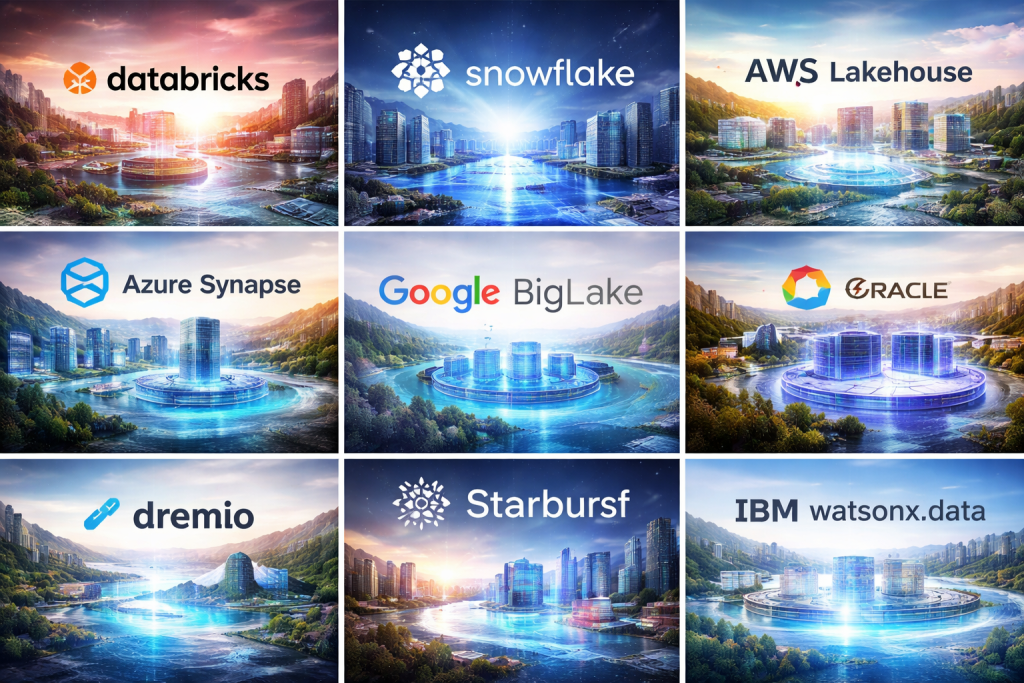
Introduction
Lakehouse platforms are modern data architectures that combine the flexibility of data lakes with the performance, governance, and reliability of data warehouses. Traditionally, organizations had to choose between data lakes (cheap storage, flexible formats, but weak governance) and data warehouses (high performance, strong governance, but rigid and expensive). Lakehouse platforms bridge this gap by enabling analytics, BI, machine learning, and real-time processing on a single unified data foundation.
The importance of lakehouse platforms has grown rapidly as businesses deal with massive data volumes, diverse data types, AI workloads, and real-time decision-making needs. From healthcare analytics and financial risk modeling to e-commerce personalization and IoT data processing, lakehouse platforms power modern data-driven organizations.
When evaluating lakehouse platforms, users should focus on:
- Open data formats and interoperability
- Performance for analytics and AI workloads
- Scalability and cost efficiency
- Security, governance, and compliance
- Integration with existing tools and cloud ecosystems
Best for:
Lakehouse platforms are ideal for data engineers, data scientists, analytics teams, AI/ML teams, and enterprises dealing with large-scale structured and unstructured data across industries such as finance, healthcare, retail, manufacturing, SaaS, and media.
Not ideal for:
Small teams with minimal data needs, organizations relying solely on simple reporting, or use cases where a traditional database or lightweight data warehouse is sufficient may not need a full lakehouse platform.
Top 10 Lakehouse Platforms Tools
1 — Databricks Lakehouse Platform
Short description:
Databricks is one of the pioneers of the lakehouse architecture, built on Apache Spark. It is designed for large-scale analytics, data engineering, and machine learning workloads.
Key features:
- Unified data, analytics, and AI platform
- Delta Lake for ACID transactions and reliability
- Native support for batch and streaming
- Integrated notebooks and collaborative workspace
- Strong ML lifecycle management
- Open-source foundations (Spark, Delta Lake)
- Cloud-native scalability
Pros:
- Excellent performance for large-scale analytics
- Strong ecosystem for AI and ML workloads
- Mature lakehouse implementation
Cons:
- Steep learning curve for beginners
- Can be costly at scale if not optimized
Security & compliance:
SSO, role-based access control, encryption at rest and in transit, audit logs, GDPR, SOC 2, HIPAA support.
Support & community:
Extensive documentation, strong open-source community, enterprise-grade support plans.
2 — Snowflake Data Cloud (Lakehouse Capabilities)
Short description:
Snowflake has evolved from a data warehouse into a platform supporting lakehouse-like capabilities through open table formats and external data access.
Key features:
- Separation of storage and compute
- Support for structured and semi-structured data
- Iceberg table support
- High-performance SQL analytics
- Secure data sharing
- Automatic scaling
- Minimal infrastructure management
Pros:
- Very easy to use
- Excellent performance and reliability
- Strong governance features
Cons:
- Less flexible for deep ML workloads
- Proprietary architecture
Security & compliance:
SOC 2, ISO, GDPR, HIPAA, encryption, SSO, audit logs.
Support & community:
Strong enterprise support, rich documentation, growing community.
3 — Amazon Redshift + Lake Formation (AWS Lakehouse)
Short description:
AWS provides a lakehouse architecture by combining Redshift, Lake Formation, S3, and analytics services like Athena.
Key features:
- Deep integration with AWS ecosystem
- Centralized data governance via Lake Formation
- Query data directly from S3
- Scales for petabyte-level data
- Supports multiple analytics engines
- Fine-grained access controls
Pros:
- Highly scalable and flexible
- Strong governance and security
- Ideal for AWS-centric organizations
Cons:
- Complex setup and management
- Costs can grow quickly without governance
Security & compliance:
IAM, encryption, audit logging, SOC, ISO, HIPAA, GDPR.
Support & community:
Extensive AWS documentation, large global user base, enterprise support.
4 — Azure Synapse Analytics (Microsoft Fabric Lakehouse)
Short description:
Azure Synapse is Microsoft’s lakehouse and analytics platform, deeply integrated with Azure services and Power BI.
Key features:
- Unified SQL and Spark analytics
- Tight integration with Power BI
- Azure Data Lake Storage support
- Built-in data integration pipelines
- Enterprise-grade security
- Scalable cloud-native design
Pros:
- Excellent BI and analytics integration
- Strong enterprise governance
- Familiar ecosystem for Microsoft users
Cons:
- Azure lock-in
- Complex pricing structure
Security & compliance:
Azure AD, encryption, audit logs, GDPR, ISO, HIPAA.
Support & community:
Strong enterprise support, extensive learning resources, large user base.
5 — Google BigLake (BigQuery Lakehouse)
Short description:
Google BigLake extends BigQuery to enable lakehouse-style analytics across data lakes and warehouses.
Key features:
- Unified analytics across data sources
- Serverless architecture
- Strong performance for SQL analytics
- Integrated governance
- AI and ML integration
- Open table format support
Pros:
- Minimal operational overhead
- Excellent query performance
- Strong AI/ML ecosystem
Cons:
- Less control over infrastructure
- GCP-centric
Security & compliance:
Encryption, IAM, GDPR, ISO, SOC compliance.
Support & community:
Strong documentation, growing community, enterprise support.
6 — Dremio Lakehouse Platform
Short description:
Dremio is an open lakehouse platform focused on high-performance SQL analytics directly on data lakes.
Key features:
- Apache Iceberg-native
- High-speed SQL query engine
- Data virtualization
- Open-source foundation
- Cloud and on-prem support
- BI-friendly architecture
Pros:
- Excellent performance on open data
- No data movement required
- Strong Iceberg support
Cons:
- Limited ML tooling
- Smaller ecosystem than hyperscalers
Security & compliance:
Role-based access, encryption, audit logging (varies by deployment).
Support & community:
Active community, commercial enterprise support available.
7 — Starburst (Trino-Based Lakehouse)
Short description:
Starburst is built on Trino and enables distributed SQL analytics across data lakes, warehouses, and databases.
Key features:
- Federated querying across sources
- Open data format support
- High-performance distributed SQL
- Cloud and on-prem deployment
- Flexible data access
Pros:
- Strong federated analytics
- Open architecture
- Scales well across sources
Cons:
- Requires skilled data engineering
- Limited native ML features
Security & compliance:
SSO, role-based access, encryption, audit logs (varies).
Support & community:
Strong enterprise support, active Trino community.
8 — Cloudera Data Platform (CDP Lakehouse)
Short description:
Cloudera provides an enterprise lakehouse built for hybrid and multi-cloud environments.
Key features:
- Hybrid and multi-cloud support
- Unified data governance
- Built-in data engineering and ML
- Strong metadata management
- Enterprise security controls
Pros:
- Mature enterprise platform
- Strong governance and compliance
- Hybrid cloud flexibility
Cons:
- Heavy platform footprint
- Higher operational complexity
Security & compliance:
Kerberos, Ranger, encryption, SOC, GDPR, HIPAA.
Support & community:
Enterprise-grade support, established user community.
9 — Oracle Autonomous Data Warehouse Lakehouse
Short description:
Oracle extends its autonomous database with lakehouse features for analytics across data lakes.
Key features:
- Autonomous scaling and tuning
- High-performance analytics
- Strong transaction consistency
- Oracle ecosystem integration
- Built-in security automation
Pros:
- Excellent reliability
- Minimal administration
- Strong enterprise support
Cons:
- Proprietary ecosystem
- Less open than competitors
Security & compliance:
Encryption, audit logs, GDPR, ISO, SOC.
Support & community:
Strong enterprise support, smaller community.
10 — IBM watsonx.data (Lakehouse Platform)
Short description:
IBM watsonx.data is a modern lakehouse platform focused on AI-ready analytics and open data formats.
Key features:
- Open table formats
- AI and ML integration
- Hybrid cloud deployment
- Data governance and lineage
- High-performance query engine
Pros:
- AI-focused architecture
- Hybrid flexibility
- Strong governance
Cons:
- Newer platform
- Smaller ecosystem
Security & compliance:
Enterprise security, encryption, GDPR, SOC, ISO.
Support & community:
Enterprise IBM support, developing community.
Comparison Table
| Tool Name | Best For | Platform(s) Supported | Standout Feature | Rating |
|---|---|---|---|---|
| Databricks | AI & big data teams | Multi-cloud | Native lakehouse pioneer | N/A |
| Snowflake | Analytics-first teams | Cloud | Ease of use & performance | N/A |
| AWS Lakehouse | AWS-native orgs | AWS | Deep ecosystem integration | N/A |
| Azure Synapse | Microsoft users | Azure | BI & analytics integration | N/A |
| Google BigLake | Serverless analytics | GCP | Unified analytics | N/A |
| Dremio | Open data lakes | Cloud / On-prem | Iceberg performance | N/A |
| Starburst | Federated analytics | Cloud / On-prem | Trino-based querying | N/A |
| Cloudera CDP | Enterprises | Hybrid / Multi-cloud | Governance strength | N/A |
| Oracle Lakehouse | Oracle customers | Oracle Cloud | Autonomous management | N/A |
| IBM watsonx.data | AI-driven orgs | Hybrid | AI-ready lakehouse | N/A |
Evaluation & Scoring of Lakehouse Platforms
| Criteria | Weight | Description |
|---|---|---|
| Core features | 25% | Data processing, ACID, analytics |
| Ease of use | 15% | Learning curve, UI, onboarding |
| Integrations & ecosystem | 15% | Cloud, BI, ML tool support |
| Security & compliance | 10% | Enterprise-grade governance |
| Performance & reliability | 10% | Speed, scalability, stability |
| Support & community | 10% | Docs, enterprise help |
| Price / value | 15% | Cost efficiency |
Which Lakehouse Platforms Tool Is Right for You?
- Solo users & startups: Lightweight, serverless options with minimal setup
- SMBs: Tools balancing cost and ease of use
- Mid-market: Platforms with strong integrations and scalability
- Enterprise: Governance, security, and hybrid deployment matter most
- Budget-conscious teams: Open-source and pay-as-you-go models
- AI-focused teams: Platforms with native ML and data science tooling
Frequently Asked Questions (FAQs)
1. What is a lakehouse platform?
A lakehouse combines data lake flexibility with data warehouse reliability and performance.
2. Is a lakehouse better than a data warehouse?
It depends on use cases. Lakehouses excel at mixed analytics and AI workloads.
3. Do lakehouse platforms support AI and ML?
Yes, most modern lakehouse platforms are designed for AI and ML workloads.
4. Are lakehouse platforms expensive?
Costs vary widely depending on scale, usage, and architecture.
5. Can lakehouse platforms handle real-time data?
Many support streaming and near real-time analytics.
6. Are lakehouses cloud-only?
No, several support hybrid and on-prem deployments.
7. What skills are required?
SQL, data engineering, and cloud skills are typically needed.
8. How secure are lakehouse platforms?
Enterprise-grade security and compliance are standard in leading platforms.
9. Can SMBs use lakehouse platforms?
Yes, but simpler configurations are recommended.
10. What is the biggest mistake when choosing a lakehouse?
Overbuying complexity without clear data strategy.
Conclusion
Lakehouse platforms represent the future of modern data architecture by eliminating silos, improving scalability, and enabling analytics and AI on a unified foundation. While tools like Databricks and Snowflake lead the market, each platform has strengths tailored to specific needs.
The most important takeaway is that there is no single “best” lakehouse platform for everyone. The right choice depends on data volume, team skills, budget, cloud strategy, and compliance requirements. Evaluating tools based on real-world use cases and long-term scalability will ensure maximum value from your lakehouse investment.

Find Trusted Cardiac Hospitals
Compare heart hospitals by city and services — all in one place.
Explore Hospitals
