
Introduction
In today’s data-driven world, organizations rely heavily on data to make decisions, build products, personalize customer experiences, and meet regulatory requirements. However, data is only valuable when it is accurate, complete, consistent, and reliable. This is where Data Quality Tools play a critical role.
Data Quality Tools are specialized software solutions designed to profile, clean, validate, standardize, monitor, and govern data across different systems. They help identify errors, duplicates, missing values, inconsistencies, and anomalies before poor data impacts analytics, reporting, machine learning models, or business operations.
In real-world scenarios, these tools are used to:
- Ensure accurate reporting for leadership and regulators
- Maintain clean customer and product databases
- Improve analytics, BI dashboards, and AI models
- Reduce operational errors caused by bad data
- Support compliance with data regulations
When choosing a Data Quality Tool, users should evaluate:
- Depth of core data quality features
- Ease of use for technical and non-technical teams
- Integration with existing data stacks
- Scalability and performance
- Security, compliance, and governance support
- Cost vs long-term value
Best for:
Data Quality Tools are ideal for data analysts, data engineers, data scientists, BI teams, IT leaders, compliance teams, and product teams across industries like finance, healthcare, e-commerce, SaaS, manufacturing, and government. They are especially valuable for mid-market and enterprise organizations dealing with large, complex, or regulated datasets.
Not ideal for:
Very small teams with minimal data, one-time data cleanup needs, or simple spreadsheets may not need full-fledged Data Quality Tools. In such cases, basic data validation scripts or lightweight tools may be more cost-effective.
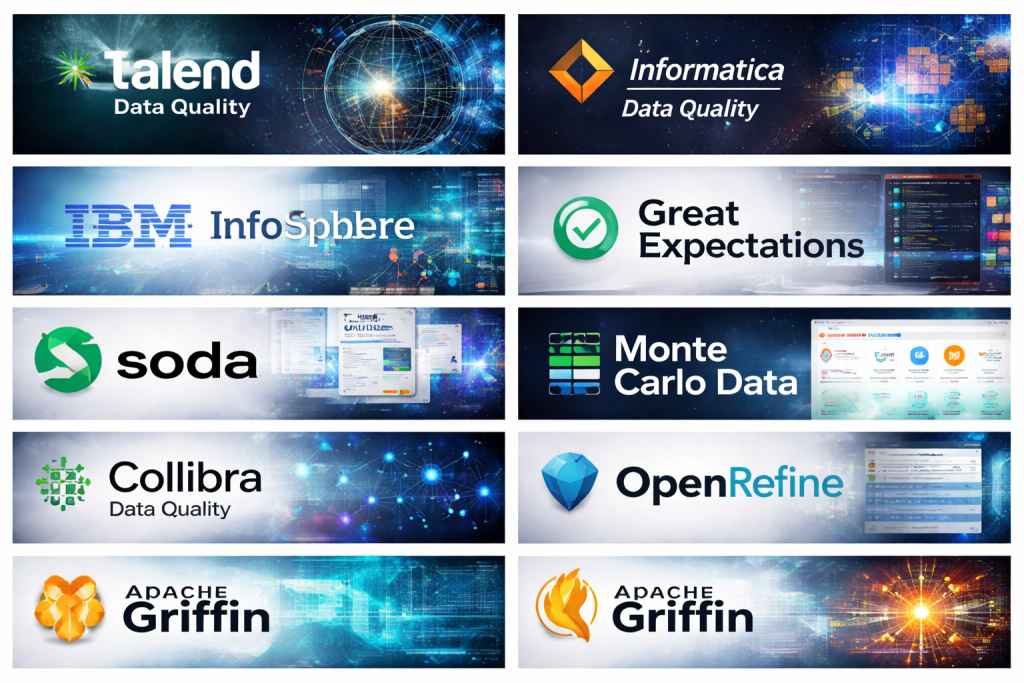
Top 10 Data Quality Tools
1 — Talend Data Quality
Short description:
Talend Data Quality is a comprehensive enterprise-grade tool for profiling, cleansing, matching, and monitoring data across on-premise and cloud environments.
Key features:
- Data profiling and discovery
- Data cleansing and standardization
- Matching and deduplication
- Data quality rules and validations
- Continuous monitoring and alerts
- Integration with ETL and data pipelines
- Metadata and data governance support
Pros:
- Strong enterprise capabilities
- Deep integration with data integration workflows
- Scales well for large datasets
Cons:
- Steeper learning curve
- Can be expensive for smaller teams
Security & compliance:
Supports encryption, role-based access, audit logs, GDPR readiness, and enterprise security standards.
Support & community:
Extensive documentation, enterprise support plans, professional services, and an active user community.
2 — Informatica Data Quality
Short description:
Informatica Data Quality is a powerful, widely adopted solution for enterprise data quality, governance, and master data management.
Key features:
- Advanced data profiling
- Rule-based data validation
- Data enrichment and standardization
- Duplicate detection and matching
- Data quality dashboards
- Integration with Informatica ecosystem
- AI-assisted recommendations
Pros:
- Industry-leading data management platform
- Robust governance and compliance features
- Trusted by large enterprises
Cons:
- High cost
- Requires skilled implementation
Security & compliance:
Strong support for SOC 2, GDPR, HIPAA, audit logs, and enterprise IAM.
Support & community:
Premium enterprise support, certifications, and a large professional ecosystem.
3 — IBM InfoSphere Information Analyzer
Short description:
IBM InfoSphere Information Analyzer focuses on deep data profiling and quality analysis for complex enterprise data environments.
Key features:
- Data profiling and statistics
- Data quality rule creation
- Data anomaly detection
- Integration with IBM data tools
- Metadata management
- Historical trend analysis
Pros:
- Excellent for complex enterprise data
- Strong analytical depth
- Reliable performance
Cons:
- Complex UI for beginners
- Limited appeal outside IBM ecosystem
Security & compliance:
Enterprise-grade security, encryption, audit logs, and compliance support.
Support & community:
IBM enterprise support, documentation, and partner network.
4 — Great Expectations
Short description:
Great Expectations is an open-source data quality framework focused on validating data through expectations and tests.
Key features:
- Data validation rules (“expectations”)
- Automated data documentation
- Integration with data pipelines
- Support for SQL, Spark, Pandas
- Version-controlled quality checks
- CI/CD-friendly workflows
Pros:
- Open-source and flexible
- Developer-friendly
- Strong data testing approach
Cons:
- Requires technical expertise
- Limited UI for non-technical users
Security & compliance:
Varies / N/A (depends on implementation and environment).
Support & community:
Strong open-source community, active forums, and good documentation.
5 — Ataccama ONE
Short description:
Ataccama ONE is an AI-powered data quality and governance platform designed for modern, large-scale data ecosystems.
Key features:
- AI-driven data profiling
- Automated data quality rules
- Data observability and monitoring
- Master data management
- Metadata and lineage tracking
- Cloud-native architecture
Pros:
- Intelligent automation
- Unified data management platform
- Scales well for enterprises
Cons:
- Premium pricing
- Overkill for small teams
Security & compliance:
Supports encryption, access controls, audit trails, GDPR, and enterprise compliance.
Support & community:
Enterprise onboarding, professional support, and growing community.
6 — Soda
Short description:
Soda is a modern data quality and observability platform built for analytics engineers and data teams working with cloud data stacks.
Key features:
- Data quality checks as code
- Automated anomaly detection
- Monitoring for freshness, volume, and distribution
- Cloud data warehouse integrations
- Alerting and reporting
- Lightweight deployment
Pros:
- Easy to adopt
- Strong focus on data observability
- Works well with modern stacks
Cons:
- Less suited for legacy systems
- Limited non-technical UI
Security & compliance:
Supports encryption, SSO, role-based access; compliance varies by plan.
Support & community:
Good documentation, responsive support, and active data engineering community.
7 — Monte Carlo Data
Short description:
Monte Carlo Data focuses on data observability, helping teams detect and resolve data quality issues before they impact business users.
Key features:
- End-to-end data observability
- Automated anomaly detection
- Root cause analysis
- Pipeline health monitoring
- Schema change detection
- Alerting and dashboards
Pros:
- Excellent for proactive issue detection
- Reduces data downtime
- Minimal configuration
Cons:
- Higher cost
- Less emphasis on manual data cleansing
Security & compliance:
Enterprise security standards, encryption, SSO, and audit logs.
Support & community:
Enterprise-grade support and strong onboarding resources.
8 — Collibra Data Quality
Short description:
Collibra Data Quality integrates data quality with governance, enabling organizations to trust and manage data at scale.
Key features:
- Data quality rules and scoring
- Business glossary integration
- Data lineage and governance
- Workflow automation
- Collaboration tools
- Reporting and dashboards
Pros:
- Strong governance alignment
- Business-friendly interface
- Enterprise-ready
Cons:
- Complex setup
- Higher cost
Security & compliance:
Supports GDPR, audit logs, access controls, and enterprise compliance standards.
Support & community:
Professional services, enterprise support, and training programs.
9 — OpenRefine
Short description:
OpenRefine is a powerful open-source tool for exploring, cleaning, and transforming messy datasets.
Key features:
- Data cleaning and transformation
- Faceted data exploration
- Clustering and deduplication
- Custom transformations
- Extensible via plugins
Pros:
- Free and open-source
- Excellent for ad-hoc data cleanup
- Easy to use
Cons:
- Not designed for automation at scale
- Limited enterprise features
Security & compliance:
Varies / N/A (local usage, depends on environment).
Support & community:
Active open-source community and extensive tutorials.
10 — Apache Griffin
Short description:
Apache Griffin is an open-source data quality solution designed for big data environments.
Key features:
- Data quality measurements
- Rule-based validation
- Batch and streaming support
- Integration with Hadoop and Spark
- Metadata management
Pros:
- Open-source
- Suitable for big data platforms
- Customizable
Cons:
- Requires engineering effort
- Limited UI and documentation
Security & compliance:
Varies / N/A depending on deployment.
Support & community:
Open-source community support with limited enterprise backing.
Comparison Table
| Tool Name | Best For | Platform(s) Supported | Standout Feature | Rating |
|---|---|---|---|---|
| Talend Data Quality | Enterprise data integration | Cloud, On-prem | End-to-end data quality | N/A |
| Informatica Data Quality | Large enterprises | Cloud, On-prem | Industry-leading governance | N/A |
| IBM InfoSphere | Complex enterprise data | On-prem, Hybrid | Deep profiling analytics | N/A |
| Great Expectations | Data engineers | Cloud, On-prem | Data testing as code | N/A |
| Ataccama ONE | AI-driven data management | Cloud, Hybrid | AI-powered automation | N/A |
| Soda | Modern data stacks | Cloud | Data observability | N/A |
| Monte Carlo Data | Analytics reliability | Cloud | Data downtime prevention | N/A |
| Collibra Data Quality | Governance-focused orgs | Cloud, Hybrid | Governance integration | N/A |
| OpenRefine | Ad-hoc data cleanup | Desktop | Interactive cleaning | N/A |
| Apache Griffin | Big data platforms | Cloud, On-prem | Big data quality checks | N/A |
Evaluation & Scoring of Data Quality Tools
| Tool | Core Features (25%) | Ease of Use (15%) | Integrations (15%) | Security (10%) | Performance (10%) | Support (10%) | Price/Value (15%) | Total Score |
|---|---|---|---|---|---|---|---|---|
| Talend | 22 | 11 | 14 | 9 | 9 | 9 | 11 | 85 |
| Informatica | 24 | 10 | 15 | 10 | 9 | 9 | 8 | 85 |
| IBM InfoSphere | 21 | 9 | 12 | 9 | 9 | 8 | 9 | 77 |
| Great Expectations | 18 | 12 | 11 | 6 | 8 | 8 | 14 | 77 |
| Ataccama ONE | 23 | 11 | 14 | 9 | 9 | 8 | 9 | 83 |
| Soda | 17 | 13 | 13 | 8 | 8 | 8 | 12 | 79 |
| Monte Carlo | 19 | 12 | 13 | 9 | 9 | 8 | 9 | 79 |
| Collibra | 22 | 10 | 13 | 9 | 8 | 9 | 8 | 79 |
| OpenRefine | 14 | 14 | 6 | 4 | 6 | 7 | 15 | 66 |
| Apache Griffin | 16 | 8 | 10 | 5 | 8 | 6 | 14 | 67 |
Which Data Quality Tools Tool Is Right for You?
- Solo users: OpenRefine or Great Expectations
- SMBs: Soda, Great Expectations
- Mid-market: Talend, Ataccama, Monte Carlo
- Enterprise: Informatica, IBM, Collibra
Budget-conscious: Open-source tools
Premium needs: Enterprise platforms
Choose based on data scale, technical skills, compliance needs, and long-term growth.
Frequently Asked Questions (FAQs)
- What is a Data Quality Tool?
It ensures data accuracy, consistency, completeness, and reliability across systems. - Do I need data quality tools for small datasets?
Not always; simple validation may be enough. - Are open-source tools reliable?
Yes, but they require technical expertise and maintenance. - Do these tools support real-time data?
Some support streaming; others focus on batch processing. - How long does implementation take?
From days (open-source) to months (enterprise tools). - Are these tools expensive?
Costs vary widely based on features and scale. - Can non-technical users use them?
Some offer user-friendly UIs; others are developer-focused. - Do they support compliance requirements?
Enterprise tools usually do. - Can they integrate with cloud data warehouses?
Most modern tools support cloud platforms. - What is the biggest mistake buyers make?
Overbuying features they don’t need.
Conclusion
Data Quality Tools are no longer optional—they are essential for organizations that rely on data for decision-making, analytics, and compliance. From open-source frameworks to enterprise-grade platforms, each tool offers unique strengths and trade-offs.
The most important takeaway is that there is no single “best” data quality tool for everyone. The right choice depends on your data volume, technical expertise, budget, compliance requirements, and long-term strategy. By aligning tool capabilities with your actual needs, you can build trustworthy data foundations that support growth, innovation, and confidence in your data-driven decisions.

Find Trusted Cardiac Hospitals
Compare heart hospitals by city and services — all in one place.
Explore Hospitals
This article does an excellent job breaking down the top data quality tools by clearly comparing their features, strengths, and limitations. The balanced explanation helps readers understand what to look for when evaluating tools—such as rule-based validation, automation capabilities, integration support, and ease of use. It’s especially useful for both beginners and experienced data professionals who want to improve the accuracy, consistency, and reliability of their data pipelines. By focusing on practical differences rather than just listing names, this post serves as a valuable guide for making informed decisions about the right data quality solution for your organization’s needs. Great resource for anyone working to ensure high-quality data!